
If your diagnostic equipment arrives at an Orange County lab out of calibration, the foam insert didn’t just fail; it became a liability that costs thousands in technical labor and downtime. In a region where medtech manufacturing employment grew by 2.2 percent this year, the pressure to maintain precision during transit has never been higher. Selecting the right foam packaging for medical diagnostic equipment Orange County facilities depend on is a strategic decision that impacts both product integrity and fiscal responsibility. You likely already know that standard catalog solutions often fall short when it comes to preventing ESD damage or dampening the specific frequencies of transit vibration.
We agree that high recalibration costs and inconsistent lead times from national suppliers are unacceptable risks for your operations. This guide explores how to secure your high-value diagnostic assets with custom-engineered foam inserts designed for the rigorous Southern California supply chain. You’ll discover how to achieve zero-damage shipping rates, optimize box sizing to lower logistical expenses, and leverage local vendor-managed inventory to ensure a reliable supply of packaging materials. By focusing on the intersection of engineering and economics, you can turn your protective packaging from a cost center into a competitive advantage.
Key Takeaways
- Learn why precision-engineered foam packaging for medical diagnostic equipment Orange County is essential to prevent costly recalibration and internal circuitry damage during transit.
- Understand the technical differences between Polyethylene and Polyurethane foams to select the optimal cushioning for fragile instrumentation.
- Discover how CAD design and CNC prototyping ensure a perfect equipment fit, eliminating the inconsistencies of standard catalog solutions.
- Identify how local supply chains and Vendor Managed Inventory (VMI) programs can reduce logistical costs and prevent production shutdowns.
- Evaluate the benefits of integrated packaging systems, including foam-lined crates and heavy-duty corrugated boxes, for comprehensive protection.
The High Stakes of Shipping Medical Diagnostic Equipment in Orange County
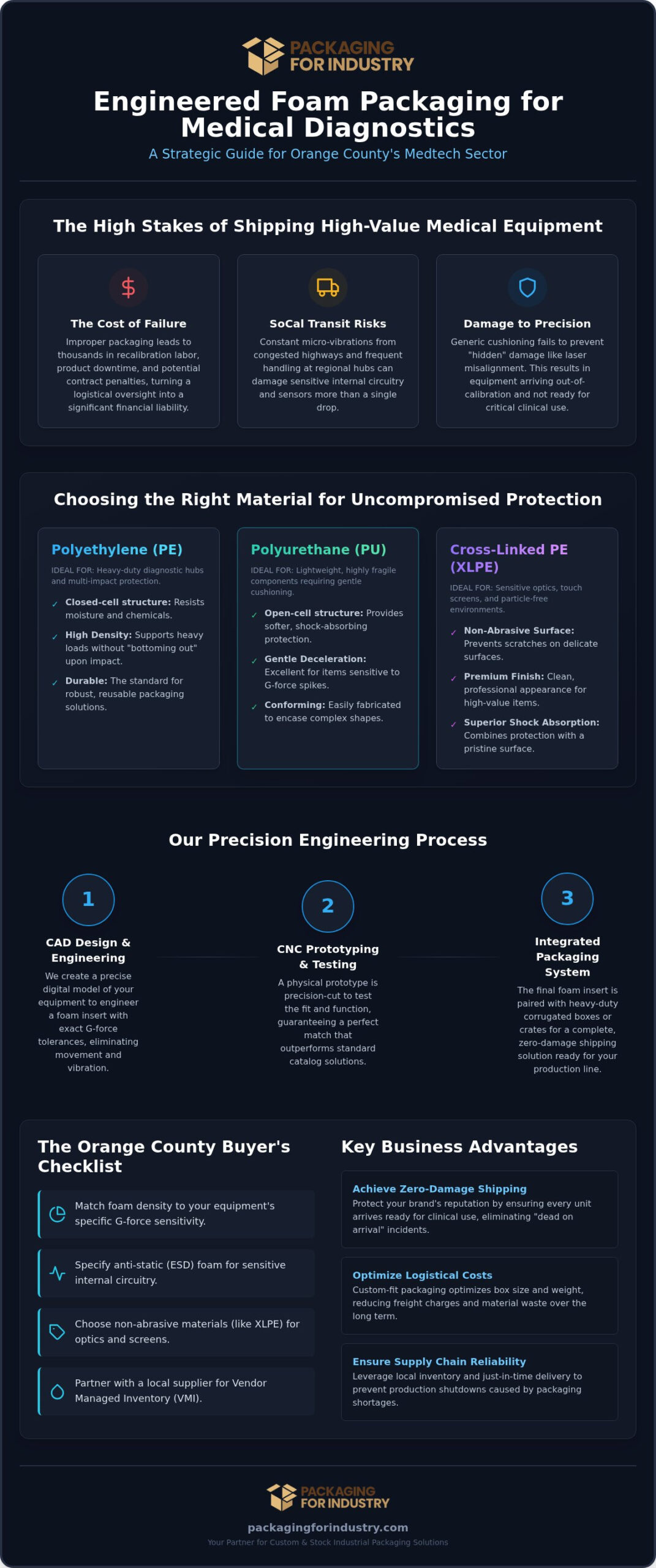
Orange County remains one of the premier global hubs for medical technology, with a workforce of over 24,000 specialists in the medical device sector alone. From the high-tech corridors of Irvine to the industrial centers in Brea, the demand for precision is absolute. When shipping high-value assets like blood analyzers or imaging sensors, the packaging isn’t just a container; it’s a critical component of the product’s engineering. Utilizing generic catalog cushioning often leads to “hidden” damage that isn’t visible until the machine is powered on. This is why specialized foam packaging for medical diagnostic equipment Orange County manufacturers rely on must be engineered to specific G-force tolerances to ensure every unit arrives ready for clinical use.
The Cost of Transit Failure
The financial impact of shipping failure isn’t limited to the cost of the outer box. For diagnostic equipment, the real expense lies in recalibration and laser misalignment. Standard cushioning materials, such as bubble wrap or loose-fill peanuts, don’t provide the structural integrity needed for sensitive optics and internal circuitry. If a unit arrives at a hospital uncalibrated, the manufacturer faces significant technical labor costs and potential contract penalties. We focus on the ROI of precision foam. By investing in custom-cut inserts, you eliminate the risk of delivering a “dead on arrival” unit and protect your brand’s professional reputation in a competitive market.
Meeting Southern California Logistical Challenges
Logistics in the Inland Empire and Orange County involve unique stressors. LTL freight movements across Southern California are subject to constant vibration from congested highways and frequent handling at regional hubs. These micro-vibrations can be more damaging to internal fasteners and sensitive sensors than a single drop. Our engineering team designs foam packaging for medical diagnostic equipment Orange County firms use to withstand these specific environmental factors. We also account for regional climate variables, such as coastal humidity that can weaken standard cardboard. By pairing moisture-resistant custom foam with heavy-duty corrugated boxes, we ensure your assets remain secure from our Orange County service area to their final destination. This integrated approach effectively reduces shipping damage and helps you lower packaging costs over the long term.
Selecting the Right Foam Materials for Medical Instrumentation
Material selection determines whether your equipment survives the Southern California logistics environment. We don’t just provide padding; we engineer protection based on FDA-recognized packaging standards like ISO 11607-1. For heavy-duty diagnostic hubs, Polyethylene (PE) foam is the standard for multi-impact protection. It’s a closed-cell material that resists moisture and chemicals. Conversely, Polyurethane (PU) foam provides a softer, open-cell structure ideal for lightweight, highly fragile diagnostic components that require gentle deceleration.
When your equipment requires a particle-free, non-abrasive surface, Cross-Linked Polyethylene (XLPE) is the necessary choice. This foam won’t scratch sensitive optics or screens, which is critical for precision instrumentation. It offers a premium finish while maintaining high-performance shock absorption. Selecting the right foam packaging for medical diagnostic equipment Orange County manufacturers depend on often involves blending these materials for a multi-layered solution.
Material Density and Shock Absorption
Matching foam density to the G-force sensitivity of your machine is a technical requirement. High-density foams support heavier loads without bottoming out, while lower densities provide better cushioning for lighter items. Foam density determines the rate at which an object slows down upon impact, directly influencing the G-forces transferred to internal circuitry. Regarding Southern California LTL freight, where vibration is constant, selecting the right density is vital to prevent fatigue in internal fasteners and sensitive sensors.
Specialized ESD Protection for Diagnostics
Automated lab analyzers often contain sensitive internal circuitry susceptible to Electrostatic Discharge (ESD). We integrate specialized protective foam packaging to mitigate this risk. You can choose between pink anti-static foam, which prevents static buildup, and black conductive foam, which actively bleeds off charges. For Orange County manufacturers, using ESD-safe foam packaging for medical diagnostic equipment Orange County labs require is non-negotiable for long-term reliability. If you’re ready to optimize your material selection, you can request a packaging quote to speak with our engineering team.
Engineering Precision: CAD Design and CNC Prototyping
Engineering precision is the bridge between selecting a high-performance material and achieving a zero-damage shipping rate. For medical device manufacturers, a “close enough” fit isn’t acceptable. We utilize advanced CAD/CAM support to ensure every insert mirrors the exact geometry of your diagnostic equipment. Unlike traditional die-cutting, which requires expensive physical tooling and limits design complexity, our CNC precision cutting allows for intricate shapes and tighter tolerances. This approach is vital when designing foam packaging for medical diagnostic equipment Orange County suppliers provide, as it ensures that sensitive components like optical lenses or fluidic modules are held in a state of suspended protection.
Beyond protection, engineering precision impacts your bottom line. We use specialized nesting software to arrange parts on a foam sheet, which significantly reduces material waste. This efficiency allows us to help you lower packaging costs while maintaining the highest protective standards. When you’re managing high-value diagnostic assets, every inch of material must serve a functional purpose. Precision engineering ensures that the foam doesn’t just fill space, but actively manages the energy of transit impacts.
From Digital Blueprint to Physical Insert
The design process begins with your product’s digital blueprints or a physical unit. Our engineers analyze weight distribution to identify critical vibration dampening zones. We then create a multi-piece assembly that cradles the device while leaving clearance for easy extraction by lab technicians. This level of detail prevents the common issue of technicians damaging equipment while trying to pry it out of poorly designed foam. If you need to refine an existing design or start from scratch, you can request a custom design packaging consultation to see how we address complex logistical challenges.
The Value of Rapid Prototyping in OC
Speed is a competitive necessity in the Irvine and Anaheim medtech corridors. We offer free prototyping to help you validate designs before committing to a full production run. Because we are local, we can often provide physical samples much faster than national catalog suppliers. This proximity allows your team to test the foam performance against the specific vibration profiles of Southern California LTL freight. Shortening this design cycle ensures your new medical device rollouts stay on schedule without compromising the integrity of the foam packaging for medical diagnostic equipment Orange County facilities depend on.
The Orange County Buyer’s Checklist for Medical Foam
Procuring foam packaging for medical diagnostic equipment Orange County requires a rigorous evaluation of supplier capabilities beyond a simple price sheet. In a high-stakes industry where transit failure results in expensive technical labor, your checklist must prioritize reliability and engineering depth. You need a partner who understands the nuances of the local medtech landscape and the specific stressors of Southern California logistics. Use the following criteria to evaluate your current or prospective suppliers:
- Material Certification: Verify the supplier can provide documentation for medical-grade materials and ESD compliance.
- Integrated Solutions: Assess their ability to design both the custom foam inserts and the outer heavy-duty corrugated boxes as a single, unified system.
- Value-Added Services: Check for custom kitting and assembly capabilities to reduce the labor burden on your own warehouse staff.
- Prototyping Speed: Confirm they offer free, local prototyping to shorten your product development cycles.
- Supply Chain Security: Evaluate their capacity for Vendor Managed Inventory (VMI) to prevent production shutdowns.
Evaluating Total Cost of Ownership
True efficiency comes from looking beyond the price per piece. You should focus on total logistical savings. An optimized foam design reduces the outer box dimensions, which directly lowers UPS and FedEx dimensional weight surcharges. We provide a detailed packaging cost savings analysis to identify these hidden expenses. By reducing the overall footprint of your shipping units, you often save more on monthly freight bills than the actual cost of the packaging materials themselves.
Local Partner vs. Catalog Supplier
Relying on national catalog distributors often introduces unacceptable lead times and shipping delays that a local manufacturer can’t afford. For facilities in Anaheim and Irvine, a local partner offers the distinct advantage of next-day delivery and immediate on-site design support. Our Vendor Managed Inventory program takes this a step further by monitoring your stock levels for you. This proactive approach ensures you never run out of critical supplies during a production surge. Local oversight ensures that your foam packaging for medical diagnostic equipment Orange County labs depend on remains as precise as the equipment it protects.
PFI: Your Integrated Partner for Medtech Packaging Solutions
Success in medical device logistics requires more than just a piece of foam; it requires a total system of protection. While many suppliers focus purely on the material, we specialize in the integration of custom foam packaging for medical diagnostic equipment Orange County firms need to survive global transit. By engineering the foam inserts alongside the outer corrugated boxes, we ensure that every component works in unison to absorb shock and vibration. This holistic approach eliminates the common failure point where a third-party box doesn’t align with a custom insert, compromising the safety of the unit.
Integrated Packaging Engineering
Our engineering team often utilizes foam end caps paired with double-wall or triple-wall corrugated boxes to provide maximum safety for heavy instrumentation. For larger diagnostic hubs destined for global markets, we design custom foam lined crates for export. These crates provide the structural rigidity of wood with the precision cushioning of polyethylene or polyurethane foam. To help you further optimize your warehouse operations, we offer packaging kitting. We deliver ready-to-use units directly to your line, which saves significant technical labor and reduces the footprint of your packaging inventory.
We provide local next-day delivery across Orange County, serving manufacturers in Anaheim, Irvine, Brea, and Costa Mesa. This proximity allows us to respond immediately to production surges or design changes. While we are a local Southern California partner, our nationwide shipping capabilities ensure that your satellite facilities receive the same high-quality foam packaging for medical diagnostic equipment Orange County headquarters demand. Our goal is to streamline your supply chain while ensuring your high-value assets arrive in perfect calibration.
Get a Custom Quote Today
Submitting your equipment specifications for a custom review is a straightforward process. Our engineers use your product dimensions and weight to recommend the optimal foam density and box strength for your specific application. We’re committed to helping you lower packaging costs and eliminate shipping damage through precision design and reliable local supply. If you’re ready to improve your logistical reliability and protect your diagnostic assets, you can request a quote from our team today. We’ll provide a comprehensive analysis of your needs and demonstrate how our integrated solutions can secure your bottom line.
Securing Your Diagnostic Assets for Global Distribution
Securing your diagnostic assets requires a shift from viewing packaging as a commodity to treating it as a precision component. You’ve seen how specialized foam materials and CAD design work together to prevent the high costs of recalibration. By choosing a local partner, you gain the advantage of free CAD prototyping and specialized medical-grade foam expertise. National catalog suppliers simply cannot match this level of service. Our team understands Southern California LTL freight. We design every insert to meet those rigorous demands.
We prioritize your operational flow through local Orange County next-day delivery and integrated inventory management. This approach doesn’t just protect your machines. It stabilizes your supply chain and helps you lower packaging costs. Selecting the right foam packaging for medical diagnostic equipment Orange County facilities depend on is the most effective way to guarantee zero-damage shipping rates. We’re ready to help you optimize your logistical strategy. We provide technical solutions tailored to your exact equipment specifications.
We look forward to partnering with you to enhance your shipping reliability and protect your high-value medtech investments.
Frequently Asked Questions
What is the best foam for high-value medical diagnostic equipment?
Cross-linked polyethylene (XLPE) is generally considered the best material for high-value diagnostics due to its non-abrasive, particle-free surface and excellent shock absorption. It protects sensitive optics from scratches while maintaining structural integrity during transit. For heavier equipment, standard closed-cell polyethylene (PE) provides superior multi-impact protection. The choice depends on the device’s weight and fragility. We engineer these materials to ensure your equipment arrives in perfect calibration.
Can you provide ESD-safe foam for sensitive medical electronics?
Yes, we specialize in both anti-static and conductive foam assemblies to protect sensitive internal circuitry from electrostatic discharge damage. These materials are essential for automated lab analyzers and digital diagnostic sensors that are prone to ESD failure during handling or shipping. Integrating ESD-safe foam packaging for medical diagnostic equipment Orange County electronics require ensures long-term reliability and reduces the risk of expensive technical repairs upon delivery.
Do you offer free prototyping for custom medical foam inserts in Orange County?
We provide free prototyping and CAD/CAM support for all custom medical foam projects to ensure a precise equipment fit before full production. This local service allows manufacturers in the Irvine and Anaheim medtech hubs to test physical samples against their specific vibration and shock requirements. By validating the design early, you eliminate the risk of transit failure and avoid the long lead times associated with national catalog suppliers.
How do I choose between Polyethylene and Polyurethane foam for my device?
You should choose Polyethylene (PE) for heavy equipment requiring rugged, multi-impact protection and Polyurethane (PU) for lightweight, highly fragile components needing soft cushioning. PE is a closed-cell foam that resists moisture and chemicals, making it ideal for base inserts. PU is an open-cell foam that provides gentle deceleration for sensitive optics. Our engineers often combine both materials in a single assembly to provide comprehensive protection for complex diagnostic instrumentation.
Can PFI manage my packaging inventory to prevent production shortages?
We offer a comprehensive Vendor Managed Inventory (VMI) program designed to monitor your stock levels and prevent production shortages. This program isn’t just about storage; it helps you lower packaging costs by reducing on-site space requirements. By housing your custom materials in our local warehouse, we can provide just-in-time delivery based on your actual usage. It’s an efficient way to maintain a reliable and steady supply chain.
What information do I need to provide for a custom foam packaging quote?
To generate an accurate quote, please provide the dimensions, weight, and fragility (G-force sensitivity) of your diagnostic device. Digital blueprints or CAD files are helpful for complex geometries, but we can also work from a physical unit. Mentioning your typical shipping method, such as LTL freight or international air, helps us determine the necessary foam density. This data allows us to engineer the most cost-effective solution for your specific application.
Do you offer local next-day delivery to medical manufacturers in Irvine or Anaheim?
We provide local next-day delivery to medical manufacturers throughout Orange County, including key industrial centers in Irvine, Anaheim, Brea, and Costa Mesa. This proximity allows your team to maintain a lean inventory without the risk of shipping delays from out-of-state distributors. Our local logistics network is specifically optimized to handle the foam packaging for medical diagnostic equipment Orange County labs need to maintain their production schedules and meet clinical demand.
Can you design foam inserts that fit into existing shipping crates or boxes?
Our engineering team can design custom foam inserts to fit perfectly within your existing RSC boxes, plastic cases, or wooden crates. We analyze the internal dimensions of your current containers to ensure the new cushioning provides maximum protection without wasted space. This integration helps you avoid the cost of replacing entire packaging systems while significantly improving the shock and vibration dampening for your sensitive and high-value medical instrumentation.