
A single micro-abrasion on a finished component can turn a high-value asset into a total loss before it even reaches the customer. While many operations assume any soft material will suffice, the reality is that the wrong cell structure often causes the very scuffing it’s meant to prevent. Specifying the correct non-abrasive foam for protecting Class A surfaces is a critical engineering step that directly impacts your bottom line and your reputation for quality. If you’ve struggled with high rejection rates or the rising costs of over-engineered packaging, you aren’t alone in facing these logistical hurdles.
We understand that protecting sensitive finishes requires more than just a generic cushion; it demands a precise match between material density and surface energy. This guide provides the expert insights you need to specify and source custom foam inserts that eliminate transit damage while streamlining your supply chain. You’ll learn how to evaluate friction coefficients, compare cost-effective material options, and implement recurring supply strategies like vendor-managed inventory. By the end of this article, you’ll have a clear framework for achieving zero-damage shipping for your most sensitive industrial components.
Key Takeaways
- Identify the specific risks associated with Class A surfaces and how micro-abrasions lead to increased rejection rates in aerospace and medical manufacturing.
- Evaluate the technical properties of PE, PU, and XLPE to choose the ideal non-abrasive foam for protecting Class A surfaces without over-packaging.
- Learn how custom-engineered CAD/CAM foam inserts eliminate internal part movement to prevent scuffing during long-haul transit.
- Streamline your supply chain by utilizing vendor-managed inventory (VMI) and just-in-time delivery to reduce warehouse overhead and ensure material availability.
- Discover how to balance the total cost of protection against potential rework expenses to optimize your packaging budget and improve reliability.
Defining Class A Surfaces and the Risk of Surface Abrasion
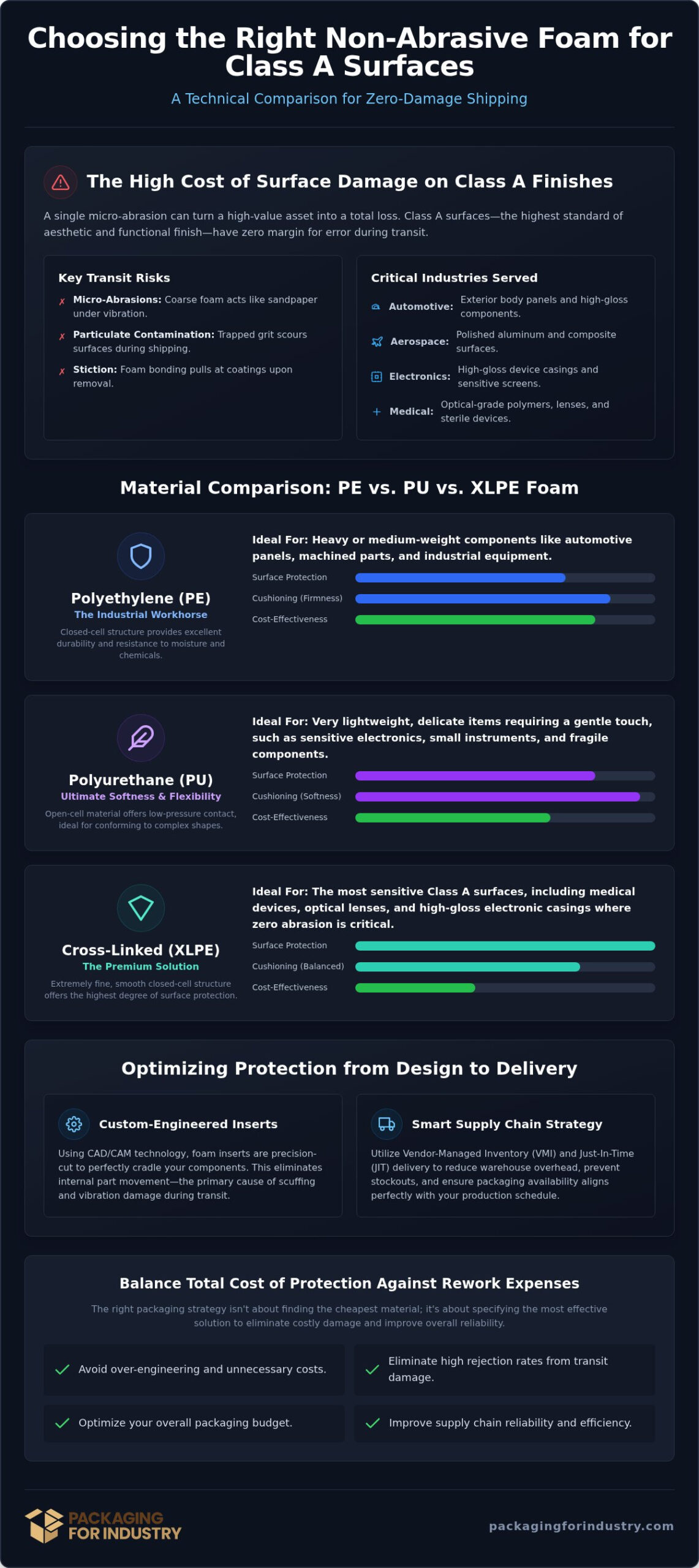
A Class A surface represents the highest standard of aesthetic and functional finish in industrial design. In the automotive sector, this includes exterior body panels; in aerospace, it covers polished aluminum or composite wings; and in electronics, it refers to the high-gloss casings of consumer devices. These surfaces aren’t just about looks. They often serve aerodynamic or structural roles where even a minor scratch compromises the part’s integrity. When you’re shipping components with these requirements, the margin for error is zero.
Manufacturers often face high rejection rates when they rely on standard packaging. A single scuff during transit can lead to expensive rework or total scrap. Beyond the immediate material loss, frequent defects damage your brand reputation and strain relationships with Tier 1 suppliers or OEMs. It’s a common mistake to assume that any soft material is safe. In reality, many standard industrial foams have a coarse cell structure that acts like fine-grit sandpaper when subjected to the continuous vibration of a truck bed or cargo plane. Using a specialized non-abrasive foam for protecting Class A surfaces is the only way to ensure these components arrive in showroom condition.
The Science of Micro-Abrasions in Transit
Transit-induced abrasion isn’t usually the result of a single impact. Instead, it’s a cumulative effect of high-frequency vibration. When a part sits inside a foam insert, tiny movements create friction. If the foam’s surface is too rough, it creates micro-scratches that dull the finish. Another major risk is “stiction,” where the foam bonds slightly to the surface finish due to surface energy, pulling at the coating when the part is removed. The most dangerous factor, however, is particulate contamination. If dust or grit gets trapped between the foam and the part, the foam holds that grit against the surface, turning the entire assembly into an abrasive pad during the shipping cycle.
Industry Standards for Surface Integrity
Different sectors have unique benchmarks for finish quality. Aerospace manufacturers require absolute precision for polished aluminum and composite surfaces to maintain aerodynamic efficiency and prevent corrosion. Automotive standards focus on the “showroom finish” of painted plastic components, where even slight hazing is cause for rejection. In the medical field, the stakes are even higher. Optical-grade polymers and lenses must remain perfectly clear to function correctly. Meeting these rigorous standards requires a proactive approach to material selection. We help clients lower packaging costs by specifying the exact foam density needed to meet these industry-specific requirements without over-engineering the solution.
Comparing Non-Abrasive Foam Materials: PE vs. PU vs. XLPE
Selecting the right material is a balance of engineering precision and fiscal responsibility. While the previous section established the risk of surface abrasion, solving that risk depends on matching the foam’s cell structure to the part’s weight and finish. Most industrial applications rely on three primary materials: Expanded Polyethylene (EPE), Polyurethane (PU), and Cross-Linked Polyethylene (XLPE). Using a non-abrasive foam for protecting Class A surfaces requires understanding how these materials interact with sensitive coatings under the stress of vibration.
Polyethylene Foam: Durability Meets Surface Safety
Expanded Polyethylene (EPE) is the industrial workhorse for protecting heavy or medium-weight components. Its closed-cell structure provides excellent resistance to moisture and chemical transfer, ensuring the packaging doesn’t react with the part’s coating. For most automotive panels or machined parts, 1.7lb or 2.0lb density PE provides the necessary structural support without being hard enough to cause scuffing. You can explore various densities and custom profiles in PFI’s foam packaging category to find a cost-effective solution for your production line.
Polyurethane and Convoluted Foam Applications
Polyurethane (PU) is an open-cell material known for its extreme softness and flexibility. It’s often used in “eggcrate” or convoluted formats to provide low-pressure contact for very lightweight, delicate items. However, PU has limitations. Its open-cell nature can trap moisture or contaminants more easily than PE. Over long-term storage, some PU foams may degrade, potentially leaving a residue on sensitive finishes. It’s best reserved for internal kitting or short-term transit of lightweight electronics where cushioning is the primary concern over structural rigidity.
The XLPE Advantage for Aerospace and Medical Parts
Cross-Linked Polyethylene (XLPE) is the premium choice when failure isn’t an option. Unlike standard EPE, XLPE has an extremely fine, smooth cell structure that feels almost like skin. This lack of “beading” makes it the gold standard non-abrasive foam for protecting Class A surfaces in aerospace-specific packaging solutions. XLPE is also highly resistant to off-gassing, a process where chemicals from the foam can cloud lenses or react with sensitive coatings. If you’re managing high-value components, it’s worth the time to compare packaging pricing for XLPE to ensure total surface integrity.
To further reduce friction, some foams incorporate specialized Low-Abrasion (LA) additives. These additives modify the surface energy of the foam, creating a “slicker” interface that allows for minute vibrations without the foam grabbing at the part’s finish. This technical approach ensures your Class A surfaces remain flawless from the factory floor to the end user.
Engineering Custom Foam Inserts for Maximum Protection
Engineering a non-abrasive foam for protecting Class A surfaces is as much about geometry as it is about chemistry. Even the most advanced XLPE material will fail if the part is allowed to shift within its housing during transit. Our engineering team utilizes CAD/CAM design to create zero-tolerance cavities that lock components in place, effectively eliminating the internal friction that leads to micro-abrasions. When movement is neutralized, the risk of surface scuffing drops significantly, ensuring your components arrive in the same condition they left the factory floor.
Choosing the correct fabrication method is a critical step in the procurement process. Die-cutting remains the industry standard for high-volume production, offering a cost-effective way to produce thousands of identical inserts with minimal lead times. However, for highly specialized Class A parts, CNC routing is often the superior choice. Routing creates a cleaner, more vertical edge without the “concave” squeeze often seen in thick die-cut foam. These clean cuts prevent localized scratching that can occur when rough edges or “beading” fragments press against a sensitive finish. By integrating these precision inserts with custom corrugated boxes, we create a multi-layered defense system that manages both impact energy and surface integrity.
Prototyping and Fit Testing
We don’t leave protection to chance. PFI provides free prototyping for industrial buyers to ensure a perfect fit before you commit to full-scale production. During this phase, we test for “part migration,” which happens when a component slowly vibrates out of its designated pocket during long-haul truck or air freight. Through iterative design, we refine foam densities and cavity depths based on actual sample feedback. This proactive approach ensures that your high-value components remain stationary and secure, regardless of the shipping duration or the intensity of the transit cycle.
Anti-Static and ESD Foam Considerations
For electronics and semiconductor manufacturers, surface protection must also account for electrostatic discharge. Pink anti-static foam is chemically treated to prevent the buildup of static electricity, but it’s important to verify that these additives don’t compromise the foam’s non-abrasive properties. In cleanroom environments, we often specify specialized non-abrasive foam for protecting Class A surfaces that is both ESD-safe and low-sloughing. This prevents particulate contamination from interfering with sensitive optical gear or reactive coatings. Whether you need standard PE or specialized ESD-safe XLPE, our team ensures the material meets both your electrical and aesthetic requirements without increasing your scrap rates.
Procurement Strategy: Lowering Costs Without Sacrificing Protection
Effective procurement for high-value components requires a shift from viewing packaging as a commodity to treating it as a risk management tool. While premium materials like XLPE carry a higher unit price than standard poly, the total cost of damage often dwarfs the initial investment in better protection. A single rejected shipment of aerospace panels or medical optics can wipe out the savings gained from using cheaper, abrasive materials. Selecting the correct grade of non-abrasive foam for protecting Class A surfaces ensures you aren’t over-packaging, but you also aren’t under-protecting your assets.
By utilizing a high-performance non-abrasive foam for protecting Class A surfaces, you reduce the total cost of ownership by eliminating the rework and scrap fees that plague standard packaging setups. Bulk purchasing is another lever for efficiency. By ordering custom sizes in larger quantities, you can lower your per-unit cost. However, storing large volumes of foam can consume valuable floor space. This is where leveraging Vendor Managed Inventory (VMI) becomes a strategic advantage. We monitor your stock levels and replenish them automatically, ensuring you never face a stockout that halts production.
Packaging Cost-Reduction Analysis
Hidden costs often reside in the labor required for manual wrapping and taping. If your warehouse team spends minutes wrapping each part in generic foam sheets, you’re losing money on every unit. Switching to custom die-cut inserts reduces kitting time to seconds. These precision assemblies allow workers to “drop and go,” significantly increasing throughput on high-volume manufacturing lines. We encourage operations managers to review PFI’s guide on packaging cost savings to identify where labor-intensive processes can be replaced with engineered solutions.
Just-In-Time (JIT) Supply for Southern California Manufacturers
For facilities in Anaheim, Irvine, and Torrance, warehouse space is a premium asset. Our Just-In-Time (JIT) supply model allows you to outsource your foam storage to us. Instead of tying up capital in months of inventory, you receive exactly what you need for the week’s production. This improves cash flow and frees up square footage for revenue-generating manufacturing equipment. Our local next-day delivery capabilities in Southern California mean you can maintain lean operations without the risk of supply chain delays.
Why PFI is the Preferred Partner for Class A Surface Protection
PFI acts as more than just a supplier; we’re a strategic extension of your engineering and logistics teams. With decades of experience solving complex shipping challenges, we understand that protecting high-value finishes requires a holistic view of the supply chain. We don’t just sell foam. We provide an integrated solution where we design the non-abrasive foam for protecting Class A surfaces, the corrugated outer box, and the custom crate simultaneously. This integrated approach ensures that every layer of your packaging system works in harmony to manage impact energy and prevent surface defects.
Our comprehensive material range allows us to match the specific needs of your project without compromise. Whether you require standard PE for heavy automotive parts or specialized XLPE and ESD foams for sensitive aerospace electronics, we have the stock and the technical expertise to deliver. By centralizing your packaging procurement with a single partner, you reduce administrative overhead and ensure total accountability for the safety of your components. This focus on the intersection of engineering and economics helps you lower the total cost of ownership while maintaining the highest quality standards.
The PFI Design Process: From Concept to Production
Every project begins with a detailed assessment of your part’s finish and the specific transit hazards it will face. We use CAD-driven design to create precision cavities and offer rapid prototyping at our Anaheim facility. This allows you to verify the performance of your non-abrasive foam for protecting Class A surfaces before moving to full-scale production. Once the design is finalized, we can provide kitting services to deliver shelf-ready packaging assemblies directly to your production line, which significantly reduces your internal labor costs and assembly time.
Nationwide Shipping and Local SoCal Expertise
We maintain a strong local presence throughout Southern California, serving the industrial hubs of Orange County, Los Angeles, San Diego, and the Inland Empire with our own fleet of trucks. This local focus enables us to offer next-day delivery and on-site consultations that large catalog suppliers can’t match. For multi-site manufacturers, our nationwide distribution capabilities ensure that you receive the same high standard of protection and supply reliability at every facility. Our goal is to provide peace of mind by eliminating the professional stress associated with shipping damage and supply chain delays.
Securing Your Supply Chain with Precision Surface Protection
Achieving zero-damage shipping for sensitive components requires a shift from generic materials to engineered packaging solutions. You’ve seen how matching the correct cell structure to your part’s weight prevents micro-abrasions. Custom CAD/CAM design locks components in place. Implementing a high-performance non-abrasive foam for protecting Class A surfaces is a business-critical decision that protects both your finished product and your operational budget. By reducing rejection rates and streamlining kitting processes, you improve your bottom line and your brand reputation.
PFI provides the technical expertise and logistical support needed to optimize your manufacturing flow. We offer aerospace and Mil-Spec compliant materials. Our team also provides free CAD/CAM prototyping to ensure a zero-tolerance fit for every component. With our dedicated Southern California fleet, we provide reliable next-day delivery to keep your warehouse operations efficient and responsive.
We’re ready to help you eliminate surface damage and lower your packaging costs today.
Frequently Asked Questions
What is the best foam for protecting painted automotive parts?
Cross-linked polyethylene (XLPE) is generally the superior choice for painted automotive components due to its extremely fine cell structure. Unlike standard industrial foams, XLPE lacks the abrasive “beading” that can cause micro-scratches on high-gloss finishes during transit. For heavier parts, 1.7lb or 2.0lb density polyethylene provides the necessary structural support. We recommend testing a prototype to ensure the friction coefficient doesn’t lead to scuffing under vibration.
Can standard bubble wrap protect Class A surfaces as well as foam?
Standard bubble wrap is typically insufficient for Class A finishes because it can cause “cell marks” or circular impressions on the surface. These marks occur when the plastic film reacts with the part’s coating under pressure or heat. A dedicated non-abrasive foam for protecting Class A surfaces provides a uniform contact area that distributes pressure evenly. This prevents localized damage and ensures the aesthetic integrity of the component remains intact.
What is the difference between polyethylene and cross-linked polyethylene foam?
The primary difference lies in the cell structure and manufacturing process. Standard polyethylene (PE) is a cost-effective workhorse with a slightly coarser texture, while cross-linked polyethylene (XLPE) undergoes a chemical process that creates a much finer, smoother surface. This makes XLPE the gold standard for high-value aerospace and medical parts. XLPE also offers better resistance to off-gassing, which prevents chemical clouding on sensitive lenses or reactive industrial coatings.
Does PFI offer custom die-cut foam inserts for small production runs?
Yes, PFI supports both small-batch specialized production and high-volume manufacturing lines. We understand that aerospace and medical device sectors often require limited runs of custom die-cut foam inserts. Our CAD/CAM design process allows us to transition from a digital model to a physical prototype quickly. This flexibility helps you avoid the high minimum order quantities often required by large catalog suppliers while still receiving precision-engineered protection for your components.
How do I know if my foam is abrasive to my specific part finish?
You can identify abrasive potential by examining the foam’s surface under magnification or performing a localized rub test on a scrap part. If the foam has visible beads or a rough, sandpaper-like texture, it’s likely to cause micro-abrasions. For a more scientific approach, we conduct vibration testing during the prototyping phase. This simulates actual shipping conditions to see how the foam interacts with your specific finish over a long-haul transit cycle.
Do you provide local delivery for foam packaging in Orange County?
We provide local next-day delivery across Orange County, including industrial hubs in Anaheim, Irvine, and Brea. Our private fleet of trucks ensures that your foam packaging arrives on time, helping you maintain a lean inventory and reduce warehouse overhead. This local service is part of our commitment to Southern California manufacturers. We also offer nationwide shipping for companies with multiple distribution centers located across the country.
What is the lead time for a custom foam prototype?
Our standard lead time for a custom foam prototype is typically a few business days once we receive your part specifications or CAD files. Because we handle our design and fabrication in-house at our Anaheim facility, we can iterate quickly to find the perfect fit. This rapid turnaround allows you to validate the packaging design before committing to a full production order. You can request a packaging quote to start the prototyping process immediately.
Can I get anti-static non-abrasive foam for electronic components?
Yes, we provide pink anti-static non-abrasive foam for protecting Class A surfaces specifically for electronic and semiconductor components. This material is chemically treated to dissipate static charges that could damage sensitive circuitry. It combines electrostatic discharge protection with the soft, smooth surface required for high-gloss casings. We ensure that the anti-static additives don’t leach or react with your part’s finish, maintaining both electrical safety and aesthetic quality.