
A single non-compliant crate can halt your entire supply chain at a foreign port, resulting in expensive delays or the total destruction of your cargo. If you’re sourcing wooden crates for international export out of Los Angeles, the stakes involve more than just wood and nails; they involve strict regulatory compliance and the physical integrity of your high-value assets. You likely already know that a rejected shipment doesn’t just hurt your bottom line, it damages your reputation with global partners.
We’ve designed this guide to help you navigate these logistical hurdles with confidence. You’ll learn how ISPM-15 certified, custom-engineered packaging ensures your shipments clear customs without delay and arrive at their destination damage-free. We’ll also cover how to optimize crate dimensions to reduce freight surcharges and leverage local Los Angeles services to streamline your operations. From aerospace components to industrial machinery, protecting your investment starts with a crate built for the rigors of global transit.
Key Takeaways
- Understand why ISPM-15 heat treatment is a non-negotiable requirement for wood packaging to prevent costly rejections or cargo destruction at international borders.
- Discover how to select the optimal design between open-slat crates and fully enclosed wooden boxes to balance physical protection with freight weight efficiency.
- Learn the technical advantages of integrated protection, such as custom foam linings, when sourcing wooden crates for international export out of Los Angeles for sensitive industrial equipment.
- Evaluate the benefits of on-site crating services and local next-day delivery to streamline your warehouse logistics and reduce handling risks in Southern California.
- Explore how a Vendor Managed Inventory (VMI) program can lower packaging costs and eliminate stockouts by optimizing your recurring crate orders and warehouse footprint.
Understanding ISPM-15 Requirements for International Export
ISPM-15, or International Standards for Phytosanitary Measures No. 15, is the critical regulation governing wood packaging in global trade. Its primary function is to prevent the international transport and spread of timber pests that could devastate local ecosystems. When you procure wooden crates for international export out of Los Angeles, ensuring every component meets these standards isn’t optional. ISPM-15 compliance is a mandatory requirement for all solid wood export packaging in 2026.
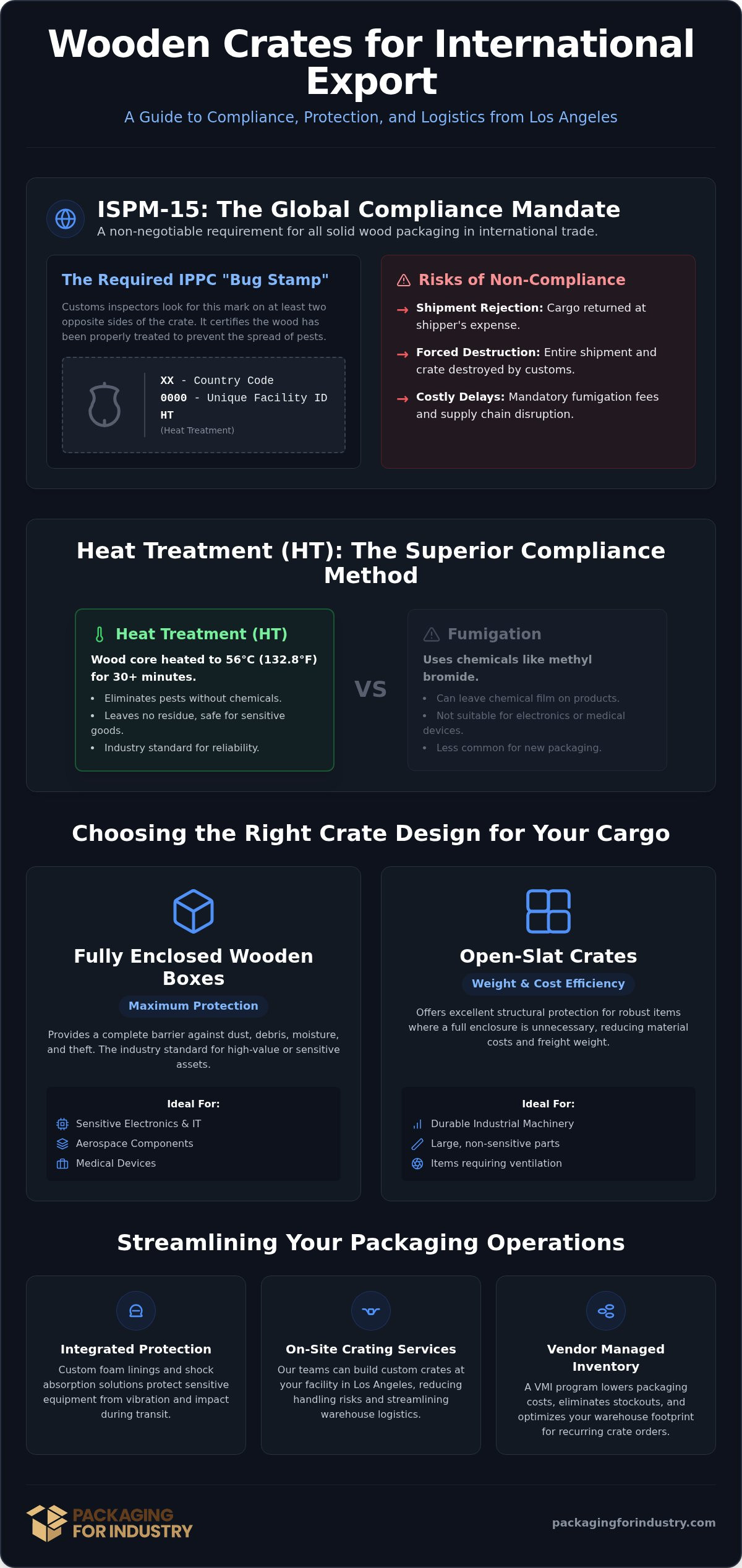
Customs inspectors specifically search for the IPPC mark, commonly known as the “bug stamp.” This mark must be permanent and clearly visible on at least two opposite sides of the crate. It contains a two-letter country code, a unique registration number for the wood treatment facility, and the “HT” abbreviation for heat treatment. If this mark is missing or appears fraudulent, your shipment will be flagged. The risks of non-compliance include immediate rejection at the port of entry, mandatory fumigation at high cost, or the total destruction of the cargo and the crate at the shipper’s expense.
Heat-Treated (HT) Wood vs. Fumigation
Heat treatment is the superior industrial standard for Southern California manufacturers looking to lower packaging costs while maintaining compliance. While fumigation uses chemicals like methyl bromide, HT relies on thermal energy to eliminate pests. The process requires the wood’s core to reach a temperature of 56°C (132.8°F) for at least 30 consecutive minutes. This method is safer for sensitive electronics and medical devices as it leaves no chemical film. PFI manages this certification process strictly, ensuring all wooden crates for international export out of Los Angeles are fully compliant before they leave our facility.
Target Countries and Compliance Risks
Exporters must be particularly vigilant when shipping to trade partners with aggressive enforcement, such as the European Union, China, and Australia. These regions often conduct physical inspections of a high percentage of incoming wood packaging. A common documentation pitfall is failing to match the treatment certificates with the specific bill of lading. By partnering with a local supplier in Carson or Santa Fe Springs, you gain access to experts who understand these regional nuances. We help you avoid the logistical nightmare of a quarantined shipment by providing precision-engineered, fully stamped crates that move through customs without friction.
Choosing the Right Crate Design for Your Cargo
Selecting the right container is an engineering decision based on the specific requirements of your equipment. For industrial machinery or delicate instruments, the enclosure must do more than just hold the item; it must facilitate safe handling across thousands of miles. When sourcing wooden crates for international export out of Los Angeles, custom engineering ensures the crate integrates with heavy-duty skids for seamless forklift and crane handling at busy ports like San Pedro. Because we have custom sizes available for every industrial application, we eliminate the structural weaknesses often found in over-sized, generic packaging that fails under heavy load.
Standardized catalog sizes often lead to wasted space or “dim weight” surcharges from carriers. We design custom enclosures that mirror the footprint of your equipment. This optimization reduces freight surcharges and maximizes the utilization of ocean freight containers, directly lowering your total landed costs. If you are shipping irregular or heavy loads, you can request a packaging quote to see how custom sizing and optimized weight distribution impact your bottom line.
Fully Enclosed Wooden Boxes
Fully enclosed boxes provide the maximum level of protection against dust, debris, and opportunistic theft during long-haul transit. They are the industry standard for sensitive electronics, medical devices, and high-value aerospace components. We typically use plywood for enclosure panels to achieve a high strength-to-weight ratio, while solid lumber is reserved for structural framing and heavy-duty bases. This combination creates a rigid barrier against the environmental hazards found in sea and air freight. It ensures your cargo arrives in factory condition regardless of the environmental shifts experienced during transit.
Open-Slat Crates and Skids
For durable machinery and large industrial components that don’t require total environmental isolation, open-slat crates offer a more cost-effective solution. These designs use less material, which reduces both the initial packaging cost and the overall shipping weight. A significant logistical advantage is that they allow customs officials to perform visual inspections of the cargo without dismantling the entire enclosure, which can speed up the clearance process at foreign ports. You can explore our manufacturing packaging solutions to see how these designs fit into a broader logistics strategy to lower packaging costs while using wooden crates for international export out of Los Angeles. Whether you need a simple skid or a complex open-frame crate, we focus on balancing structural integrity with material efficiency.
Integrated Protection: Foam Linings and Shock Absorption
The structural integrity of a crate is only half of the protection equation. While a rigid wooden shell provides a barrier against external impact, it cannot absorb the micro-vibrations of a cargo ship or the sudden G-force shifts of air freight handling. Sensitive industrial components require a secondary layer of defense. When you source wooden crates for international export out of Los Angeles, the engineering must include a comprehensive internal strategy to mitigate these dynamic risks. By integrating plywood shells with custom polyethylene or polyurethane foam linings, we isolate the cargo from the physical rigors of the supply chain.
Effective internal protection is not a one-size-fits-all application. You can learn about custom foam packaging and how it serves as a critical buffer between your high-value equipment and the crate walls. Unlike generic cushioning, engineered foam inserts are tailored to the specific weight, center of gravity, and fragility of your item. This precision ensures that the product remains stationary, preventing the internal collisions that frequently lead to damage during long-haul sea or air transit.
Custom Foam Inserts for Aerospace and Electronics
Aerospace and electronics manufacturers face unique regulatory and physical requirements. Sensitive circuit boards and avionics require anti-static (ESD) foam to prevent electrostatic discharge during handling. We utilize die-cut foam end caps and precision-fit inserts that lock the component in place, distributing the load evenly across the packaging surface. PFI engineers these solutions to meet specific G-force protection ratings. This ensures that even under extreme handling conditions, the internal components remain within their operational tolerances. This technical oversight is a standard feature of our wooden crates for international export out of Los Angeles.
Vapor Barriers and Moisture Protection
Ocean transit presents a significant environmental threat: high humidity and salt-laden air. Raw metal industrial parts are highly susceptible to oxidation and corrosion during a weeks-long journey. To counter this, we implement vapor barriers and vacuum-sealed foil bags combined with high-grade desiccants. These materials create a controlled micro-environment inside the crate, neutralizing moisture before it can reach the cargo. For a deeper look at these technical specifications, see our guide on Engineering Custom Crates for International Transit. Combining moisture control with shock absorption provides a total protection system that guarantees your equipment arrives in factory-ready condition.
Local Los Angeles Logistics and On-Site Services
Speed and proximity are critical for manufacturers in the LA basin. Relying on a Southern California packaging partner for wooden crates for international export out of Los Angeles means less time spent on transit and more on production. Our strategic location allows for next-day delivery of stock components and rapid turnaround for custom orders. We maintain a strong presence in key logistical hubs including Carson, Torrance, San Pedro, and Santa Fe Springs.
For oversized industrial machinery that’s difficult to transport, we provide on-site crating services. Our technicians bring the necessary materials directly to your facility and build the enclosure around the equipment. This process eliminates an unnecessary handling step, which significantly reduces the risk of pre-shipment damage. It’s a pragmatic solution for businesses that want to maintain total oversight of the crating process within their own warehouse environment.
Prototyping and Custom Design Support
High-value industrial rollouts shouldn’t rely on guesswork. We provide free prototyping to ensure the crate design is perfect before you commit to mass production. Our engineering team utilizes CAD/CAM support to create precise digital models and physical prototypes. This phase is essential for verifying the fit and function of complex designs, especially those requiring integrated foam or specialized internal bracing. It’s a proactive approach that eliminates the “trial and error” costs often associated with specialized industrial packaging.
Serving the Los Angeles Aerospace Corridor
The aerospace corridor in Torrance and Long Beach requires a specialized level of logistical precision. Defense and aviation contractors operate under rigorous quality standards that leave no room for error. We specialize in aerospace packaging solutions that meet these specific demands. From flight-ready components to sensitive laboratory equipment, our crates provide the structural integrity and compliance documentation required for high-stakes aerospace shipments. Being local allows us to respond to the fluctuating lead times and strict delivery windows common in this sector. This proximity ensures that your wooden crates for international export out of Los Angeles are ready exactly when your production schedule demands them.
Maximizing ROI with Vendor Managed Inventory (VMI)
For high-volume manufacturers, the procurement of wooden crates for international export out of Los Angeles shouldn’t be a reactive process. A Vendor Managed Inventory (VMI) program transforms packaging from a transactional expense into a strategic asset. By allowing PFI to monitor and replenish your crate stock based on your specific shipping volumes, you eliminate the risk of production stops caused by packaging shortages. This proactive oversight ensures that your international shipping schedules remain on track, regardless of sudden spikes in demand. It’s about creating a steady logistical flow that supports your bottom line.
One of the most immediate benefits of VMI is the reduction of your warehouse footprint. Wooden crates are inherently bulky and occupy significant square footage that could be better used for production or finished goods. By stocking your custom crates at our facilities and utilizing just-in-time delivery, you reclaim valuable floor space while maintaining a constant supply of ready-to-ship enclosures. We act as an extension of your warehouse, managing the logistics of your packaging supply so your team can focus on core manufacturing tasks.
Lowering Packaging Costs for High-Volume Exporters
High-volume exporters often find themselves trapped in expensive catalog pricing for standardized products that don’t fit their equipment. Transitioning to a VMI model allows you to explore our VMI services and secure custom bulk rates that reflect your actual usage. When you compare packaging pricing between large catalog retailers and a specialized manufacturer like PFI, the savings in material optimization and reduced freight surcharges become evident. Our engineers identify cost-reduction opportunities by refining the crate’s design to use less material without sacrificing structural integrity. It’s a pragmatic way to scale your export operations without scaling your overhead.
Kitting and Assembly Services
Efficiency on the warehouse floor is often lost during the final stages of packing. Our kitting and assembly services simplify the procurement process by combining heavy-duty corrugated boxes, custom foam inserts, and wooden crates into a single, ready-to-use SKU. PFI’s kitting services reduce assembly time on the warehouse floor by delivering pre-configured components that are ready for immediate use. This integrated approach is particularly effective for complex industrial shipments where multiple protective layers are required for sensitive equipment. By consolidating your supply chain, you ensure that every component of your wooden crates for international export out of Los Angeles arrives together, properly labeled, and ready for the port. This level of organization eliminates the stress of missing parts and speeds up the entire fulfillment cycle.
Secure Your Global Supply Chain with Precision Engineering
Successful global logistics require more than just a sturdy box; they demand a comprehensive system of protection and compliance. By prioritizing ISPM-15 certified heat-treated wood and custom-engineered internal cushioning, you eliminate the risks of port rejections and transit damage. Whether you’re shipping high-value aerospace components from Torrance or industrial machinery from Carson, your packaging should be a driver of efficiency rather than a source of stress.
PFI provides the technical expertise and local support needed to streamline your international operations. Our free prototyping and CAD support ensure a perfect fit before production begins, while our next-day delivery in Southern California keeps your warehouse moving. Investing in high-quality wooden crates for international export out of Los Angeles is a pragmatic decision that protects your assets and your bottom line.
We’re ready to help you optimize your industrial packaging and ensure your next shipment arrives exactly as intended.
Frequently Asked Questions
Do I need ISPM-15 certified crates for shipping to Canada or Mexico?
Yes, ISPM-15 certification is mandatory for all solid wood packaging moving between the United States, Canada, and Mexico. While historical exemptions once existed, current trade regulations require heat-treated (HT) wood for all pallets and crates crossing these borders. Using certified materials is the only way to prevent your cargo from being delayed or rejected by customs officials at the border, ensuring a seamless North American supply chain.
What is the difference between a shipping skid and a wooden crate?
A shipping skid is a single-deck platform without a bottom deck, primarily used as a base for heavy machinery. In contrast, a wooden crate is a fully enclosed, six-sided structure that provides comprehensive protection. While skids are cost-effective for durable goods, crates are necessary for sensitive items that require integrated foam linings, vapor barriers, or protection from side impacts and stacking during long-haul international transit.
How long does it take to get a custom export crate manufactured in Los Angeles?
Standard lead times for a custom export crate in the Los Angeles area typically range from 3 to 5 business days. PFI offers next-day local delivery for many stock components and can often fast-track urgent industrial orders. Because we manage the design, heat treatment, and assembly in-house, we bypass the delays common with multi-vendor supply chains, helping you meet tight international shipping windows without compromising on quality.
Can PFI provide on-site crating at my facility in Carson or Torrance?
Yes, we provide professional on-site crating services for manufacturers in Carson, Torrance, and across the South Bay. Our technicians bring all necessary materials and equipment directly to your facility to build custom enclosures around oversized or high-value machinery. This service eliminates the risk of damaging un-protected equipment during transit to a secondary packing site, providing a pragmatic solution for the aerospace and manufacturing sectors.
Is heat-treated wood the same as pressure-treated wood?
No, heat-treated (HT) wood is specifically processed for export compliance, while pressure-treated wood is intended for domestic construction. HT wood is baked until the core reaches 56°C for 30 minutes to eliminate pests without chemicals. When sourcing wooden crates for international export out of Los Angeles, you must use HT wood. Pressure-treated wood contains chemical preservatives that are often restricted in international trade or sensitive electronic environments.
What information is required to get an accurate custom crating quote?
To provide an accurate quote, we need the cargo’s exact dimensions, weight, and fragility level. You should also specify the destination country and any requirements for internal protection, such as anti-static foam or vapor barriers. Providing CAD drawings or photos allows our engineering team to optimize the crate design. This level of detail helps us identify ways to lower packaging costs while ensuring your equipment remains fully protected during transit.
Do you offer reusable wooden crates for recurring international loops?
We design and manufacture heavy-duty reusable wooden crates for businesses operating in closed-loop international supply chains. These crates feature reinforced corners, recessed handles, and durable link-lock fasteners to withstand multiple transit legs. While the initial cost is higher than a single-use container, the long-term ROI is substantial for recurring shipments. We can also engineer custom foam inserts that maintain their protective properties across dozens of shipping cycles.
How does PFI ensure crates meet aerospace-grade protection standards?
We meet aerospace standards by utilizing precision CAD/CAM design and selecting materials that meet specific G-force protection ratings. Our engineers calculate the necessary foam densities to negate vibration and impact during air or sea freight. When building wooden crates for international export out of Los Angeles for the aerospace corridor, we also integrate specialized vapor barriers and ESD linings to protect sensitive avionics from moisture and electrostatic discharge.