
What if your protective packaging functioned as a precision engineering tool rather than just a shipping expense? For manufacturers navigating the high-stakes logistics of Southern California ports, a minor oversight in cushioning can result in catastrophic assembly failures and ballooning freight costs. If you’re managing a high-tech supply chain, you’ve likely realized that off-the-shelf foam rarely provides the stability needed for sensitive electronics or medical devices. Relying on generic inserts often leads to excessive material waste, making it harder to meet California’s SB 54 requirement for a 10% reduction in plastic packaging weight by January 1, 2027.
We understand that protecting your bottom line is just as important as protecting your product. By implementing custom die cut polyethylene foam Orange County manufacturers can achieve zero-damage shipping while simultaneously reducing their warehouse footprint. This guide explores how precision engineering and local vendor-managed inventory programs solve the most common industrial pain points. We’ll examine the technical benefits of custom-engineered inserts, the fiscal advantages of high-volume local production, and the logistical efficiency of just-in-time delivery from our Anaheim headquarters.
Key Takeaways
- Understand why closed-cell polyethylene foam provides superior cushioning for heavy industrial components compared to standard polyurethane options.
- Learn how to select the correct foam density, such as 1.7lb or 2.2lb, to optimize shock absorption and meet specific G-force protection requirements.
- Discover how high-speed die cut polyethylene foam Orange County production runs lower unit costs for high-volume electronics and aerospace manufacturing.
- Identify how local procurement and Just-in-Time (JIT) delivery from Anaheim reduce freight expenses and minimize your warehouse footprint.
- Explore the benefits of integrated packaging design, combining custom foam inserts with heavy-duty corrugated boxes for total product security.
Die Cut Polyethylene Foam in Orange County Industry
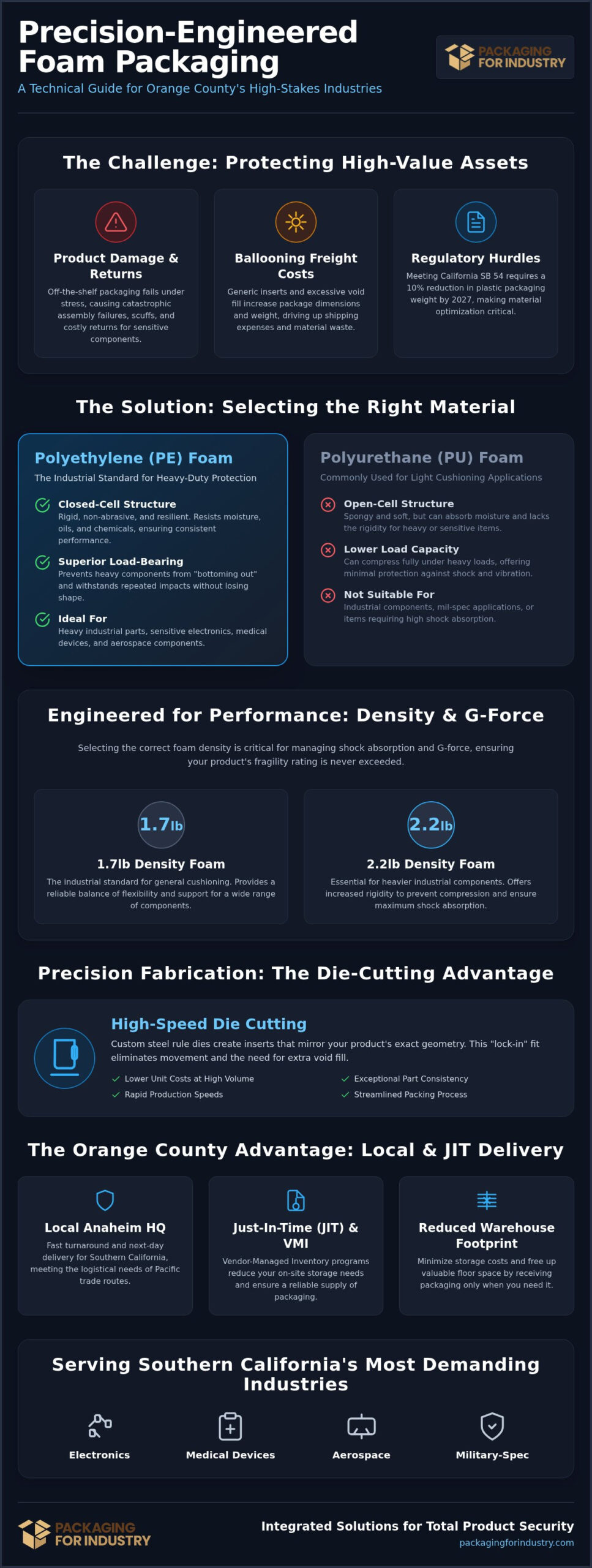
Polyethylene foam serves as the backbone of industrial protection for sensitive equipment. Unlike softer alternatives, Expanded polyethylene (EPE) is a closed-cell material that offers high buoyancy and excellent shock absorption. It’s engineered to withstand repeated impacts without losing its shape, making it ideal for heavy assemblies. When manufacturers utilize die cut polyethylene foam Orange County suppliers provide, they gain a material that is both lightweight and resilient against the rigors of long-haul logistics.
Choosing between polyethylene (PE) and polyurethane (PU) foam is a critical decision for any operations manager. Polyurethane is an open-cell material often used for light cushioning, but it lacks the load-bearing capacity required for industrial components. PE foam provides a rigid, supportive structure that prevents heavy items from “bottoming out” during transit. This structural stability is essential for high-value items that cannot afford even a millimeter of movement. It ensures that the product remains suspended and secure even when subjected to rough handling.
Precision die-cutting takes this protection a step further by creating a “lock-in” fit. By using custom-designed steel rule dies, we fabricate inserts that mirror the exact geometry of your product. This eliminates the need for excess void fill and prevents parts from shifting. The financial impact is immediate. Custom foam reduces the rate of scuffed parts and damaged returns, directly improving your bottom line and maintaining your reputation for quality. Investing in die cut polyethylene foam Orange County services allows you to streamline your packing process while ensuring total product integrity.
The Industrial Advantage of Closed-Cell PE Foam
Closed-cell foam is the industrial standard for non-abrasive surface protection. Because the cells are sealed off from one another, the material is naturally resistant to moisture, oils, and common industrial chemicals. This makes it the preferred choice for long-term storage in environments where humidity or chemical exposure might degrade lesser materials. Its structural integrity ensures that the cushioning remains consistent throughout the entire shipping cycle. It won’t break down or crumble, which is vital for maintaining a clean-room environment in medical or electronic applications.
Orange County’s High-Tech Manufacturing Standards
The manufacturing landscape in Southern California demands rigorous quality control. From Irvine medical device firms to Huntington Beach aerospace suppliers, companies must adhere to strict industrial and military-spec (mil-spec) packaging standards. Utilizing custom foam solutions ensures compliance with these requirements while optimizing supply chain reliability. Our engineering team specializes in Aerospace Packaging Solutions that meet the highest durability benchmarks. By choosing a local partner, you ensure your packaging meets the specific logistical needs of the Pacific trade routes and local distribution hubs.
Engineering Custom PE Foam Inserts: Density and Material Science
Industrial packaging is an exercise in applied physics. Selecting the correct material starts with understanding density, which is typically measured in pounds per cubic foot. Density is the primary factor in determining a foam’s load-bearing capacity. For most die cut polyethylene foam Orange County applications, we frequently utilize 1.7lb and 2.2lb densities. A 1.7lb foam serves as the industrial standard for general cushioning, providing a reliable balance of flexibility and support. However, for heavier industrial components, a 2.2lb density is necessary to prevent the material from compressing fully under the weight of the part.
Shock absorption is not just about thickness; it’s about managing G-force. Every industrial product has a specific fragility rating. Sensitive electronics might require a packaging design that limits impact to 40G or less during a standard drop. By calculating the static loading, which is the weight of the product divided by the surface area of the foam it rests upon, we can engineer an insert that decelerates the product safely. This technical approach ensures that your high-value assemblies survive the transit through Southern California’s busy logistical hubs without internal damage or mechanical failure.
Matching Foam Density to Product Weight
Lightweight electronics require a delicate touch. Using a foam that is too dense can be just as damaging as using one that is too soft, as the shock will transfer directly through the rigid material into the sensitive components. Conversely, heavy industrial machinery requires high-density planks or end caps. These high-density materials maintain their structural integrity under significant pressure, ensuring that heavy metal parts don’t crush the cushioning and strike the outer corrugated box. You can compare custom foam packaging options to find the right fit for your specific weight requirements.
Specialized Materials: ESD and Cross-Linked Foam
Orange County’s semiconductor and electronics sectors have unique requirements for electrostatic discharge (ESD) protection. We provide pink anti-static foam inserts that dissipate static charges, preventing latent defects in circuit boards and microchips. For medical device manufacturers in Irvine or Costa Mesa, cross-linked polyethylene (XLPE) offers a superior solution. XLPE is a closed-cell foam with a smoother surface and higher chemical resistance. It doesn’t shed particles or outgas, making it ideal for clean-room environments where purity is a requirement. If you’re unsure which material meets your industrial specs, you can request a quote to speak with one of our engineers.
Die-Cutting vs. CNC Routing: Selecting the Right Fabrication Method
Choosing the right fabrication method is a balance between initial investment and long-term per-unit savings. Die-cutting remains the industry standard for high-speed, high-volume production. This process utilizes a steel rule die to stamp out shapes from foam planks with extreme repeatability. When you source die cut polyethylene foam Orange County manufacturers provide, you’re investing in a process designed for speed. Before committing to a specific method, it’s helpful to compare packaging pricing across different volume tiers to see where the savings occur. While the physical die requires an upfront tooling fee, the speed of the hydraulic press significantly lowers the labor cost per part compared to manual or automated routing.
For specialized aerospace and medical components, achieving tight tolerances is non-negotiable. Die-cutting provides consistent results across thousands of cycles, ensuring every insert fits into its corrugated box or plastic case without variation. However, for complex three-dimensional shapes or ultra-thick planks, CNC routing or water-jet cutting might be more appropriate. These methods use computer-controlled bits or high-pressure water streams to carve the foam. They don’t require physical dies, making them the preferred choice for low-volume runs where the cost of a steel rule die isn’t justified.
The Economics of Die-Cutting for Bulk Orders
Die-cutting becomes the most cost-effective method once production exceeds the 500-unit threshold. At this volume, the initial tooling expense is amortized across enough units to drop the individual price below what CNC routing can offer. We optimize material yield through efficient nesting, which is the process of arranging parts on a sheet to minimize scrap. This reduces waste and further lowers your total procurement cost. You can request a packaging quote to see the specific price breaks for your inventory requirements.
Prototyping and Small-Batch Solutions
Rapid prototyping is essential for new product launches. Before committing to a full production run, we use CAD/CAM support to create one-off samples via CNC routing. This allows engineers to test the “lock-in” fit of a component and make adjustments without incurring expensive tooling modifications. This flexibility is vital for the iterative design cycles common in Irvine’s medical device sector. Our Custom Design Packaging team works directly with your CAD files to ensure the transition from prototype to high-volume die cut polyethylene foam Orange County production is seamless and accurate.
The Orange County Advantage: Local Logistics and Procurement
Logistics efficiency is the hidden factor in packaging profitability. When you ship foam from out-of-state, you’re essentially paying to transport air. This volume-based inefficiency quickly erodes the margins of high-volume manufacturing runs. By sourcing die cut polyethylene foam Orange County businesses can drastically reduce these freight expenses. Our Anaheim-based facility allows for direct, local delivery, ensuring that your protective packaging arrives exactly when it’s needed without the overhead of long-haul logistics.
Streamlining Southern California Supply Chains
Proximity to major industrial hubs like Irvine and Huntington Beach provides a strategic advantage. Navigating the “last mile” from our Anaheim headquarters to your facility is faster and more reliable than relying on national carriers. This local presence also mitigates the risks associated with regional disruptions. While others face delays at the Port of Long Beach or local rail hubs, our local supply chain remains insulated. This ensures your production line never stalls due to a missing shipment of protective inserts. You can learn more about our local reach on our Orange County Service Area page.
Inventory Management and Warehouse Efficiency
With Orange County industrial rents averaging between $1.35 and $1.45 per square foot as of Q2 2026, every inch of floor space must be optimized. Storing bulky foam planks or large quantities of finished inserts is a poor use of expensive real estate. Our Vendor Managed Inventory (VMI) and Just-in-Time (JIT) programs allow you to reclaim your warehouse footprint. We manage your foam stock and schedule replenishment cycles based on your actual consumption. This proactive approach reduces purchasing friction and ensures you always have the necessary protection on hand.
Benefits of our local delivery model include:
- Reduced lead times for custom-engineered prototypes.
- Lower carbon footprint through localized transport via our Southern California fleet.
- Direct accountability with a local, engineering-minded team.
- Next-day delivery capabilities for high-volume stocked inventory items.
Implementing these strategies is one of the most effective ways to lower packaging costs. By shifting the burden of inventory management to a local partner, you improve your cash flow and operational agility. It’s not just about the material; it’s about the entire system of protection and logistical optimization that keeps your business moving forward.
Partnering with PFI for Custom Foam Fabrication and Design
Success in industrial logistics requires more than a simple material purchase; it demands a partnership based on accountability and technical oversight. At PFI, our engineering process bridges the gap between raw material and a fully optimized protective system. We utilize your CAD files to design inserts that account for every protrusion and sensitive surface of your assembly. With custom sizes available for any industrial footprint, we ensure that your die cut polyethylene foam Orange County order is tailored specifically to your product’s unique geometry rather than forced into a standard template.
Our role as a seasoned industrial consultant means we look for every opportunity to lower packaging costs through total system integration. While many suppliers stop at the foam, we provide comprehensive oversight by kitting your inserts directly into heavy-duty RSC boxes or custom-engineered wood crates. This integrated approach reduces the complexity of your procurement and ensures that the outer container and internal cushioning function as a single, unified unit of protection. By receiving pre-assembled packaging, your team can focus on production rather than manual kitting on the warehouse floor.
Total Integrated Packaging Solutions
We specialize in kitting and assembly services that streamline the fulfillment cycle for electronics and medical device manufacturers. By delivering your boxes with foam inserts pre-installed, we help you reclaim valuable labor hours and reduce the risk of assembly errors. For heavy industrial export, we combine foam lining with Custom Shipping Crates to survive the vibration and impact of international transit. This comprehensive oversight is what distinguishes PFI from national catalog suppliers who lack the capability for local, hands-on assembly.
Get Started with a Custom Foam Prototype
The design phase is a collaborative journey where we prioritize your bottom line. We invite you to submit your product dimensions or CAD files to our engineering team for a thorough design review. To ensure total peace of mind, we provide a free prototype for product fit, allowing you to verify the protection levels and “lock-in” security before committing to a high-volume run. This methodical approach eliminates the professional stress of transit damage and guarantees that your die cut polyethylene foam Orange County solution is engineered for long-term reliability.
Optimizing Your Supply Chain with Engineered Protection
Success in the Southern California industrial sector requires a balance of precision engineering and logistical efficiency. Selecting the correct material density and fabrication method ensures that high-value components reach their destination without damage. Localizing your procurement reduces freight overhead and minimizes the warehouse footprint needed for bulky inventory. These strategies are essential for maintaining a competitive edge in Irvine’s medical device or Huntington Beach’s aerospace manufacturing hubs.
Partnering with a local expert for die cut polyethylene foam Orange County ensures that your packaging meets strict industrial and military-spec standards. We provide free prototyping and CAD/CAM design support to guarantee a perfect fit before production begins. With our Anaheim facility, you benefit from local accountability and the reliability of local next-day delivery for stocked items.
We’re ready to help you eliminate transit damage and streamline your operations. Let’s build a more resilient supply chain together.
Frequently Asked Questions
What is the minimum order quantity for die-cut polyethylene foam?
Minimum order quantities depend on the size and complexity of the insert. We prioritize bulk industrial runs for manufacturers and distributors rather than small consumer orders. For custom die-cutting, we usually look for volumes that amortize the initial tooling costs effectively. You should request a packaging quote to get specific volume requirements and price breaks tailored to your project’s inventory needs.
How do I determine the right foam density for my industrial parts?
Density is selected based on the fragility and weight of your component. We calculate the static loading to determine if a 1.7lb or 2.2lb material is appropriate. Heavier industrial parts require higher density to prevent bottoming out, while sensitive assemblies need softer cushioning to manage G-force. Our engineering team helps you select the correct die cut polyethylene foam Orange County specifications to ensure your product survives the rigors of long-haul logistics.
Does PFI offer anti-static (ESD) foam for electronics packaging?
Yes, we provide pink anti-static (ESD) polyethylene foam for the electronics and semiconductor sectors. This material is specifically treated to dissipate electrostatic charges, preventing latent damage to microchips and circuit boards. It can be precision die-cut into kitting trays or box inserts. This specialized protection is critical for high-tech manufacturers who need to ensure their assemblies remain safe from both physical shock and electrical discharge during distribution.
What is the typical lead time for custom foam inserts in Orange County?
Typical lead times for custom-engineered foam inserts are between one and two weeks following prototype approval. This timeframe includes the fabrication of the steel rule die and the completion of the production run. Being based in Anaheim allows us to offer faster turnaround times than out-of-state suppliers. We focus on supply reliability, ensuring your production lines in Southern California never stall due to a lack of protective packaging materials.
Can you fabricate foam inserts that fit into my existing corrugated boxes?
We can fabricate custom inserts to fit your existing RSC boxes or heavy-duty corrugated containers. By using your internal box dimensions, we engineer the foam to create a “lock-in” fit that eliminates shifting. This is a highly effective way to lower packaging costs by utilizing current inventory while upgrading your internal protection. Our design team ensures the inserts provide maximum cushioning without requiring oversized outer containers.
Do you provide free prototypes for custom foam designs?
We provide a free prototype for product fit to ensure your custom design meets all protective requirements before full-scale production. Using CAD/CAM design support, we create a physical sample for your team to test with the actual product. This step is vital for verifying tolerances and cushioning performance. It guarantees that your final die cut polyethylene foam Orange County production run is accurate and performs exactly as engineered.
What industries in Southern California do you typically serve with custom foam?
We serve the aerospace, medical, and electronics industries across Orange County, Los Angeles, San Diego, and the Inland Empire. Our experience includes fabricating mil-spec packaging for defense contractors and clean-room compatible inserts for medical device firms. Whether you’re shipping from the Port of Long Beach or distributing locally, our custom foam solutions are engineered to meet the high-durability standards required by Southern California’s diverse manufacturing and high-tech sectors.
How does local Orange County delivery work for bulk foam orders?
Local delivery is handled by our own fleet, providing reliable next-day service for stocked items throughout Southern California. We utilize Vendor Managed Inventory (VMI) and Just-in-Time (JIT) programs to manage your foam stock based on actual consumption. This local-to-local supply chain model helps you reclaim warehouse floor space and reduces the freight costs associated with shipping “air.” It ensures a steady, accountable flow of materials directly to your production line.