
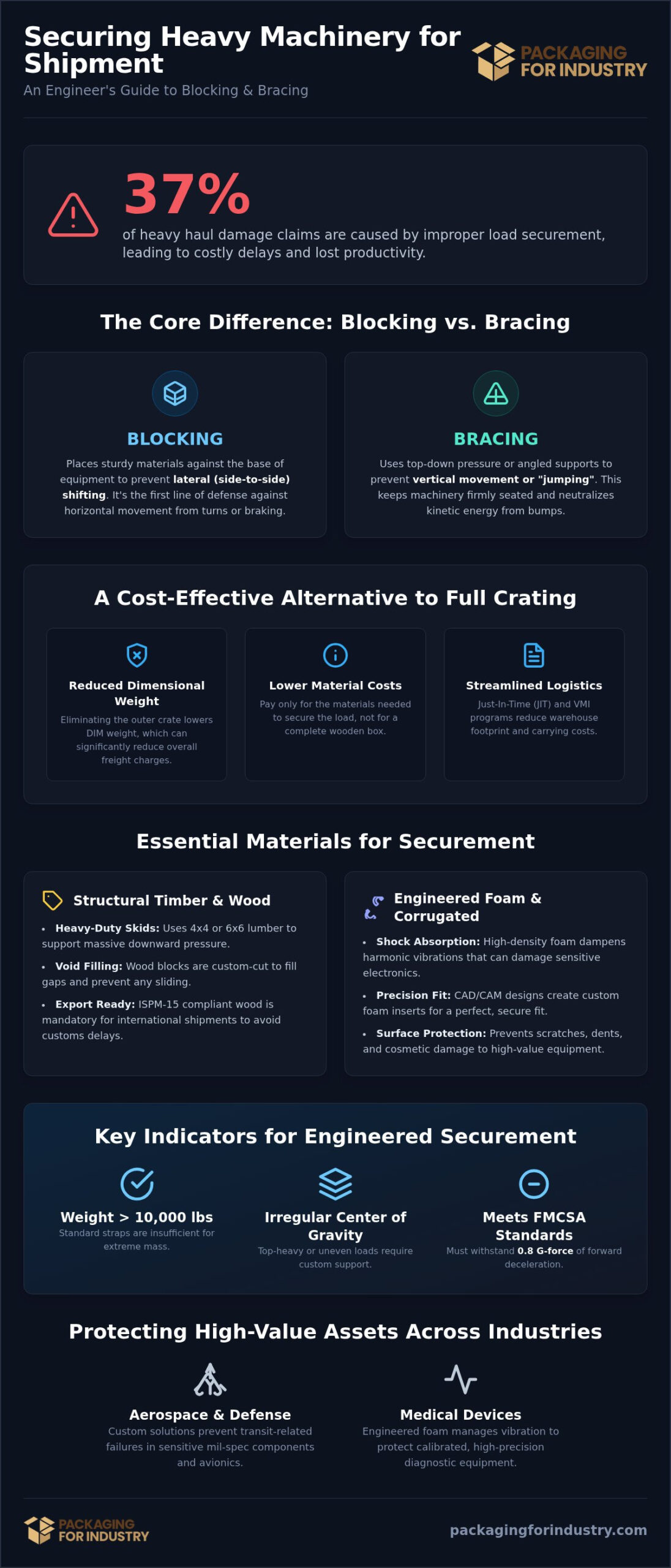
Did you know that improper securement accounts for 37% of all heavy haul damage claims? For manufacturers and distributors, a shifting load doesn’t just mean a broken machine; it often results in thousands of dollars in lost productivity and weeks of project delays. You’ve likely experienced the frustration of relying on generic catalog supplies that fail to provide the precision needed for high-value, oversized equipment. Implementing the right blocking and bracing solutions for shipping heavy machinery is the most effective way to protect your bottom line and ensure your assets arrive intact.
We understand that securing irregular loads is a complex task that often leads to excessive material waste and high freight damage rates. This guide provides a professional roadmap for securing your industrial assets using engineered strategies that reduce costs and improve reliability. You’ll learn how to move away from one-size-fits-all options and toward custom-tailored protection. We’ll explore how integrated material solutions and local expertise in Southern California can streamline your logistics and provide the peace of mind that comes with a perfectly secured shipment.
Key Takeaways
- Understand the technical distinction between blocking and bracing to implement a cost-effective alternative to expensive full-crating methods.
- Learn to select industrial-grade materials, such as heavy-duty timber and protective foam, that provide critical shock absorption for sensitive equipment.
- Master the engineering principles behind blocking and bracing solutions for shipping heavy machinery, including center of gravity calculations and harmonic vibration management.
- Identify industry-specific securement strategies for high-value aerospace components and calibrated medical devices to prevent transit-related failures.
- Discover how custom CAD/CAM prototyping and local vendor-managed inventory (VMI) programs can significantly lower your long-term packaging costs.
What is Blocking and Bracing in Industrial Shipping?
In industrial logistics, Load securing is a critical engineering discipline rather than a simple warehouse task. Effective blocking and bracing solutions for shipping heavy machinery rely on two primary forces: friction and mechanical securement. While friction provides a baseline level of resistance, heavy industrial assets require mechanical intervention to withstand the intense G-forces experienced during transit. Securement systems must withstand 0.8 g deceleration in a forward direction to prevent the cargo from shifting or breaking loose during transit.
The Core Difference: Blocking vs. Bracing
While often used interchangeably, blocking and bracing serve distinct roles in cargo protection. Blocking involves placing sturdy materials, typically industrial-grade lumber or heavy-duty corrugated, against the base of the machine to prevent lateral shifting. This stops the load from sliding side-to-side or front-to-back during sharp turns or sudden braking. It’s the first line of defense against horizontal movement.
Bracing focuses on preventing vertical movement or “jumping.” By using top-down pressure or angled supports, bracing keeps the machinery firmly seated against the trailer floor or pallet. When these two methods work together, they create a rigid shipping environment that neutralizes kinetic energy. This ensures that your high-value hardware remains stationary regardless of road or rail conditions.
Economic Advantages of Strategic Bracing
Many manufacturers default to full custom crating because it feels like the safest option. However, this often leads to excessive material waste and inflated shipping costs. Strategic blocking and bracing offers a precision-engineered alternative that protects the machine’s critical points without the weight and bulk of a full enclosure. This approach provides several financial benefits:
- Reduced Dimensional Weight: By eliminating the outer crate, you lower the DIM weight of the shipment, which can significantly lower overall freight charges.
- Lower Material Costs: You only pay for the materials required to secure the load, rather than paying for a complete wooden box that adds little structural value to the machine itself.
- Streamlined Logistics: Implementing just-in-time inventory management allows you to receive custom bracing components exactly when needed, reducing warehouse footprint and carrying costs.
Identifying when a shipment requires engineered bracing over standard palletization is a matter of weight and geometry. If a machine has an irregular center of gravity or weighs over 10,000 lbs, standard straps and stretch film are usually insufficient. In these scenarios, you need custom-fit blocking and bracing solutions for shipping heavy machinery to meet FMCSA regulatory standards and prevent catastrophic freight damage.
Essential Materials for Heavy Machinery Blocking and Bracing
Selecting the right materials is the first step in executing a successful securement plan. Professional blocking and bracing solutions for shipping heavy machinery don’t rely on a single material; instead, they utilize a tiered system of structural components and protective layers. Every material chosen must satisfy the performance requirements of the Cargo Securement Rules to ensure the load remains immobile under heavy braking. Using substandard materials is a primary cause of the equipment damage incidents that plague industrial shippers.
Timber and Wood Securement
Structural timber remains the most reliable material for base securement and skidding. For heavy industrial loads, 4×4 or 6×6 lumber is typically used to build custom skids that can support the massive downward pressure of the machine. When your project involves international export, it’s mandatory to use wood that meets ISPM-15 standards to avoid customs delays or quarantine. Beyond the base, we use wood blocking to fill voids and prevent lateral sliding. These components are often part of a specialized kitting service, where all required wood and foam pieces are pre-cut and delivered as a single assembly to speed up your warehouse operations.
Engineered Foam and Corrugated Hybrids
While wood provides the strength, protective foam packaging and heavy-duty corrugated provide the precision. We use high-density polyethylene foam for vibration dampening, ensuring that sensitive internal components don’t shake loose. For secondary parts or smaller hardware shipped alongside the main machine, we provide heavy-duty RSC boxes in double or triple-wall configurations. These boxes offer high stacking strength and can be integrated directly into the bracing plan. To protect the machine’s finish from high-tension strapping, we apply corner boards. These edge protectors distribute the strap’s pressure across a wider surface area, preventing the steel or polyester bands from crushing the machine’s frame or custom corrugated boxes used for internal partitions.
For long-term storage or defense contracts, we provide mil-spec packaging solutions that include moisture barrier bags and specialized desiccants. These materials are essential for preventing corrosion during ocean transit or extended outdoor storage. If you’re looking to optimize your current setup or reduce material waste, you can request a packaging quote to see how an integrated material approach can improve your securement reliability. Combining these materials into a unified strategy ensures your equipment is protected from every angle, from the structural base to the most delicate electronics.
Engineering the Load: Physics and Weight Distribution
Engineering a shipment for heavy machinery requires a deep understanding of kinetic energy and the “Objects in Motion” principle. When a 15,000-pound machine is in transit, any sudden change in velocity creates massive force that standard securement cannot contain. Effective blocking and bracing solutions for shipping heavy machinery must account for the fact that a load’s momentum increases exponentially with its weight. This means that bracing designed for a standard 2,000-pound pallet will fail catastrophically when applied to industrial hardware. Proper engineering prevents load shifts during emergency braking or sharp cornering, which are responsible for 28% of equipment-damage incidents according to FMCSA data.
Center of Gravity and Tip Prevention
Irregularly shaped machinery often possesses a high or offset center of gravity, making it prone to tipping during transit. To mitigate this risk, outrigger bracing is used to widen the effective base of the machine and provide structural stability. Securing the base directly to the skid or pallet is essential to prevent sliding, but it doesn’t address the risk of the machine toppling over. As the center of gravity shifts higher or further from the center of the load, the required strength of the bracing system increases exponentially to counteract tipping forces. Identifying these balance points during the design phase allows for the creation of targeted supports that prevent the machine from breaking free of its skids.
Vibration and Shock Protection
Beyond structural failure, harmonic vibration is a silent threat to calibrated industrial assets. Long-haul trucking and rail transport subject machinery to constant micro-vibrations that can loosen internal fasteners or damage sensitive electronics. Integrating foam packaging into your bracing strategy isolates the hardware from road shock and dampens these vibrations. The G-forces experienced during transit can also cause strapping to bite into the machine’s finish or frame. Using corner and edge protection distributes the tension of high-tensile strapping, preventing surface damage while maintaining the pressure required by FMCSA Cargo Securement Rules. This combination of structural bracing and shock isolation creates a comprehensive protection system for high-value assets.
Industry-Specific Blocking and Bracing Applications
While the physics of load securement remains constant, the application of blocking and bracing solutions for shipping heavy machinery varies significantly between specialized industries. A standard industrial lathe requires structural rigidity, but a semiconductor wafer stepper or an aerospace turbine housing demands a higher level of environmental and electrostatic protection. Generic catalog dunnage often fails to accommodate the irregular footprints of specialized hardware. We ensure your assets are protected by offering custom sizes available for all wood, foam, and corrugated bracing components, ensuring a precise fit for every unique machine profile.
Aerospace and Defense Securement
In the aerospace sector, securing turbine components or high-value flight hardware involves strict adherence to aerospace packaging standards and Mil-Spec requirements. These assets often feature complex, irregular geometries that traditional wood blocking cannot support alone. We utilize custom-engineered foam inserts to cradle these components, distributing pressure evenly across delicate surfaces to prevent deformation. Our CAD/CAM design support allows for rapid prototyping and fit-testing, ensuring that mission-critical parts remain completely immobile even during the high-G maneuvers common in specialized transport.
Medical and Laboratory Equipment
Medical and laboratory equipment presents a distinct set of logistical challenges. Calibrated diagnostic machinery and imaging equipment are highly sensitive to both shock and contamination. Bracing for these assets requires cleanroom-compatible materials that won’t off-gas or shed particles during transit. We often integrate shock-monitored bracing systems for sensitive optics to provide a verifiable record of the shipment’s integrity. Furthermore, we design these systems to ensure ease of unboxing, allowing hospital staff to remove the bracing safely without risking damage to the calibrated equipment at its final destination.
Industrial manufacturing facilities in Orange County and Los Angeles frequently move oversized CNC machines, lathes, and heavy presses. These assets possess massive kinetic energy that can easily overwhelm standard securement if the center of gravity isn’t properly managed. Similarly, the electronics sector requires ESD-safe bracing for semiconductor manufacturing tools to prevent static discharge from damaging microcircuitry. Whether you’re moving a multi-ton press or a delicate wafer stepper, utilizing precision bracing helps you lower packaging costs by eliminating the need for over-engineered, heavy crates.
Custom Bracing Solutions from Packaging For Industry (PFI)
Packaging For Industry (PFI) provides the specialized engineering expertise required to secure high-value industrial assets. We don’t offer generic catalog solutions; instead, we provide precision-engineered blocking and bracing solutions for shipping heavy machinery that prioritize both protection and fiscal efficiency. By conducting comprehensive packaging cost savings reviews, we help our clients move away from oversized, expensive crating and toward targeted, high-performance bracing systems that reduce dimensional weight and material waste.
The PFI Design and Prototyping Process
Every project begins with our custom CAD/CAM design support. We analyze the specific dimensions, weight distribution, and fragility of your machine to engineer a bracing plan that neutralizes transit risks. We offer free prototyping for product fit, allowing you to verify the securement strategy before committing to a full production run. This iterative process ensures zero-damage transit by testing and refining the interaction between timber, foam, and corrugated materials. Whether you’re shipping a single prototype or managing a large-scale manufacturing rollout, our designs scale seamlessly to meet your specific volume requirements.
Local Support and Supply Chain Reliability
For manufacturers in Orange County and the surrounding regions, supply chain reliability is often the difference between meeting a deadline and facing late-delivery penalties. PFI offers local next-day delivery across Southern California, including Los Angeles, San Diego, and the Inland Empire. Our fleet provides consistent support to facilities in Anaheim, Irvine, and Santa Fe Springs, ensuring your team never faces downtime due to missing packaging components. We understand the local logistical landscape, allowing us to navigate tight delivery windows that national catalog suppliers simply can’t match.
To further streamline your operations, we provide vendor-managed inventory (VMI) programs for recurring shipping needs. This service ensures that your custom bracing components are always in stock, with PFI managing inventory levels on your behalf to free up warehouse space and capital. While we maintain a strong local presence in Southern California, our nationwide shipping capabilities allow us to support multi-location manufacturers with the same level of precision and accountability. You can request a packaging quote for your heavy machinery project today to begin optimizing your securement strategy and reducing your total cost of transport.
Secure Your Industrial Assets with Engineered Precision
Moving from generic catalog supplies to engineered blocking and bracing solutions for shipping heavy machinery reduces transit damage and lowers total logistical costs. Integrating structural timber with custom foam and heavy-duty corrugated creates a robust protection system tailored to your equipment’s specific geometry and center of gravity. This precision approach is vital for maintaining the integrity of high-value aerospace hardware and calibrated medical devices that cannot tolerate road shock or harmonic vibration.
Packaging For Industry (PFI) supports your manufacturing goals with custom CAD/CAM engineering and local next-day delivery across Orange County, Los Angeles, and San Diego. We don’t just provide materials; we offer a partnership focused on supply chain reliability and fiscal responsibility. Our specialized expertise ensures that your most complex logistical challenges have a dependable, local solution that arrives exactly when your warehouse team needs it.
We’re ready to help you eliminate professional stress and protect your bottom line. Let’s start engineering a safer, more efficient shipping strategy for your high-value assets today.
Frequently Asked Questions
Is blocking and bracing cheaper than using a custom shipping crate?
Blocking and bracing is generally more cost-effective than full crating because it utilizes fewer raw materials and reduces the total dimensional weight of the shipment. By securing only the critical structural points of the asset, you avoid paying for an entire wooden enclosure. This allows manufacturers to lower packaging costs while maintaining high protection standards. Professionals often compare packaging pricing to determine if a hybrid solution of wood and foam offers better value than a traditional crate.
What are the best materials for securing heavy machinery in a shipping container?
The most effective blocking and bracing solutions for shipping heavy machinery utilize a combination of industrial-grade timber, high-density polyethylene foam, and triple-wall corrugated. Timber provides the structural rigidity needed to prevent base shifting, while foam absorbs harmonic vibrations that occur during transit. For containerized shipments, adding moisture barrier bags and desiccant is also recommended to prevent corrosion during long-haul transport. These integrated materials ensure the load remains stable and protected from environmental stress.
Does PFI provide on-site blocking and bracing services in Southern California?
PFI specializes in the engineering and supply of custom bracing materials, supporting local manufacturers in Orange County and Los Angeles with precision-designed components and blueprints. We provide the CAD/CAM designed wood, foam, and corrugated parts ready for your team to install. Our local next-day delivery in cities like Anaheim and Santa Fe Springs ensures you have the necessary supplies exactly when your project hits the loading dock, allowing your team to maintain peak operational efficiency.
How do I know if my machinery requires a custom-engineered bracing solution?
You should consider custom engineering if your equipment has an offset center of gravity, irregular geometry, or weighs more than 10,000 lbs. Standard palletization often fails when faced with the high G-forces of emergency braking or sharp cornering. If your asset is high-value, such as a calibrated medical device or aerospace component, an engineered plan is necessary to ensure zero-damage arrival. You can request a packaging quote to have our engineers evaluate your specific load requirements today.
Can blocking and bracing be used for international ocean freight?
Blocking and bracing is a standard practice for international ocean freight, provided all wood materials are ISPM-15 compliant. Any timber used must be heat-treated and stamped to meet global biosecurity regulations. For ocean transit, it’s also critical to incorporate moisture protection and high-tension strapping that can withstand the constant pitch and roll of a vessel. This method is often preferred for oversized machinery that won’t fit in standard closed containers, offering significant cost savings over full crating.
What is the difference between blocking and bracing for rail vs. truck transport?
Rail transport involves significantly higher longitudinal forces due to car shunting and coupling, requiring much more robust blocking than standard over-the-road trucking. While truck transport focuses on lateral stability and braking, rail securement must withstand the intense forward and backward jolts of a train. Our engineering team designs blocking and bracing solutions for shipping heavy machinery that account for these specific G-force requirements to prevent the load from breaking free during rail transit or intermodal transfers.
How does PFI help reduce packaging costs for heavy equipment manufacturers?
PFI helps manufacturers lower packaging costs through precision engineering and supply chain optimization. By designing bracing that uses fewer materials than a full crate, we reduce your initial spend and lower freight costs through reduced dimensional weight. Our Vendor-Managed Inventory (VMI) and just-in-time delivery programs also eliminate the need for you to store bulky packaging supplies, freeing up valuable warehouse space in Southern California for your primary production activities and improving your overall logistical flow.
Are there specific Mil-Spec requirements for blocking and bracing heavy defense equipment?
Defense contracts often require adherence to Mil-Std-2073 and specific military packaging guidelines for load securement. These standards dictate the types of fasteners, wood quality, and preservation methods required for sensitive military hardware. PFI specializes in providing mil-spec packaging materials and custom-engineered bracing that meets these rigorous federal requirements. Our team ensures that your defense-related shipments are fully compliant, preventing costly rejections at the point of delivery or during government inspections and maintaining your status as a reliable contractor.