
Shipping damage isn’t just a logistical hiccup; it’s a direct tax on your manufacturing profit margins that many Southern California firms accept as an unavoidable cost of doing business. Optimizing the industrial packaging design process Southern California manufacturers rely on is difficult when you’re balancing high freight costs with the need for specialized protection. You likely understand the frustration of seeing high-value components arrive damaged or paying excessive surcharges because of non-optimized box sizes. Coordinating custom designs with local production schedules often adds another layer of complexity to an already strained operation.
This guide provides a clear roadmap to reducing shipping damage and optimizing your bottom line through better engineering. We’ll explore how integrating custom corrugated solutions with precision foam inserts and local inventory management can transform your packaging from a simple overhead expense into a strategic competitive advantage. By focusing on engineering-led design and local supply chain reliability in Orange County and Los Angeles, you can achieve a damage-free shipping solution that keeps your warehouse running at peak efficiency for 2026 and beyond.
Key Takeaways
- Master the industrial packaging design process Southern California manufacturers use to transition from inefficient stock sizes to high-performance custom corrugated solutions.
- Identify the specific engineering requirements for your products, including how to choose between polyethylene and ESD foam to eliminate shipping damage.
- Learn how to lower packaging costs by designing for freight efficiency and avoiding the common pitfalls of dimensional weight surcharges.
- Discover the benefits of local prototyping and CAD/CAM support to ensure your custom packaging is retail-ready and operationally sound.
- Streamline your warehouse logistics by integrating Vendor Managed Inventory (VMI) to maintain a reliable supply of custom materials for just-in-time delivery.
Understanding the Industrial Packaging Design Process in Southern California
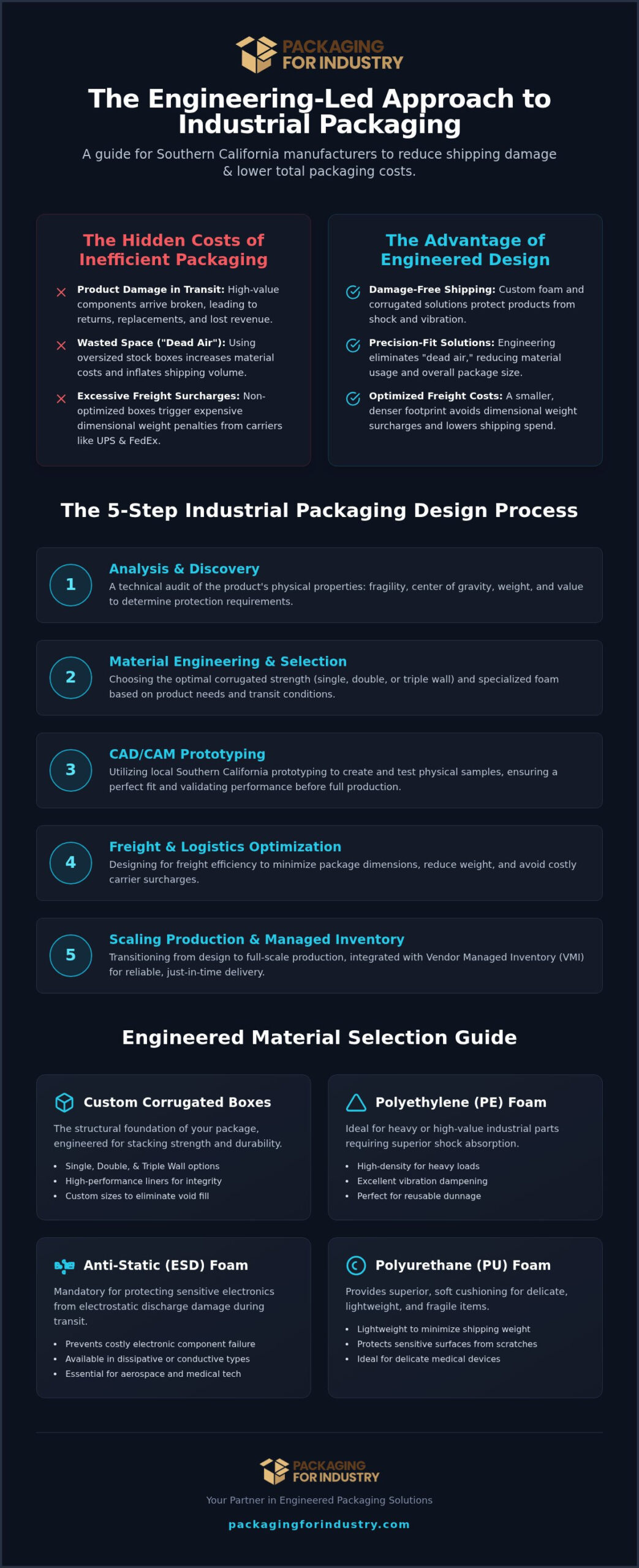
Industrial packaging design in 2026 has evolved beyond simple containment into a sophisticated engineering discipline. For manufacturers across the Southland, it’s now a critical component of the supply chain that directly influences profit margins. Many firms are moving away from stock catalog sizes because generic boxes often lead to wasted space and inadequate protection. An optimized industrial packaging design process Southern California companies utilize focuses on precision engineering to eliminate the “dead air” that triggers expensive freight surcharges. When you lower packaging costs through better design, you’re not just saving on materials; you’re streamlining your entire logistics operation.
Using custom-sized corrugated boxes and engineered foam packaging reduces damage rates significantly. When a product is secured with materials tailored to its specific fragility and weight, the risk of transit failure drops. This shift also helps businesses stay compliant with federal regulations like the Fair Packaging and Labeling Act, ensuring that all industrial goods are properly identified and protected throughout the logistics cycle. Standard shipping focuses purely on getting a part from point A to point B, but 2026 standards often require “retail-ready” designs. This means the packaging must protect the item while allowing a distributor to place it directly on a warehouse shelf or display without repacking.
The Role of Engineering in Modern Packaging
Engineering is the backbone of high-performance packaging. It involves analyzing material science to protect high-value parts from shock and vibration. By utilizing custom design packaging, engineers can select the exact density of foam needed for a specific component. This precision reduces the overall footprint of the shipment. It’s vital for avoiding UPS and FedEx dimensional weight surcharges. It’s about finding the intersection where maximum durability meets minimal logistical volume. A well-engineered solution ensures that even the most delicate aerospace or medical components remain stationary during high-vibration transit.
Regional Factors Influencing SoCal Design
Operating within the Los Angeles and Orange County logistics hubs requires a localized approach. Manufacturers in cities like Anaheim or Santa Fe Springs benefit from rapid prototyping and shorter production cycles when they source locally. Regional design must also account for West Coast shipping routes, where temperature fluctuations and port handling intensities vary. Local expertise ensures that your packaging is built for the specific rigors of the Southern California supply chain. Having an Anaheim-based custom design team allows for immediate adjustments and faster speed-to-market for new product launches.
The Engineering Phase: Material Selection and Custom Prototyping
The industrial packaging design process Southern California manufacturers follow begins with a technical audit of the product’s physical properties. We analyze the fragility, center of gravity, and total weight of the components. This data dictates the material selection. For example, high-density polyethylene foam is ideal for heavy industrial parts, while polyurethane provides superior cushioning for delicate medical devices. If you’re shipping sensitive electronics, anti-static ESD foam is mandatory to prevent electrostatic discharge damage. While functionality remains the priority, many manufacturers are also looking to incorporate sustainable packaging alternatives into their engineering phase to meet corporate environmental goals.
Selecting the right corrugated strength is equally critical for structural integrity. While standard corrugated boxes might suffice for lightweight goods, heavy-duty applications often require double-wall or even triple-wall board to prevent box failure during stacking. Our CAD/CAM support ensures that every cut is precise, allowing for a tight tolerance between the product and its protective housing. This level of engineering is what separates a professional shipping solution from a generic box. To see how these materials work together for your specific application, you can request a packaging quote and receive a technical review of your current setup.
Custom Foam Packaging Integration
Designing die-cut foam inserts is essential for complex aerospace or medical geometries. These inserts immobilize the product, preventing any internal movement that could lead to surface scratches or mechanical failure. For heavy machinery, custom foam packaging can be integrated into heavy-duty crates, providing a shock-absorbing base that protects against the rigors of long-distance freight. This integration ensures that even the most irregularly shaped parts remain secure throughout the entire logistics cycle.
The Prototyping and Sample Process
PFI provides free prototyping to ensure a perfect product fit before you commit to a full production run. Our Anaheim-based design team creates physical samples that allow you to test the assembly in your own warehouse environment. This phase includes real-world drop and vibration simulation to verify that the design meets your specific protection requirements. We use this feedback to refine the design for manufacturing (DFM), which helps lower production costs by identifying the most efficient way to assemble and pack the final solution. This local, hands-on approach eliminates the guesswork and long lead times associated with overseas or out-of-state suppliers.
Designing for “Retail-Ready” Industrial Goods: Balancing Protection and Presentation
In 2026, the distinction between industrial containment and retail presentation has largely evaporated. Modern distributors and warehouse clubs now demand goods that arrive ready for immediate shelf placement without the need for additional handling. This shift has fundamentally changed the industrial packaging design process Southern California manufacturers implement. You must now engineer solutions that provide the heavy-duty protection required for long-haul freight while ensuring the aesthetic and functional standards of a retail environment. It’s a balance of structural integrity and ease of access that directly impacts your ability to secure contracts with major industrial distributors.
Incorporating branding and clear labeling is essential, yet it shouldn’t compromise the strength of your corrugated boxes. High-visibility graphics and precise labeling help warehouse staff identify parts quickly, reducing picking errors and improving supply chain flow. When you compare packaging pricing for these advanced designs, you’ll find that the slight increase in per-unit cost is often offset by the reduction in labor costs at the distribution point. We focus on creating custom sizes available through our Anaheim facility that fit perfectly on standard pallet racks and club store shelving.
Industrial vs. Retail-Ready Design Requirements
Standard RSC boxes are the workhorses of the shipping world, but they often fail the “retail-ready” test because they require box cutters and significant effort to unpack. Die-cut designs, however, allow for “easy-open” features like perforated tear strips that warehouse staff can use without risking damage to the internal product. We select materials that maintain a professional, clean appearance even after surviving the rigors of the Southern California logistics network. This ensures your brand looks as good on a distributor’s shelf in Irvine as it did when it left your manufacturing floor.
Optimizing for the End-User Experience
The final stage of retail-readiness often involves complex assembly. Our packaging kitting services simplify this process by pre-assembling components and protective inserts before they reach your facility. This “just-in-time” approach ensures that your production line stays focused on manufacturing rather than box folding. Compliance with big-box retailer packaging standards is non-negotiable in 2026. We use our local prototyping capabilities to verify that every design meets the specific height, weight, and labeling requirements of your target distributors, preventing costly chargebacks and rejected shipments.
How to Optimize Packaging Designs for SoCal Freight and Logistics
The industrial packaging design process Southern California manufacturers utilize must account for the specific rigors of regional freight and national carrier pricing models. Optimization starts with a comprehensive review of your current package-to-product ratio. If your boxes contain more air than components, you’re paying for space you don’t need. Our engineering team follows a methodical path: we evaluate the product’s fragility, calculate the minimum required protection, and then shrink the external dimensions to the smallest possible footprint. This process ensures that your goods are protected without incurring unnecessary costs.
Calculating the “Dimensional Weight” (DIM) impact is a critical part of this review. Carriers often charge based on the volume of the box if it exceeds the actual weight. By reducing the external dimensions of a corrugated container by even a small margin, you can often shift a shipment into a lower pricing tier. This engineering approach also reduces the need for excessive void fill. When the box fits the product perfectly, you spend less on bubble wrap or paper dunnage, which simplifies your packing station operations and reduces material waste.
Load Stabilization and Pallet Logistics
Matching custom boxes to standard 48×40 pallets ensures maximum cube utilization. When boxes overhang or underhang, the structural integrity of the entire stack is compromised, leading to crushed corners and collapsed loads. We integrate corner and edge protection to stabilize these loads and prevent strap damage during transit. To secure the unitized load, using high-performance stretch film is essential. It maintains the tension required to survive the vibration of local truck routes across the Inland Empire and Los Angeles.
Regional Sourcing Benefits in Anaheim and Orange County
Sourcing from our Anaheim facility offers distinct economic advantages over national catalog suppliers. Local production significantly reduces the carbon footprint of your supply chain by eliminating long-distance inbound freight. We provide local next-day delivery to manufacturing hubs in Brea, Costa Mesa, and Carson. These local partnerships beat national suppliers because you aren’t paying hidden shipping costs for the packaging itself. It’s a pragmatic way to lower packaging costs while maintaining a reliable, just-in-time inventory model.
Scaling Production: Transitioning from Design to Managed Inventory
The industrial packaging design process Southern California manufacturers follow doesn’t end with a successful prototype. Even the most engineered solution fails if it isn’t available when your production line needs it. Transitioning from a single sample to high-volume production requires a strategic approach to supply chain reliability. Once your custom corrugated and foam designs are approved at our Anaheim facility, we move into the scaling phase. This is where many businesses encounter friction; they either over-order and lose valuable warehouse space or under-order and face production-stopping stockouts.
In regions like Orange County or Los Angeles, where industrial real estate costs remain high, warehouse efficiency is paramount. Integrating just-in-time inventory management allows you to receive packaging only when you need it. This prevents warehouse clutter and frees up capital that would otherwise be tied up in stagnant inventory. We ensure that your custom sizes are always available without requiring you to manage the complex logistics of replenishment yourself. It’s a pragmatic way to maintain a lean operation while ensuring your high-value goods are always ready for transit.
Vendor Managed Inventory (VMI) for Packaging
Our Vendor Managed Inventory services take the burden of stock monitoring off your operations team. PFI tracks your usage patterns and automatically replenishes supplies before they reach critical levels. This proactive approach eliminates the stress of last-minute ordering and ensures that your foam packaging and heavy-duty boxes are always ready for the next shipment. By shifting to a managed stocking model, you improve your cash flow and can focus your internal resources on core manufacturing tasks rather than inventory counts.
Ready for a Design Review?
If your current packaging isn’t meeting your 2026 performance goals, it’s time to request a packaging quote for a custom design review. To prepare for your initial consultation with a PFI engineer, have your product dimensions, weight, and current damage reports ready. We’ll analyze your existing setup to identify where you can lower packaging costs through better engineering. For those shipping beyond the West Coast, see our case study on engineering custom crates for international transit to understand how we handle the most demanding logistical challenges with precision and durability.
Optimizing Your 2026 Industrial Supply Chain
Transitioning to a high-performance industrial packaging design process Southern California manufacturers can trust requires a fundamental shift from catalog parts to precision engineering. By prioritizing material science and freight optimization, you eliminate the hidden costs of shipping damage and excessive dimensional weight surcharges. Our Anaheim-based team provides the local oversight needed to ensure every custom corrugated box and foam insert meets the rigorous standards of modern industrial distribution and warehouse logistics.
Reliability is secured through our free custom prototyping and specialized VMI and JIT programs. These systems prevent production-stopping shortages while maintaining lean warehouse operations in the competitive Southland market. You gain a steady partner focused on your bottom line and logistical flow. We’re here to help you navigate the complexities of 2026 shipping requirements with confidence and fiscal responsibility.
We look forward to helping you streamline your operations and achieve a damage-free shipping cycle for 2026.
Frequently Asked Questions
What is the typical lead time for the industrial packaging design process in Southern California?
The lead time for the industrial packaging design process Southern California manufacturers experience typically ranges from a few days to a couple of weeks, depending on the project’s complexity. Initial CAD designs and physical prototypes are produced rapidly due to our local Anaheim presence. This local speed allows you to move from the engineering phase to full-scale production much faster than when working with out-of-state catalog vendors or overseas suppliers.
Do you provide free prototypes for custom corrugated boxes and foam inserts?
We provide free prototyping for custom corrugated boxes and protective foam inserts to ensure a precise product fit before you commit to bulk quantities. Our design team uses these samples to conduct drop tests and vibration simulations. This proactive step eliminates the risk of shipping damage and allows you to compare packaging pricing with a physical model in hand. It’s a standard part of our commitment to engineering reliability and fiscal responsibility.
How can custom packaging design help lower my shipping costs?
Custom packaging design helps lower packaging costs by optimizing box dimensions to eliminate dead air. This reduction directly impacts dimensional weight (DIM) calculations used by carriers like UPS and FedEx. When your packaging is engineered to the smallest possible footprint without sacrificing protection, you avoid expensive freight surcharges. Additionally, precision-fitted foam inserts reduce the need for excessive void fill materials, further lowering your per-unit expenses and warehouse waste.
What industries in Southern California do you specialize in for custom packaging?
We specialize in high-stakes sectors across Southern California, including aerospace, medical device manufacturing, and electronics. These industries require specialized solutions like anti-static ESD foam for sensitive components or heavy-duty triple-wall corrugated boxes for aviation parts. Whether you are located in Orange County, Los Angeles, or the Inland Empire, our team understands the specific regulatory and durability standards required to protect your high-value industrial goods during local and nationwide transit.
Can you design packaging that meets both military-spec and retail-ready requirements?
Yes, we can engineer packaging that bridges the gap between military-spec (mil-spec) durability and retail-ready presentation. Our design process accounts for the strict material requirements of government contracts while incorporating features like perforated tear strips for easy-open warehouse display. This dual-purpose approach is ideal for manufacturers who distribute products through both government channels and industrial warehouse clubs, ensuring compliance and aesthetic appeal in a single, cost-effective shipping solution.
What is the difference between a custom crate and a heavy-duty corrugated box for industrial equipment?
A custom crate is typically constructed from wood or heavy-duty composites and is designed for oversized or extremely heavy machinery that requires a forklift-ready base. In contrast, a heavy-duty corrugated box, such as a double-wall or triple-wall RSC, is used for smaller or mid-sized industrial components. While both offer significant protection, crates are preferred for international transit and high-load stabilization, whereas corrugated solutions are more cost-effective for standard domestic freight and logistics.
How does Vendor Managed Inventory work after the design phase is complete?
After the design phase is complete, our Vendor Managed Inventory (VMI) program monitors your packaging usage to ensure you never face a stockout. We maintain a local inventory of your custom sizes and protective materials at our Anaheim facility. This allows for just-in-time delivery to your warehouse, preventing clutter and freeing up capital. It transforms your packaging from a recurring procurement headache into a streamlined, automated part of your Southern California supply chain.
Do you offer local next-day delivery for custom packaging orders in Orange County?
We offer local next-day delivery for custom packaging orders throughout Orange County and the greater Southern California area. Because our headquarters and design team are based in Anaheim, we can respond to urgent production needs much faster than nationwide suppliers. This proximity ensures that manufacturers in cities like Irvine, Santa Fe Springs, and Carson have a reliable local supply chain that supports rapid production cycles and high-volume, just-in-time fulfillment requirements.