
What if the most expensive part of your next automation project isn’t the robotic arm itself, but the hidden cost of a single hairline fracture in a sensor during transit? For manufacturers and integrators, the stakes are incredibly high when moving sensitive electronics across the country or overseas. You need packaging solutions for industrial automation cells that do more than just fill space in a box. It’s a delicate balance between providing maximum protection and avoiding the massive UPS and FedEx large package surcharges that often accompany bulky, poorly designed crates.
We understand that lead-time delays for custom-engineered crates can stall a deployment just as quickly as shipping damage can. It’s frustrating to watch your margins shrink due to carrier fees or replacement costs for precision components. This article will show you how to engineer integrated packaging systems that safeguard high-value robotics while actively reducing your total shipping spend. We’ll explore how custom foam dampening, heavy-duty corrugated materials, and ISPM 15 compliant wood crates work together to create a reliable, cost-effective logistical flow for your most sensitive equipment.
Key Takeaways
- Understand how to balance high-density structural support with precision foam dampening to safeguard delicate robotic sensors and control units from transit vibration.
- Determine the specific criteria for moving from heavy-duty triple-wall corrugated boxes to custom wood crates and skids based on component weight and fragility.
- Discover how engineered packaging solutions for industrial automation cells can eliminate expensive carrier surcharges by optimizing dimensional weight and footprint.
- Learn how to streamline on-site assembly and ensure precision fit through custom packaging kitting and free prototyping services.
- Leverage local Southern California logistics and Vendor Managed Inventory (VMI) programs to reduce lead times and improve overall supply reliability.
Challenges in Packaging Solutions for Industrial Automation Cells
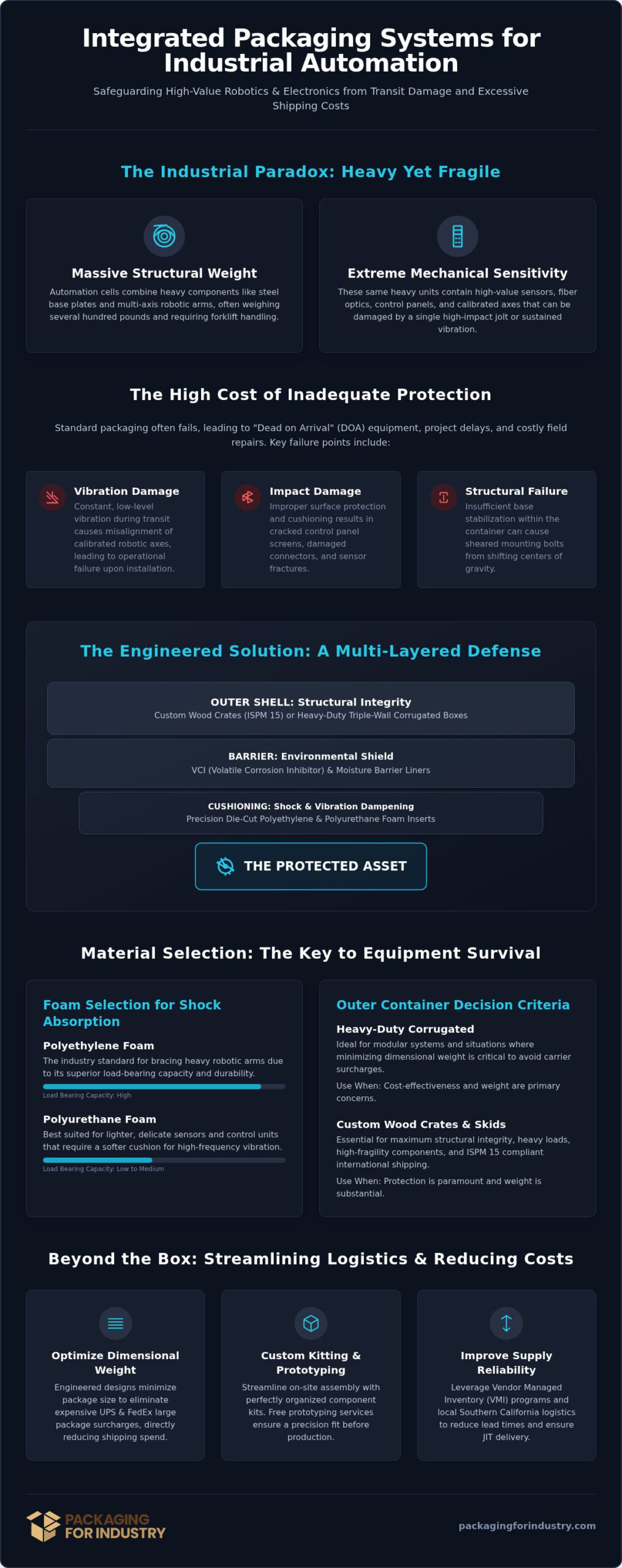
Automation cells present a unique logistical challenge because they combine massive structural weight with extreme mechanical sensitivity. A typical unit might feature a heavy steel base plate weighing several hundred pounds, while the robotic arm attached to it contains high-value sensors and fiber optic cables that can fail after a single high-impact jolt. Standard off-the-shelf catalog boxes simply cannot account for these shifting centers of gravity or the specific fragility of electronic components. Effective packaging solutions for industrial automation cells require a move toward custom design packaging that treats the equipment as a single, integrated system rather than a collection of parts.
The Risk of High-Value Transit Damage
Standard shipping methods often fail because they rely on generic cushioning that doesn’t account for the specific resonant frequencies of robotic components. When equipment arrives “Dead on Arrival” (DOA), the damage extends far beyond the repair bill. It disrupts entire production timelines and delays the project’s return on investment (ROI). Common failure points in automation logistics include misalignment of calibrated robotic axes due to constant vibration, cracked control panel screens from improper surface protection, and sheared mounting bolts caused by insufficient base stabilization. These issues often stem from using inadequate materials that can’t withstand the rigors of long-haul transit.
Weight vs. Fragility: The Industrial Paradox
Packaging for the manufacturing sector often faces an “industrial paradox” where the heaviest components are also the most fragile. You’ve got to manage heavy-duty skids designed for forklifts while simultaneously protecting sensitive electronics from electrostatic discharge (ESD). Finding this balance means pairing a rigid outer shell with precision-engineered internal dampening to prevent internal components from rattling. Relying on packaging solutions for industrial automation cells that utilize high-density foam and reinforced corrugated walls is essential for maintaining equipment integrity. For 2026 logistics, an integrated protection system is defined as a multi-layered assembly that combines structural load-bearing supports with specialized foam inserts to isolate delicate internal circuitry from external kinetic energy. This approach ensures that even the most cumbersome automation cells arrive ready for immediate installation without the need for costly field repairs.
Engineered Materials for Robotic and Electronic Protection
Protecting an automation cell requires a multi-layered material strategy that addresses both environmental and kinetic threats. While the structural exterior provides the first line of defense, internal engineering determines the equipment’s survival during long-haul transit. Integrating moisture barriers and VCI (Volatile Corrosion Inhibitor) materials is a vital step to prevent oxidation on precision-machined surfaces, especially for ocean freight or high-humidity storage. These specialized packaging solutions for industrial automation cells ensure that environmental factors don’t compromise your hardware before it reaches the assembly floor. By layering these barriers with structural supports, we create a secure environment that maintains the integrity of high-value components.
Custom Foam Inserts and End Caps
Selecting the right foam density is critical for effective shock absorption during the shipping cycle. Polyethylene foam is the industry standard for bracing heavy robotic arms because its closed-cell structure offers superior load-bearing capacity and durability. Conversely, polyurethane foam is better suited for lighter, more delicate sensors that require a softer cushion to absorb high-frequency vibrations. We utilize precision die-cut custom foam packaging to create end caps and inserts that lock components into place. This prevents lateral movement and ensures your packaging solutions for industrial automation cells are tailored to the exact center of gravity of your hardware. Using the wrong foam density can lead to “bottoming out,” where the cushion transfers the full force of an impact directly to the robotic axes.
ESD and Mil-Spec Protection for Control Units
The control units and PLCs within an automation cell are highly susceptible to electrostatic discharge (ESD). To comply with the ANSI/ESD S541-2026 standard, we integrate static shielding bags and moisture barrier protection into the primary packaging layer. For projects involving defense contracts or high-reliability sectors, we also provide mil-spec packaging solutions that meet rigorous military and aerospace standards for durability and environmental resistance. Anti-static foam assemblies are essential for securing circuit boards, as they prevent the friction of transit from generating a static charge that could fry sensitive electronics. If you need to evaluate material performance for a specific project, you can request a packaging quote to see how these engineered solutions fit your budget and protection requirements. Avoiding a single component failure through proper material selection is the most effective way to protect your project’s timeline and budget.
Custom Crates vs. Heavy-Duty Corrugated for Automation
Choosing the right exterior for packaging solutions for industrial automation cells is a financial decision as much as an engineering one. While standard pallets might suffice for generic industrial gear, they often fail to stabilize top-heavy robotic components. The choice between triple-wall corrugated and custom wood crates usually depends on the equipment’s weight, its center of gravity, and the total distance it needs to travel. For domestic shipments of lighter sub-assemblies, heavy-duty corrugated offers a significant advantage by reducing the overall tare weight. This helps manufacturers navigate the 2026 general rate increases while providing high-level puncture resistance.
Dimensional weight (DIM weight) plays a massive role in modern freight costs for large automation cells. Carriers like UPS and FedEx have set specific thresholds for 2026, where packages exceeding 130 inches in combined length and girth incur heavy surcharges. We offer custom sizes available for all containers to ensure you stay within these dimensional limits. To further protect these loads, we integrate corner boards and edge protection to prevent strapping from damaging the corrugated walls during high-tension palletization. We evaluate the cost-benefit of reusable versus one-way packaging for every project. While a custom wood crate has a higher upfront cost, its ability to be reused for recurring maintenance cycles can lower packaging costs in the long run.
Designing Heavy-Duty Skids and Crates
Large automation cells often feature heavy steel frames that standard pallets cannot safely support. We specialize in Engineering Custom Crates that include reinforced bases and integrated foam-lined interiors. These crates are essential for international transit, where ISPM 15 compliance is mandatory to avoid customs delays. Effective January 1, 2026, the IPPC mark must include a hyphen, and there is a zero-tolerance policy for visible bark. By using custom-engineered skids, we ensure the robotic base is bolted directly to the frame, preventing any shifting that could lead to axial misalignment or structural damage during rough handling.
Optimizing Corrugated for Smaller Components
Not every part of an automation line requires a wood crate. Auxiliary parts like wiring harnesses, mounting brackets, and smaller sensors are often better suited for RSC boxes and industrial corrugated boxes. Using double-wall or triple-wall boxes provides the stacking strength needed for warehouse environments without the bulk of timber. We design custom partitions and dividers for these boxes to keep wiring harnesses organized and prevent delicate connectors from rubbing against one another. This hybrid approach—using crates for the core cell and corrugated for the peripherals—optimizes your shipping budget while maintaining total system protection.
Streamlining Logistics with Kitting and Prototyping
Operational efficiency in the automation sector depends on how quickly a system moves from the delivery truck to the production line. Advanced packaging solutions for industrial automation cells must bridge the gap between logistics and final assembly. We utilize CAD/CAM support to ensure every custom foam insert and triple-wall corrugated partition fits the hardware with surgical precision. This engineering-first approach eliminates the guesswork often found with catalog-bought supplies. By implementing a Just-In-Time (JIT) supply model, we help manufacturers in Southern California hubs like Irvine and Anaheim reduce their warehouse footprint. You can focus your floor space on production rather than storing empty crates and bulk foam sheets.
Packaging Kitting for Efficient Deployment
Unboxing a multi-component automation cell is often a slow, disorganized process if the parts aren’t sequenced correctly. Our packaging kitting services address this by grouping components to match the technician’s assembly workflow. Instead of digging through multiple RSC boxes for specific sensors, wiring harnesses, or mounting brackets, the assembly team finds everything they need in a single, organized kit. This organized delivery method eliminates the need for redundant individual wraps, which significantly reduces the volume of waste at the installation site. It’s a direct way to improve operational flow while helping you lower packaging costs through reduced material usage and labor hours.
The Value of Prototyping and Testing
Protecting multi-million dollar cells requires more than just heavy-duty materials; it requires proof of performance. We provide free prototyping to ensure every material choice and structural design is verified before your full production rollout. During these packaging reviews, our engineers identify potential cost-reduction areas, such as refining the dimensions of custom wood crates to avoid the 2026 FedEx and UPS Large Package Surcharges. Our integrated CAD support prevents design errors by allowing us to simulate the fit and clearance of robotic arms within their foam assemblies before any material is cut. This proactive problem-solving ensures that your packaging solutions for industrial automation cells are both fiscally responsible and technically sound. Testing these prototypes under simulated transit conditions gives you the peace of mind that your sensitive electronics will arrive without a scratch.
Choosing a Local Southern California Packaging Partner
When you’re ready to compare packaging pricing against large national catalog suppliers, the value of a local partner becomes clear through reduced freight costs and immediate response times. Our headquarters in Anaheim serves as a strategic hub for the Southern California manufacturing corridor, providing direct access to industrial packaging consultants who specialize in packaging solutions for industrial automation cells. This proximity allows for on-site consultations and rapid CAD/CAM design iterations that national competitors simply can’t match. We act as a resourceful “fixer” for your logistics team, focusing on tangible outcomes like reduced lead times and optimized shipping footprints for high-value robotic components.
Local Service in Orange County and Los Angeles
We provide dedicated support to the aerospace and tech hubs in Irvine, Torrance, and Santa Fe Springs. Our local fleet offers next-day delivery on both stock items and recurring custom orders, which is vital for maintaining production line continuity. For companies operating in the Anaheim service area and surrounding cities, this responsiveness becomes a major cost-saving tool. You don’t have to over-order supplies “just in case” when you know a reliable delivery is only hours away. This agility is especially important when dealing with the sensitive electronics and fiber optics found in modern automation cells. We understand the specific needs of the local industrial landscape and provide the steady, dependable partnership required for complex deployments.
VMI and Stocking Programs for Manufacturers
Managing inventory for complex packaging solutions for industrial automation cells can be a logistical burden for busy operations managers. Our Vendor Managed Inventory (VMI) programs solve this by allowing us to monitor and replenish your stock levels automatically. This prevents stockouts of critical triple-wall boxes and precision-cut ESD foam, ensuring you’re always ready to ship. By moving the inventory burden to our facility, you improve your cash flow and reclaim valuable square footage on your production floor. It’s a pragmatic approach to supply chain reliability that focuses on total accountability from the design phase to final delivery. This end-to-end oversight ensures that your packaging system remains as efficient as the automation cells it protects.
Optimizing Your Automation Logistics for 2026
Engineering a reliable supply chain for high-value robotics requires moving beyond generic shipping supplies. By integrating precision foam dampening with structural outer shells, you ensure that sensitive sensors and control units remain calibrated during transit. This proactive approach doesn’t just prevent damage; it protects your project’s ROI by eliminating costly carrier surcharges and lead-time delays. Implementing engineered packaging solutions for industrial automation cells allows you to leverage local next-day delivery in Southern California and free prototyping to verify every design before rollout.
With dedicated CAD design support and specialized aerospace expertise, your most complex components are in safe hands. We focus on the intersection of engineering and economics to help you lower packaging costs while improving overall supply reliability. Our team acts as a dependable partner to resolve your most difficult logistical challenges with pragmatic, custom-tailored responses. We’re committed to ensuring your hardware arrives on time and in perfect working order.
It’s time to streamline your operations and gain the peace of mind that comes with a professional logistical partner. We’re ready to help you optimize your shipping flow and secure your high-value assets today.
Frequently Asked Questions
What are the best packaging materials for sensitive robotic arms?
High-density polyethylene foam is the most effective material for bracing the heavy structural components of a robotic arm. It provides the necessary load-bearing capacity to prevent shifting during transit. For more delicate sensors and internal wiring, we use softer polyurethane foam to absorb high-frequency vibrations. Combining these with triple-wall corrugated boxes or custom wood crates creates a comprehensive protection system that keeps your precision equipment calibrated and secure.
How can I reduce shipping damage for industrial automation equipment?
Reducing damage starts with a custom-engineered approach that addresses the specific center of gravity of your equipment. We utilize vibration-dampening foam and secure mounting skids to isolate sensitive electronics from kinetic energy. Effective packaging solutions for industrial automation cells also involve moisture barriers and VCI materials to prevent oxidation on machined surfaces. Regular packaging reviews and testing prototypes help identify and eliminate potential failure points before they lead to project delays.
Do I need custom foam or a custom crate for my automation cell?
The choice depends on the total weight and fragility of your automation equipment. Large, heavy robotic bases typically require custom wood crates with integrated skids for forklift handling and structural stability. Smaller sub-assemblies or auxiliary parts are often better suited for heavy-duty double-wall or triple-wall corrugated boxes paired with custom foam inserts. We evaluate each component’s requirements to recommend the most cost-effective solution that doesn’t compromise on safety or durability.
What is the benefit of packaging kitting for industrial deployments?
Packaging kitting streamlines the deployment process by organizing all necessary components into a single, sequenced package. This approach allows technicians to unbox parts in the exact order they’re needed for assembly, which significantly reduces downtime at the installation site. It also lowers packaging costs by eliminating redundant individual wraps and reducing the volume of waste materials. Kitting ensures that no critical connectors or brackets are lost during the unboxing of complex automation systems.
How does ESD foam protect automation control panels during transit?
ESD foam prevents the buildup of static electricity that occurs when materials rub together during transit. This is critical for protecting the circuit boards and PLCs inside automation control panels from permanent damage. By using anti-static foam assemblies, we ensure that electrostatic discharge is dissipated safely away from sensitive electronics. This protection is a standard requirement for meeting industrial shipping regulations and maintaining the long-term reliability of your automation hardware.
Can custom packaging help lower my UPS or FedEx freight surcharges?
Yes, custom packaging is a primary tool for avoiding the significant Large Package Surcharges introduced by carriers like UPS and FedEx for 2026. We use CAD design to optimize the dimensional weight of your containers, ensuring they stay beneath the thresholds for girth and length surcharges. By engineering a tighter fit around your equipment, we reduce the footprint of your shipment. This strategic optimization helps you manage freight costs by utilizing packaging solutions for industrial automation cells that prioritize efficiency.
Does PFI offer free prototyping for custom automation packaging?
We provide free prototyping and CAD design support for all custom automation projects to ensure a perfect material fit. This allows your team to verify the performance of foam inserts and crate structures before moving into full production. Prototyping helps us identify potential design errors and cost-reduction opportunities early in the process. It’s a critical step for protecting multi-million dollar automation cells and ensuring that every component is secured according to its specific fragility and weight.
What local delivery options are available for manufacturers in Southern California?
We offer local next-day delivery throughout Southern California, including Orange County, Los Angeles, and the Inland Empire. Our private fleet ensures that your packaging supplies arrive exactly when needed to keep your production lines moving. Manufacturers can also take advantage of our Vendor Managed Inventory (VMI) programs, where we monitor and replenish your stock levels automatically. This local proximity reduces lead times and provides direct access to our industrial packaging consultants for immediate support.