
Shipping a multi-million dollar turbine or generator isn’t just a logistics task; it’s a high-stakes engineering challenge where a single structural failure can lead to catastrophic financial loss. You likely already understand that standard wood boxes aren’t enough to handle the immense weight and sensitivity of energy assets. This is why specialized custom crates for power generation equipment shipping are essential for any manufacturer looking to avoid the added complexity of international ISPM 15 regulations and the latest 2026 DOE supply chain requirements. It’s a stressful process where even a minor oversight in crate engineering can result in months of project delays and blown budgets.
We’re here to help you secure your mission-critical energy assets with engineered solutions designed to eliminate transit damage and ensure operational uptime. By focusing on right-sized packaging and integrated foam protection, you can lower packaging costs while keeping your shipments compliant and on schedule. This article examines how precision-built industrial crating improves reliability for manufacturers and distribution centers. From local next-day delivery in Southern California to nationwide shipping, you’ll learn how to optimize your logistics and get a competitive custom packaging quote for your heaviest equipment.
Key Takeaways
- Learn why standard crates fail and how precision engineering prevents the hidden financial loss caused by internal vibration during transit.
- Discover how to specify custom crates for power generation equipment shipping by using CAD/CAM design to accurately calculate the center of gravity for asymmetrical loads.
- Identify the best protective materials, including vapor barriers and custom foam inserts, to safeguard sensitive electronics and turbines from moisture and shock.
- Ensure global compliance by using ISPM 15 heat-treated wood and proper marking to avoid delays at international ports of entry.
- Lower your logistics costs with local next-day delivery services throughout Southern California, including Los Angeles, Orange County, and the Inland Empire.
Why Standard Shipping Crates Fail Power Generation Equipment
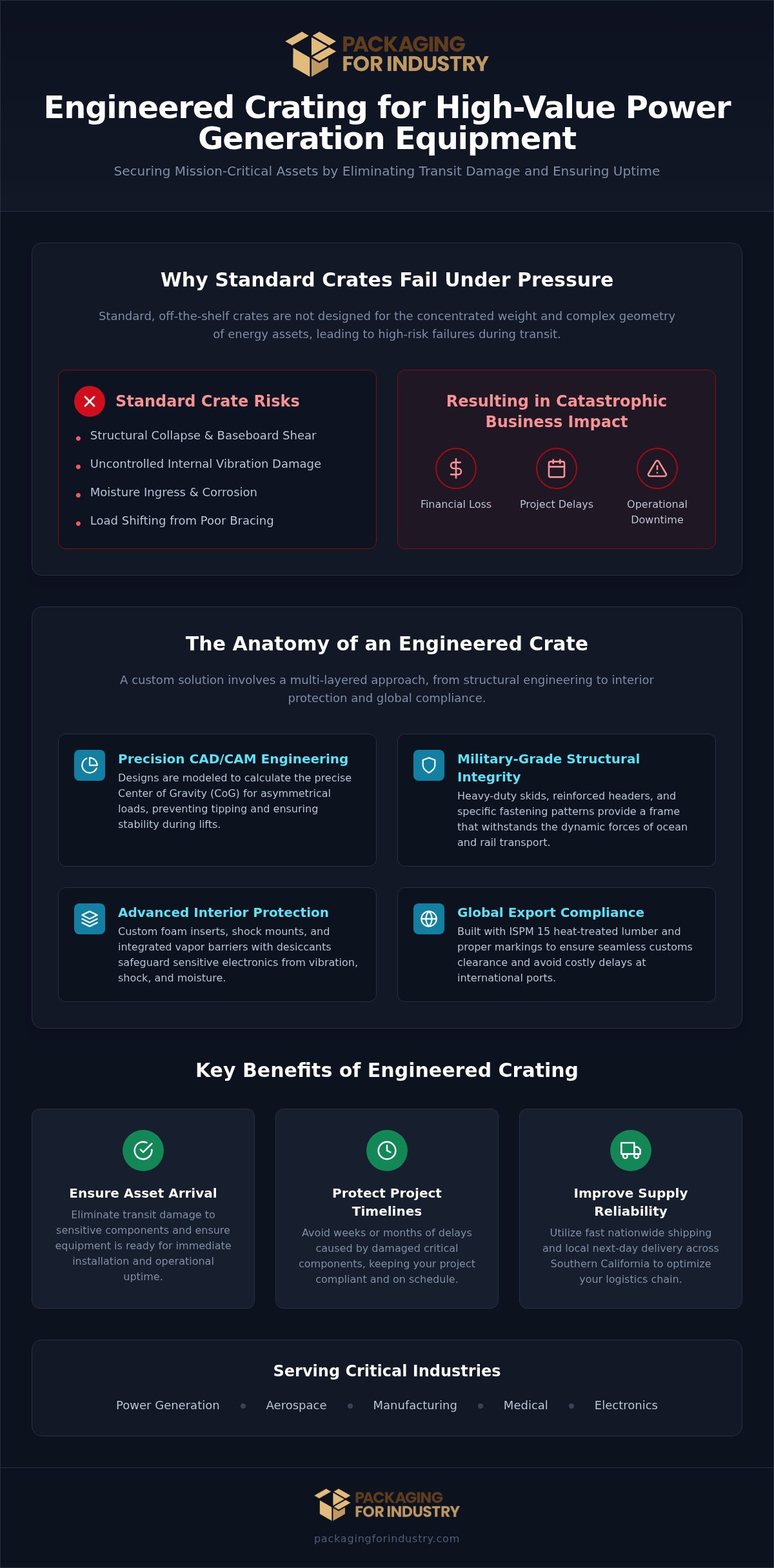
Shipping a 20,000-pound generator requires more than just a sturdy box. Standard crates fail because they’re designed for uniform, lighter loads, not the concentrated, asymmetrical weight of energy infrastructure. When using custom crates for power generation equipment shipping, the engineering must account for the specific center of gravity. Off-the-shelf options often suffer from baseboard shear or frame collapse when subjected to the dynamic forces of ocean or rail transport. These failures aren’t just inconvenient; they’re often catastrophic for the equipment inside.
Most standard designs prioritize speed of assembly over long-term structural integrity. However, foundational knowledge of wooden crate construction shows that heavy payloads require reinforced skids and specific fastening patterns to prevent the bottom from dropping out during a crane lift. Without these custom reinforcements, the risk of physical damage increases exponentially during every stage of the logistics chain. We’ve seen many instances where a lack of proper blocking and bracing allowed a 10,000 lb component to shift, compromising the entire shipment.
The High Cost of Energy Infrastructure Downtime
For EPC contractors and utility managers, the crate is a small part of the budget but a massive part of the risk profile. If a transformer arrives with internal damage, the cost isn’t just the repair; it’s the daily revenue loss of an idle power plant. A “just enough” procurement strategy often backfires when a project timeline slips by weeks or months due to a damaged critical component. Choosing high-quality wooden crates designed specifically for industrial loads is a form of insurance against these operational delays. Reliable packaging ensures that your assets are ready for immediate installation upon arrival.
Vulnerability of Power Gen Assets
Power generation assets are surprisingly fragile despite their immense size. Rotor blades and internal windings are susceptible to micro-vibrations that can’t be seen from the outside. This hidden damage often isn’t discovered until the equipment is powered on, leading to immediate failure and expensive warranty claims. Additionally, standard crates don’t provide adequate protection against moisture ingress. Salt air and high humidity lead to corrosion on electrical contacts. Effective custom crates for power generation equipment shipping integrate environmental controls, such as vapor barriers and desiccant systems, directly into the structural design to ensure the asset arrives in peak operational condition.
Engineering Custom Crates for Heavy Payloads and Complex Geometry
The physics of transporting a 30,000-pound turbine requires more than basic carpentry. It demands a rigorous engineering approach that begins long before the first piece of lumber is cut. When designing custom crates for power generation equipment shipping, our team utilizes CAD/CAM software to model the equipment and identify its precise center of gravity (CoG). This is critical because energy assets are rarely symmetrical. If the CoG is miscalculated, the load could shift or tip during a crane lift, leading to catastrophic failure. We perform a detailed load-bearing analysis to ensure every crate meets stacking and lifting requirements for both sea and rail transit.
Our structural designs often align with the strict military standards for equipment packaging, which dictate how to preserve and protect heavy machinery under extreme conditions. By using heavy-duty lag bolts and reinforced headers, we create a frame that can withstand the dynamic forces of international logistics. This level of precision is why leading manufacturers trust us to handle their most sensitive energy infrastructure. If you are preparing a shipment, you can request a packaging quote to review a custom design tailored to your specific payload.
Load Distribution and Structural Integrity
Heavy-duty skids are the foundation of any industrial crate. We design these bases to distribute concentrated weight across the entire surface area to prevent baseboard shear. For sub-components, we often integrate heavy-duty double-wall and triple-wall corrugated reinforcements within the wooden structure. This hybrid approach optimizes weight without sacrificing protection. Strategic internal bracing then locks the equipment in place, ensuring it remains stationary during rough ocean or rail handling.
Prototyping and Performance Testing
We don’t believe in guesswork. Our process includes free prototyping to ensure a perfect fit for your equipment before full-scale production. By using SolidWorks and CAD data, we align every crate dimension with your equipment specifications down to the millimeter. This allows us to simulate transit stresses and identify potential failure points digitally. Because we provide local next-day delivery across Southern California, including Orange County and Los Angeles, we can get these prototypes to your facility quickly for immediate fit-testing. This rigorous phase ensures that your custom crates for power generation equipment shipping perform exactly as engineered.
Protective Interior Solutions: Foam, Vapor Barriers, and Shock Mounts
The external structure of a crate provides the necessary load-bearing capacity, but the interior protection determines whether your equipment arrives in operational condition. For high-value energy assets, we integrate custom foam packaging to mitigate the constant vibration and sudden shocks common in industrial transit. This interior engineering is what separates a standard box from effective custom crates for power generation equipment shipping. We don’t just cushion the gear; we engineer a multi-layered defense system that accounts for the specific fragility of turbines and transformers.
Material selection is the first step in this process. For heavy industrial gear, we typically utilize high-density polyethylene foam. It’s a closed-cell material that offers excellent compressive strength, making it ideal for blocking and bracing 10,000-pound components. In contrast, for lighter control panels or delicate internal sub-systems, we use polyurethane foam. This softer, open-cell material excels at absorbing the high-frequency vibrations that can loosen electrical windings or damage sensitive sensors. For the most critical electronics, we often install shock-mount bases that decouple the equipment from the crate’s floor entirely.
Environmental Shielding for International Transit
Ocean freight presents unique challenges, specifically “container rain” and saltwater corrosion. When shipping across different climate zones, humidity trapped inside a crate can condense and cause rapid oxidation on critical electrical contacts. To prevent this, we utilize heat-sealed vapor barrier bags combined with calculated desiccant placement to create a controlled internal micro-climate. Before sealing the barrier, we often use heavy-duty stretch film to bundle auxiliary parts or secure loose wiring, providing an extra layer of stabilization. This is especially vital when navigating the Export Administration Regulations (EAR) for sensitive power generation technology. We also apply corner and edge protection to prevent the equipment from abrading the vapor barrier during transit movement.
Custom Foam Inserts for Sensitive Sub-Systems
Power plant control systems require specialized handling that goes beyond basic cushioning. We design die-cut foam end caps that lock electrical components into place, preventing any internal shifting. When these systems include sensitive circuit boards, we use anti-static (ESD) foam to prevent electrostatic discharge during handling. By combining these advanced foam materials with our structural wood designs, we create a hybrid protective environment that works to reduce shipping damage. This comprehensive approach ensures that every sub-system, no matter how small or sensitive, receives the same level of protection as the primary turbine. Our goal is to lower packaging costs by eliminating the need for secondary repairs or onsite calibration after delivery.
Navigating Export Compliance and Logistics for Energy Infrastructure
Navigating the logistics of global energy infrastructure projects requires a deep understanding of international phytosanitary standards. If you are using custom crates for power generation equipment shipping, every piece of solid wood must comply with ISPM 15 regulations. This means the lumber must be heat treated to a core temperature of 56°C for at least 30 minutes to prevent the spread of invasive pests. At PFI, we ensure every export crate is debarked and carries the official IPPC stamp on at least two opposite sides. Failing to meet these standards can result in your shipment being quarantined, destroyed, or sent back at your expense, causing catastrophic project delays.
Beyond wood treatment, logistics coordination involves designing crates that fit within standard 20 foot or 40 foot ocean containers. We analyze your equipment’s dimensions to maximize container cube utilization, which directly reduces freight spend. Our proactive design phase ensures that your generators and turbines don’t just survive the trip but also pass through customs without friction. By right-sizing the exterior dimensions, we help manufacturers avoid the common pitfalls of oversized load permits and the associated costs that can arise when crates aren’t engineered for standard logistics lanes.
International Trade Compliance
The risks of using non-HT wood in the energy sector are too high to ignore. Many countries now enforce strict zero tolerance policies for non-compliant packaging. Our team certifies every crate for IPPC standards, providing the necessary documentation to streamline the customs clearance process. We stay current on destination specific regulations, ensuring that your custom crates for power generation equipment shipping meet the legal requirements of any port, from Rotterdam to Singapore. This expertise eliminates the professional stress of potential regulatory fines or impounded assets during critical infrastructure rollouts.
Optimizing for Freight Costs
Shipping heavy machinery is expensive, but your crate design shouldn’t make it worse. We focus on minimizing dimensional weight (DIM) surcharges by right-sizing the crate to the equipment’s geometry. For recurring projects, we offer nestable or collapsible designs that allow you to return and reuse crates, significantly lowering your total cost of ownership. These strategies contribute to long term packaging cost savings and improved supply chain reliability. By integrating structural engineering with logistical flow, we help you maintain your bottom line while ensuring zero damage delivery.
Request a Quote for Custom Power Generation Crating in Southern California
Procurement for energy assets requires a local partner who understands the urgency of the power grid. As an experienced Anaheim packaging supplier, PFI provides the engineering expertise and logistical speed needed for critical infrastructure. If you are searching for a packaging supplier near me that offers custom boxes in Anaheim and specialized wood crating, we are positioned to support your operations. You can request a packaging quote today to begin designing custom crates for power generation equipment shipping that meet your exact specifications.
We don’t just sell crates; we provide a comprehensive system of protection. For companies with recurring shipping needs, our Vendor Managed Inventory (VMI) program ensures you never run out of critical crating components. We manage the inventory levels of your crates, pallets, and foam inserts so your team can focus on production. This system ensures that every component is available exactly when it’s needed, reducing the space required for storage in your facility. It’s a proactive way to lower packaging costs while maintaining a steady flow of compliant shipping materials.
Southern California Proximity and Support
Our team provides on-site crating services and local packaging delivery throughout Irvine, Huntington Beach, and Santa Fe Springs. Being near your facility means we can perform fit-tests and prototyping without the delays associated with national catalog suppliers. With custom sizes available for even the most awkward turbine components, we eliminate the risk of poor fit. While our roots are in Southern California, we also provide fast nationwide shipping to support distributed energy projects across the country.
Cost-Reduction and Supply Reliability
Large catalog suppliers often provide generic solutions that lead to higher shipping damage and wasted space. When you compare packaging pricing for custom wood crates, you’ll find that precision engineering actually lowers your total cost of ownership. We can provide a comprehensive corrugated box quote or a high-volume stretch film quote alongside your crating needs to consolidate your procurement. This allows you to secure bulk packaging pricing for all packaging for manufacturers/warehouses/distribution centers. If you’re tired of dealing with damaged turbines or customs delays, it’s time to partner with a “fixer” who understands the high stakes of energy logistics. Contact us today to secure your most complex custom crates for power generation equipment shipping and improve your supply reliability.
Secure Your Energy Infrastructure Logistics Today
Protecting high-value energy assets requires more than just a wooden box; it demands integrated engineering and environmental controls. By utilizing advanced CAD modeling and custom foam inserts, you can eliminate the risk of micro-vibration damage and moisture ingress that often leads to costly downtime. Ensuring your custom crates for power generation equipment shipping meet ISPM 15 standards is non-negotiable for international projects. PFI provides the structural reliability and regulatory expertise needed to navigate complex global supply chains.
With free prototyping and local next-day delivery across Southern California, we help you lower packaging costs without sacrificing the safety of your turbines or generators. Whether you’re shipping from Anaheim, Irvine, or Santa Fe Springs, our regional proximity ensures your lead times remain short and your project schedules stay on track. It’s a proactive way to maintain your bottom line while ensuring zero-damage delivery for every asset. Our team is ready to serve as your dependable partner in industrial logistics.
Let’s work together to ensure your critical equipment reaches its destination in peak operational condition. We look forward to helping you optimize your industrial packaging and improve your supply reliability.
Frequently Asked Questions
What is ISPM 15 and why does my power generation crate need it?
ISPM 15 is the International Standards for Phytosanitary Measures No. 15, which requires all solid wood packaging used for international trade to be heat treated. Your power generation crate needs this certification to pass through customs without being quarantined or destroyed. We ensure every export crate carries the official IPPC mark, confirming it was heated to 56°C for 30 minutes. This compliance is essential for shipping turbines and generators to global markets.
How do you determine the weight capacity of a custom wooden crate?
We determine weight capacity through structural load-bearing analysis and the selection of specific wood species and skid thicknesses. By using CAD/CAM software, our engineers calculate the distribution of concentrated weight for asymmetrical energy assets. We design the base skids and headers to handle payloads exceeding 30,000 pounds when required. This engineering process ensures that custom crates for power generation equipment shipping maintain their integrity during crane lifts and heavy-haul transit.
Can custom crates be designed for reuse in turbine maintenance cycles?
Yes, we can engineer custom crates for multiple reuse cycles during turbine maintenance and repair programs. By utilizing heavy-duty lag bolts and reinforced internal bracing, these crates are designed to be opened and resealed without compromising structural stability. This approach lowers your total cost of ownership over the asset’s lifecycle. It’s an efficient solution for manufacturers who need to transport components back and forth between power plants and service centers.
What is the lead time for a custom-engineered heavy-duty crate?
Lead times for custom-engineered crates depend on project complexity, but we offer free prototyping to accelerate the design phase. For recurring industrial parts, our Vendor Managed Inventory (VMI) programs can reduce lead times to zero by stocking completed crates at our facility. If you need a single custom build, we prioritize fast Southern California delivery to keep your production moving. We recommend starting the design process early to ensure all specifications are met.
Do you provide on-site crating services for large generators in Southern California?
We provide dedicated on-site crating support throughout Southern California, including Anaheim, Irvine, Huntington Beach, and Santa Fe Springs. Our team can travel to your facility to secure large generators that are too heavy or sensitive to move before they are fully protected. This local service ensures that your equipment is crated correctly from the start, reducing the risk of shipping damage during the initial move from your warehouse to the port.
How does vapor barrier packaging protect electrical equipment during sea transit?
Vapor barrier packaging creates a hermetically sealed micro-climate that prevents saltwater corrosion and “container rain” during ocean freight. We use heat-sealed foil bags and calculated desiccant loads to absorb any internal moisture. This protection is critical for sensitive electrical windings and control panels that are susceptible to oxidation. It ensures that your power generation equipment arrives in peak operational condition regardless of the humidity levels encountered during transit across global climate zones.
Can you integrate custom foam inserts into a wood crate design?
We specialize in integrating custom crates for power generation equipment shipping with specialized foam inserts for a total protection solution. Our designers use polyethylene or polyurethane foam to create die-cut end caps and internal cradles that absorb high-frequency vibrations. By combining the structural strength of wood with the shock absorption of foam, we provide a hybrid environment that protects both the heavy outer casing and the delicate internal electronics of your machinery.
How do I lower my shipping costs for heavy industrial equipment?
You can lower your shipping costs by optimizing crate dimensions to reduce dimensional weight (DIM) surcharges and using right-sized packaging. We help manufacturers identify and eliminate wasted space within their crates, which lowers freight spend and material costs. Additionally, implementing a stocking program or VMI can reduce the overhead associated with emergency orders. By engineering crates for standard container sizes, you avoid the high fees associated with oversized or non-standard loads.