
A packaging prototype that looks good on your desk but fails in a FedEx hub isn’t a design; it’s a liability. For manufacturers and distribution centers, the transition from a sample to a bulk order often reveals hidden flaws like unreliable lead times or unexpected dimensional weight surcharges. We understand that you’re looking for more than a container. You need a system that ensures zero transit damage while keeping your unit costs predictable. Establishing strict packaging prototype evaluation criteria is the only way to move from guesswork to a high-performance supply chain.
Whether you’re vetting heavy-duty corrugated boxes or precision foam inserts for aerospace components, your evaluation must balance protection with logistical flow. This article provides a technical roadmap to help you lower packaging costs and reduce shipping damage. We’ll examine how to audit structural integrity, verify fit for custom sizes, and ensure your supplier can meet the demands of local packaging delivery and bulk production. By the end of this checklist, you’ll have the benchmarks needed to evaluate packaging for manufacturers, compare packaging pricing, and request a packaging quote with total confidence in the final outcome.
Key Takeaways
- Understand why functional engineering samples are superior to off-the-shelf solutions for protecting industrial products and maintaining predictable unit costs.
- Apply a technical 10-point checklist to your packaging prototype evaluation criteria to ensure perfect dimensional accuracy and material integrity before starting production.
- Learn to evaluate freight economics during the design phase to minimize wasted space and proactively reduce shipping damage and dimensional weight surcharges.
- Leverage local Southern California expertise and free prototyping to vet custom foam inserts and heavy-duty boxes for aerospace or manufacturing applications.
The Role of Prototyping in Industrial Packaging Reliability
In industrial logistics, a packaging prototype isn’t a mere suggestion; it’s a functional engineering sample. Relying on “off-the-shelf” boxes for high-value machinery or sensitive electronics is a gamble that rarely pays off. Standard corrugated boxes often fail because they don’t account for the unique center of gravity or fragile points of industrial components. Skipping the prototype phase to save a few dollars upfront often leads to a spike in shipping damage rates, which quickly erodes the thin margins of bulk manufacturing orders. Effective custom design packaging starts with a physical sample that proves its worth under stress.
Prototyping vs. Production Samples
Precision is non-negotiable for sectors like aerospace and medical device manufacturing. An industrial packaging prototype allows engineering teams to verify CAD/CAM designs in the real world before committing to a full production run. This distinction is critical: a physical mock-up lets you test the exact fit of protective foam inserts and structural integrity. By establishing clear packaging prototype evaluation criteria at this stage, purchasing and operations teams can ensure that the final product meets every technical specification. It bridges the gap between a digital drawing and a reliable shipping solution that protects your bottom line.
Reducing Shipping Damage Through Iterative Design
Iterative design identifies weak points in the container before they become a liability in the field. Custom sizes available through prototyping eliminate “box-slop,” the primary cause of internal movement and subsequent damage. Testing impact resistance in a controlled environment ensures that your heavy-duty corrugated boxes can withstand the rigors of the global supply chain. The broader discipline of Packaging and labeling emphasizes that protection and transport efficiency are inseparable. A prototype allows you to adjust wall thickness or foam density to find the perfect balance between safety and weight.
Prototyping simplifies the purchasing process for manufacturing teams. It provides a tangible benchmark for quality control during bulk production. When you compare packaging pricing, you aren’t just looking at the cost of materials; you’re looking at the reliability of the entire system. A well-vetted prototype ensures that unit costs remain predictable and that your warehouse space is optimized for efficiency. This proactive approach helps lower packaging costs by preventing the expensive cycle of returns and replacements caused by inadequate protection.
Engineering Integrity: Material Selection Evaluation Criteria
Successful industrial protection depends on how different materials interact under stress. You shouldn’t evaluate a box in isolation when it relies on foam inserts and a pallet to function. This synergy is the foundation of professional packaging prototype evaluation criteria. If the foam is too rigid, it transfers shock directly to the product. If the corrugated wall is too thin, it buckles before the pallet can provide a stable base. Evaluating these materials as a single system is essential for any manufacturer looking to reduce shipping damage and ensure long-term reliability.
Custom Corrugated Boxes Benchmarks
When you vet a prototype, start with the board grade. A standard Regular Slotted Carton (RSC) might suffice for lightweight goods, but heavy industrial loads often require double or triple-wall construction. Flute selection is equally important. Larger flutes provide better vertical stacking strength, while smaller flutes offer superior puncture resistance. For international freight, check for weather-resistant adhesives that prevent delamination in high humidity. Using the ASTM D4169 standard during this phase helps you confirm that your shipping containers can withstand the specific hazards of your distribution cycle.
Protective Foam Packaging and Cushioning Criteria
The foam’s density and cell structure dictate its shock absorption capabilities. Polyethylene (PE) is ideal for heavy, sharp-edged industrial parts due to its durability and moisture resistance. In contrast, Polyurethane (PU) offers softer cushioning for delicate medical or electronic instruments. If you’re shipping sensitive components, your prototype must utilize anti-static ESD foam to prevent electrostatic discharge. Precision is key here. Die-cut inserts should have a friction fit that prevents movement without putting undue pressure on the product. High-quality foam inserts should feel integrated into the box, not like an afterthought.
Don’t overlook compliance. If your contract requires Mil-Spec or specific aerospace standards, the prototype must be verified against those exact material codes. This level of technical oversight is what separates a generic supplier from a dedicated industrial partner. It’s often more cost-effective to over-engineer a prototype slightly than to risk a single failed shipment of high-value parts. To see how these materials work for your specific application, you can request a packaging quote and receive a technical review of your current design. This step ensures your materials are optimized for both protection and budget before you commit to a bulk order.
Logistical Benchmarks: Evaluating Freight and Operational Costs
A prototype that provides total protection but occupies 30% more volume than necessary is an economic failure. In industrial shipping, dimensional weight (DIM) is often the hidden profit killer. Carriers like UPS and FedEx charge based on the space a package occupies rather than its actual weight. Integrated packaging prototype evaluation criteria must include a rigorous audit of freight economics to ensure your design doesn’t trigger avoidable surcharges. By optimizing the external dimensions of your corrugated boxes or custom crates during the design phase, you can maintain predictable unit costs even as carrier rates fluctuate.
Operational flow is another critical benchmark. Your team should evaluate how the prototype performs on the warehouse floor. If a custom foam insert is difficult to orient or takes too long to seat within the box, it will bottleneck your kitting and assembly lines. We recommend using ISTA Test Procedures to validate that your logistical benchmarks meet industry standards for vibration, compression, and shock. This technical validation ensures that your palletization strategy is sound, maximizing load stability and trailer cube utilization for every bulk shipment.
Lower Packaging Costs Through Dimensional Optimization
The “air-to-product” ratio in your prototype directly impacts your bottom line. A high ratio means you’re paying to ship air, which is an unnecessary expense for any manufacturer. Custom-engineered crates and boxes designed specifically for your product footprint can reduce your freight class and lead to significant packaging cost savings. When you vet a prototype, measure the internal clearance carefully. Even a half-inch reduction in each dimension can move a package into a lower DIM weight bracket, saving thousands of dollars over a large production run.
Vendor Managed Inventory (VMI) Readiness
Logistical success also depends on supply reliability. Your prototype should be evaluated for its “VMI readiness,” meaning the design is optimized for high-volume, recurring production. Our Vendor Managed Inventory services rely on standardized designs that we can manufacture and deliver just-in-time. For businesses in Orange County, Los Angeles, and the Inland Empire, this means your custom packaging is always available without cluttering your warehouse. A well-designed prototype ensures that your packaging supplier can maintain consistent lead times and offer local next-day delivery to support your manufacturing schedule.
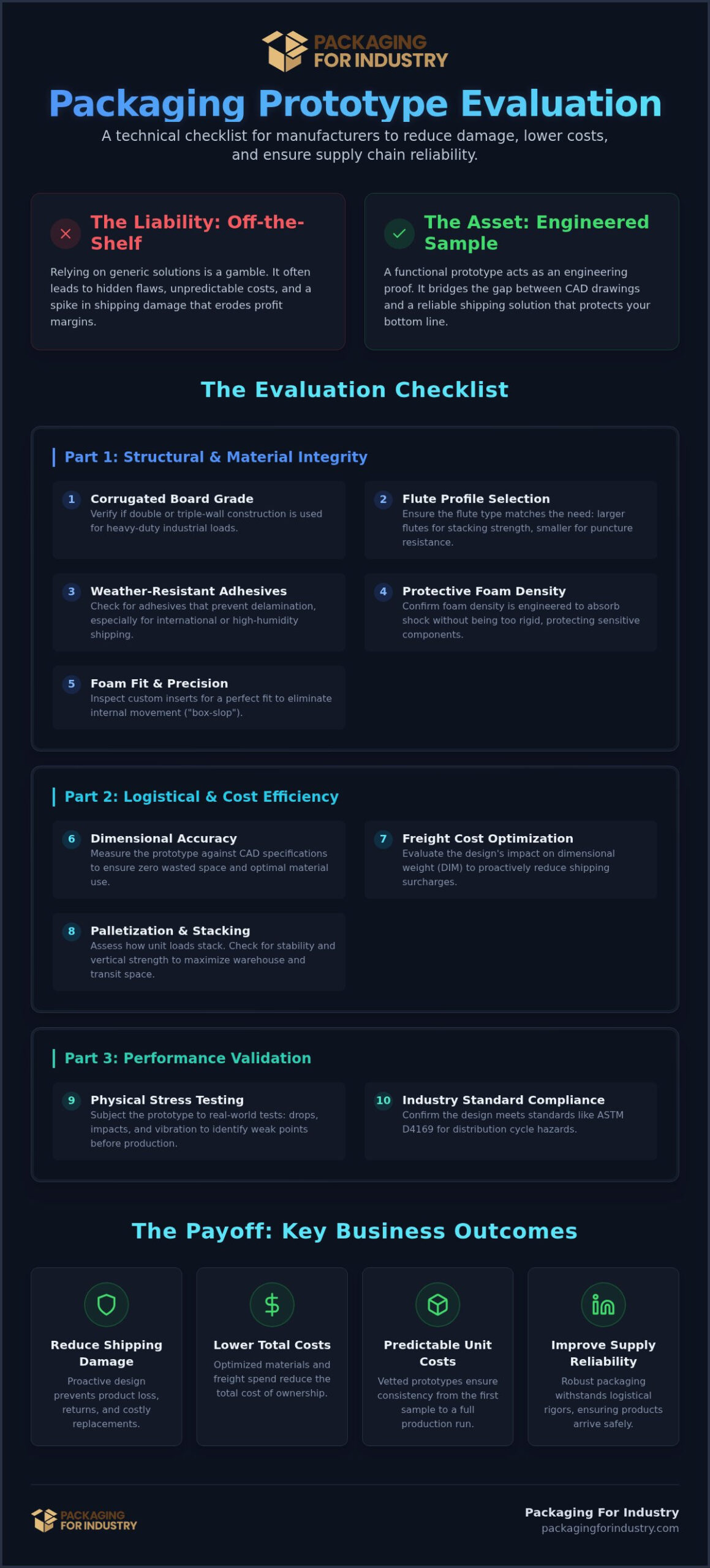
The 10-Point Packaging Prototype Evaluation Checklist
Transitioning from a custom design to a full production run requires more than just a visual inspection. You’ve got to stress-test every component. A definitive 10-point checklist ensures your packaging prototype evaluation criteria cover both the physical protection and the operational efficiency of the kit. This process identifies hidden liabilities before they become expensive mistakes on your balance sheet. Use these benchmarks to vet your next sample:
- Dimensional Accuracy: The product must fit securely with zero internal movement.
- Material Specification: Verify corrugated burst strength and foam density against engineering specs.
- Assembly Speed: A warehouse worker should assemble the kit in under 30 seconds.
- Closure Integrity: Ensure industrial adhesive tapes or staples hold under high tension.
- Environmental Resistance: Check for protection against moisture, dust, or ESD.
- Drop Test Performance: The prototype must survive impacts from various angles.
- Stacking Strength: The container must handle the weight of a full pallet.
- Edge Protection: Verify that corners won’t crush under strapping pressure.
- Lead Time Verification: Confirm the supplier can meet production deadlines.
- Bulk Pricing Stability: Ensure the unit cost remains predictable for large orders.
Physical and Functional Testing
The “Drop Test” remains the gold standard for industrial components. Your prototype must survive repeated impacts from various orientations without any transfer of force to the product. Stacking strength is another non-negotiable metric. The box has to support the weight of a full pallet without crushing the bottom layer. To improve vertical stability, we often integrate cardboard edge protectors into the design. This reinforcement prevents strap damage and allows for higher stacking in the warehouse, which helps you maximize vertical storage space and lower overall costs.
Supplier and Capability Verification
Vetting a prototype is also an audit of your supplier’s reliability. You need to confirm the exact lead time for bulk production once the design is finalized. Predictability is key for managing your inventory levels and meeting customer demands. Look for transparency in bulk packaging pricing and a commitment to unit cost stability. A reliable partner should scale from a single prototype to nationwide shipping without a drop in quality. We focus on providing local next-day delivery for our Southern California clients in Los Angeles and Orange County to keep their production lines moving without interruption.
Why Choose Packaging For Industry for Custom Engineering?
Selecting a supplier that understands the technical nuances of packaging prototype evaluation criteria is the difference between a successful product launch and a logistical nightmare. At Packaging For Industry (PFI), we don’t just sell boxes; we provide engineered protection systems. Our team offers free prototyping and design reviews specifically for industrial clients who can’t afford the risk of shipping damage. By integrating heavy-duty corrugated, custom protective foam, and wooden crates into a single design, we eliminate the need for multiple vendors and ensure every component fits perfectly.
Our expertise in aerospace, medical, and high-tech manufacturing allows us to address the specific cleanliness and precision requirements of these sectors. We understand that your operations team needs a “fixer” who can solve complex logistical challenges without adding unnecessary overhead. Whether you need military packaging that meets strict Mil-Spec standards or a custom stretch film solution for oddly shaped pallets, PFI delivers the technical oversight required for high-stakes shipping. We focus on creating a steady and dependable partnership that prioritizes your fiscal responsibility and operational peace of mind.
Southern California’s Industrial Packaging Partner
Speed is a critical factor when vetting a prototype. While large catalog suppliers might take weeks to send a custom sample, PFI leverages its local presence to provide rapid turnaround times. We serve manufacturers throughout Irvine, Santa Ana, and Huntington Beach with local next-day delivery across Orange County, Los Angeles, and Anaheim. This proximity allows supply chain managers in the Inland Empire and San Diego to receive local support and physical samples faster than nationwide competitors. We also offer fast nationwide shipping for bulk orders, ensuring that your production facilities across the country maintain a reliable supply of tubes and cores, pallets, and edge protectors.
Request a Packaging Quote Today
Starting your custom design and prototyping project is a straightforward process. When you compare packaging pricing, you’ll find that PFI offers a cost-saving alternative to generic catalog suppliers. We focus on lower packaging costs through dimensional optimization and to reduce shipping damage rather than just selling the cheapest material. Our bulk packaging pricing is transparent, with custom sizes available for any industrial application. We provide packaging for manufacturers, warehouses, and distribution centers that require a partner who values long-term reliability and local packaging delivery. Our goal is to improve your supply reliability and provide peace of mind through a well-engineered system.
Secure Your Supply Chain with Engineered Prototypes
Adopting a technical approach to your packaging prototype evaluation criteria is the most effective way to eliminate logistical waste and protect your bottom line. By vetting material integrity and optimizing dimensional weight during the design phase, you ensure that every bulk order arrives safely while avoiding carrier surcharges. A high-performance prototype isn’t just a sample; it’s a blueprint for operational efficiency and long-term reliability.
Packaging For Industry provides the technical expertise needed for high-stakes applications. We offer free CAD/CAM design and prototyping services to help you transition from concept to production without the guesswork. Our team specializes in aerospace and military-grade solutions, providing the precision required for sensitive components. For manufacturers in Orange County, Los Angeles, and the Inland Empire, we offer local next-day delivery to keep your production lines moving without interruption.
We’re ready to help you optimize your shipping process and lower your total costs. Let’s build a more reliable packaging system together.
Frequently Asked Questions
What is the standard lead time for a custom packaging prototype?
Lead times for custom prototypes vary depending on the complexity of the design, but we prioritize speed to keep your production moving. For standard corrugated or foam designs, we typically provide samples within a few business days. This rapid turnaround allows your engineering team to verify the packaging prototype evaluation criteria quickly before committing to a full production run. Fast prototyping is a core part of our service for Southern California manufacturers.
Do you provide free prototyping for industrial bulk orders?
Yes, Packaging For Industry provides free prototyping and samples for our industrial clients. We understand that vetting a design is essential for high-value manufacturing and aerospace applications. By offering free CAD/CAM support and physical mock-ups, we help you verify the fit and protection level before you place a bulk order. This ensures that the final product meets your operational needs without the risk of expensive design flaws or unreliable material performance.
How can a custom prototype help lower my packaging costs?
Custom prototypes lower costs by optimizing the “air-to-product” ratio and reducing dimensional weight. By engineering a box or crate that fits your product exactly, you avoid paying to ship empty space. Additionally, a well-designed prototype reduces shipping damage and returns, which are significant hidden costs. Improving assembly speed also lowers labor expenses in the warehouse, making your entire logistical process more efficient and predictable for bulk orders while helping you lower packaging costs significantly.
Which materials are best for protecting sensitive aerospace components?
Protecting sensitive aerospace components requires high-performance materials like polyethylene foam and anti-static ESD foam. These materials offer superior shock absorption and moisture resistance for delicate instruments. We often combine these with heavy-duty triple-wall corrugated boxes or custom wood crates to provide a complete protection system. Our expertise in aerospace packaging ensures that your components remain secure during transit while meeting the strict technical specifications and burst strength requirements of the aviation and defense industries.
Can a packaging prototype help me avoid UPS and FedEx surcharges?
Yes, a custom prototype is an essential tool for avoiding UPS and FedEx dimensional weight surcharges. Carriers charge based on the volume a package occupies, so even a small reduction in external dimensions can move your shipment into a lower pricing bracket. During the design phase, we analyze your prototype to eliminate wasted space and ensure the container is as compact as possible while still providing total protection for your high-value industrial products.
Do you offer local delivery for prototypes in Southern California?
We offer local next-day delivery for prototypes and production orders throughout Southern California. Our fleet serves businesses in Anaheim, Orange County, Los Angeles, and the Inland Empire daily. This local presence means you don’t have to wait for long-distance shipping to test a design. Whether you are located in Irvine, Santa Fe Springs, or San Diego, our proximity allows for faster iterations and more responsive support for your manufacturing, warehouse, and distribution teams.
What information do I need to provide for a custom packaging quote?
To provide an accurate custom packaging quote, we need your product’s dimensions, weight, and fragility level. It’s also helpful to know your expected order volume and typical shipping methods, such as small parcel or LTL freight. If you have CAD drawings or current packaging samples, our engineering team can use them to refine the design. This detailed information allows us to compare packaging pricing and offer the most cost-effective and reliable solution for your needs.
Can you design prototypes for Mil-Spec or military packaging requirements?
Yes, we specialize in designing and manufacturing prototypes that meet Mil-Spec and military packaging requirements. Our team understands the rigorous standards for durability, moisture protection, and long-term storage required for defense contracts. We can produce custom foam assemblies and heavy-duty crates that comply with specific military codes. This expertise ensures that your shipments pass inspection and arrive at their destination in perfect condition, regardless of the environmental hazards or handling stresses they encounter during transit.