
What if the “safe” box you’re currently using is the primary reason your freight costs continue to climb? Many manufacturers assume that standard corrugated sizes provide adequate protection, but inefficient sizing often leads to high freight surcharges and repeated product damage. To avoid these operational pitfalls, you need to know the specific questions to ask a custom packaging engineer before you commit to a long-term partnership. It isn’t just about the price per unit. It’s about whether the design protects your components while eliminating the “shipped air” that inflates your freight bill.
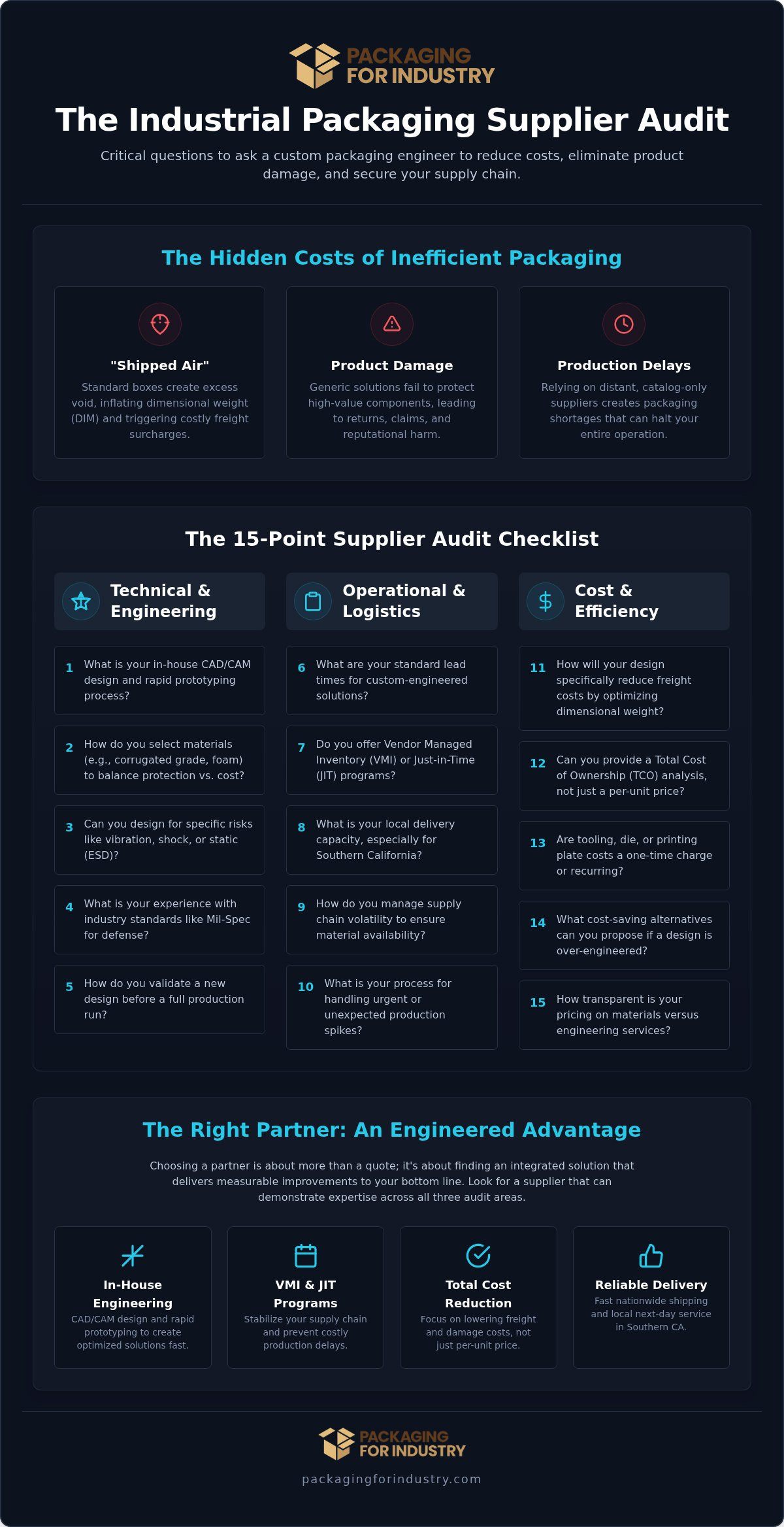
You’ve likely dealt with the frustration of production stops due to packaging shortages or the headache of filing damage claims for high-value industrial components. We understand that reliability is just as important as the engineering itself. This checklist provides a technical and operational audit to ensure your potential partners can deliver custom-engineered protection that reduces your total cost of ownership. We will cover fifteen critical questions ranging from CAD/CAM prototyping to local VMI programs in Southern California that keep your distribution centers running without interruption.
Key Takeaways
- Learn how to evaluate in-house CAD/CAM capabilities and rapid prototyping to ensure custom sizes eliminate product damage before you commit to a production run.
- Use our checklist of technical questions to ask a custom packaging engineer to verify if a supplier can actually lower packaging costs through better material selection.
- Understand how Vendor Managed Inventory (VMI) programs in Southern California can stabilize your supply chain and prevent production delays.
- Discover how to identify hidden freight surcharges and how engineering-led design can reduce shipping damage while optimizing dimensional weight.
- Audit your supplier’s transparency regarding tooling, plates, and local delivery logistics to ensure you aren’t overpaying for basic industrial components.
Why Evaluating Packaging Supplier Capabilities is Critical for Industrial Operations
Relying on a standard catalog for industrial components is a common mistake that leads to inflated operational costs. While off-the-shelf corrugated boxes might seem convenient, they rarely account for the specific protection needs of aerospace parts or medical devices. Choosing a partner based solely on the lowest unit price often ignores the total cost of ownership. Technical depth and engineering expertise are what actually lower packaging costs over time. Identifying the right questions to ask a custom packaging engineer allows you to move beyond transactional vendor relationships and toward a strategic partnership that prioritizes efficiency.
An engineer’s material choice directly impacts your bottom line. Using a double-wall RSC when a custom-engineered single-wall box with strategic edge protectors would suffice is a waste of capital. Conversely, under-packaging leads to repeated product damage and costly returns. A qualified engineer looks at the entire supply chain, from the assembly line to the final mile, ensuring that materials like protective foam and heavy-duty corrugated work together as a single, integrated system. This technical precision is what separates a simple box provider from a true industrial partner.
The Risks of Catalog-Only Suppliers
Catalog-only suppliers provide generic solutions that force you to use excessive void fill. This creates a two-fold financial drain: you pay for unnecessary materials and you pay higher freight rates. Carriers use dimensional weight (DIM) pricing, meaning a box that is larger than necessary triggers significant surcharges. Without in-house CAD/CAM support, a supplier cannot optimize the footprint of your packaging. Additionally, suppliers without a local presence in Southern California often struggle with lead-time volatility. If your warehouse in Anaheim or Irvine faces a production spike, a distant supplier’s shipping delays can halt your entire operation.
Defining Your Industrial Packaging Requirements
Before you request a packaging quote, you must define the technical demands of your product. High-value electronics and fragile industrial components often require custom foam inserts made from polyethylene or ESD-safe materials to prevent shipping damage. If you are working within the defense sector, you must verify if the supplier can meet Mil-Spec packaging standards. Establishing your recurring volume expectations is also vital. A supplier might handle a small prototype well but fail to scale when your distribution center requires bulk quantities on a Just-In-Time basis. Knowing the right questions to ask a custom packaging engineer ensures the supplier’s infrastructure matches your production scale and compliance needs.
Technical & Engineering Capabilities: A Design Audit Checklist
Industrial packaging is a precision science. It’s an engineered system designed to survive the rigors of transit and heavy warehouse handling. When you evaluate a supplier, you must look past their stock inventory and focus on their engineering depth. Identifying the right technical questions to ask a custom packaging engineer will reveal if a supplier can handle the complexity of your specific product. A true industrial partner doesn’t just sell boxes; they integrate multiple materials, combining heavy-duty triple-wall corrugated with custom foam and even wooden crates into a single, cohesive solution.
The most capable engineers utilize in-house CAD/CAM design and rapid prototyping to move your project from concept to production quickly. This is especially critical for sensitive electronics or aerospace parts where tolerances are tight. If a supplier lacks these tools, you’re often left with trial and error, which leads to delays and potential shipping damage. Before committing to a large order, you can request a custom packaging quote to see how an engineer approaches your specific protection requirements.
Custom Engineering and Prototyping Questions
The design phase is where your long-term costs are decided. You should ask: “Do you provide free prototyping to ensure fit before a full rollout?” This step is non-negotiable for custom sizes. You also need to know if they can perform a cost-reduction analysis on your current packaging. An engineer might find that switching from a standard RSC to a custom-designed die-cut box reduces your dimensional weight significantly. Utilizing professional custom design packaging services ensures that every square inch of material serves a purpose, eliminating the waste common in catalog-buying.
Specialized Industrial Compliance and Standards
Specialized industries like aerospace and defense have zero tolerance for material failure. You must ask questions regarding military packaging and Mil-Spec compliance to ensure your supplier understands the strict regulatory landscape. For semiconductor components, verify their expertise in ESD and anti-static foam standards. Aerospace-grade protection often requires custom crate engineering that integrates wood and foam to secure high-value assemblies. If your supplier cannot demonstrate a history of meeting these technical standards, they aren’t the right fit for your industrial operations. It’s better to verify these capabilities early than to face a rejected shipment or damaged components later.
Operational Reliability: Inventory and Logistics Checklist
Engineering a superior box is only the first step. If that packaging isn’t on your warehouse floor when the production line starts, the engineering has failed. Operational reliability is the backbone of any successful industrial supply chain. Custom-engineered items, such as heavy-duty triple-wall boxes or complex foam inserts, often carry longer lead times than stock items. You must understand how a supplier manages these timelines to prevent bottlenecks. A key part of the questions to ask a custom packaging engineer involves their ability to buffer your inventory. Ask if they can stock your custom-sized boxes at their facility. This strategy frees up your valuable warehouse space for finished goods while ensuring you have a reliable supply ready for immediate release.
Vendor Managed Inventory (VMI) Questions
Traditional transactional purchasing often leads to inventory levels that are either too high or dangerously low. To avoid this, inquire about VMI packaging programs that automate the replenishment process. You should ask: “How do you handle scheduled inventory reviews to prevent stockouts?” A professional supplier won’t wait for you to place an order; they will monitor your usage patterns and identify spikes before they become critical. This proactive approach is essential for high-volume manufacturers and distribution centers that can’t afford a single day of downtime. Integrating just-in-time inventory management ensures that your packaging arrives exactly when it’s needed, reducing your carrying costs and improving cash flow.
Geographic Logistics and Delivery Speed
Logistics infrastructure is just as important as the manufacturing process. For businesses operating in Southern California, proximity to your supplier is a significant risk-mitigation factor. You should evaluate the benefits of local next-day delivery across Orange County, Los Angeles, and the Inland Empire. If your production facility is located in Anaheim, Irvine, or San Diego, a local partner can respond to shifting demands much faster than a national catalog supplier. Ask: “What is your process for handling emergency or rush orders?” A supplier with a dedicated local fleet can often bypass the delays common with third-party LTL carriers. This proximity allows for a tighter feedback loop between your operations team and the packaging engineer, ensuring that any necessary design adjustments are implemented and delivered without the typical cross-country shipping delays.
The Cost-Efficiency Checklist: Beyond the Quote
Evaluating a supplier based on the per-unit price of a box is a narrow approach that often leads to higher long-term expenses. Technical engineering is the most effective tool for driving down the total cost of ownership. When you prepare your questions to ask a custom packaging engineer, you must focus on transparency regarding secondary costs. Tooling, printing plates, and delivery fees should be clearly defined upfront. A professional partner provides a comprehensive breakdown so you can accurately calculate your landed cost per unit without unexpected surcharges appearing on your final invoice.
Strategic engineering also addresses the financial impact of material selection. An engineer can often suggest material substitutions, such as adjusting foam densities or corrugated wall thickness, to maintain protection while lowering material costs. For high-volume operations, you should ask if the supplier offers tiered bulk packaging pricing. This allows you to leverage your scale to secure better rates for the same custom-engineered protection. These economic considerations ensure that your packaging system is as fiscally responsible as it is technically sound.
Lowering Total Packaging Costs
Real packaging cost savings are found by optimizing the relationship between the box size and carrier pricing structures. In 2026, major carriers like UPS and FedEx continue to tighten dimensional weight (DIM) rules, meaning you pay for the space your package occupies, not just its weight. Custom-sized boxes designed by an engineer eliminate the “shipped air” that triggers high freight surcharges. Moving from a catalog vendor to a custom manufacturer typically results in a high ROI because you stop paying for excessive void fill and the inflated shipping rates that come with oversized standard boxes.
Damage Reduction Audit Questions
Reducing transit damage is the fastest way to improve your bottom line. You should ask your engineer for case studies on how they solved recurring damage for other industrial clients. Inquire about the integration of specialized corner and edge protection for your palletized loads. These components prevent the crushing that often occurs during stacking in a distribution center. Additionally, evaluate their expertise in load stabilization using high-performance stretch film. An engineer understands that the right film gauge and wrap pattern are critical for keeping heavy industrial components secure, preventing the shifts that lead to costly insurance claims and product loss.
Why PFI is the Preferred Industrial Packaging Partner in Southern California
Packaging For Industry (PFI) operates with an industrial-only focus. We don’t serve the retail gift market or residential movers. Instead, we dedicate our engineering resources to manufacturers, warehouses, and aerospace firms that require high-performance protection. We understand that your operational success depends on reliability and cost-efficiency. Our team provides integrated solutions that combine custom corrugated boxes, precision foam packaging, and heavy-duty wooden crates into a single shipment. This holistic approach reduces your vendor count and ensures all components of your packaging system work together perfectly.
When you are finalizing your questions to ask a custom packaging engineer, the most important query is whether they can execute at the speed of your production line. We maintain proven VMI programs that eliminate the risk of stockouts. Our local Southern California expertise allows us to provide next-day delivery to industrial hubs in Anaheim, Irvine, and Los Angeles. We don’t just sell products; we provide a managed system of protection that stabilizes your supply chain and protects your bottom line from the volatility of transit damage and freight surcharges.
Request a Custom Packaging Quote
Starting a project with PFI begins with a comprehensive, free packaging review. We analyze your current material usage and shipping patterns to identify specific cost-reduction opportunities. Our engineers prioritize technical utility over flashy design, focusing on how your packaging performs in the real world. Whether you need custom sizes for a new electronics line or a corrugated box quote for bulk distribution, we provide transparent pricing and engineering-led support. We’re committed to helping you lower packaging costs without compromising the safety of your industrial components.
Serving Southern California’s Industrial Hubs
PFI provides dedicated support for the diverse industrial landscape of the Southwest. We offer local packaging delivery and technical support to businesses in Anaheim, Huntington Beach, and Riverside. Our proximity to major shipping hubs means we can react faster than national catalog suppliers when emergency orders arise. For procurement teams managing multi-location manufacturing operations, we also offer fast nationwide shipping to ensure consistency across all your facilities. Our engineering-minded support team is ready to help you audit your potential partners using the right questions to ask a custom packaging engineer to ensure your operations remain lean, protected, and profitable.
- Next-day local delivery across Orange County and Los Angeles.
- Custom-engineered protection for aerospace, medical, and electronics.
- Integrated CAD/CAM design and free prototyping services.
- Scalable bulk packaging pricing for high-volume distribution centers.
Optimize Your Industrial Supply Chain Today
Securing your inventory and reducing operational overhead requires more than a standard catalog selection. By utilizing this checklist of questions to ask a custom packaging engineer, you can identify a partner who prioritizes both technical precision and fiscal responsibility. A strategic audit ensures that your packaging materials, from heavy-duty corrugated to custom foam inserts, are engineered to eliminate shipping damage and minimize freight surcharges.
At Packaging For Industry, we specialize in industrial cost-reduction analysis and custom CAD/CAM design. Our free prototyping process allows you to verify every specification before moving to full-scale production. With our local next-day delivery across Southern California hubs like Anaheim, Irvine, and Los Angeles, we provide the logistical agility needed to keep your production lines moving without interruption.
We look forward to helping you build a more reliable and cost-effective packaging system that supports your long-term manufacturing goals and protects your bottom line.
Frequently Asked Questions
What are the most important criteria in a packaging supplier assessment checklist?
A robust assessment checklist should prioritize technical engineering depth, in-house CAD/CAM capabilities, and local logistical reliability. You should evaluate their ability to integrate multiple materials like corrugated, foam, and wood into a single solution. Additionally, verify their inventory management programs, such as VMI, to ensure they can prevent production stops. These are critical questions to ask a custom packaging engineer to ensure they can scale with your manufacturing volume while maintaining precision.
How can a custom packaging supplier help lower my freight costs?
Custom suppliers lower freight costs by right-sizing your packaging to eliminate shipped air and reduce dimensional weight. Since carriers like UPS and FedEx use DIM weight pricing, oversized boxes trigger expensive surcharges. An engineer designs packaging that fits your product perfectly, which reduces the box footprint and minimizes the need for excessive void fill. This engineering-led approach ensures you aren’t paying to ship empty space, directly improving your bottom line and lowering total landed costs.
What is the difference between a packaging distributor and a custom manufacturer?
A packaging distributor typically resells stock items from a catalog, while a custom manufacturer like PFI engineers and produces bespoke solutions in-house. Distributors are often limited by standard sizes, whereas manufacturers use CAD/CAM design to create specific corrugated boxes and foam inserts for your unique products. Choosing a manufacturer provides greater control over material quality, lead times, and technical specifications, which is essential for protecting high-value industrial components or meeting specialized compliance standards.
Why is prototyping essential when evaluating packaging supplier capabilities?
Prototyping is essential because it lets you verify the fit and protection level of a design before committing to a full production run. It eliminates the risk of ordering thousands of units that don’t adequately secure your product. At PFI, we provide free prototyping so you can test how custom foam and heavy-duty corrugated work together in real-world transit. This step ensures that your technical requirements are met and that the final solution will effectively reduce shipping damage.
How does a Vendor Managed Inventory (VMI) program work for packaging?
A Vendor Managed Inventory (VMI) program involves the supplier taking responsibility for monitoring and replenishing your packaging stock based on actual usage. We conduct scheduled inventory reviews at your facility in Southern California to prevent stockouts and emergency orders. By managing the replenishment of custom-engineered items with long lead times, we ensure your production lines never stop. This process improves your cash flow and frees up valuable warehouse space by only stocking what you need.
Can a packaging supplier help reduce UPS and FedEx surcharges in 2026?
Yes, a specialized supplier can reduce surcharges by engineering packaging that falls below the carrier’s dimensional weight thresholds. In 2026, UPS and FedEx continue to apply strict surcharges for oversized and inefficiently packed shipments. An engineer analyzes these surcharge triggers and designs custom corrugated boxes that stay within optimal pricing tiers. This technical oversight helps you avoid the Additional Handling fees that often plague manufacturers using standard, off-the-shelf catalog boxes for industrial parts.
What industries benefit most from custom foam and crate engineering?
Aerospace, electronics, and medical device manufacturing benefit the most from custom foam and crate engineering. These sectors handle fragile, high-value components that require precise ESD protection and structural support. For example, semiconductor parts often need anti-static foam inserts, while aerospace assemblies require heavy-duty wooden crates with integrated cushioning. Custom engineering ensures these items survive the rigors of global transit, meeting strict compliance standards while eliminating the high costs of product replacement and transit damage.
How do I request a bulk packaging pricing comparison?
To request a bulk packaging pricing comparison, you should provide your current usage data, box dimensions, and material specifications to a custom manufacturer. Ask for a tiered quote that shows how price per unit drops as volume increases. A professional supplier will also perform a cost-reduction analysis to see if material substitutions or design changes can further lower your costs. This comparison allows you to see the ROI of switching from a catalog vendor to an engineering-focused partner.