
How much does a single hour of a stalled production line actually cost your facility when a shipment of custom corrugated boxes fails to arrive? For manufacturers across Anaheim and Los Angeles, the reality of supply chain volatility is no longer a theoretical risk. You likely already know that waiting on national catalogs for rush shipments is a recipe for inflated costs and missed deadlines. With containerboard prices seeing unprecedented hikes in 2026 and new SB 54 reporting requirements adding operational complexity, the pressure to maintain a lean yet resilient inventory has never been higher.
This article provides a roadmap to establishing a strategic emergency stock of packaging supplies in Southern California to safeguard your operations against stockouts without overextending your warehouse footprint. You’ll learn how to identify critical fail-safe materials, from heavy duty double wall boxes to high-performance stretch film. We also explore how a local partner can implement a replenishment system that ensures next-day delivery, effectively turning your packaging supply from a bottleneck into a competitive advantage.
Key Takeaways
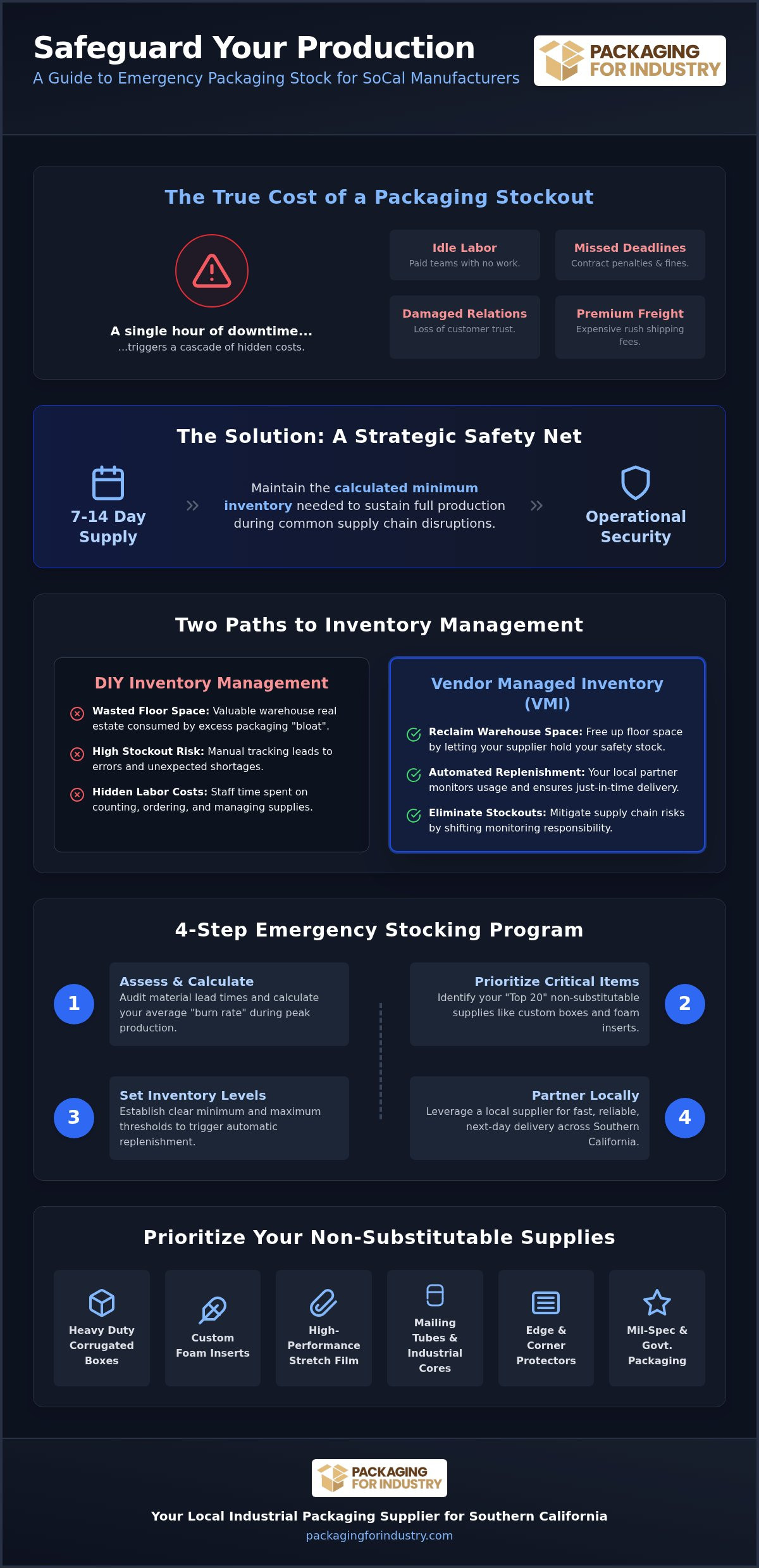
- Define your safety net by calculating the minimum inventory needed to sustain production during a 7 to 14-day supply chain disruption.
- Maintain a strategic emergency stock of packaging supplies in Southern California that includes critical non-substitutable items like custom foam inserts and heavy duty corrugated boxes.
- Compare the hidden costs of DIY inventory “bloat” against the efficiency of a Vendor Managed Inventory (VMI) program to free up valuable warehouse floor space.
- Implement a structured replenishment system by identifying your “Top 20” high-usage items and establishing clear min-max levels based on current lead times.
- Leverage a local industrial packaging supplier for next-day delivery in Anaheim and Los Angeles to eliminate the need for expensive rush shipping from national catalogs.
The Risks of Packaging Shortages in Southern California Manufacturing
Defining an emergency stock of packaging supplies Southern California operations can rely on starts with understanding your specific risk profile. In an industrial context, emergency stock isn’t a warehouse full of excess materials. It’s the calculated minimum inventory needed to maintain full production capacity during a 7 to 14-day supply chain disruption. For facilities in Orange County or Los Angeles, these disruptions often stem from localized issues like port congestion at LA and Long Beach or severe logistics bottlenecks in the Inland Empire. When these regional hubs slow down, the flow of raw materials stops, leaving manufacturers vulnerable.
The financial impact of a packaging stockout extends far beyond the cost of the missing box. You face significant hidden expenses, including idle labor costs where production teams are paid while the line is down. Missed shipping windows lead to strained customer relationships and potential contract penalties. Relying on national catalogs during these periods often results in astronomical expedited freight fees for materials that may still arrive late due to centralized shipping delays. A Vendor Managed Inventory (VMI) strategy helps mitigate these risks by shifting the burden of stock monitoring to a local partner.
Why Regional Proximity Matters for Emergency Supply
The “Last Mile” problem is particularly acute in Southern California. Heavy traffic congestion can turn a 20-mile delivery into a multi-hour ordeal. Utilizing an Anaheim packaging supplier provides a distinct logistical advantage for businesses in Brea, Irvine, or Santa Fe Springs. Local proximity allows for next-day delivery, which effectively replaces the need for massive on-site safety stock. Instead of losing valuable floor space to stacks of corrugated cardboard boxes, you can maintain a lean operation knowing your replenishment is only minutes away.
Impact on Key SoCal Industries
Different sectors face unique challenges when supplies run low. In aerospace and defense, a delay in mil-spec packaging can halt the delivery of critical components, affecting government contracts. Medical device manufacturers must maintain sterile supply chains; any interruption in protective foam or specialized bags can compromise product integrity. For e-commerce fulfillment centers, consistent access to shipping supplies is the only way to protect customer ratings and avoid the high costs of shipping damage. A strategic emergency stock of packaging supplies Southern California manufacturers can access quickly is essential for maintaining these high standards.
Essential Checklist: Assessing Your Emergency Packaging Supply Needs
Building a resilient emergency stock of packaging supplies Southern California operations can count on requires more than just filling warehouse racks. It demands a rigorous assessment of which materials are truly critical to your daily output. Effective business continuity planning involves identifying the specific failure points in your current inventory. If you run out of standard tape, you can likely find a local alternative, but if your supply of custom-engineered foam or branded containers vanishes, your production line stops entirely.
Start by auditing lead times for every component in your shipping process. While stock items might be available for next-day delivery, custom printed boxes or specialized military packaging often require four weeks or more to manufacture. You must calculate your “burn rate,” which is the average volume of supplies consumed during peak production periods. This data allows you to set realistic inventory thresholds that account for both current usage and the time required for replenishment.
High-Priority Packaging Materials
Your checklist should prioritize items that provide structural integrity and load stability. For industrial manufacturers, this includes:
- Heavy duty corrugated boxes: Ensure you have a reserve of double wall and triple wall boxes for heavy equipment that standard RSCs cannot support.
- Stretch film: Both machine stretch film and hand wrap are essential for pallet stabilization. A shortage here means pallets cannot be safely moved or loaded onto trucks.
- Industrial tubes and cores: Manufacturers of textiles, films, or roll goods should stock heavy duty mailing tubes and industrial cores to prevent product crushing during transit.
Protective and Specialty Supplies
High-value or highly regulated industries require a more nuanced approach to emergency stocking. Aerospace and electronics firms often rely on custom foam packaging and ESD-safe materials that are not easily substituted during a shortage. Similarly, defense contractors must maintain a safety stock of mil-spec materials to remain compliant with federal shipping regulations. Don’t overlook corner and edge protection, as these simple components are vital for preventing shipping damage on palletized loads. If you’re unsure which custom components require the largest safety buffer, you can request a packaging quote to evaluate lead times and bulk pricing for your specific needs.
DIY Inventory Management vs. Vendor Managed Inventory (VMI)
Establishing a reliable emergency stock of packaging supplies Southern California companies can trust requires a shift from reactive hoarding to proactive management. Many manufacturers attempt to handle their own safety stock, falling into what we call the DIY Trap. In an effort to prevent a production shutdown, purchasing agents often over-order materials, tying up significant cash flow in inventory that sits idle on the warehouse floor. This approach is a common but inefficient method of supply chain risk management that prioritizes volume over velocity.
Hoarding pallets of corrugated boxes or film rolls quickly leads to warehouse bloat. This excess inventory reduces the floor space available for actual manufacturing, effectively increasing your overhead costs. A smarter alternative is to leverage a local partner who can maintain those safety buffers for you, allowing you to focus on your core operations while improving your fiscal responsibility.
The Costs of Manual Stocking
Manual inventory tracking consumes significant labor hours. Your team spends time counting rolls of stretch film or stacks of pallets instead of focusing on production output. Beyond labor, DIY stocking carries the risk of inventory obsolescence. If a product design changes or a customer updates their shipping requirements, those thousands of pre-ordered custom boxes become expensive waste. Additionally, when a stockout does occur, manufacturers often resort to “panic” orders from national catalog suppliers. These orders come with premium pricing and high shipping costs that erode your profit margins.
How VMI Secures Your SoCal Supply Chain
Implementing a Vendor Managed Inventory (VMI) program with PFI eliminates the stress of monitoring stock levels. We take full accountability for your supply reliability by conducting scheduled replenishment cycles tailored to your usage. Whether your facility requires weekly, biweekly, or monthly check-ins, our team ensures your “Min-Max” levels are always maintained. This system removes the risk of lead-time surprises, especially for custom-engineered items like protective foam packaging.
VMI integrates naturally with Just-In-Time inventory management. By letting PFI manage your emergency stock of packaging supplies Southern California, you only pay for inventory as it is used. This improves your cash flow and frees up valuable warehouse space for production equipment or finished goods. If you are ready to lower packaging costs and eliminate stockouts, you can request a packaging quote to see how a managed program can streamline your logistics.
Implementing an Emergency Stocking Program: A Step-by-Step Guide
Transitioning from a reactive inventory model to a structured emergency stock of packaging supplies Southern California operations can depend on requires a methodical implementation. You don’t need to stock every SKU in high volume. Instead, focus on the components that would immediately halt your shipping capabilities if they were unavailable. This guide outlines a pragmatic workflow designed to stabilize your supply chain while maintaining fiscal responsibility.
- Step 1: Identify your “Top 20” high-usage items. Review your procurement data to find the 20 items that represent 80% of your packaging volume. This usually includes standard corrugated boxes, stretch film, and pallet wrap.
- Step 2: Establish “Min-Max” levels based on current lead times. Set a minimum threshold that triggers a reorder and a maximum level that prevents warehouse bloat. Your “Min” should account for the time it takes for a local supplier to deliver a new shipment.
- Step 3: Designate a dedicated “Safety Stock” area. Physically separate your emergency inventory from your daily usage stock. This prevents the accidental depletion of your safety buffer during high-volume shifts.
- Step 4: Partner with a local Southern California packaging supplier. Establish a relationship with an Anaheim-based distributor who offers next-day delivery. Having a local emergency stock of packaging supplies Southern California partner allows you to keep your on-site “Min” levels lower since replenishment is only hours away.
Establishing Your Safety Buffer
A reliable rule of thumb is to maintain a two-week supply for stock items and a four-week buffer for custom-engineered materials like protective foam inserts. You must also account for seasonal spikes, such as the increased logistics demand often seen in the Inland Empire during the fourth quarter. Safety stock is the insurance policy for your production line. By calculating these buffers accurately, you prevent the need for expensive rush shipping from national catalogs when regional port congestion or traffic delays occur.
Reviewing and Updating Your Plan
Your stocking program isn’t a static document. It requires quarterly audits to evaluate actual usage against your projected burn rate. If you’re seeing high damage rates, you might need to adjust the grade of your corner and edge protection or increase your stock of heavy duty boxes. Whenever you launch a new product, update your stocking levels to reflect the new packaging requirements. Regularly conducting a packaging cost-savings analysis ensures your emergency stock spend is optimized for both protection and price.
Why Local SoCal Manufacturers Choose PFI for Reliable Supply
Manufacturers across the region require a partner that understands the specific logistical hurdles of the Southland. PFI operates from a strategic headquarters in Anaheim, providing a centralized hub to serve Orange County, Los Angeles, and the Inland Empire. While national distributors rely on distant fulfillment centers that are susceptible to interstate delays, our local presence ensures your emergency stock of packaging supplies Southern California is never more than a few miles from your loading dock. We provide integrated solutions that combine custom corrugated boxes, protective foam, and wooden crates into a single, cohesive stocking program.
Our expertise in high-stakes industries like aerospace, medical devices, and electronics allows us to anticipate the rigorous shipping standards your products must meet. The PFI Promise is simple: we keep your production moving with a dependable, local supply chain that eliminates the stress of potential stockouts. By consolidating your packaging needs with a single local distributor, you reduce administrative overhead and improve your overall supply reliability.
Local Expertise and Support
We don’t just ship boxes; we provide consultative support to optimize your entire warehouse workflow. Our team conducts on-site inventory reviews for facilities in cities like Irvine and Santa Fe Springs to identify where safety stock levels can be improved. If your products require specialized protection, our custom design packaging team offers engineering and free prototyping to ensure a precision fit. You’ll have direct access to a dedicated account manager who understands Southern California logistics and can pivot quickly when your production demands change.
Request a Packaging Quote Today
Securing your emergency stock of packaging supplies Southern California starts with a comprehensive inventory assessment. Whether you’re looking to implement a full Vendor Managed Inventory (VMI) program or simply need a more reliable source for bulk supplies, PFI is ready to assist. We offer local next-day delivery for bulk orders across Anaheim and the surrounding areas, ensuring you never have to pay for expedited freight from out-of-state catalogs. Contact our team today to request a packaging quote and secure the inventory you need to protect your production line.
Secure Your Production Line with Strategic Inventory Management
Maintaining a reliable emergency stock of packaging supplies Southern California manufacturers can trust is about more than just filling racks. It’s about shifting from reactive hoarding to a proactive, managed inventory system that balances protection with warehouse efficiency. By identifying your high-usage items and establishing clear min-max levels, you eliminate the threat of sudden stockouts and the high costs of rush shipping from national catalogs.
PFI provides the local safety net your facility needs to stay operational despite port congestion or regional logistics bottlenecks. Our Anaheim-based custom engineering team and aerospace specialists ensure that even your most complex packaging requirements are met with precision. With local next-day delivery across Southern California, we help you lower packaging costs while improving your overall supply reliability. Protecting your production flow shouldn’t be a source of stress.
Take the first step toward a more resilient supply chain today. Our team is ready to help you optimize your inventory levels and secure your production line against future disruptions.
Frequently Asked Questions
What is the recommended emergency stock level for industrial packaging?
A standard recommendation is to maintain a two-week supply for stock materials and a four-week buffer for custom-engineered items. This safety net protects your facility from regional logistics bottlenecks or sudden spikes in production demand. By calculating your average weekly usage, you can establish a reliable baseline. This approach ensures your production line remains operational without committing too much capital or warehouse floor space to excess inventory.
How can I reduce packaging costs while maintaining a safety stock?
You can lower overall expenses by implementing a managed stocking program that eliminates expensive rush shipping and panic orders from national catalogs. Smarter inventory control prevents warehouse bloat and the accumulation of obsolete materials when product designs change. PFI conducts detailed usage reviews to optimize your stock levels. This strategy improves your cash flow by ensuring you only pay for the inventory required to sustain your current production cycles.
Does PFI offer next-day delivery for emergency packaging supplies in Los Angeles?
Yes, PFI provides local next-day delivery across Southern California, including all major industrial hubs in Los Angeles County. Our Anaheim headquarters is strategically located to serve facilities in Carson, Torrance, and Santa Fe Springs. This proximity allows us to act as a local safety net for your operations. By providing rapid replenishment, we help you maintain a leaner on-site inventory without the risk of a production shutdown.
What is a Vendor Managed Inventory (VMI) program for packaging?
A Vendor Managed Inventory (VMI) program is a service where PFI takes full accountability for monitoring and replenishing your packaging supplies. We perform scheduled on-site reviews at weekly, biweekly, or monthly intervals to assess your current stock levels. Based on agreed-upon thresholds, we automatically trigger replenishment orders. This system simplifies the purchasing process for your procurement team and ensures that critical materials are always available for shipping.
Can PFI help with custom-size corrugated boxes on short notice?
PFI is a specialist in custom corrugated boxes and protective foam engineering. While bespoke designs require manufacturing lead times, we use our stocking programs to manage these items proactively. We engineer the boxes to your specific dimensions and keep a safety buffer in our warehouse. This allows for rapid delivery of custom solutions on short notice, effectively solving the lead-time issues that typically plague custom-size packaging procurement.
How do I avoid production stops caused by packaging shortages?
The most effective way to prevent downtime is to maintain a strategic emergency stock of packaging supplies Southern California operations can access immediately. You should identify your critical items and designate a dedicated safety stock area in your warehouse. Partnering with a local industrial supplier for scheduled replenishment ensures that your inventory levels are always monitored. This proactive approach eliminates the guesswork and lead-time surprises that cause production stops.
What industries in Southern California benefit most from a managed stocking program?
High-stakes sectors such as aerospace, medical device manufacturing, electronics, and defense contractors benefit the most. These industries often require specialized, non-substitutable materials like mil-spec packaging or custom-engineered foam inserts. A managed stocking program ensures these critical components are always available. Food and beverage producers also rely on consistent supplies to maintain sterile supply chains. Any interruption in their packaging flow can result in significant financial losses and product waste.
Is there a minimum order quantity for PFI’s local delivery in Orange County?
We tailor our delivery services to the needs of B2B industrial clients, manufacturers, and distribution centers. While we don’t serve one-time residential or retail customers, we offer competitive minimums for recurring bulk orders and wholesale packaging supplies. Our goal is to support the ongoing operational needs of businesses throughout Orange County. You can request a packaging quote to determine the most cost-effective order frequency and delivery schedule for your specific facility.