
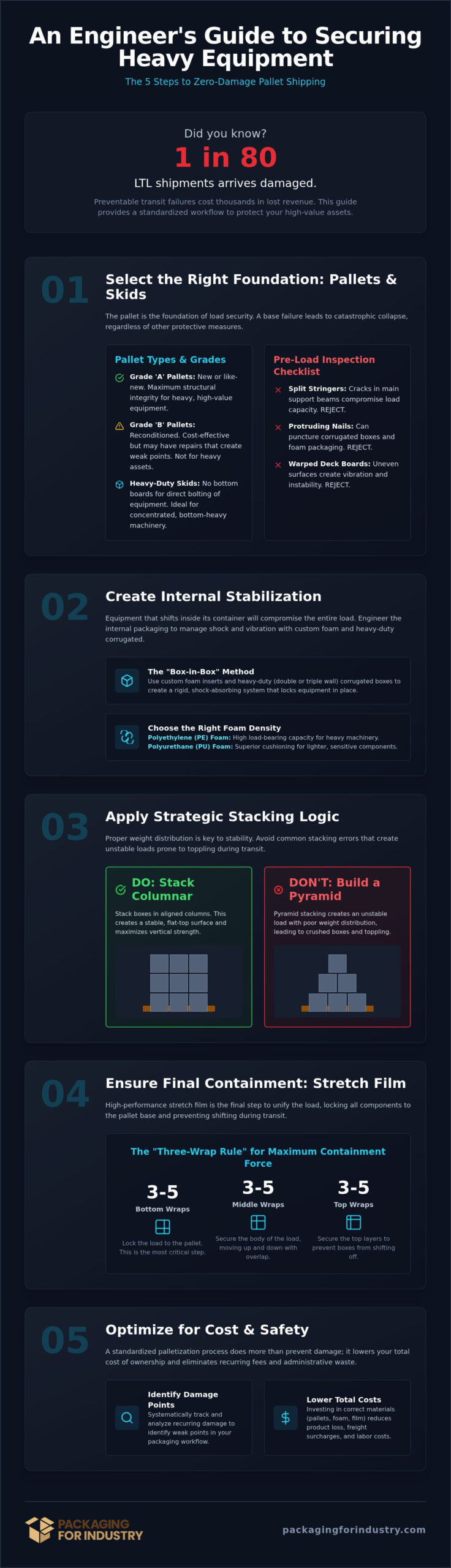
Did you know that nearly 1 in every 80 LTL shipments arrives damaged? For manufacturers shipping heavy industrial machinery, that statistic isn’t just a data point. It represents thousands of dollars in lost revenue, administrative headaches, and strained customer relationships. You’ve likely seen the results of inconsistent warehouse practices, where generic packaging supplies fail to withstand the rigors of the supply chain. It’s frustrating to watch your bottom line shrink because of preventable transit failures.
This guide teaches you exactly how to properly secure equipment to a pallet using an engineered approach that prioritizes stability and cost-efficiency. We’ll explore the synergy between heavy duty corrugated boxes, custom foam inserts, and high-performance stretch film to help you achieve a zero-damage shipping record. By the end, you’ll have a standardized workflow that lowers your total cost of ownership while ensuring every shipment arrives in pristine condition. Whether you’re a local Southern California manufacturer or a nationwide distributor, mastering these technical logistics will transform your shipping reliability and protect your high-value assets during every mile of the journey.
Key Takeaways
- Selecting the right pallet grade and heat-treatment status is the critical first step in preventing load failure during transit.
- Custom foam packaging and heavy duty corrugated boxes create a “box-in-box” system that safeguards sensitive equipment from internal shifts.
- Master the weight distribution logic required for how to properly secure equipment to a pallet, including why flat-top stacking beats the “pyramid” trap for long-term stability.
- Learn how to calculate containment force and apply the “three-wrap rule” with industrial stretch film to ensure your load stays locked to the base.
- Identify recurring damage points to eliminate freight surcharges and lower your operation’s total cost of ownership for packaging supplies.
Step 1: Selecting the Right Foundation for Heavy Equipment
Most warehouse managers view pallets as a commodity expense. That’s a costly mistake. The pallet is the literal foundation of load securing principles. If the base fails, the most expensive stretch film in the world won’t save your machinery from a catastrophic collapse. Understanding how to properly secure equipment to a pallet begins with selecting a platform engineered to withstand both static and dynamic forces during transit. A pallet that flexes or cracks under a load creates a chain reaction of instability that leads directly to damage claims.
Wooden Shipping Pallets vs. Heavy-Duty Skids
Standard 48×40 GMA pallets are sufficient for uniform boxed inventory, but heavy industrial machinery often requires specialized wooden shipping pallets with reinforced stringers or custom dimensions. If your machinery has a concentrated footprint, a standard pallet might snap under the PSI. Heavy-duty skids are frequently the better choice for bottom-heavy equipment. Since skids lack bottom deck boards, they allow for easier forklift access and more direct bolting of the equipment to the wood frame. Matching the pallet dimensions to your equipment footprint is non-negotiable. Any overhang reduces the stacking strength of your load by up to 40% and leaves the equipment vulnerable to forklift impact in a crowded warehouse.
Pallet Condition and Safety Standards
Pallet grades are a primary indicator of reliability for high-value aerospace or medical equipment shipments. Grade ‘A’ pallets are essentially new and have no stringer repairs, providing the maximum structural integrity required for heavy loads. Grade ‘B’ pallets are reconditioned and often feature “companion” stringers. While these are cost-effective for lighter goods, they introduce weak points when supporting heavy industrial assets. For international logistics, compliance is mandatory. You must utilize heat-treated pallets marked with the IPPC stamp to satisfy ISPM-15 standards. Failure to do so results in quarantined cargo and expensive shipping delays at customs.
Before staging your load, your team should perform a rapid structural integrity check. Look for these red flags:
- Split Stringers: Cracks in the main support beams compromise the entire load capacity.
- Loose or Protruding Nails: These can puncture protective foam packaging or heavy duty corrugated boxes.
- Warped Deck Boards: Uneven surfaces prevent the equipment from sitting flush, creating vibration issues.
As a local Southern California packaging supplier, we ensure that every pallet delivered to your facility meets these rigorous industrial standards. Starting with a high-quality foundation is the most effective way to lower your total cost of ownership and eliminate the professional stress of shipping damage.
Step 2: Internal Stabilization with Custom Foam and Heavy-Duty Corrugated
A secure foundation is only the first phase of damage prevention. Even on a high-quality pallet, equipment that shifts internally during transit will eventually compromise the entire load. This is where many standard shipping protocols fail. Industrial machinery requires more than just a generic container; it needs an engineered environment that manages shock and vibration. Understanding how to properly secure equipment to a pallet involves treating the internal packaging as a structural component of the shipment. By utilizing a “box-in-box” method or custom-fitted bracing, you create a rigid system that prevents the equipment from migrating toward the pallet edges.
Custom Protective Foam Packaging
Precision-engineered foam is the most effective way to neutralize transit vibration. For heavy industrial assets, material density is the deciding factor in performance. Polyethylene (PE) foam is ideal for heavier machinery due to its high load-bearing capacity and durability. In contrast, Polyurethane (PU) foam provides superior cushioning for lighter, more sensitive components. Our custom foam inserts are designed to lock equipment into a fixed position, eliminating the friction that causes surface abrasions. For industries like aerospace and medical manufacturing, we also provide anti-static and ESD foam solutions to protect sensitive electronics from electrostatic discharge during handling. This level of precision ensures that your high-value equipment remains centered and stabilized, regardless of the transit duration.
Heavy-Duty Corrugated Stabilization
Standard single-wall boxes lack the stacking strength required for industrial logistics. When your load exceeds 50 pounds, you must transition to heavy duty corrugated boxes. Double-wall and triple-wall corrugated options provide the vertical compression strength needed to support stacked pallets without collapsing. These materials function as an external skeleton, protecting the internal foam and equipment from external impacts. Adhering to OSHA handling and storage guidelines is also critical here, as proper stacking and weight distribution prevent workplace hazards.
To further optimize costs, consider using corrugated pads and partitions to create internal structure. This reduces the need for expensive void-fill materials while increasing the overall rigidity of the package. Prototyping custom box sizes allows you to eliminate “air” in your shipments, which lowers dimensional weight surcharges and reduces your total freight spend. If you are struggling with recurring transit damage, you can request a packaging quote to see how an engineered corrugated and foam solution can stabilize your supply chain.
Step 3: Strategic Stacking and Weight Distribution Logic
Physics dictates the success of your shipment. While many warehouse teams instinctively build “pyramid” loads to prevent items from falling off, this practice is a major logistical error. A pyramid stack prevents carriers from double-stacking trailers, which leads to wasted space and higher freight costs. More importantly, it concentrates pressure on the center of the bottom boxes rather than the corners. For those learning how to properly secure equipment to a pallet, the goal is always a flat-top load. This configuration ensures that downward pressure from any stacked pallets is distributed across the strongest vertical points of your packaging.
Weight distribution is equally vital. You must position heavy items as low as possible and centered on the deck. An off-center center of gravity creates a tipping hazard during forklift maneuvers and high-speed transit turns. Adhering to FMCSA cargo securement rules isn’t just about legal compliance; it’s about preventing the lateral shifts that lead to equipment damage and warehouse accidents. To maximize compression strength, we recommend column stacking over interlocking patterns. While interlocking feels more stable, it can reduce the vertical strength of your corrugated boxes by up to 50%. By stacking boxes directly on top of each other, you align the corners where the structural integrity is highest.
The Role of Corner and Edge Protection
Even the strongest column stack is vulnerable to the tension of industrial strapping. High-tension straps can easily crush the edges of your boxes, compromising the entire load. This is why cardboard edge protectors are essential for industrial logistics. These angle boards distribute strap pressure across a wider surface area and add significant vertical stacking strength. By applying a “top cap” or corrugated sheet over the final layer, you create a unified surface that resists downward pressure and keeps the equipment locked in place. This simple addition significantly lowers packaging costs by allowing you to use lighter boxes without sacrificing protection.
Load Alignment and Overhang Prevention
Precision alignment is the final piece of the stacking puzzle. You must avoid overhang at all costs. Industry data shows that just one inch of overhang can reduce the structural strength of your pallet by 30%. When equipment hangs over the edge, it absorbs the impact of every bump and vibration directly, rather than transferring that energy to the pallet deck. If you’re dealing with irregular machinery that doesn’t fit standard dimensions, use dunnage and cushioning materials to fill internal voids. This prevents the equipment from migrating during transit. Our team at PFI provides custom-sized pallets and crates across Southern California to ensure your equipment has the exact footprint it needs for maximum stability.
Step 4: Final Containment: Stretch Film and Strapping Techniques
Once the foundation and internal stabilization are set, the final containment layer determines if the load will survive the vibration of a long-haul truck. Containment force is the actual pressure the film applies to the load. Mastering how to properly secure equipment to a pallet requires a calculated approach to these final layers. You must apply the three-wrap rule: three wraps at the base to anchor the load to the pallet, three in the middle for structural unity, and three at the top to lock the cap. Without a strong anchor at the base, the entire load can slide off the pallet during a sudden stop.
When evaluating how to properly secure equipment to a pallet for long-distance hauls, don’t overlook the importance of film gauge. A film that’s too thin will stretch beyond its elastic limit, losing its ability to hold the load. Conversely, using a gauge that’s too heavy for light equipment can crush your heavy duty corrugated boxes. Finding the balance between film tension and material strength is the key to a zero-damage shipping record.
Stretch Film Selection for Load Stability
Choosing the right film type is a matter of engineering. Blown stretch film offers superior puncture resistance and a high level of “cling,” making it the preferred choice for industrial machinery with sharp edges or irregular profiles. Cast film is quieter and more transparent, which helps with barcode scanning, but it lacks the tear resistance of blown film. For high-volume operations, machine stretch film provides the consistency that manual wrapping can’t match. This is especially vital for distribution centers across Southern California that handle high-velocity freight. It ensures every pallet receives the exact same containment force, reducing the risk of human error. If your team wraps manually, pre-stretched film is a cost-effective alternative that provides high tension with less physical effort.
Strapping and Banding Best Practices
For heavy industrial anchoring, strapping provides the primary structural link between the equipment and the pallet. Polypropylene strapping is suitable for light to medium loads, but heavy machinery requires polyester. Polyester strapping has a unique “elastic memory” that allows it to stay tight even as the load settles or vibrates during transit. You should always thread straps through the pallet fork entries to create a direct mechanical bond with the wood frame. Use professional tensioning tools to reach the required PSI; hand-tightening is never sufficient for industrial assets. In cases where vibration or impact risks are extreme, we recommend transitioning to custom shipping crates for total enclosure and maximum protection.
Step 5: Optimizing Your Palletization Process for Cost and Safety
The final stage of industrial logistics isn’t the physical wrapping of the load; it’s the continuous optimization of your packaging workflow. A technical understanding of how to properly secure equipment to a pallet provides the foundation, but long-term fiscal responsibility requires a data-driven review of your shipping records. By identifying recurring damage points, you can pinpoint exactly where your current materials or methods are failing. This proactive approach transforms packaging from a sunk cost into a strategic advantage that protects your bottom line and improves supply chain reliability.
Operational efficiency also extends to how you manage your packaging supplies. Many warehouses struggle with inconsistent inventory, leading to “panic buying” from expensive catalog suppliers. Implementing a Vendor Managed Inventory (VMI) program ensures you always have the heavy duty corrugated boxes, custom foam, and stretch film you need without cluttering your floor space. This just-in-time approach is especially effective for manufacturers in Southern California who need to maintain high-velocity fulfillment cycles while minimizing warehouse overhead.
Reducing Shipping Damage and Freight Costs
Carriers are increasingly strict regarding pallet integrity. Non-stackable loads or pallets with significant overhang often trigger expensive LTL surcharges. When you master how to properly secure equipment to a pallet using flat-top stacking and precise alignment, you eliminate these unnecessary fees. There’s also the delicate balance of “over-packaging.” While excess material might reduce damage, it increases dimensional weight (DIM) charges and total material spend. We help our clients find the engineering “sweet spot” where protection meets cost-efficiency. If you’re looking to lower packaging costs, you can request a custom packaging quote to see how optimized dimensions and material density can reduce your total freight expenditure.
Why Choose PFI as Your Industrial Packaging Supplier?
PFI serves as a seasoned industrial consultant for businesses across Southern California. We understand that for aerospace, medical, and electronics companies, a single damaged shipment can derail a multi-million dollar contract. Our strength lies in our integrated approach. Instead of sourcing pallets, foam, and crates from different vendors, we provide a unified solution that ensures every component works in synergy. We offer local next-day delivery across Anaheim, Orange County, and Los Angeles, providing the speed and reliability that national distributors simply can’t match.
Our team understands the specific needs of distribution centers and manufacturing plants. We don’t just sell supplies; we provide an entire system of protection and logistical optimization. Whether you need bulk packaging pricing for standard inventory or a custom-engineered crate for sensitive aerospace equipment, we have the expertise and the local infrastructure to support your operations. By choosing a local packaging supplier with deep roots in the Inland Empire and San Diego, you gain a partner dedicated to your zero-damage shipping record and long-term professional success.
Standardize Your Industrial Palletization Strategy
Mastering the technical requirements of how to properly secure equipment to a pallet is more than a warehouse task; it’s a strategic investment in your company’s operational reliability. By moving away from generic supplies and adopting an engineered system of heavy duty corrugated boxes, custom foam, and high-performance stretch film, you eliminate the high rates of shipping damage that drain your bottom line. The synergy between a stable pallet foundation and calculated containment force creates a standardized workflow that your team can execute with precision every time.
PFI specializes in aerospace and industrial solutions, offering custom engineering and free prototyping to ensure your high-value assets are protected during every mile. Our local infrastructure supports fast next-day delivery across Southern California, providing a dependable partner for your just-in-time logistics needs.
Take control of your logistics costs and start building a zero-damage shipping record today. We’re ready to help you optimize your packaging strategy and provide the reliability your customers expect.
Frequently Asked Questions
What is the best way to secure a top-heavy machine to a pallet?
The most effective method is using a custom heavy-duty skid rather than a standard pallet. A wider base provides the necessary stability to prevent tipping. You should bolt the equipment directly to the wooden frame to create a mechanical bond. Additionally, incorporate custom foam inserts to brace the heaviest components and lower the effective center of gravity. This ensures the machine remains upright during the lateral G-forces experienced in transit turns.
How many layers of stretch wrap are required for a standard industrial load?
We recommend following the three-wrap rule as a professional baseline. Apply at least three to five full rotations at the pallet base to create a secure anchor. Continue with three wraps in the middle and three at the top. For heavy machinery, using high-performance machine stretch film ensures consistent containment force. This method prevents the load from “walking” off the pallet or shifting during frequent terminal handling.
Should I use plastic or steel strapping for heavy equipment?
Polyester strapping is the industrial standard for most heavy equipment. Unlike steel, polyester has elastic memory; it stays tight even if the load settles or shifts slightly during a long haul. Steel strapping is typically reserved for extremely heavy, non-compressible loads like steel beams. For most machinery, polyester provides superior shock absorption and won’t damage the equipment’s finish or snap under high-frequency vibrations.
How do I prevent my load from shifting during LTL shipping?
LTL shipments undergo frequent handling, which increases the risk of shifting. The best defense is eliminating all internal voids with dunnage or custom partitions. Use cardboard edge protectors to stabilize the corners and provide a rigid frame for your strapping. Mastering how to properly secure equipment to a pallet for LTL requires creating a unified, dense load that resists independent movement when the trailer is in motion.
What are the common causes of pallet failure in a warehouse?
Structural failure often stems from poor weight distribution or deck board overhang. When weight isn’t centered, it puts uneven pressure on the stringers, leading to catastrophic cracks. Using B-grade pallets for high-value machinery is another common error, as reconditioned stringers may not handle concentrated industrial weight. Pyramid stacking also causes failure by concentrating pressure on the center of the pallet rather than the stronger vertical supports.
How can custom foam inserts reduce my total shipping costs?
Custom foam inserts reduce costs by eliminating shipping damage and the administrative fees of processing claims. Because the foam is engineered to the exact dimensions of your equipment, you can often use smaller heavy duty corrugated boxes. This reduces the dimensional weight of your shipment, which lowers total freight charges. It also simplifies the packing process, significantly reducing labor hours in your warehouse and improving overall throughput.
Does PFI offer local delivery for pallets and crates in Anaheim?
Yes, PFI provides local next-day delivery for pallets, crates, and all packaging supplies throughout Anaheim. Being headquartered in Orange County allows us to support Southern California manufacturers with reliable just-in-time logistics. We also serve Los Angeles, San Diego, and the Inland Empire. This local presence ensures you don’t have to waste valuable warehouse space storing bulk quantities of bulky items like custom wood crates.
Can I get a custom prototype for a heavy-duty corrugated box?
PFI offers free prototyping for custom heavy-duty corrugated boxes and protective foam packaging. Our team uses CAD/CAM support to design a solution that matches your equipment’s specific footprint and fragility requirements. This allows you to test the fit and protection level before committing to a full production run. It’s a critical step in learning how to properly secure equipment to a pallet without overspending on unnecessary materials.