
Did you know that for every dollar you successfully claim in freight damage, your company actually loses an average of $3.42 in hidden costs? Between replacement inventory production and the administrative burden of processing paperwork, the financial impact of shipping failures is often triple what’s on the invoice. If you’re struggling with high loss rates, you aren’t alone. Many operations managers find that preventing product damage claims in logistics is more about engineering than luck. It’s frustrating to see unsalvageable goods returned or deal with strained distributor relationships because a pallet collapsed in transit.
We understand that your goal is a reliable supply chain with zero-damage arrivals. This guide provides a comprehensive checklist to audit your current packaging strategy, from selecting the right heavy duty corrugated boxes to implementing custom foam inserts. You’ll learn how to lower insurance premiums and reduce rejected claims through strategic material selection and better containment standards. Whether you’re a manufacturer in Orange County or a distribution center in the Inland Empire, these industrial solutions will help you secure your freight and improve your bottom line.
Key Takeaways
- Learn why the true cost of a damage claim is over three times the invoice value and how to identify damage hotspots in Southern California logistics hubs.
- Discover how engineered materials like triple-wall corrugated boxes and edge protection are essential for preventing product damage claims in logistics by eliminating corner crush.
- Compare the shock absorption of polyethylene and polyurethane foam to determine the best custom inserts for fragile electronics or aerospace components.
- Apply the “containment force” rule to your stretch wrap process to eliminate the lateral shifting that causes the majority of pallet-level collapses.
- See how a professional packaging review identifies hidden weak points in your shipping process to reduce insurance premiums and rejected claims.
The Hidden Costs of Logistics Damage Claims in 2026
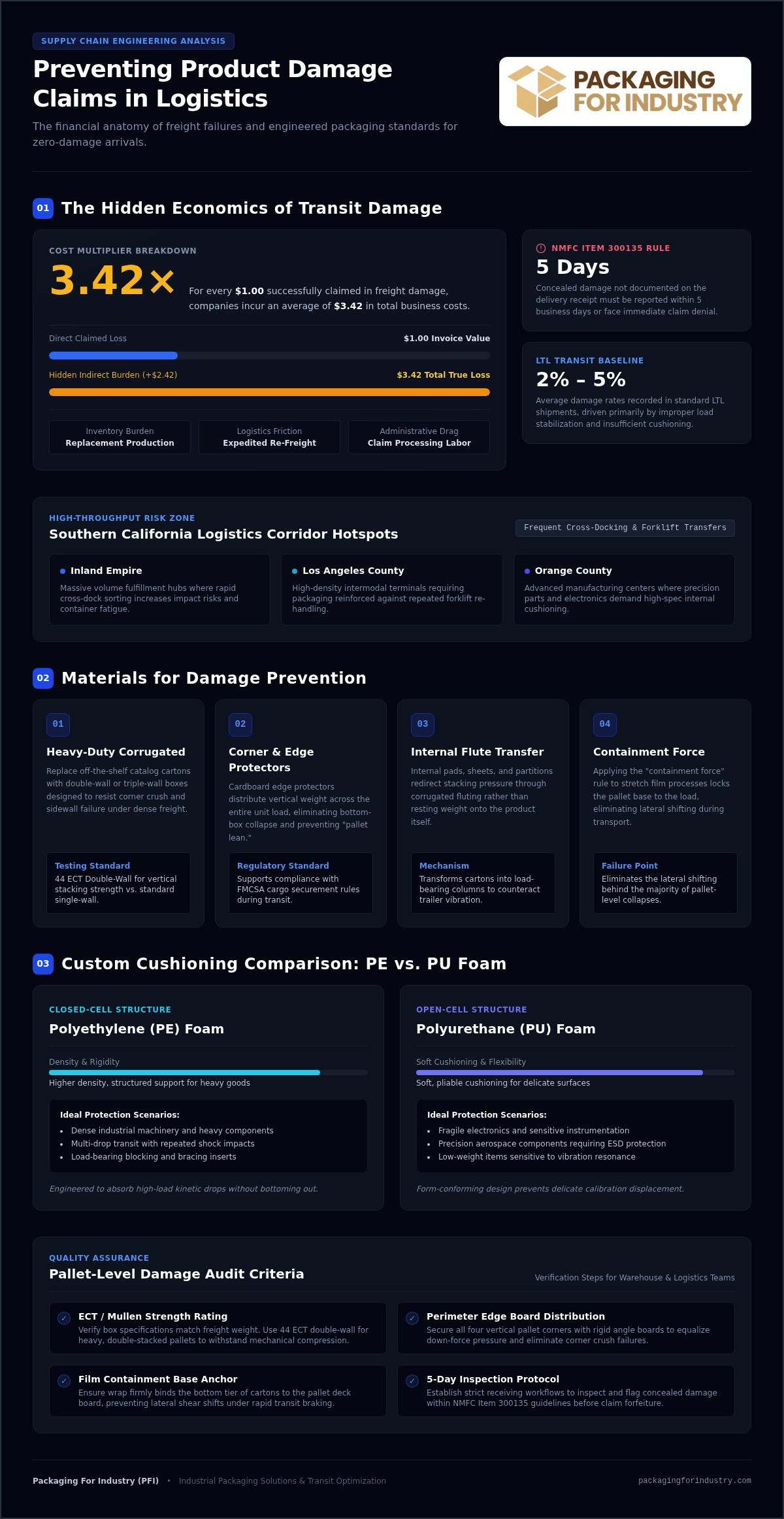
The financial impact of transit failures extends far beyond the value of the broken item. Research from Inbound Logistics indicates that for every $1.00 directly claimed in freight damage, companies incur an average of $3.42 in total business costs. This hidden multiplier accounts for replacement inventory production, expedited freight, and the administrative labor required to manage the paperwork. In high-volume regions like the Southern California logistics corridor, these costs escalate quickly. Facilities in the Inland Empire and Los Angeles handle massive throughput, making them hotspots for damage due to frequent cross-docking and forklift transfers. For manufacturers, preventing product damage claims in logistics requires moving beyond generic shipping methods toward engineered protection.
Direct vs. Indirect Financial Impact
Processing a logistics claim is a resource-intensive operation that often costs more in man-hours than the claim itself is worth. Beyond the immediate loss, companies must contend with “concealed damage” that stays hidden until the pallet is broken down. Under NMFC Item 300135, you must report damage not documented on the delivery receipt within five business days. Missing this narrow window often leads to immediate claim denial, shifting the entire financial burden to your bottom line. Repeated claims also damage your risk profile, leading to higher freight insurance premiums and strained relationships with distributors who expect zero-damage arrivals.
Why Traditional “Off-the-Shelf” Solutions Fail
Many industrial businesses rely on stock catalog boxes that weren’t designed for the rigors of heavy machinery or precision components. Using one-size-fits-all double-wall or triple-wall boxes might seem convenient, but it often results in corner crush or sidewall failure when stacked under dense freight. These generic solutions also contribute to high UPS/FedEx surcharges when dimensions don’t align with carrier automation. Logistics Fatigue is the cumulative mechanical stress and structural degradation that packaging experiences during multi-stop transit and repeated handling. To combat this, you must understand package cushioning mechanics to ensure your internal protection can withstand resonance vibration and drop shocks. Improper load stabilization and insufficient cushioning are the primary drivers of the 2% to 5% damage rates seen in LTL shipments today.
Industrial Packaging Checklist: Materials for Damage Prevention
Effective logistics management isn’t just about the truck; it’s about the engineering of the container. Selecting materials based on weight, density, and fragility is the first step in preventing product damage claims in logistics. While many companies default to standard shipping supplies, industrial-grade protection requires a more methodical approach to material selection to withstand the rigors of the modern supply chain.
The Foundation: Heavy-Duty Corrugated Boxes
Regular Slotted Cartons (RSC) are the industry standard, but heavy industrial components often require custom die-cut designs for a precision fit. When shipping dense parts or equipment, you should switch to double-wall or triple-wall boxes to ensure structural integrity. Don’t overlook the importance of internal pads, sheets, and partitions. These components increase stacking strength by transferring the load through the corrugated fluting rather than the product itself. Before placing a bulk order, you must verify the Edge Crush Test (ECT) rating for stacking strength or the Mullen (Bursting) Test for puncture resistance. For instance, a 44 ECT double-wall box provides significantly more compression strength than a standard single-wall carton, which is vital for preventing product damage claims in logistics when containers are double-stacked in a trailer.
The Shield: Corner and Edge Protection
Palletized loads are particularly vulnerable to “pallet lean” during long-haul transit across the United States. High-quality cardboard edge protectors distribute vertical weight across the entire unit load, preventing the bottom boxes from collapsing under the weight of the stack. This level of stabilization is critical for compliance with FMCSA cargo securement rules, which mandate that cargo must be immobilized to prevent shifting. Angle board prevents strap damage on sensitive product edges by creating a rigid barrier that allows for high-tension banding without crushing the corrugated corners.
Internal cushioning and closure integrity complete the protection system. Cushioning must be selected based on the product’s fragility; while bubble wrap works for light items, heavy industrial parts require custom foam or kraft paper rolls to prevent migration within the carton. Finally, use high-performance industrial adhesive tapes to prevent “flagging” or seal failure during transit. If you’re ready to audit your current supplies, you can compare packaging pricing for custom-engineered solutions that reduce shipping damage.
Engineering Protection with Custom Foam and Crates
High-value industrial components require a higher level of protection than standard corrugated materials can provide. When shipping aerospace sensors or medical imaging equipment, engineering the interior of the package is as important as the outer shell. CAD/CAM design and rapid prototyping allow us to validate the fit and performance of a package before mass production begins. This proactive approach is a critical step in preventing product damage claims in logistics, as it ensures the product remains immobilized during the most turbulent transit phases.
Custom Foam Inserts vs. Stock Cushioning
Selecting the right foam density is a technical decision based on the product’s fragility and weight. Polyethylene (PE) is a closed-cell foam that offers excellent support for heavy parts, while Polyurethane (PU) provides the soft cushioning needed for lightweight, delicate items. Using custom foam inserts such as end caps prevents “box-in-box” movement, which is a common cause of internal damage. Die-cut foam inserts eliminate the human error associated with inconsistent hand-packing by warehouse staff. Below is a comparison of foam applications across different industrial sectors:
- Electronics: ESD and Anti-static Polyurethane foams are used to dissipate static charges while cushioning fragile circuit boards.
- Aerospace: High-density Polyethylene is preferred for its vibration resistance and ability to support heavy, precision-machined metal components.
- Medical: Polyethylene is often selected for its non-abrasive and moisture-resistant properties, protecting sensitive surgical instruments.
Heavy-Duty Crating for International Transit
When equipment exceeds the weight limits of even the strongest triple-wall corrugated, custom wood crates become the necessary standard. For international shipments, these must be constructed from heat-treated pallets and crates to comply with ISPM-15 regulations. A dual-layer protection strategy, where a wood crate is lined with custom-engineered foam, offers the ultimate defense against the crushing forces of sea freight or heavy-duty LTL transit. This level of stabilization is vital for preventing product damage claims in logistics when cargo is subjected to extreme mechanical stress. We often reference ISTA transport simulation test standards during the design phase to ensure these crates can withstand the specific vibration and drop profiles of your shipping lane. PFI’s engineering team specializes in these heavy-duty solutions for the Southern California aerospace and industrial manufacturing hubs, ensuring your high-value goods arrive in factory condition.
Load Stabilization: Preventing Pallet-Level Failures
While high-quality corrugated boxes and custom foam inserts protect individual items, they can’t save a shipment if the entire pallet collapses. Load stabilization is often the final, yet most critical, step in preventing product damage claims in logistics. Real-time freight tracking provides visibility, but it won’t physically stop a pallet from leaning or shifting during a hard brake. True security comes from engineering the unit load so that it acts as a single, immobile block of freight.
The Science of Stretch Wrap
Choosing the right stretch film is a balance between material performance and cost-efficiency. Blown stretch film is the industrial workhorse; it offers superior puncture resistance and high “cling” levels, making it ideal for loads with sharp corners or irregular shapes. Cast stretch film is a quieter, more transparent alternative that’s often more cost-effective for uniform, high-volume operations. Regardless of the material, you must adhere to the containment force rule. This is the measure of how much pressure the film exerts on the load. If the containment force is too low, the boxes will slide; if it’s too high, you risk crushing the corrugated walls. Using pre-stretched film is a smart way to lower packaging costs while maintaining high tension, as it requires less physical effort from warehouse staff to achieve a secure wrap.
Pallet and Skid Selection
The foundation of your shipment is just as important as the wrap. Selecting the right wooden shipping pallets depends entirely on your load weight and the storage environment. Standard 48×40 skids work for many applications, but heavy industrial machinery often requires custom-sized pallets to ensure full deck coverage. One of the most common causes of transit damage is box overhang. When a box extends beyond the edge of the pallet, it loses a significant portion of its vertical stacking strength, leading to bottom-box failure and pallet lean. You can learn more about choosing between different pallet types in our guide on Load Stabilization: Stretch Film and Pallet Logistics. For specialized needs, we also provide vented film for products that require airflow and opaque film to obscure high-value goods from theft during transit.
Optimizing for Zero Damage: The PFI Packaging Review
A professional packaging review is the most effective way to identify structural weak points that lead to financial loss. Many businesses continue to use stock supplies that don’t match their product’s specific dimensions or weight. This mismatch is a primary driver of transit failure. By moving from generic stock items to custom-engineered solutions, you can actually lower overall packaging costs while significantly improving protection. Our team acts as a consultant to audit your entire shipping process, from the warehouse floor to the final delivery point. We look for inefficiencies such as excessive void fill or incorrect box sizing that increases dimensional weight surcharges. This holistic audit is a foundational step in preventing product damage claims in logistics.
One often overlooked cause of damage is material substitution. When a warehouse runs out of the correct heavy-duty corrugated box, staff often use whatever is available, regardless of its ECT rating. Leveraging Vendor Managed Inventory (VMI) eliminates this risk by ensuring your facility is always stocked with the exact materials your engineering specs require. This consistency maintains the integrity of your unit loads and prevents the makeshift packing errors that cause logistics claims. It also allows your purchasing team to focus on high-level operations rather than monitoring box counts.
Custom Prototyping and Testing
PFI provides a free prototyping service to ensure every custom foam insert and corrugated design fits your product perfectly before you commit to a bulk order. We use advanced CAD/CAM support to create precision-engineered protection for complex aerospace and medical components. This engineering phase allows us to validate the design’s effectiveness against vibration and shock. Drop testing prototypes is essential to simulate the real-world mechanical stress and impact profiles encountered throughout the logistics journey. This data-driven approach removes the guesswork and ensures your packaging is ready for the rigors of LTL transit.
Local Support for Southern California Manufacturers
Efficiency in the supply chain requires more than just good design; it requires reliable delivery. PFI offers local next-day delivery across Anaheim, Irvine, and Los Angeles, providing a critical safety net for Southern California manufacturers. Having a local industrial packaging supplier means you can reduce your on-site inventory footprint while maintaining the ability to fulfill emergency rush orders. Our just-in-time packaging delivery model reduces downtime and ensures you never have to delay a shipment due to a lack of supplies. Whether you’re shipping precision electronics or heavy industrial equipment, our local expertise helps you maintain a zero-damage arrival rate.
Secure Your Supply Chain with Engineered Protection
We’ve analyzed how the true cost of shipping damage is far higher than the value of the replacement item. Preventing product damage claims in logistics requires moving beyond generic catalog supplies toward engineered solutions that address the specific mechanical stresses of your shipping lane. By following a systematic checklist, incorporating high-ECT corrugated boxes, custom foam cushioning, and verified containment force, you can eliminate the logistics fatigue that leads to rejected claims and financial loss.
Packaging For Industry (PFI) supports your operations with free prototyping and CAD/CAM design to ensure every component is fully immobilized during transit. We specialize in bespoke solutions for the aerospace and defense industries, where precision and durability are operational requirements. Our local next-day delivery across Southern California ensures your warehouse remains stocked with the exact materials needed to maintain supply reliability without the need for large inventory footprints.
Taking control of your packaging specifications today prevents professional stress and protects your bottom line tomorrow. We’re ready to serve as your partner in logistical optimization and damage reduction.
Frequently Asked Questions
What are the most common causes of product damage in logistics?
The primary drivers of transit damage include insufficient containment force on pallets, improper void fill, and using single-wall boxes for heavy industrial components. In the Southern California logistics corridor, frequent forklift transfers and LTL cross-docking increase the risk of impact damage. Many claims stem from structural failure of the outer container or internal shifting due to poor cushioning. Addressing these root causes through engineered packaging is the most effective way of preventing product damage claims in logistics.
How can I calculate the ROI of switching to custom foam packaging?
To calculate ROI, you must look beyond the unit price of the foam and evaluate the total cost of damage. This includes the value of the unsalvageable goods, expedited shipping for replacements, and the administrative labor of processing claims. If custom polyethylene or polyurethane foam reduces your damage rate even slightly, the savings often outweigh the material cost. We provide custom foam inserts that eliminate the human error of inconsistent packing, further boosting operational efficiency.
Does double-wall corrugated really prevent more claims than single-wall?
Double-wall corrugated provides significantly higher Edge Crush Test (ECT) ratings and stacking strength compared to single-wall alternatives. This extra layer of fluting prevents the bottom boxes in a stack from collapsing under the weight of a pallet. For heavy industrial parts or high-density goods, double-wall boxes are essential for maintaining structural integrity during multi-stop transit. Switching to heavy-duty corrugated is a practical step for any business focused on preventing product damage claims in logistics.
What is the best way to protect heavy machinery during international shipping?
Protecting heavy machinery for international transit requires a combination of custom wood crates and internal shock absorption. These crates must be heat-treated to meet ISPM-15 export standards. We often integrate custom foam end caps or lining within the crate to isolate the machinery from resonance vibrations and drop shocks. This dual-layer protection strategy ensures that high-value industrial equipment arrives in factory condition despite the extreme mechanical stress of sea or air freight transit.
How do I know if I need machine stretch film instead of hand wrap?
If your facility wraps more than 15 pallets per day, machine stretch film is usually the more efficient choice. Automated wrapping ensures a consistent containment force that hand wrapping rarely achieves, which is vital for preventing load shifting. Machine film can also be pre-stretched up to 300%, allowing you to use less material per pallet. This transition lowers packaging costs while improving the overall stability of your unit loads during the rigors of the supply chain.
Can custom packaging actually lower my UPS and FedEx shipping costs?
Yes, custom packaging solutions can significantly reduce your parcel shipping expenses by optimizing the dimensional weight of your containers. Standard catalog boxes often contain excessive void space, which triggers expensive surcharges from carriers like UPS and FedEx. By engineering a box that fits your product exactly, you eliminate unnecessary volume and reduce the need for expensive void fill. Our packaging reviews focus on these cost-reduction strategies to improve your bottom line while maintaining high protection levels.
What information do I need to provide for a custom packaging quote?
To request a packaging quote, you should provide the exact dimensions, weight, and fragility of your product. It’s also helpful to share your current shipping method, such as LTL freight or parcel, and any specific environmental challenges like moisture or extreme temperatures. Our team uses this data to recommend the right materials, such as heavy-duty corrugated or ESD foam. Providing these details allows us to engineer a solution that balances cost-efficiency with maximum product protection.
How does a VMI program help reduce shipping damage errors?
A Vendor Managed Inventory (VMI) program prevents damage by ensuring your warehouse always has the correct, engineered materials in stock. When specific supplies run low, warehouse staff often substitute incorrect boxes or cushioning, which leads to transit failure. With VMI, we monitor your usage and replenish your inventory on a scheduled basis. This consistency eliminates the guesswork and prevents the makeshift packing errors that frequently result in costly product damage claims during logistics and distribution.