
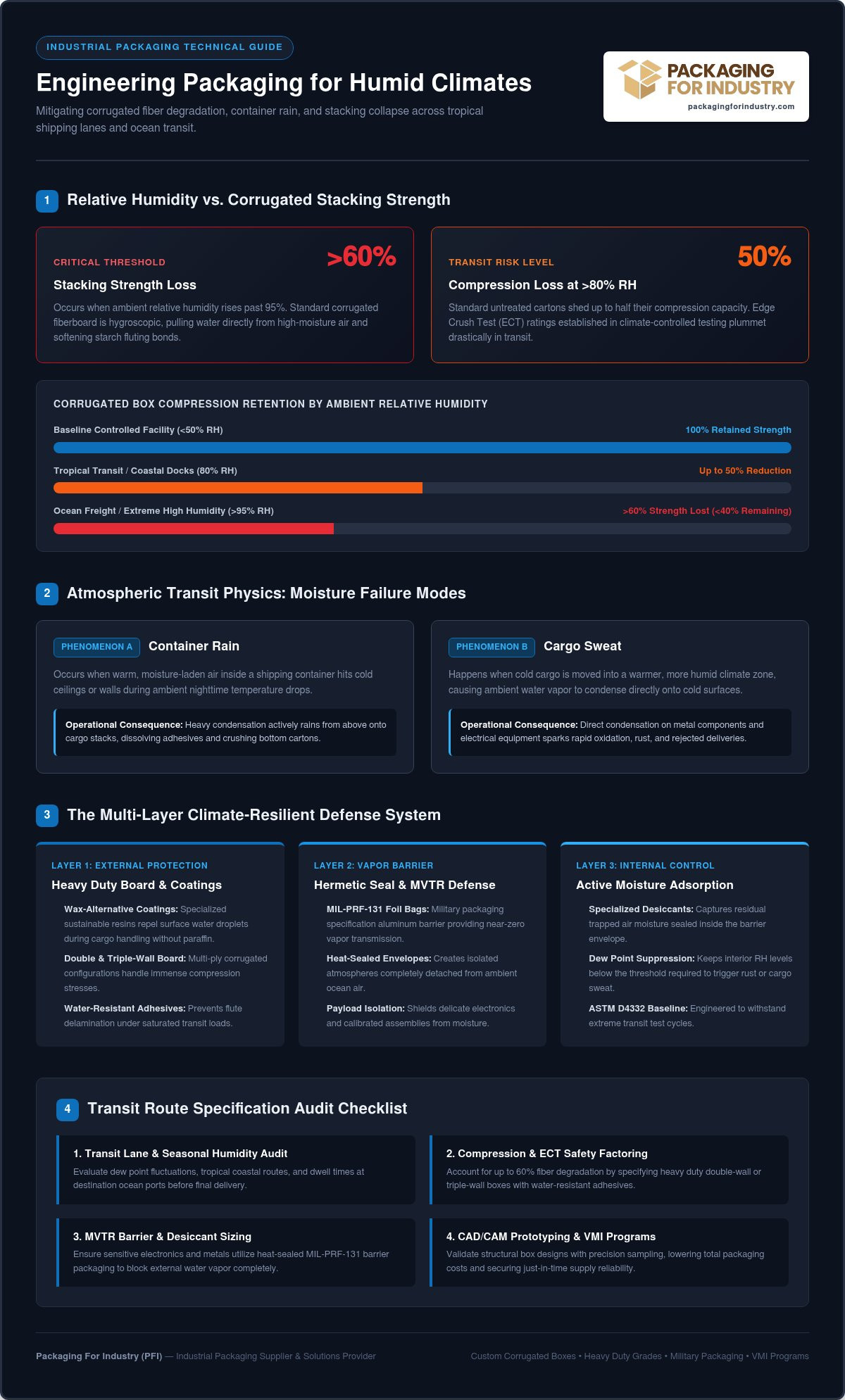
The stacking strength of a standard corrugated box can decrease by more than 60% when ambient relative humidity rises past 95%. For manufacturers and distribution centers, this isn’t just a technical statistic; it’s a direct threat to the bottom line. You’ve likely dealt with the fallout of standard containers crushing under compression or arriving at a destination port riddled with mold and corrosion. Selecting the right packaging for shipping to humid climates is the difference between a successful delivery and a rejected, costly freight return.
We understand that protecting your industrial shipments requires more than just thicker cardboard. It demands an integrated engineering approach that balances material performance with fiscal responsibility. In this guide, we’ll show you how to protect your cargo against moisture damage and container rain using advanced barrier films, specialized desiccants, and heavy duty board grades. You’ll learn how to maintain box integrity throughout high humidity zones while lowering your total packaging costs and improving overall supply reliability.
Key Takeaways
- Understand how high relative humidity weakens corrugated fibers and why standard containers often collapse under compression during long-haul transit.
- Identify the high-performance board grades and weather-resistant coatings required for effective packaging for shipping to humid climates.
- Discover the three-layer defense framework that uses vapor barriers and desiccants to eliminate cargo sweat, rust, and container rain.
- Use our professional buyer’s checklist to audit transit routes and seasonal humidity patterns before placing a custom corrugated box quote.
- Learn how to lower packaging costs and improve supply reliability through precision CAD/CAM prototyping and vendor-managed inventory programs.
The Impact of High Relative Humidity on Industrial Packaging
Standard corrugated fiberboard is hygroscopic, meaning it naturally attracts and holds water molecules from the surrounding air. In high-humidity zones, this physical property becomes a significant liability for industrial shipments. When relative humidity exceeds 80 percent, standard untreated corrugated boxes lose up to half of their compression strength. This degradation isn’t just a surface issue; it fundamentally alters the material physics of your shipping containers, leading to costly product losses and safety hazards in the warehouse.
The consequences of ignoring environmental moisture are often visible at the destination port. Common damage scenarios include widespread mold growth on porous materials, rapid oxidation and corrosion on metal components, and the total collapse of pallet stacks. These issues stem from a failure to account for how moisture interacts with standard packaging materials during long-haul transit through tropical or coastal shipping lanes.
Corrugated Fiberboard Degradation Under High Moisture
The starch-based adhesives used to bond fluting to liners are particularly vulnerable to moisture. As humidity levels rise, these adhesives soften, which leads to delamination and a total loss of box rigidity. While a container might have a high Edge Crush Test (ECT) rating in a dry, climate-controlled facility, that rating drops sharply in transit. This explains why the bottom cartons in a pallet stack fail first. They bear the greatest compression load while their fibers are saturated, resulting in the “leaning” pallets and crushed freight often seen in humid climates. Manufacturers often require custom packaging design services to engineer board grades that maintain structural integrity under these specific stressors.
Understanding Cargo Sweat and Container Rain
Container rain occurs when warm, moist air inside a shipping container hits a cold surface, such as the ceiling or walls, as ambient temperatures drop at night. This triggers heavy condensation that literally “rains” onto the freight. Conversely, cargo sweat happens when cold cargo is moved into a warmer, more humid environment, causing moisture to condense directly on the product surface. These phenomena are standard risks on high-humidity routes where dew point fluctuations are extreme. Understanding the Moisture Vapor Transmission Rate (MVTR) of your barrier materials is vital for prevention. Even vented containers struggle to stop this because venting alone doesn’t remove the moisture already trapped within hygroscopic packaging. Effective packaging for shipping to humid climates must address these internal atmospheric shifts to protect sensitive payloads from moisture-related rejection.
Essential Moisture-Resistant Packaging Materials and Solutions
Standard shipping materials often fail when exposed to the high-moisture environments typical of ocean freight and tropical logistics. To ensure the structural integrity of your shipments, you must select materials engineered to meet the ASTM D4332 standard, which provides a baseline for testing packaging performance in extreme environmental conditions. When sourcing packaging for shipping to humid climates, moving beyond basic kraft board to technical barrier solutions is essential for preventing product loss and reducing shipping damage.
Weather-Resistant and Heavy-Duty Corrugated Board
Standard kraft board absorbs water, leading to the fiber softening discussed in the previous section. In contrast, wax-alternative coated corrugated uses specialized resins to repel surface water droplets during cargo handling. These coatings are more sustainable and easier to recycle than traditional paraffin wax while maintaining high performance. For heavy industrial loads, heavy duty corrugated boxes in double-wall or triple-wall configurations are necessary. These utilize water-resistant adhesives that maintain a structural bond even when the ambient humidity is high, preventing the delamination that causes pallet stacks to lean or collapse.
Vapor Barrier Bags and Desiccant Integration
For electronics or sensitive metal components, external boxes aren’t enough. You need primary protection like military packaging barrier materials. Specifically, MIL-PRF-131 aluminum foil bags provide a near-zero water vapor transmission rate when heat-sealed. Within these bags, desiccant integration is vital. Choosing the right absorber depends on your specific transit duration and payload sensitivity:
- Clay Desiccants: Economical for shorter routes with moderate humidity levels.
- Silica Gel: Ideal for smaller, sealed electronic enclosures due to its chemical stability and non-liquid nature.
- Calcium Chloride: The most effective choice for high-humidity ocean transit, as it can absorb up to 300% of its own weight in moisture.
Heat-sealing these foil barrier bags prevents water vapor transmission entirely, creating a micro-environment that remains dry regardless of the external “container rain” occurring inside the shipping vessel.
Moisture-Repellent Cushioning and Custom Foam
The choice of cushioning material significantly impacts corrosion risk. Open-cell polyurethane foam acts like a sponge, trapping moisture against the product surface. You should instead utilize non-absorbent polyethylene foam packaging. Because it’s a closed-cell material, it won’t retain water, effectively isolating sensitive product surfaces from environmental dampness. Custom die-cut foam inserts provide the precision fit required to keep components secure while ensuring no moisture-retaining materials touch the payload. This engineering-minded approach helps manufacturers lower packaging costs by eliminating the need for over-packing while simultaneously reducing shipping damage.
If you need to evaluate which materials best fit your specific shipping route and budget, you can request a packaging quote to compare performance-grade options for your next shipment.
Engineering Multi-Layer Protection Systems for Humid Shipping Routes
Defending industrial cargo against moisture requires more than just high-quality materials; it requires a systematic, multi-layer architecture. A single barrier often fails during the temperature swings and high-humidity spikes of ocean transit. We utilize a three-layer defense framework to ensure total cargo safety: the primary layer manages the internal micro-environment, the secondary layer provides structural containment, and the tertiary layer ensures pallet and load stabilization. This integrated strategy is the most effective way to optimize packaging for shipping to humid climates while controlling total landed costs.
Primary Layer: Hermetic Sealing and Desiccant Packs
The primary line of defense creates a sealed environment around the product itself. You should use professional vacuum heat-sealing methods for moisture barrier bags rather than simple tape closures. Taping leaves microscopic gaps that allow water vapor to enter over time. Secure desiccant packs inside the sealed barrier to absorb any residual moisture trapped during the packing process. We also recommend including humidity indicator cards. These cards provide your customers with immediate, visual verification of internal dryness upon arrival, which is critical for high-value electronics and aerospace components.
Secondary Layer: Rigid Boxes and Structural Inserts
The secondary layer focuses on mechanical integrity. You must specify custom corrugated boxes engineered with high-compression board grades to endure the structural weakening caused by secondary humidity exposure. Even if the primary barrier stays dry, the outer box must resist the crushing forces of a multi-ton pallet stack. Utilize heavy-duty corner board and edge protectors to reinforce carton vertical strength. Additionally, incorporate closed-cell foam blocking to immobilize items. This material is superior to open-cell foam because it does not hold ambient moisture, preventing localized corrosion at contact points.
Tertiary Layer: Pallet Stabilization and Exterior Protection
The final layer secures the entire unitized load for the rigors of the supply chain. Apply high-performance machine stretch film using wrapping patterns designed to prevent pallet shifting in damp conditions. While many distributors use standard wrap, we evaluate whether your route requires top sheeting to block container rain or vented film to manage ambient condensation. For the most demanding environments, we specialize in engineering custom crates for international transit. These crates, paired with treated wooden pallets, provide a rigid exterior shield that ensures compliance with international shipping standards while protecting the inner layers from mechanical impact and extreme weather.
How to Specify Packaging for High-Humidity Transit: Buyer’s Checklist
Procurement teams often rely on minimum freight standards that fail to account for the physical realities of global logistics. While a carrier might accept a standard single-wall box, that container won’t necessarily survive a three-week dwell time in a tropical port. To protect your bottom line, you must bridge the gap between basic compliance and environmental engineering. Specifying the correct packaging for shipping to humid climates requires a proactive audit of your entire distribution cycle, from the manufacturing floor to the final unconditioned warehouse at the destination.
Begin by calculating a necessary Edge Crush Test (ECT) safety margin. As established in the initial sections of this guide, humidity can strip a box of 60 percent of its stacking strength. If your pallet stack requires 1,000 pounds of compression strength, you shouldn’t buy a box rated for exactly 1,000 pounds. Instead, you need to specify a heavy-duty double-wall or triple-wall carton with a significant overhead to compensate for moisture-induced degradation. This ensures your products don’t arrive crushed, regardless of the relative humidity levels encountered in transit.
Evaluating Product Vulnerability and Environmental Exposure
Classify your payload into a moisture sensitivity class before selecting materials. Bare metal components and precision optics are in the highest risk category, requiring hermetic foil barriers and high-capacity calcium chloride desiccants. Electronics fall into a secondary category where ESD foam and silica gel are often sufficient. You must also map your distribution lanes. If your freight passes through equatorial ocean crossings or spends time in coastal ports like Long Beach or Savannah during peak humidity seasons, your protection levels must increase. Don’t overlook the “last mile” storage; many intermediate warehouses in humid regions lack climate control, extending the period your packaging must resist fiber softening and mold growth.
Selecting Closure Systems and Structural Reinforcements
Carton failure often starts at the seams. Standard hot-melt tapes can lose their tack in warm, damp environments, leading to “pop-opens” that expose your product to the elements. We recommend comparing solvent acrylic industrial packing tape against water-activated reinforced paper tape. Solvent acrylic adhesives are specifically engineered to maintain a bond in high-heat and high-moisture conditions. Additionally, determine if heavy-duty corner board is necessary. These reinforcements provide the vertical column strength that corrugated board loses when it absorbs water, preventing pallet corner crushing during long-term storage.
By following this checklist, you move from reactive damage control to proactive supply reliability. High-performance packaging isn’t just an expense; it’s a strategic investment that lowers packaging costs by eliminating the massive financial drain of freight returns and rejected shipments.
Optimizing Climate-Resilient Packaging with Packaging For Industry
Standard catalog supplies often fail to meet the rigorous demands of high-humidity logistics. Effective protection requires an engineering partner who understands the intersection of material science and supply chain economics. Packaging For Industry (PFI) provides the technical expertise and logistics support necessary to ensure your cargo arrives in perfect condition, regardless of the environmental stressors encountered in transit. By choosing a specialized industrial packaging supplier, you don’t just buy boxes; you invest in a comprehensive system of protection and logistical optimization.
Custom Engineering for Sensitive Industrial Cargo
We specialize in designing custom crates, non-absorbent foam inserts, and heavy-duty corrugated cartons under one roof. Our custom packaging design services leverage advanced CAD/CAM prototyping to ensure a precision fit before full production begins. This process allows us to conduct thorough packaging reviews that identify opportunities to lower packaging costs while eliminating moisture damage. We manufacture custom sizes tailored specifically to optimize your container cube, which reduces wasted space and lowers overall freight expenses. For aerospace and medical manufacturers, this precision is vital for maintaining product reliability and meeting strict quality standards. Our engineers focus on combining custom crates and barrier films into a single, cohesive solution that addresses the specific risks of your shipping route.
Reliable Supply and Inventory Programs
A superior moisture defense system is only effective if the supplies are available when you need them. We help manufacturers and distribution centers streamline procurement through Vendor Managed Inventory (VMI). This program eliminates packaging stockouts by maintaining scheduled replenishment of your critical barrier supplies and heavy-duty boxes. Whether you operate in Anaheim, Los Angeles, or the Inland Empire, our local next-day delivery ensures your production lines never stop. This proactive “fixer” approach to supply chain management allows your team to focus on operations rather than warehouse stock levels.
For businesses with a broader footprint, our nationwide shipping capabilities provide the same level of supply reliability across the country. We encourage B2B purchasing teams to request a custom packaging quote for their high-humidity freight. Our team will work with you to compare packaging pricing and develop a climate-resilient solution that reduces shipping damage and improves your bottom line. Transitioning to an integrated supply model ensures that your packaging for shipping to humid climates is both technically sound and fiscally responsible.
Secure Your Supply Chain Against Environmental Volatility
Protecting industrial freight requires a shift from standard supplies to an engineered, multi-layer defense system. By integrating heavy duty board grades, vapor barriers, and specialized desiccants, you ensure that humidity doesn’t compromise your operational efficiency or product integrity. The right packaging for shipping to humid climates is a strategic investment that eliminates the high costs associated with moisture damage and rejected freight.
Packaging For Industry provides a comprehensive multi-material capability, combining heavy duty boxes, custom foam inserts, and export crates into a single, unified solution. We offer free custom prototyping to guarantee payload fit and transit protection before your full production rollout. Whether you need local next-day delivery across Southern California or dependable nationwide freight distribution, we have the logistical infrastructure to support your business goals.
We’re ready to help you lower packaging costs and improve supply reliability with custom-tailored solutions designed for the most challenging shipping environments.
Frequently Asked Questions
How does high humidity cause corrugated shipping boxes to collapse?
High humidity causes corrugated boxes to collapse because paper fibers are hygroscopic and naturally attract water molecules from the air. As these fibers saturate, the starch-based adhesives that bond the fluting to the liners begin to soften and fail. This leads to a total loss of vertical compression strength. A saturated box can lose more than half of its stacking capacity, causing the entire pallet to lean or crush under its own weight.
What is the difference between standard poly bags and moisture barrier bags?
Standard poly bags are typically made of low-density polyethylene, which is porous enough to allow water vapor to pass through over time. In contrast, moisture barrier bags utilize multiple layers, including aluminum foil laminates, to achieve a near-zero moisture vapor transmission rate. When heat-sealed, these bags create a hermetic environment. This makes them the superior choice for packaging for shipping to humid climates when protecting sensitive electronics or bare metal components.
Why is container rain a major hazard for freight shipping to humid climates?
Container rain occurs when warm, moist air inside a shipping container hits a cold ceiling during nocturnal temperature drops. This triggers heavy condensation that drips directly onto the cargo. This cycle repeats daily during long-haul ocean transit. Without secondary protection like top sheeting or specialized desiccants, this moisture leads to widespread mold growth, label peeling, and the structural failure of the outer corrugated packaging before the shipment reaches the port.
How do I calculate how much desiccant my export shipment requires?
Calculating desiccant requirements involves auditing the container volume, the expected transit duration, and the moisture sensitivity of the payload. Industrial standards use “units” as a measurement, where one unit absorbs a specific amount of water vapor at defined humidity levels. We recommend consulting with an industrial packaging supplier to determine the exact dosage. Factors like the moisture content of timber pallets can significantly increase the total desiccant volume required for safety.
Can regular stretch film protect palletized goods from ambient humidity?
Regular stretch film is effective for stabilization but can actually trap moisture against your products, accelerating corrosion. If your transit route passes through high-humidity zones, using vented stretch film allows the pallet to breathe, reducing the risk of internal condensation. For total protection, we combine high-performance pallet wrap with top sheeting to block exterior water while ensuring the internal micro-environment remains stable through the use of non-absorbent barrier materials.
Which tape adhesive performs best on corrugated cartons in high-humidity conditions?
Solvent acrylic adhesives perform best for corrugated cartons in high-humidity conditions because they maintain their tack across wide temperature and moisture ranges. While hot-melt adhesives are popular for high-speed automated lines, they often lose their bond strength in damp environments, leading to carton pop-opens. Alternatively, water-activated reinforced paper tape creates a permanent bond with the box fibers that won’t fail even when exposed to high relative humidity during long-term storage.
How does Packaging For Industry help companies reduce moisture-related shipping damage?
Packaging For Industry (PFI) reduces damage through custom engineering and multi-material integration. We design custom crates and foam inserts that isolate products from moisture while providing structural support. Our Southern California teams in Anaheim and Los Angeles provide local next-day delivery and VMI programs to ensure you never run out of critical barrier supplies. By conducting thorough packaging reviews, we help manufacturers lower packaging costs while eliminating the risk of moisture-related freight rejections.