
The film that performs well on a warm warehouse floor may behave differently in a freezer. For stretch film for cold storage warehouses, a product label alone won’t confirm whether a film fits your application. Temperature, wrapping location, pallet condition, and equipment all matter.
Film strength is important, but stable loads also depend on consistent application and how wrapped pallets move through storage and handling. Cold conditions can affect film behavior, so check supplier documentation against your operating conditions rather than assuming one option suits every cold room.
This guide compares hand, machine, pre-stretch, blown, and cast film in the context of load type and warehouse workflow. It also outlines what to share when requesting a recommendation, including application location, wrapping method, load characteristics, and replenishment needs. PFI supplies these stretch film formats and supports recurring packaging requirements through vendor managed inventory and just in time programs. Use the checklist to assess options and plan a reliable supply for your operation.
Key Takeaways
- Specify stretch film for cold storage warehouses based on the full application, including the load, wrapping location, equipment, and storage conditions.
- Compare hand, machine, pre-stretch, blown, and cast film against your workflow instead of assuming one format fits every pallet.
- Give suppliers your current film details and a clear description of load shifting, tearing, or inconsistent application to focus their recommendations.
- Review a film change under actual operating conditions with supplier guidance before rolling it out across warehouse production or shipping.
- Plan recurring film replenishment around usage patterns and consider whether VMI or just in time packaging programs fit your operation.
Stretch Film for Cold Storage Warehouses: Define the Load and Operating Conditions
A pallet that stays secure on the wrapping line may behave differently after entering a freezer, moving through a temperature transition, or traveling over a rough route. For stretch film for cold storage warehouses, start with the load and process, not a general “cold rated” label. Cold storage stretch film should be assessed for a specific pallet, application method, and operating environment.
Stretch wrap or stretch film is used to unitize pallet loads. In a frozen goods operation, assess the film in context: film applied in a warm staging area may face different conditions from film applied inside cold storage. Don’t assume one film type or product description will suit every freezer or load. Check suitability against current supplier or manufacturer documentation.
Which warehouse and load details affect film selection?
Give the supplier a clear picture of what the film must secure and where wrapping takes place. Record actual storage conditions and the temperature range for evaluation. Include pallet dimensions, load shape and weight, how the load contacts the pallet, and any exposed edges or corners that could catch or puncture the film.
Also describe the wrapping method and equipment, plus the load’s handling steps, storage duration, transport route, and transitions between temperature zones. These details help the supplier assess film for your workflow instead of recommending from a product category alone. PFI offers stretch film options for industrial and warehouse customers and can discuss your application details.
What can change after a pallet enters cold storage?
Track what happens to the wrapped load across its full route, not just at the wrapper. Ask the supplier whether condensation or temperature changes may affect your specific application. Record visible symptoms such as loosening, tearing, punctures, or load movement, including when and where each issue appears.
Those symptoms don’t prove the film is the only cause. Check the pallet for splinters or damage, review how the load is arranged, and note application settings and handling conditions. A sharp carton edge, inconsistent wrapping, or rough movement may contribute to a failure. Share your observations and, where practical, compare loads under controlled operating conditions before making a broad film change.
A useful sourcing brief is specific and verifiable: document the load, pallet, wrapping process, temperature conditions, and observed problem. This gives your packaging supplier a sound basis for evaluating options and helps your team assess whether a proposed change supports stable loads and consistent warehouse work.
Compare Cold Storage Stretch Film Options by Wrapping Method and Load
Film selection involves two comparisons: how the pallet is wrapped and which film category is being evaluated. Hand, machine, and pre-stretch film describe application formats; blown and cast describe film types. Compare them against your workload, load shape, wrapper or dispenser, and supplier documentation. The category alone doesn’t confirm freezer suitability.
When should a warehouse compare hand and machine film?
Assess hand film against the manual wrapping process, the number and variety of loads, and how consistently staff can apply it. For machine film, document the wrapper and operating setup, then ask the supplier to confirm compatibility. PFI supplies several stretch film options for industrial and warehouse applications. Compare candidates under the conditions your supplier has reviewed instead of assuming the format determines performance.
How do cast, blown, and pre-stretched film differ as buying categories?
Use these terms to identify categories for comparison, not as proof of cold room performance. Ask for current technical data relevant to the intended load and storage conditions. If film may directly contact food, verify the applicable material information with the supplier and consult the FDA’s food contact substance inventory.
Format alone cannot establish suitability for a particular cold room application. Use a consistent procurement comparison:
| Film category | Application or equipment to assess | Questions for the supplier |
|---|---|---|
| Hand | Manual wrapping process and workload | Can the film be applied consistently to this load under the stated conditions? |
| Machine | Specific wrapper and operating setup | Is compatibility confirmed for the equipment and application? |
| Pre-stretch | Application process and handling requirements | What current documentation addresses this load and storage environment? |
| Blown | Film category considered for the application | What documented suitability applies to the actual conditions? |
| Cast | Film category considered for the application | What evidence and handling guidance apply to the load and workflow? |
For a useful comparison, keep the load and handling conditions constant while reviewing candidate options. Record the application method, equipment, load characteristics, storage conditions, and any wrapping issue. Ask suppliers which documentation supports each recommendation and what needs to be verified before a wider change. Buyers evaluating stretch film for cold storage warehouses can use these details to request a focused stretch film quote rather than compare product labels alone.
Evaluate Film Performance Without Assuming Every Cold Room Is the Same
A film category or “freezer” label doesn’t verify suitability for a specific cold storage operation. Loads, application equipment, handling routes, and storage conditions vary. For stretch film for cold storage warehouses, assess the full application and ask the supplier to support any cold storage suitability claim with current technical documentation.
What should a warehouse confirm with its stretch film supplier?
Share the operating environment, load description, application method, and recurring problem patterns. Specify where and when you see film breaks, loosening, rewrapping, or load movement. Ask which conditions the supplier’s documentation covers and whether they match your operation. If a claim is verbal, request written clarification before using it as the basis for a purchasing change.
Confirm compatibility with the actual wrapper or dispenser and established handling process. A recommendation that hasn’t been checked against your equipment and workflow may not address the problem. For transit evaluation questions, the International Safe Transit Association (ISTA) provides information about packaging and transport testing. Discuss with your supplier whether an evaluation method is relevant to your load and shipping conditions.
How can a team assess a proposed film in practice?
Agree on a limited, documented evaluation with the supplier and the operations staff who wrap, move, and inspect pallets. Use representative loads and record application conditions, the storage path, and handling steps. Avoid changing several process variables at once, which can make results harder to interpret.
- Record the film under evaluation and the equipment or hand application process.
- Note conditions during wrapping and the pallet’s route through storage and shipping.
- Track observable outcomes, including load movement, film breaks, rewrapping, and handling interruptions.
- Document pallet condition, load arrangement, and any application adjustments that could affect the result.
Compare observations with the current process under comparable conditions. A single successful pallet or isolated failure is useful context, not proof that a film will perform the same way across every load or facility. Review patterns with the supplier before expanding a change across production or shipping. This measured approach helps buyers distinguish a film concern from issues involving pallets, load arrangement, application settings, or handling. Keep claims about damage reduction or cost savings tied to evidence from your own operation.
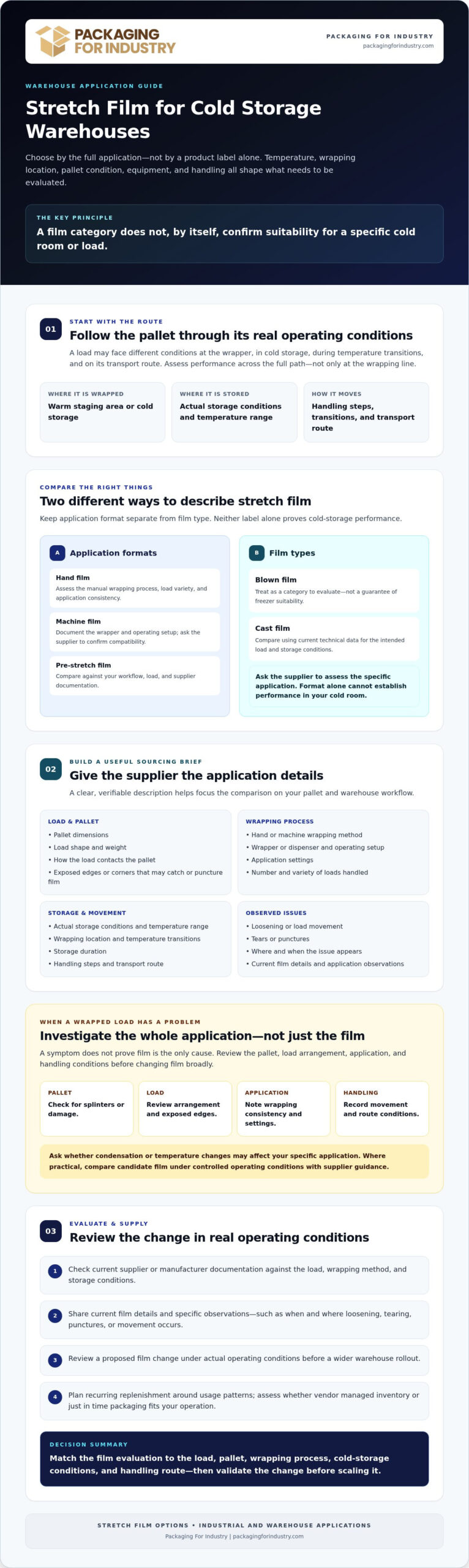
Build a Cold Storage Stretch Film Specification and Buying Checklist
A useful quote request connects film selection to the warehouse application and purchasing plan. Give the supplier enough detail to review the load and wrapping process, then compare pricing against your requirements rather than product descriptions alone. This helps buyers assess potential ways to lower packaging costs while keeping load stability and supply reliability in view.
What information belongs in a stretch film quote request?
Prepare these details before requesting a stretch film quote:
- Load: Describe the goods, approximate weight, dimensions, shape, and exposed edges.
- Pallet: Note pallet dimensions, type, condition, and any features that could affect wrapping.
- Wrapping method: State whether the team wraps by hand or uses a machine, and where wrapping takes place.
- Equipment: Identify the wrapper or dispenser and share relevant setup information. Mark unknown specifications for supplier review.
- Storage and handling: Describe the intended environment, verified temperature information, handling steps, and transitions between zones.
- Current film and issue: Include current film details if available, and explain the problem you want to address, such as tearing, rewrapping, or load movement that may contribute to shipping damage.
- Usage and delivery: Share expected usage, order frequency, bulk quantity needs, delivery location, and whether recurring replenishment is required. Ask whether custom sizes are available if your operation needs a nonstandard format.
How should buyers assess supplier and replenishment fit?
Compare suppliers on how they address your application, provide current technical information, confirm equipment compatibility, and support your order process. For packaging for manufacturers or distribution centers, include purchasing cadence and delivery requirements so the discussion reflects day to day demand. Southern California buyers can ask about local packaging supply; businesses sourcing bulk packaging supplies can request pricing for their stated quantities.
For repeat use, ask whether PFI’s vendor managed inventory program fits your usage and purchasing process. Consider the replenishment approach alongside film suitability. Evaluate any opportunity to reduce waste or packaging costs against your own operating data rather than assuming savings from a quote alone.
Source Cold Storage Stretch Film and Keep Warehouse Supply Reliable
PFI supplies hand, machine, pre-stretch, blown, and cast stretch film for industrial applications. These options give buyers categories to evaluate against their wrapping process, equipment, load, and supplier documentation. No film category alone confirms suitability for a particular cold room.
When can a packaging supplier add value beyond product supply?
A supplier can review film needs alongside pallet and load details, equipment, handling steps, and purchasing cadence. PFI serves warehouses, manufacturers, food and beverage businesses, and logistics operations. Its practical value comes from connecting product selection with supply planning, rather than treating each order as a standalone purchase.
For warehouse teams, a supplier reviewed approach may help address wrapping inconsistencies and support reliable operations. Any potential reduction in packaging costs or product damage depends on the application and customer specific evaluation. PFI also offers vendor managed inventory and just in time packaging services for businesses with recurring needs.
What is the next step for a cold storage warehouse buyer?
Gather your application information, current film details, observed issues, expected usage, order frequency, and delivery location. Ask PFI to review the requirements and identify which film options merit further evaluation, with current documentation supporting any suitability recommendation. Southern California customers can discuss local supply needs, while PFI supports nationwide requirements through distribution and manufacturing partners.
Make Your Cold Storage Film Decision With Confidence
Reliable pallet wrapping starts with matching the film to the load, wrapping process, equipment, and actual storage conditions. For stretch film for cold storage warehouses, a category or label isn’t enough. Use current supplier documentation and evaluate the option under your operating conditions before making a broader change.
PFI supplies hand, machine, pre-stretch, blown, and cast stretch film for industrial and warehouse customers. Share your application details and purchasing pattern to discuss which options merit review. For recurring needs, PFI’s vendor managed inventory and just in time packaging services can support replenishment planning. PFI serves Southern California locally and supports nationwide customers through distribution and manufacturing partners.
A clear specification gives your team and supplier a practical starting point for dependable supply and a film decision grounded in your operation’s needs.
Frequently Asked Questions
Does stretch film need to be specially rated for cold storage?
Not necessarily, but don’t assume a film is suitable for your cold storage application based on its category or label alone. Ask the supplier for current manufacturer documentation that addresses your storage conditions, wrapping method, load, and equipment. Confirm any cold storage claims in writing, and verify compatibility before making a broad purchasing change. There isn’t one universal film choice that can be confirmed for every freezer and warehouse process.
Can stretch film become less effective in a frozen goods warehouse?
Yes, cold conditions may affect film behavior, but the result depends on the specific film and application. Wrapping in a warm staging area and moving a pallet into a freezer can differ from wrapping inside cold storage. If film loosens, tears, or breaks, record when the problem occurs. Also inspect pallet condition, load arrangement, application settings, and handling rather than assuming temperature is the only cause.
How do I choose stretch film for a cold storage warehouse?
Assess the full application: load dimensions and shape, pallet condition, wrapping location, application method, equipment, storage conditions, and route through handling or shipping. Compare hand, machine, pre-stretch, blown, and cast categories with supplier guidance, then review current technical documentation for the intended conditions. For stretch film for cold storage warehouses, a controlled evaluation using representative loads can help your team assess fit before expanding a change.
Is hand or machine stretch film better for frozen goods?
Neither is automatically better for frozen goods. Assess hand film against the manual wrapping process, workload, and ability to apply film consistently. Review machine film against the specific wrapper and operating setup, with compatibility confirmed by the supplier. In either case, share where wrapping occurs and how pallets move into and through cold storage. Evaluate documented suitability for the actual load and process.
What information should I include in a cold storage stretch film quote request?
Describe the load, pallet dimensions and condition, wrapping method, dispenser or wrapper, and storage environment. Include temperature information your team has verified, where wrapping happens, and any transitions between zones. Share current film details from labels or purchasing records, if available, and explain the issue you want to address, such as film breaks, rewrapping, or shifting loads. Add expected usage, order frequency, quantity needs, and delivery location.
Can a packaging supplier help manage recurring stretch film inventory?
Yes. A packaging supplier may be able to discuss recurring needs and whether a vendor managed inventory or just in time packaging program fits your purchasing process. PFI offers both services for packaging requirements. Share usage history, order cadence, lead time needs, storage space, and production or shipping schedules to support the discussion. PFI serves Southern California locally and supports nationwide customer needs through distribution and manufacturing partners.
How can I reduce stretch film waste in a cold storage operation?
Start by tracking film use and wrapping issues on representative loads. Review application consistency, film breaks, rewrapping, pallet condition, and load arrangement with operations staff and your supplier. Avoid changing film or application settings across the warehouse without evaluating the effect on load stability under your actual conditions. Compare material use and observed outcomes with the current process. Confirm any potential reduction in waste using your own operating data.