
What if keeping less packaging on site didn’t mean accepting more production risk? Managing a just-in-time packaging supply chain takes more than trimming stock. A shortage can interrupt production or delay shipments, while bulk purchasing ties up warehouse space and working capital. Custom boxes, foam, and crates add another challenge when supplier lead times don’t match demand.
The goal is leaner inventory without putting production or shipping at risk. Set replenishment around actual usage, supplier lead times, storage capacity, and operating schedules. For critical items, assess whether a buffer is appropriate instead of applying the same stock rule to every supply.
This guide covers how to set practical stock and reorder levels, coordinate recurring and custom packaging, and reduce emergency orders and excess inventory. It also explains how vendor-managed inventory and just-in-time packaging programs can organize replenishment. Packaging For Industry reviews usage, lead times, storage, and production or shipping schedules to help businesses plan for stock and custom packaging needs.
Key Takeaways
- Set replenishment levels using usage history, demand variation, supplier lead times, storage limits, and operating schedules.
- Managing a just-in-time packaging supply chain means coordinating availability with actual use, not simply reducing on-site stock.
- Compare bulk purchasing and vendor-managed inventory by who owns stock, manages replenishment, and provides storage space.
- Assess packaging risks before implementation, and consider added protection against supply interruptions for critical items.
- PFI’s VMI and JIT programs can coordinate recurring replenishment for suitable stock and custom packaging needs.
What managing a just-in-time packaging supply chain means for operations
Just-in-time packaging coordinates replenishment with actual material use and planned operational needs. The aim is to have packaging available when work requires it, without keeping more inventory on site than necessary. For manufacturers, warehouses, distributors, and fulfillment operations, the challenge is to balance availability with storage capacity and purchasing needs, not simply reduce stock.
JIT is an inventory approach associated with the broader principles of Lean manufacturing. In practice, managing a just-in-time packaging supply chain means linking packaging orders to demand patterns, supplier lead times, and production or shipping schedules. It doesn’t require eliminating every inventory buffer. A business may retain a reserve for items where a shortage could disrupt operations, while replenishing predictable items more closely around use.
How just-in-time packaging differs from simply ordering less
Reducing inventory without changing the ordering process can leave a facility exposed to stockouts. A dependable replenishment plan defines what is used, when to reorder, who monitors stock, and how purchasing and the supplier communicate changes. If no one owns the reorder trigger, lower on-site stock can quickly become a production or shipping problem.
Base decisions on actual usage, supplier lead times, and operating schedules. For example, a warehouse with steady shipments can plan replenishment for regularly used corrugated boxes by reviewing consumption alongside incoming supply timing. If the shipping schedule changes, review the reorder plan too. The aim is to keep materials available without treating excess inventory as the default safeguard.
Which businesses and packaging items may benefit
JIT packaging can suit manufacturers, warehouses, distributors, and fulfillment operations with repeat demand and usage that can be tracked. Regularly used corrugated boxes, foam, stretch film, tape, and other packaging supplies may be candidates for planned replenishment. The fit depends on demand, storage limits, lead times, and the consequences of running short.
Custom items and irregular demand need individual assessment. A custom box or foam component may not have a suitable off-the-shelf substitute, while an unpredictable shipping schedule can make usage harder to forecast. Packaging For Industry reviews usage, lead times, storage, and production or shipping schedules when planning VMI and just-in-time inventory management. Businesses considering foam packaging options can include those requirements in the assessment rather than applying one stock rule to every item.
How to coordinate packaging demand, lead times, and replenishment
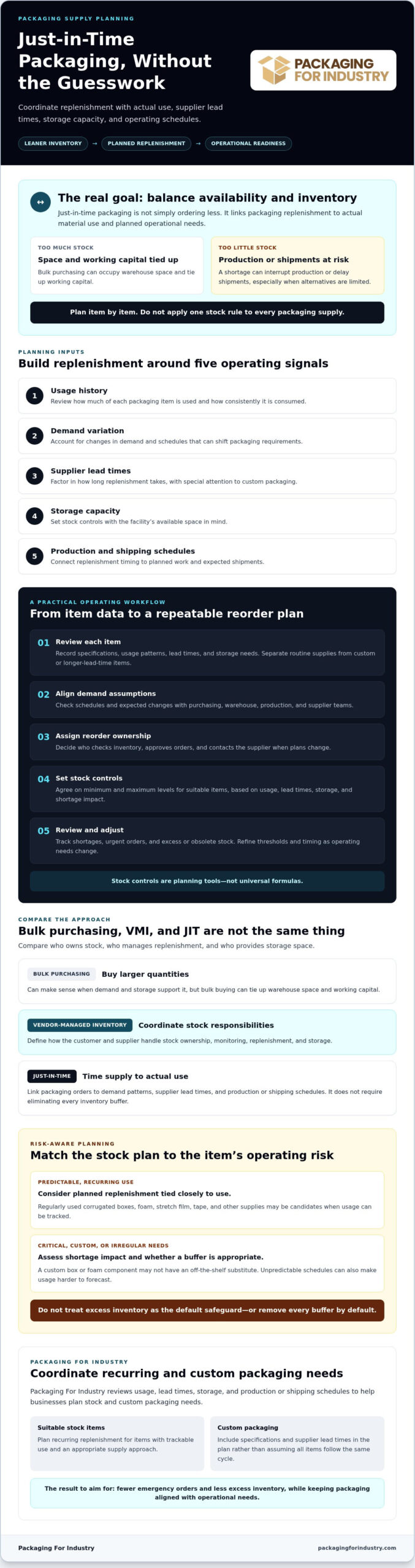
A practical replenishment plan starts with item-level information, not one inventory rule for every supply. Review usage history, demand variation, supplier lead times, storage limits, and production or shipping schedules. This helps distinguish routine needs from custom items that require more planning. It also gives purchasing teams a clearer basis for comparing packaging costs and deciding whether bulk purchasing fits their demand and available space.
Use this workflow to connect packaging demand to specific ordering actions:
- 1. Review each item. Record specifications, usage patterns, lead times, and storage needs. Separate routine, high-use materials from custom or longer lead-time items.
- 2. Align demand assumptions. Check schedules and expected changes with purchasing, warehouse, production, and supplier teams. For packaging used in warehouses, account for shipping plans that may change consumption.
- 3. Assign reorder ownership. Decide who checks inventory, approves orders, and contacts the supplier when plans change. Clear responsibility helps prevent missed reorder signals and unnecessary purchasing follow-up.
- 4. Set stock controls. Agree on minimum and maximum levels for suitable items. Treat these as planning controls, not universal formulas. Consider usage, lead times, storage capacity, and the impact of a shortage.
- 5. Review and adjust. Track shortages, urgent orders, and excess or obsolete stock. Use what you learn to refine thresholds and replenishment timing as operating needs change.
Set review cycles and replenishment triggers
Choose a review rhythm that matches usage and the team’s capacity to monitor stock. Packaging For Industry’s vendor-managed inventory reviews can be weekly, biweekly, or monthly. Agree on the stock level that triggers replenishment, who communicates schedule changes, and how potential delays are escalated. A vendor-managed inventory packaging program can support planned reviews for recurring needs.
Use each review to check whether the item mix and order timing still fit. A well-matched plan may help limit unnecessary inventory and purchasing friction. Reliable access to the correct packaging can also reduce the need for rushed substitutions that may affect product protection and complicate efforts to reduce shipping damage.
For recurring supplies or custom items, bring usage and lead-time details into a discussion with a supplier. The Lean Enterprise Institute’s overview of just-in-time production offers useful context for connecting supply timing with operational needs.
Just-in-time packaging vs. bulk purchasing and vendor-managed inventory
These approaches differ in how much packaging a business keeps on site, who monitors replenishment, and how much coordination purchasing teams manage. None is automatically the lowest-cost or most reliable choice. The right fit depends on demand stability, storage capacity, supplier lead times, and the work required to keep materials available.
- Bulk purchasing: The buyer orders larger quantities and typically manages stock and reordering. This can suit predictable demand and available storage, but changes in usage may leave excess or obsolete inventory taking up space.
- Just-in-time purchasing: Orders are coordinated more closely with expected use and operating schedules. The buyer and supplier need clear demand information, reorder triggers, and communication to help avoid shortages.
- Vendor-managed inventory: The supplier supports inventory review and planned replenishment using agreed information. Stock ownership and other terms depend on the arrangement, so clarify them rather than assuming VMI transfers ownership or risk.
When bulk packaging purchases may be a better fit
Bulk buying can work well when packaging demand is steady, the items are unlikely to change, and the facility has room to store them. A purchasing team may also prefer fewer ordering events. Before placing a larger order, consider how a production change, revised packaging requirement, or slower shipping schedule could affect the stock on hand. Inventory that no longer fits the operation can take up warehouse space and tie up working capital.
When VMI or just-in-time packaging may fit recurring demand
Recurring packaging needs may benefit from planned inventory reviews and agreed replenishment triggers. For example, regular use of a standard box may be easier to coordinate than demand for an item that varies. Custom boxes, foam, or crates still need lead-time planning because substitutes may not be suitable. A just-in-time packaging inventory management program can help align reviews and replenishment with recurring requirements.
Managed replenishment still depends on realistic planning. Schedules can change, demand can rise or fall, and supplier delays can affect availability. Agree how teams will share changes, review stock levels, and respond when a planned delivery no longer matches operational needs. Managing a just-in-time packaging supply chain means coordinating these responsibilities, not assuming that less inventory or supplier involvement removes risk.
How to implement a just-in-time packaging supply chain without ignoring risk
A JIT program should reduce unnecessary inventory without leaving production or shipping exposed to avoidable shortages. Start with a defined group of packaging items, then build controls around how each is used, replenished, and affected by operational changes. Managing a just-in-time packaging supply chain works best when the process accounts for exceptions as well as routine demand.
- Assess items and processes. List packaging in use, its purpose, current stock, and who orders it. Identify items that could interrupt production or delay shipments if unavailable.
- Map demand and constraints. Review usage history, demand changes, supplier lead times, warehouse capacity, and production or shipping schedules. Include custom items because their replenishment needs may differ from stock packaging.
- Set responsibilities and controls. Agree who monitors inventory, who places or approves orders, and what minimum and maximum stock levels apply to each item. Set review frequency and a clear process for communicating schedule changes or potential delays.
- Monitor exceptions and adjust. Track shortages, urgent orders, excess stock, and purchasing workload. Review these measures with the teams involved, then revise thresholds or timing when usage, packaging requirements, or operating plans change.
Plan for shortages, demand shifts, and custom-item lead times
Not every packaging item carries the same risk. Determine which materials are essential to keeping production running or orders shipping, and assess the likely impact of a delay for each. A buffer may be appropriate for a critical item, but its size should reflect actual demand variation, replenishment conditions, and available storage, not a blanket rule.
Custom boxes, foam, and crates deserve early attention if they have no suitable substitute. Include their specifications and supplier lead times in program planning, and revisit the plan when product or packaging requirements change. PFI’s custom packaging design can be considered when packaging needs call for a tailored design.
Use operating measures to improve the program
Review results over time instead of assuming the initial plan will remain appropriate. Repeated urgent orders may signal that a threshold or demand estimate needs adjustment. Excess stock may point to changed usage, outdated requirements, or replenishment that no longer matches the schedule. Include purchasing workload too. If stock is controlled but the process creates repeated manual follow-up, clarify ownership or improve communication.
For Southern California operations, align inventory reviews with the teams responsible for purchasing, the warehouse, and production or shipping. Keep the supplier informed when schedules or packaging specifications change so replenishment decisions reflect current needs.
How PFI supports a dependable just-in-time packaging supply chain
Packaging For Industry (PFI) supports recurring packaging needs through vendor-managed inventory and just-in-time inventory management. Its assessment considers usage, lead times, storage, and production or shipping schedules before establishing stocking levels and review cycles. This helps businesses plan supply around operational requirements instead of relying on a one-size-fits-all inventory rule.
Coordinate recurring stock and custom packaging needs
PFI supplies corrugated boxes, foam packaging, stretch film, and crates. Teams can assess suitable recurring items together, considering how each product’s usage and replenishment needs fit the operation. Custom boxes, foam, and crates can also be discussed, with their specifications and lead times included in the plan. Not every item will be suitable for managed replenishment, so the assessment focuses on program fit.
These packaging solutions serve manufacturers, aerospace and electronics companies, warehouses, distributors, and fulfillment operations. A coordinated program may help reduce excess on-site inventory and purchasing follow-up, while helping lower the risk of a packaging shortage disrupting production or shipping. PFI can support both stock products and custom packaging items, with replenishment planning shaped by the factors that affect each item.
PFI serves Southern California and supports certain multi-location or nationwide requirements. For qualifying programs, the team can consider delivery locations alongside usage and storage needs, helping businesses discuss a supply approach that fits their operating footprint.
Prepare a useful packaging program inquiry
To start a productive discussion, gather packaging item descriptions and specifications, usage history, known supplier lead times, storage limits, and production or shipping schedules. Include custom items such as boxes, foam, or crates, as well as the locations that need supply. Identifying the teams responsible for purchasing, receiving, and monitoring inventory also helps clarify how reviews and replenishment could work.
These details give PFI a practical basis for discussing stocking levels, review cycles, and which items may suit a VMI or JIT program. The goal is a supply process that supports packaging availability while keeping inventory and purchasing activity aligned with business needs.
Build a packaging plan your operation can rely on
Managing a just-in-time packaging supply chain is about coordinating replenishment, not simply cutting inventory. Set stock levels around actual usage, supplier lead times, storage capacity, and operating schedules. Then review shortages, urgent orders, and excess stock to identify where the plan needs adjustment.
Packaging For Industry can assess recurring packaging needs, including stock products and custom items such as corrugated boxes, foam, and crates. Inventory review cycles can be set weekly, biweekly, or monthly, giving teams a regular opportunity to check demand and replenishment. The right approach depends on each item and your operation’s requirements.
Bring your packaging details and usage history into the conversation to help shape a dependable program for your business. A clear plan can support availability while keeping inventory aligned with warehouse and production needs.
With a defined review process and supplier coordination, your team can work toward a more predictable packaging supply and keep operations moving.
Frequently Asked Questions
What does just-in-time packaging mean?
Just-in-time packaging means coordinating replenishment with expected use and operating needs instead of relying only on large, infrequent purchases. A practical plan considers item usage, supplier lead times, storage capacity, and production or shipping schedules. It doesn’t automatically eliminate every inventory buffer. Before starting, define who monitors stock, when reviews happen, and how internal teams and the supplier will communicate changes or escalate a potential shortage.
How can a just-in-time packaging system prevent stockouts?
A just-in-time system can help reduce stockout risk when it uses reliable usage information, realistic lead-time planning, agreed stock thresholds, and regular communication. Managing a just-in-time packaging supply chain also means identifying materials that are critical to production or shipping, including custom items that may need more planning. No replenishment process removes every disruption risk, so review shortages and urgent orders, then adjust the plan when demand or supply conditions change.
Is vendor-managed inventory the same as just-in-time packaging?
No. Just-in-time describes coordinating supply with operational needs, while vendor-managed inventory means a supplier helps review inventory and plan replenishment through an agreed process. A business can use VMI to support a just-in-time packaging approach. Before a program begins, clarify who monitors usage, recommends or sets stock levels, approves orders, and communicates changes. These responsibilities should be clear to both the supplier and the purchasing and operations teams.
What packaging items can be managed through a just-in-time program?
Recurring items such as corrugated boxes, foam packaging, and stretch film may be considered, depending on usage patterns and program fit. Custom boxes, foam, and crates may also be included, but their specifications and lead times need individual attention. Start by listing the packaging materials used regularly, how demand changes, and what happens if each item is unavailable. An inventory assessment can then help determine which supplies are suitable for planned replenishment.
How do you set packaging replenishment levels?
Set replenishment levels using actual usage, demand variation, supplier lead times, storage capacity, and production or shipping schedules. There’s no single stock level that works for every item or business. Review historical usage and current requirements with purchasing, warehouse, and operations teams. Then agree on minimum and maximum thresholds, review timing, reorder responsibility, and an exception process. Revisit those controls when packaging requirements or operating schedules change.
Can just-in-time packaging work for custom boxes and foam?
It can be considered, but custom packaging needs planning around its specifications, production requirements, and supplier lead times. A custom box or foam component may not have a suitable off-the-shelf substitute, so assess its operational importance before setting stock levels. Include custom items in the replenishment discussion, identify who will communicate changes in demand, and agree how the team will respond if delivery timing shifts or requirements change.
What information should I provide when requesting a packaging supply program?
Prepare a list of packaging items and specifications, usage history, supplier lead times, storage constraints, and production or shipping schedules. Include custom boxes, foam, or crates that need separate planning, along with the locations that require packaging. Identify who handles purchasing, receiving, and inventory monitoring. These details give a supplier serving Southern California businesses a practical starting point for discussing suitable stocking levels, review cycles, and replenishment responsibilities.