
A stock box can make a routine order simple, but a poor fit can mean excess void fill, extra handling, and avoidable shipping risk. Catalog limitations can matter when a fragile, heavy, unusually shaped, or high-value product does not fit or stay protected in standard packaging. The phrase Uline limitations for complex packaging needs is best considered as a question of fit: does the packaging option meet your product’s dimensions, protection requirements, and repeat-order needs?
Catalog purchasing still has a place for standard items and predictable replenishment. When products need a precise fit, coordinated materials, or consistent protection across recurring orders, a more tailored supply approach may be useful. Unit price is only one part of the decision. Freight, damage exposure, storage, and inventory demands also affect packaging’s operating impact.
This guide compares stock packaging with engineered solutions to help you identify where requirements are genuinely complex and how to weigh fit, protection, handling, and total cost. It also explains how PFI’s custom packaging design, packaging reviews, CAD/CAM support, prototypes, and managed replenishment can help clarify specifications and support repeat supply.
Key Takeaways
- Catalog packaging can suit standard, repeatable orders. Complex needs arise when product fit, protection, shipping, or replenishment requirements do not align with stock options.
- Compare packaging by fit, damage exposure, handling, freight dimensions, and storage needs, not only by unit price.
- Document product details, packaging materials, shipment issues, and order patterns to identify the right next step.
- Custom and stock packaging can work together. Tailor critical components while keeping suitable standard items in the regular purchasing process.
- Design support, coordinated materials, and managed replenishment can help address packaging challenges tied to product protection and recurring supply.
Catalog Limitations for Complex Packaging Needs: Where Ordering Can Fall Short
Catalogs make standard purchasing straightforward. If your team repeatedly ships products that fit known box sizes, use familiar materials, and need no special handling, selecting and reordering stock packaging can be efficient. A catalog-led approach can suit those requirements. Its limits matter when the product needs packaging built around its dimensions, protection requirements, or shipping process.
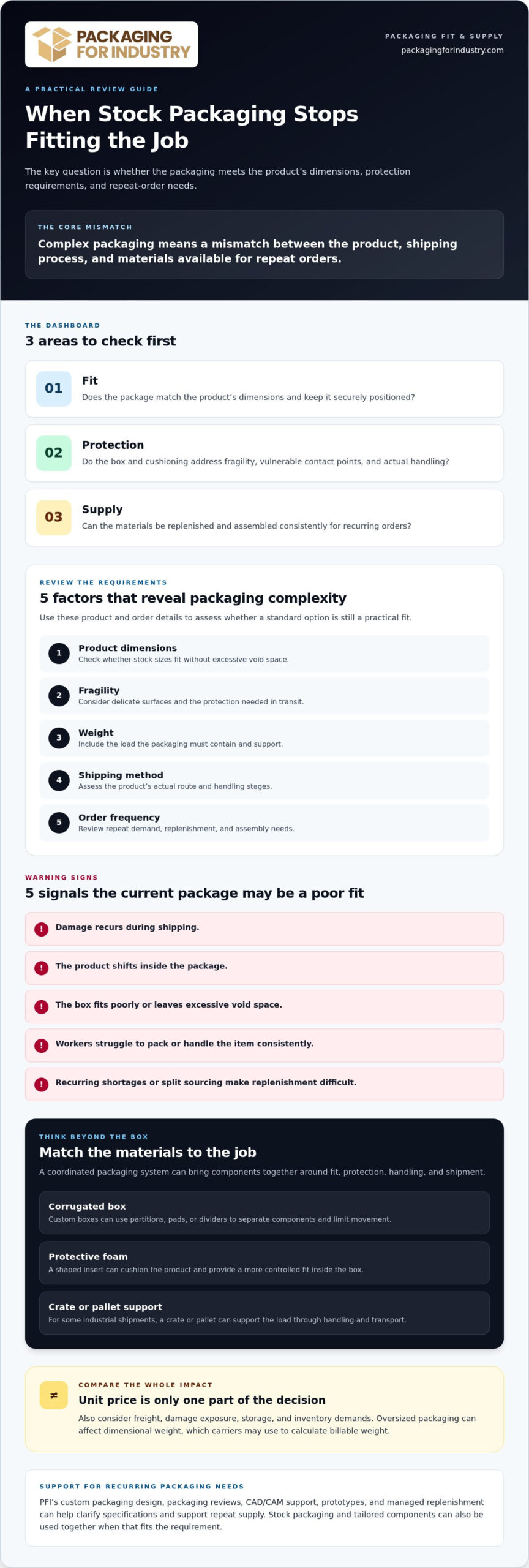
Complexity is not a judgment about a supplier. It describes a mismatch between what a product or operation needs and what standard packaging can provide. Complex packaging is a fit, protection, or supply mismatch between the product, shipping process, and materials available for repeat orders. Product dimensions, fragility, weight, shipping method, and order frequency all help reveal whether that mismatch exists.
Packaging does more than contain a product. It supports protection, handling, information, and movement through the supply chain, as outlined in this overview of packaging as a coordinated system of preparing goods.
When a standard packaging order is still a practical fit
Standard packaging is often suitable when product dimensions are consistent, the required materials are known, and handling is straightforward. A warehouse that regularly ships the same components in a familiar stock box may benefit from simple reordering and established packing procedures. Common consumables can also be purchased separately when they do not need a product-specific design.
The calculation changes for irregular, fragile, or high-value products. A stock box may not hold an item securely, and standard cushioning may not address its protection needs. In those cases, repeatability alone is not enough. The package must also fit and protect the item through its actual shipping route.
Signals that a packaging requirement is more complex
Review the packaging when damage recurs, the item shifts in transit, the box fits poorly, void space is excessive, or workers struggle to pack or handle it consistently. These are practical signs that the current box-and-cushion combination may not suit the product or shipping process.
Depending on the need, custom corrugated boxes, specialized foam packaging, crates, or a combination of materials may provide a better-matched solution. PFI’s custom packaging design services connect design decisions to documented fit and protection requirements.
Supply patterns can signal complexity, too. Recurring shortages, difficult-to-replenish items, and packaging components split across multiple sources can add purchasing and inventory work. For repeat demand, review not only the package itself but also how materials are replenished and assembled. This helps distinguish a one-time packaging adjustment from an ongoing supply issue.
Why Complex Products Need More Than a Stock Box or Standard Cushion
A stock box and standard cushioning can work well when a product’s shape, weight, and handling needs are consistent. An engineered solution becomes more useful when the product shifts in transit, has delicate contact points, or moves through several handling stages. The practical difference is repeatability: a designed package can make product placement and protection more consistent from shipment to shipment.
Oversized packaging can also affect shipping calculations. Carriers may use package dimensions to calculate dimensional weight, so extra space can influence billable weight even when the product itself is relatively light. The Uline limitations for complex packaging needs become relevant when a stock size forces a tradeoff between fit, protection, and shipment dimensions.
Material selection chooses the components; packaging system design makes those components work together to protect, handle, and ship the product. For some industrial shipments, that system may include a corrugated outer box, a shaped foam insert, and a crate or pallet that supports the load through handling and transport.
Matching corrugated boxes and protective foam to the product
Start with the product’s dimensions, weight, vulnerable surfaces, and expected handling. These details inform the outer box and how an insert holds the product in place. Custom corrugated boxes can use partitions, pads, or dividers to separate components and limit movement. Protective foam can cushion the product and provide a more controlled fit inside the box.
PFI supplies foam packaging alongside custom and stock corrugated options. Evaluating the box and cushioning together helps avoid treating each component as a separate fix.
When crates, ESD materials, or specialized protection enter the decision
Heavy, fragile, sensitive, or high-value industrial components may need more than a box-and-cushion combination. A foam-lined crate brings cushioning and a rigid outer structure together for demanding handling needs. For electronics, ESD packaging may be relevant when the application requires protection from electrostatic discharge. The right combination depends on the product and shipping conditions.
Design support can help assess the full package, from product fit to shipment handling. PFI’s custom packaging design process includes CAD/CAM support, prototypes and samples, and packaging reviews. For a product-specific solution, request a custom packaging quote with the product and shipping requirements.
Uline vs. an Industrial Packaging Supplier: Compare the Whole Packaging System
A useful comparison looks beyond the individual box or roll of cushioning. Match the purchasing model to each packaging need: a familiar stock item may suit routine shipments, while products with specific fit or protection requirements may call for design support and coordinated materials.
| Decision area | Catalog-led purchasing | Engineered industrial supply |
|---|---|---|
| Standard availability | Useful for selecting repeatable items with known requirements. | Can include stock packaging alongside items tailored to a product or process. |
| Custom design | Works when standard dimensions and materials fit the application. | Design support can address product-specific fit, protection, and handling needs. |
| Material integration | Buyers coordinate components that may come from separate orders or sources. | Boxes, foam, crates, and other materials can be considered as one packaging system. |
| Recurring supply | Reordering familiar items can keep routine purchasing simple. | Repeat-order planning, kitting, or managed replenishment may support ongoing demand. |
Use the table to assess more than item price. Check how each option affects product fit, potential damage exposure, packing labor, freight dimensions, storage needs, and emergency replenishment. An oversized box, for example, may affect dimensional shipping calculations. A poorly matched insert may also require extra handling at the packing station. The actual impact depends on the product, shipment, order pattern, and packaging design.
For a practical cost comparison, consider these factors together rather than treating each material as a separate line item.
Compare total operating impact, not only the item price
Review the current package from receiving through shipment. Track recurring damage, time spent positioning or securing the product, space used for packaging inventory, and disruptions caused by urgent replenishment. These observations help identify whether a change should target package design, the purchasing process, or both. They also give teams a consistent basis for comparing packaging pricing without assuming that one option will always cost less.
Compare supplier support for engineered and recurring requirements
For a complex project, consider whether CAD/CAM design support, prototypes, samples, packaging reviews, or kitting would help validate the solution and make packing more repeatable. Multiple materials may need to work together, especially when an outer container, protective insert, and load support serve different functions. Include crates in the comparison when the product or shipment calls for that form of protection and handling.
Keep routine items on catalog purchasing if they meet the need. A mixed sourcing model can reserve engineered packaging for products with documented fit or protection challenges while leaving straightforward consumables on familiar reorder paths. Evaluate the Uline limitations for complex packaging needs item by item, rather than treating them as a reason to replace every existing source.
How to Decide Whether Your Packaging Needs Have Outgrown Catalog Ordering
A packaging review can show whether you need a design change, a more coordinated supply plan, or no change at all. The goal is not to replace every catalog item. It is to identify the specific products or processes where the current approach creates a documented fit, protection, or replenishment problem. That makes the Uline limitations for complex packaging needs easier to evaluate without disrupting purchasing that already works.
Run a practical packaging review before comparing suppliers
Choose the products or packaging items that cause the most concern, then record details your team can observe:
- Product: Note dimensions, weight, fragile areas, and handling considerations.
- Current package: List the box or container type, cushioning, and other materials used. Identify where fit is loose, tight, or inconsistent.
- Shipment: Record shipping methods, damage or movement in transit, and freight or dimensional concerns.
- Order pattern: Track recurring usage, stockouts, substitutions, over-ordering, and storage pressure.
Separate urgent issues from operational friction. Product damage, poor fit, or difficult packing may call for a packaging review. Repeated shortages, excess inventory, or purchasing split across sources point to a longer-term supply question. Classify each item as standard, a candidate for custom sizing, or one that may need coordinated materials. Keep standard purchasing in place for items that meet documented requirements.
Decide whether to redesign, consolidate, or manage replenishment
Match the response to the problem. If the product shifts, arrives damaged, or takes extra effort to pack consistently, provide the product and shipment details for a design review. CAD/CAM support, prototypes, and samples can help assess whether a revised package addresses the observed issue before it becomes the repeat-order specification.
If the packaging design works but repeat-use items run short or are routinely over-ordered, focus on replenishment instead. Vendor managed inventory is most relevant when demand is recurring and usage can inform planned supply. PFI’s vendor managed inventory program supports that ongoing need. For a one-time order, a managed inventory approach may add unnecessary process.
Use the review to make a targeted decision: retain catalog purchasing for suitable standard items, redesign only where fit or protection falls short, and address replenishment separately when repeat demand creates friction.
How PFI Addresses Complex Packaging Needs Beyond a Catalog Order
When a packaging review identifies a fit, protection, shipping, or supply problem, the solution should match that requirement. Packaging For Industry (PFI) supplies custom and stock industrial packaging, including corrugated boxes, foam packaging, stretch film, pallets, and crates. Manufacturers, warehouses, distributors, and aerospace, electronics, and medical device companies can use custom design for specialized needs while retaining standard items that already work.
Combine packaging design, materials, and operational support
PFI’s design support includes CAD/CAM, prototypes and samples, and packaging reviews. These resources help teams assess whether a proposed design addresses a documented issue, such as product movement, damage during handling, or a package that slows packing operations.
Components can be evaluated together rather than as disconnected purchases. Depending on the application, a solution may pair a corrugated box with protective foam, cushioning, stretch film, or a crate. Coordinating materials can simplify packaging specifications and purchasing. A suitable fit and protection approach can also support efforts to reduce shipping damage and improve handling. Learn more about custom packaging design services.
PFI’s industrial focus serves product-specific requirements in aerospace and aviation, electronics, medical device manufacturing, and industrial equipment. Custom and stock options can work side by side: use tailored packaging where the product or shipping process calls for it, and keep standard packaging for routine needs. This targeted approach avoids unnecessary changes while addressing issues that affect product protection and workflow.
Plan dependable repeat supply for packaging used in production
For packaging used regularly, supply planning matters alongside design. PFI’s vendor managed inventory and just-in-time inventory management support recurring demand by considering usage, lead times, storage, and production or shipping schedules. Agreed review cycles help teams plan replenishment around operating patterns rather than treating every order as an isolated purchase. These programs are most relevant when packaging is used repeatedly.
PFI supports customers in Orange County, Los Angeles, San Diego, and Riverside, as well as nationwide needs through distribution and manufacturing partners. Buyers can bring product details, shipment conditions, current packaging concerns, and order patterns to start a focused review.
Build a Packaging Approach That Fits Your Operation
Catalog ordering remains practical for packaging with known specifications and predictable use. When a product’s fit, protection, shipping requirements, or repeat supply create friction, evaluate the full operating need rather than defaulting to a stock item. Understanding Uline limitations for complex packaging needs can help you decide what to keep standard and where a tailored solution makes sense.
PFI connects custom design support, including CAD/CAM, prototypes, and samples, to documented packaging challenges. Corrugated, foam, crates, and other materials can be coordinated as one solution, while vendor managed inventory and just-in-time management can support recurring demand. This provides a considered path to packaging that protects products and supports dependable operations without requiring an all-or-nothing switch.
Bring product details, shipment conditions, current packaging concerns, and order patterns to the review. A clear starting point helps align the packaging plan with the work it needs to do.
With the right information and a practical review, you can move toward packaging that fits your products and operation.
Frequently Asked Questions
Are catalog suppliers a good fit for complex industrial packaging needs?
Catalog suppliers can be a practical fit for standard packaging with known specifications and straightforward reordering. Complex requirements may call for more tailored support when product dimensions, fragility, handling, or recurring supply needs do not align with available stock items. Packaging for manufacturers and distribution centers can involve both types of needs, so assess items individually. Retain catalog purchasing where it meets documented requirements, and review items that create fit, protection, or replenishment issues.
When should a manufacturer consider custom packaging instead of stock boxes?
Consider custom packaging when a stock box fits poorly, leaves excess space, complicates packing, or does not protect the product consistently. Irregular dimensions, fragile areas, and specific handling conditions can all affect the right design. Custom box sizes or protective inserts may help address a documented fit or protection issue. Record product dimensions, current materials, shipping conditions, and damage patterns to give a packaging design review a useful starting point.
Can a supplier combine corrugated boxes, foam, and crates in one packaging solution?
Yes. Packaging For Industry (PFI) can coordinate corrugated boxes, protective foam, and crates as parts of an integrated solution. A product may need an outer box, an insert to help limit movement, and a crate suited to its shipping and handling needs. The appropriate combination depends on the product and shipment. Evaluating components together helps align their functions instead of treating each material as an unrelated purchase.
How can I compare packaging suppliers beyond unit price?
Compare the full operating impact, not just the price per box or cushion. Review fit, damage exposure, packing labor, freight dimensions, storage requirements, and replenishment needs. Request bulk packaging pricing based on comparable product and shipment requirements, then consider how each option affects day-to-day handling and inventory. The impact varies with the product, order pattern, shipping method, and package design, so use your own operating details to guide the comparison.
What information should I include in a custom packaging quote request?
Include product dimensions and weight, fragile or sensitive areas, current packaging materials, and shipping method. Describe any damage, fit, or packing problems, along with how the product is handled and palletized. For recurring requirements, share order patterns, usage, and replenishment concerns. These details help PFI prepare a relevant custom packaging quote or corrugated box quote and assess whether custom design, stock packaging, or a combination best fits your operation.
Can custom packaging help reduce shipping damage or freight issues?
Custom packaging can address problems related to poor fit, insufficient cushioning, or package dimensions that do not suit the shipment. A design review can assess the outer box, insert, and handling structure together. A better-matched package may support efforts to reduce shipping damage and review dimensional freight concerns, but results depend on the product, shipment, carrier, and design. Prototypes and samples can help evaluate product fit before adopting a revised package for ongoing use.
How can vendor managed inventory help with recurring packaging supplies?
Vendor managed inventory can organize recurring packaging supplies around usage, lead times, storage, and production or shipping schedules. PFI supports businesses in Orange County, Los Angeles, San Diego, and Riverside with inventory programs for repeat needs. Local packaging delivery can be considered as part of the supply plan. VMI is most useful for packaging used regularly, when planned reviews and replenishment can support inventory control rather than for a one-time order.