
What makes a product presentation kit look organized before anyone handles its contents? The foam insert. When components shift, arrive damaged, or sit unevenly in their cavities, the kit loses both protection and a polished presentation. For teams sourcing die cut foam for product presentation kits Orange County, the layout needs to suit the products and the people assembling each kit.
Specifying only the outside dimensions of a box is not enough. Each cavity should reflect the component’s size, shape, and placement, while the overall layout supports consistent presentation and repeatable assembly. Considering the box, custom foam insert, and kitting process together can help reduce handling issues and keep components organized.
This article covers the information to prepare for a custom foam quote, how CAD/CAM support and prototypes can move a design toward production, and what to consider when planning recurring kit assembly. Packaging For Industry provides custom foam design, prototypes and samples, and packaging kitting for businesses in Orange County, including Anaheim and Irvine. PFI also serves businesses in Los Angeles, San Diego, and Riverside. The goal is a practical path from your components and design inputs to a presentation-ready kit.
Key Takeaways
- Start with a complete kit inventory and component dimensions so the cavity layout reflects how each item is presented, removed, and replaced.
- Review a prototype or sample to assess the insert’s fit and arrangement before planning a broader rollout.
- Compare foam and insert options against component characteristics, presentation goals, and handling needs rather than appearance alone.
- For die cut foam for product presentation kits Orange County, consider the insert, box, and kitting sequence together to support consistent assembly.
- Prepare kit contents, dimensions, quantities, purpose, and known handling needs to help scope a custom foam quote with PFI’s CAD/CAM, prototyping, and kitting support.
Why Die-Cut Foam for Product Presentation Kits in Orange County?
A presentation kit has two jobs: protect its contents and make each item easy to see and handle. Die-cut foam inserts use shaped cushioning with cavities arranged for specific components, accessories, or documents. Unlike loose cushioning that can shift or cover the contents, a planned insert gives every item a defined place. This supports an orderly first view of the kit and helps staff return components to consistent positions during packing.
Presentation does not replace protection. The insert should help hold components in place, while the outer box and overall packaging plan support the intended handling and distribution. PFI designs custom foam inserts and assemblies around project requirements. Learn more about custom foam packaging for product kits.
What makes a foam insert suitable for a presentation kit?
A suitable layout starts with the actual contents. One cavity might be planned for the primary product, another for an accessory, and a separate space for a document that needs to stay visible and accessible. Placement matters: the order and orientation of items affect what recipients see first and how easily they can lift out and replace each piece.
Foam geometry should follow component dimensions and intended handling, not assumptions based on the box alone. The goal is an organized layout that supports both presentation and practical use.
When does custom die-cut foam make sense?
Custom die-cut foam can suit kits with several components, items with surfaces that need separation, or contents that must be placed consistently. Purpose-designed cavities make the arrangement easier to recognize than loose cushioning, which can obscure parts or leave their positions unclear. A considered die-cutting process shapes material into the planned insert layout.
For product teams and manufacturers in Anaheim or Irvine, repeatable placement can make recurring kit assembly more controlled. CAD/CAM support, prototypes, and samples let teams review how components fit and present together before a design moves toward production. The right arrangement depends on the kit, including how users remove and replace each item.
For a die cut foam for product presentation kits Orange County project, treat the insert as part of the complete packaging solution. Coordinating foam, a suitable box, and packaging kitting helps align the kit’s appearance with the work required to assemble it.
How to Design Die-Cut Foam Around Kit Components and Presentation
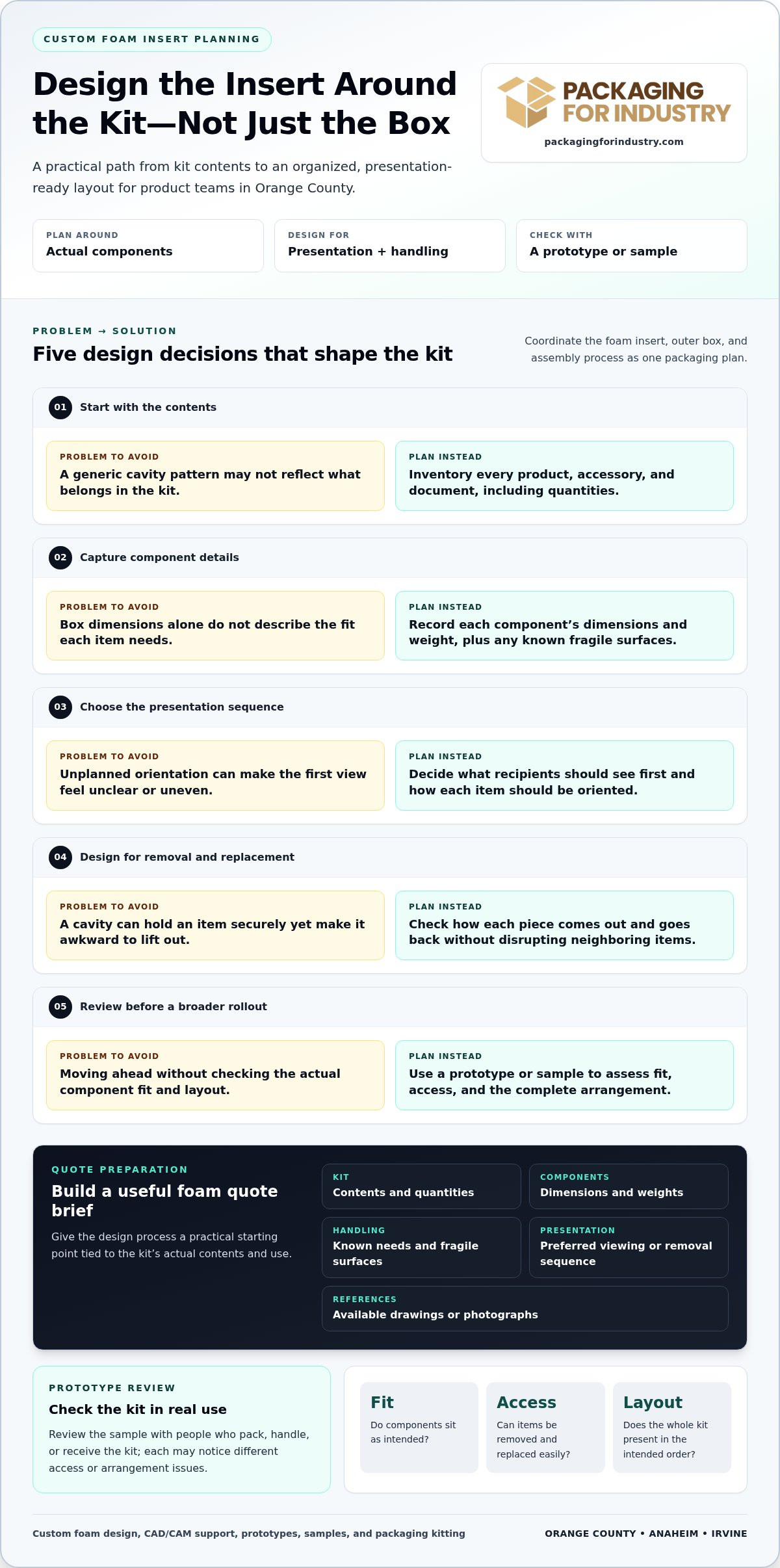
A useful insert design starts with the kit, not a generic cavity pattern. For die cut foam for product presentation kits Orange County, plan the layout around what recipients should see first, how components will be handled, and how the kit will be assembled repeatedly.
- Inventory the contents. List every product, accessory, and document, including quantities.
- Capture dimensions and details. Record each component’s dimensions and weight, and note any known fragile surfaces.
- Define the presentation. Choose the intended orientation and sequence, including which items should be most visible when the kit opens.
- Plan the cavities. Consider how each piece will be lifted out and returned. A cavity that holds an item securely but makes removal awkward can slow handling or disrupt the arrangement.
- Review a prototype. Use a sample to assess fit, access, and the complete layout before planning a rollout.
Labels, color coding, or branding may also be considered when they support the project’s presentation or assembly needs. Treat them as choices for the specific kit, not automatic requirements.
What information should buyers prepare for a foam quote?
Share component dimensions, quantities, weights, and known fragile surfaces. Include the kit’s purpose, how recipients are expected to handle it, and the preferred order for viewing or removing items. Photographs or drawings can provide useful references. These details give the design process a practical starting point and connect cavity geometry to the actual components.
A useful foam quote brief includes the kit contents, component dimensions and quantities, weights, known handling needs, presentation sequence, and any available drawings or photographs.
How do prototypes help validate a presentation layout?
A prototype or sample lets teams assess whether components fit as intended, remain easy to identify, and can be removed and replaced without disrupting neighboring items. Review the layout with people who pack, handle, or receive the kit. Each may spot a different issue with access or arrangement. PFI’s custom packaging design services include CAD/CAM support and prototypes for reviewing a proposed design.
Once you’ve assembled the component details, request a custom foam quote based on the kit’s actual contents and use.
Compare Foam Materials and Insert Styles for Presentation Kits
Material and layout decisions should support the kit’s contents, intended presentation, and handling. No single foam type or insert format suits every project. For die cut foam for product presentation kits Orange County, compare options against the specific components and how the finished kit will be used. Avoid assuming one material or construction fits every application.
How should buyers compare PE, PU, and ESD foam?
PE, PU, and ESD foam are categories to evaluate against the project brief, not interchangeable labels that determine the design on their own. The product, its handling needs, and the presentation goal should guide the discussion. If kit contents require static-control packaging, include that requirement when evaluating ESD foam. Material suitability depends on the specific application, so a material name alone should not be treated as a guarantee of protection.
| Foam category | What to consider for the kit |
|---|---|
| PE foam | Assess it against the components, intended handling, cavity layout, and project requirements. |
| PU foam | Compare its suitability for the kit contents and presentation goals with other project options. |
| ESD foam | Include it in the evaluation when static-control packaging is a requirement for the kit contents. |
Share component details and intended use with your packaging partner so material selection can be considered alongside the insert design. PFI tailors custom foam packaging to project requirements rather than assuming the same choice fits every kit.
Which insert layout fits a multi-component kit?
A single-layer insert places components together in one visible arrangement, which can suit kits where recipients need to identify contents at a glance. A layered layout can separate groups of items or create distinct levels in the presentation, but it changes how recipients access components. Consider whether the contents of each layer are clear and whether the removal sequence is practical.
Fitted cavities give individual components defined positions. Foam pads or custom foam assemblies may also suit the project, depending on the kit and how it will be handled. The best choice balances organization and access with the desired presentation. Review PFI’s foam packaging options as a starting point for a project-specific discussion.
Plan a Die-Cut Foam Project with an Orange County Packaging Supplier
A presentation-kit project moves more smoothly when design, packaging, and assembly requirements are considered together. Define the kit’s purpose and contents, then share component information with your packaging supplier. Next, review the proposed design, evaluate a sample, and plan production around the approved layout. This sequence connects the foam insert to how the kit will be packed and used.
Packaging For Industry (PFI)’s CAD/CAM support and prototyping help teams review a proposed foam design before rollout. A sample gives the people closest to the work a chance to assess the arrangement and identify adjustments during the design stage. For manufacturers and product teams in Anaheim and Irvine, working with an Orange County packaging supplier brings custom foam design and related packaging needs into the same project conversation.
What should buyers evaluate before approving a sample?
Review the sample with the complete kit in mind, not just the insert. Confirm that each component fits its intended cavity, remains visible in the planned arrangement, and can be removed and returned without disrupting other items. Test the layout inside the intended box, case, or container so you can assess the assembled kit as a whole.
Invite feedback from packing and operations teams, procurement, and staff who present or receive the kit. Their perspectives can reveal whether the layout is practical to assemble, clear to handle, and appropriate for the intended presentation. Gathering feedback before approval helps align the design with both workflow and recipient experience.
How can kitting support repeatable presentation?
Once the insert layout is set, packaging kitting and assembly can help coordinate how components are arranged in each kit. The loading sequence should follow the cavity plan, so assembly instructions and insert geometry support the same process. Pairing foam with suitable corrugated packaging lets the team plan the complete solution instead of coordinating separate parts later.
Packaging For Industry (PFI) provides packaging kitting and assembly services for businesses in the Anaheim area. For die cut foam for product presentation kits Orange County, coordinated design and assembly planning can support consistent recurring builds while keeping product protection in view.
For businesses seeking reliable packaging services in Anaheim, local support ensures streamlined logistics and quality control from start to finish.
Get a Custom Die-Cut Foam Quote for Your Orange County Presentation Kit
A focused quote request gives the design process a practical starting point. For die cut foam for product presentation kits Orange County, describe the kit’s purpose and contents, how recipients will handle it, and the arrangement you want. Packaging For Industry (PFI) serves Orange County and Southern California, supporting manufacturers and industrial teams with custom foam inserts and assemblies. PFI also serves customers in Los Angeles, San Diego, and Riverside.
What belongs in a presentation-kit foam quote request?
Share the details that shape the insert and its place in the complete kit. Include available drawings or photos, the intended component layout, and whether the insert needs to fit a coordinating box or case. If kits will be assembled repeatedly, note the expected order pattern and any assembly support needed.
- Kit contents: List each product, accessory, and document, with quantities.
- Component details: Provide dimensions, weights, and known handling needs.
- Purpose and layout: Explain the kit’s use and the intended order or orientation of its contents.
- Packaging needs: Note whether a coordinating box or kitting support is required.
- Order information: Include expected quantities so PFI can prepare a project-specific quote and help you compare packaging pricing, including bulk packaging pricing where relevant.
Custom sizes are available through project-specific design. Complete component and order details help PFI scope the work and identify practical ways to lower packaging costs without sacrificing the kit’s presentation or protection. Pricing and production planning depend on project requirements.
How does PFI support a custom kit project?
PFI supports custom kit projects with CAD/CAM design, prototypes and samples, custom foam inserts and assemblies, and packaging kitting. These capabilities serve industrial customers, including aerospace, electronics, and medical device manufacturers, as well as other manufacturing teams. Reviewing a sample before production helps teams assess the layout. Coordinating foam, a suitable box, and assembly can support organized presentation, product protection, and efficient packing.
As an Orange County industrial packaging supplier, PFI brings these project stages together for local and recurring packaging needs. Share your kit requirements to start planning a custom foam solution.
Build a Presentation Kit That Works from Design Through Assembly
A successful foam insert balances clear presentation with practical product protection. Start with the actual kit components, dimensions, and handling needs, then assess the layout with a prototype before moving toward production. Choose material and insert style for the specific kit rather than following a one-size-fits-all approach.
For buyers evaluating die cut foam for product presentation kits Orange County, Packaging For Industry brings custom foam inserts and assemblies, CAD/CAM support, prototypes, and packaging kitting together. PFI serves Orange County, including Anaheim and Irvine, as well as Los Angeles, San Diego, Riverside, and the wider Southern California region. Coordinating the foam, suitable packaging, and assembly process can help teams create a consistent kit and a more controlled packing workflow.
Share your component details and intended kit use to begin shaping a practical design.
With a clear brief and a design built around the contents, your team can move toward kits that look organized, protect their components, and are easier to assemble consistently.
Frequently Asked Questions
What is die-cut foam for product presentation kits?
Die-cut foam for a presentation kit is shaped cushioning with cavities arranged for the kit’s specific products, accessories, or documents. Each item has a planned place, making contents easier to see and return after handling. The cavity layout should reflect actual component dimensions, orientation, and how recipients will remove and replace items. The insert can be considered alongside the kit’s box or container to support presentation and protection.
How do I choose foam for a product presentation kit?
Choose foam and an insert layout based on the kit contents, presentation goals, and handling requirements. Start with a component list, dimensions, quantities, weights, and any known fragile surfaces. Then consider how recipients will view, remove, and replace each item, and whether the kit needs static-control packaging. A prototype or sample can help your team review fit and arrangement before moving toward production.
Is polyethylene or polyurethane foam better for a presentation kit?
Neither polyethylene foam nor polyurethane foam is automatically the better choice for every presentation kit. Compare them against the components, intended handling, cavity design, and project requirements rather than choosing by material name alone. Include known product sensitivities and the kit’s purpose in the design brief. PFI can consider foam material alongside the layout and packaging plan when developing custom foam inserts for a specific application.
Can die-cut foam protect products while improving kit presentation?
Yes. A planned foam insert can give components defined positions and organize what recipients see when they open the kit. Cavities designed around actual items can help keep the arrangement consistent and support handling, while the foam and outer packaging work together as a protective solution. The appropriate design depends on the products and their use. A sample review can help assess fit, visibility, removal, and placement before a broader rollout.
What information do I need for a custom foam quote in Orange County?
For a useful quote, provide a kit inventory, component dimensions and quantities, weights, purpose, and known handling needs. Include the intended layout or sequence, available drawings or photographs, and details about the box or case if it needs to coordinate with the insert. For die cut foam for product presentation kits Orange County, also describe the expected order pattern and whether packaging kitting or assembly support is part of the project.
Can a foam insert be designed for multiple components in one kit?
Yes. Custom foam inserts can have separate cavities for multiple products, accessories, and documents. The layout should reflect each component’s dimensions and orientation, plus the order in which recipients should see or handle the contents. A single-layer or layered arrangement may suit the kit, depending on access and presentation needs. PFI’s CAD/CAM support and prototypes can help teams review a proposed layout with the actual components.
Can foam inserts be supplied with packaging kitting and assembly?
Yes. PFI provides packaging kitting and assembly services that can be planned alongside custom foam inserts and suitable packaging. Coordinating the cavity arrangement with the assembly sequence gives packing teams a clear plan for placing kit components. Review a sample with the people who assemble or handle the kit to assess the workflow. PFI serves Orange County, including Anaheim and Irvine, and supports packaging projects across Southern California.