
What if reducing the number of packaging SKUs made purchasing simpler without putting product protection at risk? For manufacturers, overlapping specifications can complicate ordering, consume warehouse space, and tie up working capital. But standardizing without checking fit and performance can lead to product damage or shipping problems.
Reducing the number of packaging SKUs works best as an engineering and inventory-planning exercise, not a blanket switch to one package. Manufacturers, warehouses, distributors, aerospace companies, electronics businesses, and medical-device operations can review corrugated boxes, foam, stretch film, crates, and other industrial packaging for genuine overlap while retaining items with distinct functions.
This guide explains how to assess packaging usage, compare consolidation options, and plan changes without disrupting production or supply. Packaging For Industry supports these reviews with custom and stock packaging, design services, CAD/CAM support, and prototypes. The goal is a more manageable purchasing and inventory system that supports product protection and reliable operations.
Key Takeaways
- Map packaging specifications, usage, lead times, and storage needs to identify potential overlaps.
- When reducing the number of packaging SKUs, compare protection, fit, handling, shipping, and replenishment requirements before consolidating.
- Decide whether to retain, combine, redesign, or phase out each item based on operational evidence.
- Coordinate purchasing, warehouse, production, and shipping teams before changing approved specifications or ordering practices.
- Consider custom packaging design and managed inventory to align recurring packaging needs with reliable replenishment.
Why reducing the number of packaging SKUs can improve purchasing and inventory control
Packaging SKU rationalization means identifying and consolidating duplicate or overlapping specifications while retaining items that meet distinct protection, fit, handling, or shipping needs. Packaging SKU reduction removes unnecessary variation while preserving the fit, product protection, and supply continuity each operation requires. It isn’t a mandate to use one package for every product or substitute materials without testing.
A packaging Stock Keeping Unit (SKU) identifies an item for inventory management. In packaging, separate SKUs may reflect differences in box dimensions, foam configuration, material, or intended use. Comparing those specifications can reveal where several items serve the same need, and where apparent duplicates actually support different products or shipping methods.
Which packaging items belong in a SKU review?
Start with recurring items that teams order, stock, and use, such as corrugated boxes, foam inserts, stretch film, tapes, and bags. Include stock packaging and custom packaging designed around a particular product, packing process, or shipping method. A custom box or foam insert may be essential to product fit and protection, even if it appears similar to another item in the inventory list.
Include packaging used across manufacturing, warehouse, distribution, and fulfillment operations. The same material may be ordered under different identifiers or managed separately by different teams. Reviewing items across these handoffs can uncover duplication without overlooking packaging tied to a specific production or shipping requirement. PFI’s custom packaging design services can help assess how packaging specifications work together.
What business problems can redundant packaging SKUs create?
Overlapping specifications increase the number of items procurement must source, track, and replenish. Buyers may have to manage separate ordering cycles and supplier details for packaging that serves nearly identical purposes. These items also take up storage locations and need clear identification so employees select the right packaging during production and fulfillment.
Slow-moving materials can remain in storage after a product, process, or shipping method changes. That inventory may be harder to use when its original application is no longer active. Too much variation can also make shortages harder to manage: a rushed substitute may not fit the product or provide suitable protection.
The goal of reducing the number of packaging SKUs is a controlled review, not a blanket cut. Retain specifications with distinct functions and investigate potential overlaps using actual usage and performance information. This can simplify purchasing and inventory control while supporting production flow and dependable packaging supply.
How to audit packaging SKUs using usage, specifications, and performance
A useful audit combines purchasing records with shop-floor experience. First identify items worth reviewing. Then validate whether a shared specification can serve their applications without compromising fit, protection, or replenishment.
Build a reliable packaging SKU baseline
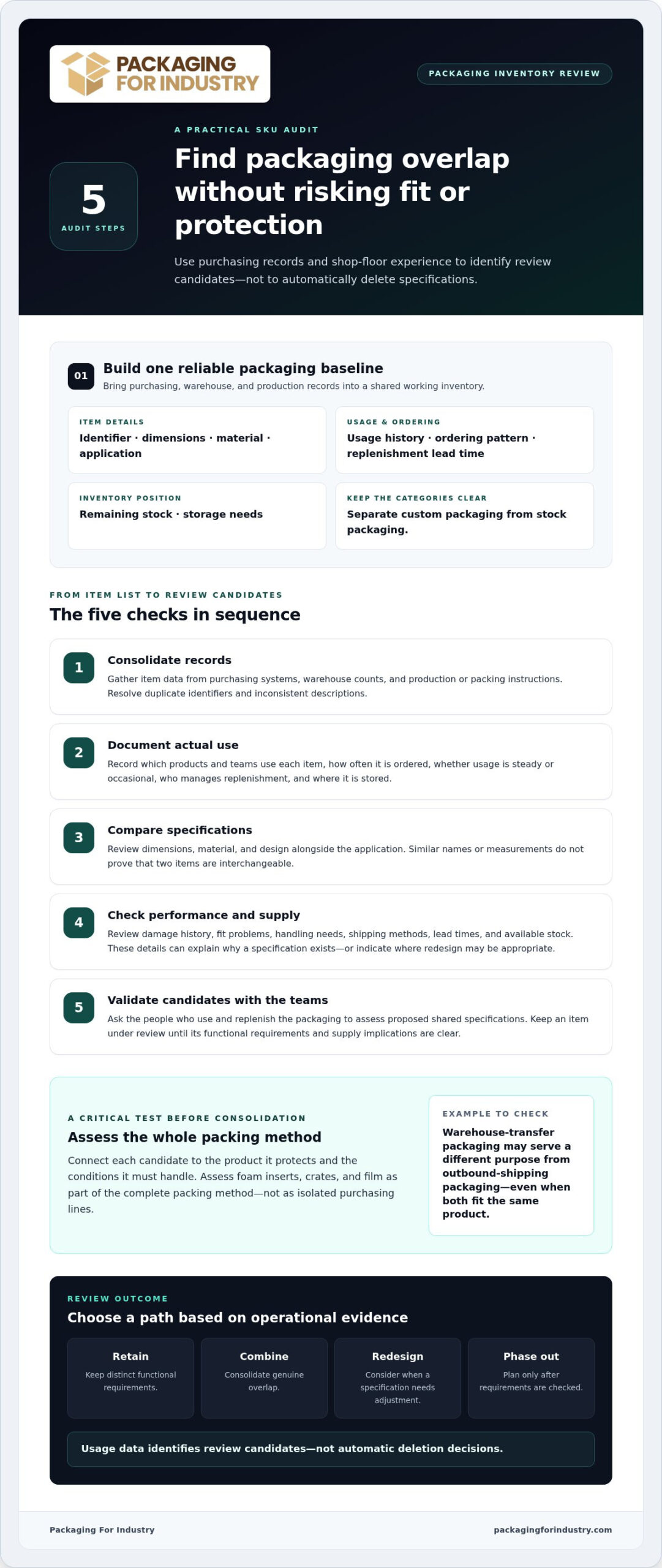
Combine purchasing, warehouse, and production records into one working inventory. Include custom corrugated boxes, foam inserts, crates, stretch film, and other recurring shipping supplies. For each item, record its identifier, dimensions, material, application, usage history, ordering pattern, replenishment lead time, remaining stock, and storage needs. Separate custom and stock items so standard supply materials aren’t confused with packaging engineered for a particular product or shipping method.
Use this sequence to move from the item list to review candidates:
- 1. Consolidate records. Gather item data from purchasing systems, warehouse counts, and production or packing instructions. Resolve duplicate identifiers and inconsistent descriptions.
- 2. Document actual use. Note which products and teams use each item, how often it is ordered, and whether usage is steady or occasional. Record who manages replenishment and where the item is stored.
- 3. Compare specifications. Review dimensions, material, and design alongside the application. Flag apparent overlaps, but don’t assume items are interchangeable because their names or measurements look similar.
- 4. Check performance and supply. Review damage history, fit problems, handling needs, shipping methods, lead times, and available stock. These details can explain why a specification exists or show where a redesign may be appropriate.
- 5. Validate candidates. Ask the teams that use and replenish the packaging to assess proposed shared specifications. Keep an item under review until its functional requirements and supply implications are clear.
Test candidate SKUs against product and shipping requirements
Connect every candidate to the product it protects and the conditions it must handle. For example, a box used for warehouse transfers may serve a different purpose from one used for outbound shipping, even if both fit the same product. Assess foam inserts, crates, and film as part of the complete packing method, not as isolated purchasing lines.
Usage data identifies review candidates, not automatic deletion decisions. Before reducing the number of packaging SKUs, use damage records and operator feedback to confirm that a proposed consolidation maintains fit and protection. PFI’s custom packaging design services can support engineering reviews when specifications need closer evaluation. For additional context on packaging waste reduction strategies, consult the U.S. Environmental Protection Agency’s guide. Once your audit has produced validated candidates, request a packaging quote to review options for recurring needs.
How to compare packaging SKU consolidation options without increasing risk
Compare candidates as complete packaging systems, not isolated line items. A box may seem suitable based on its dimensions but require different cushioning, handling, or shipping methods. Before reducing the number of packaging SKUs, consider product protection, fit, packing workflow, actual usage, and replenishment together. A change that simplifies ordering but increases damage or creates a production bottleneck isn’t a sound consolidation.
| Decision | Best fit | What to verify |
|---|---|---|
| Retain | The item serves a distinct product, shipping, or handling need. | Confirm the application still exists and the specification remains fit for purpose. |
| Combine | Several items support products with compatible dimensions, protection needs, and workflows. | Check fit, cushioning, packing steps, shipping method, and replenishment needs across each use. |
| Redesign | A packaging format may be adjusted to serve multiple applications without losing required protection. | Evaluate the proposed design through an engineering review and practical validation before adopting it. |
| Phase out | An item has no current application or a validated replacement is already in use. | Review remaining stock, upcoming demand, and the transition plan before removing it from purchasing. |
When can multiple packaging SKUs share one specification?
Shared packaging can make sense when products have compatible dimensions, protection requirements, and packing workflows. For example, two products may fit the same stock corrugated box if each can be secured appropriately and the shipping method is similar. They may still need different cushioning, so compare the complete pack-out, not just the outer container. Stock boxes can serve common applications, while custom boxes remain an option for distinct product or shipping requirements.
When should a packaging SKU remain product-specific?
Keep a dedicated specification when a product’s fragility, weight, value, or unusual shape calls for a different fit or protective design. Separate packaging may also be necessary when handling or shipping methods differ. Aerospace, electronics, and medical-device operations can have distinct product and workflow requirements, so assess each application rather than assuming one specification fits all.
Compare the total operational impact, not just the unit purchase price. Consider purchasing workload, storage use, damage exposure, packing efficiency, replenishment, and the possibility of rush orders if a shared item runs short. PFI’s custom design and packaging reviews can help assess combinations, including corrugated boxes and foam, against recurring needs.
How to implement packaging SKU reduction without disrupting production
A sound transition keeps production supplied while teams move to validated packaging. Before reducing the number of packaging SKUs, agree on the approved replacement, when it becomes standard, and how remaining stock will be handled. Procurement, operations, warehouse, production, and shipping teams should understand the change before an item is retired.
Plan the transition from old items to consolidated packaging
Set the transition point using current inventory, replenishment lead times, and production schedules. Use existing stock appropriately rather than discarding usable materials or mixing old and new specifications without clear instructions. If existing stock will be used before the change, define how teams will identify the replacement and when purchasing should switch to the approved specification.
Update connected processes together. Revise item records and purchasing instructions, then align packing procedures, warehouse locations, and internal communications. Make the approved packaging easy for employees to identify and use. Establish a way for teams to report fit issues, handling problems, or damage concerns during initial use, and assign responsibility for reviewing those reports.
Keep the right packaging available after consolidation
Fewer item numbers don’t automatically reduce stockout risk. Set replenishment expectations using actual usage, lead times, and agreed inventory levels. Review whether consolidated items are being consumed as expected, and monitor stockouts, emergency orders, damage reports, storage pressure, and changes in usage after rollout.
Packaging for warehouses depends on practical storage and replenishment planning. PFI’s warehouse packaging solutions support the task of keeping recurring supplies organized and available. For ongoing needs, vendor managed inventory (VMI) provides a structured way to review usage and plan replenishment. PFI VMI programs can use weekly, biweekly, or monthly review cycles to help teams respond to demand patterns and maintain supply continuity. Learn more about vendor managed inventory for packaging.
After implementation, compare results with the baseline. If emergency orders rise, packaging accumulates, or damage and fit concerns appear, investigate the cause and adjust the plan. A controlled rollout keeps the focus on simplifying purchasing and inventory without sacrificing the packaging performance production and shipping depend on.
How PFI supports packaging SKU reduction with custom design and managed supply
Reducing the number of packaging SKUs takes more than deleting duplicate item numbers. PFI can review custom and stock packaging used in recurring operations, connecting packaging design with purchasing and replenishment needs. That means assessing whether boxes, foam, crates, stretch film, and other materials work together as a system, rather than optimizing one item while creating fit or handling problems elsewhere.
What PFI can assess in a packaging consolidation project
A packaging review can consider current specifications, usage patterns, product requirements, lead times, and warehouse constraints. PFI’s custom packaging design capabilities include CAD/CAM support and prototypes to help evaluate fit and protection before a design is adopted. For box requirements, review corrugated box options alongside protective foam and other materials used in the same pack-out.
For example, a manufacturer may use separate box specifications for products with similar dimensions but require different foam configurations to protect them. Reviewing the box and cushioning together can show whether a shared outer package is practical while preserving product-specific protection where needed. The assessment should also account for how each option affects packing steps, storage, and recurring supply.
What to include in a packaging quote request
A clear starting point helps focus the review. Prepare:
- A list of current packaging items and identifiers, including custom and stock materials.
- Approximate usage or ordering patterns for recurring packaging needs.
- Product dimensions and a brief description of how each item is packed and shipped.
- Known concerns, such as damage, fit issues, storage pressure, or rush orders.
- Relevant replenishment lead times and upcoming production or shipping changes.
These details connect packaging specifications to actual operating conditions. They also help PFI review potential combinations, identify items that may need custom design, and compare options with the goal of lowering packaging costs without sacrificing product protection or supply reliability. For recurring demand, vendor managed inventory (VMI) and just-in-time inventory management can help align replenishment with usage after specifications are reviewed.
Make Packaging Simplification a Controlled Improvement
Reducing the number of packaging SKUs works best when you remove unnecessary variation, not packaging that serves a distinct purpose. Use purchasing and usage records to identify candidates, then assess fit, protection, shipping needs, and replenishment before changing specifications.
A phased rollout helps keep production supplied: approve the replacement, coordinate teams, manage existing stock, and monitor results. Packaging reviews, custom design, CAD/CAM support, and prototypes can help evaluate options for recurring operations. Once specifications are settled, VMI review cycles of weekly, biweekly, or monthly can support planned replenishment.
Bring your current item list, approximate usage, product dimensions, and known packaging concerns to start a practical review focused on simplifying supply while protecting performance.
With a measured approach, your team can build a packaging system that’s easier to manage and dependable in daily operations. PFI supports businesses across Orange County, Los Angeles, San Diego, and Riverside with local packaging delivery, along with packaging supply options for recurring and nationwide needs.
Frequently Asked Questions
How do you reduce the number of packaging SKUs?
Reduce packaging SKUs by comparing item records, actual usage, specifications, and performance, then validating which items can share a specification. Review fit, protection, handling, shipping method, replenishment, and remaining inventory before changing purchasing. Keep packaging that serves a distinct product or operational need. A phased transition, coordinated with the teams that pack and ship products, helps maintain production flow while simplifying inventory.
Why should a manufacturer reduce packaging SKUs?
Reducing unnecessary packaging variety can simplify purchasing, storage, and replenishment. Fewer overlapping items may also make it easier for warehouse and production teams to identify and use the right packaging. Review potential benefits alongside the full operational impact, including protection and supply reliability. The aim is to lower packaging costs and inventory complexity without removing materials needed for product fit, safe handling, or consistent shipping.
Can packaging SKU reduction increase shipping damage?
Yes, if a company consolidates items without validating the replacement against product and shipping needs. A shared box, for example, may not provide the right fit or cushioning for every item it is intended to pack. Check damage history, operator feedback, and packing performance before rollout. Monitor damage and fit reports after the change, and revise the specification if actual use reveals a problem.
How do you identify redundant packaging SKUs?
Compare packaging records for items with similar dimensions, materials, applications, and usage. Then check whether they serve the same products, packing process, and shipping method. Purchasing data can show ordering patterns, while warehouse and production teams can explain how packaging performs in practice. Treat similarities as a reason to review an item, not proof that two specifications are interchangeable.
What packaging information should be reviewed before consolidating SKUs?
Review each item’s identifier, dimensions, material, application, usage history, ordering patterns, replenishment lead time, remaining stock, and storage needs. Also document the products and shipping methods it supports, along with damage history, fit concerns, and handling requirements. Combining purchasing records with input from warehouse, production, and shipping teams gives decision-makers a fuller picture of the packaging’s function and operational impact.
How can a business avoid packaging shortages after reducing SKUs?
Plan replenishment around actual usage, lead times, production schedules, and agreed inventory levels. Coordinate the purchasing change with the transition plan, then monitor stockouts, emergency orders, and demand changes after rollout. Packaging For Industry’s vendor managed inventory programs can use weekly, biweekly, or monthly review cycles to support planned replenishment for recurring needs in Orange County, Los Angeles, San Diego, and Riverside.
Can custom packaging be included in a SKU reduction project?
Yes. Custom boxes, foam inserts, or crates belong in the review alongside stock packaging, but a custom specification may remain necessary when it serves a distinct product or shipping requirement. Packaging For Industry can assess recurring packaging needs through reviews, custom design, CAD/CAM support, and prototypes. This helps evaluate potential changes for fit and protection while preserving packaging that performs a specific function.