
More packaging doesn’t always mean fewer damage claims. A box that is poorly sized, cushioning that shifts in transit, or a product that isn’t secured for its route can leave the same failure uncorrected while adding cost. Learning how to avoid shipping damage claims with better packaging starts with identifying where protection breaks down, then matching the package to the product and its handling conditions.
Repeat damage creates work beyond replacing an item. Teams may need to investigate, arrange rework, respond to customers, and repack orders, while still facing uncertainty about which change will help. The answer isn’t simply to use heavier materials. It’s to build a repeatable packaging system that protects the product and accounts for freight efficiency and day-to-day operations.
This article covers how to identify common failure points, choose suitable corrugated boxes, foam, cushioning, or crates, and evaluate packaging changes before standardizing them. It also explains how custom packaging design, prototypes, and samples can help assess fit and packing steps. Manufacturers, warehouses, and distributors in Orange County, Los Angeles, San Diego, and Riverside can use this process to make informed improvements and reduce preventable shipping damage.
Key Takeaways
- Trace recurring damage to product, packaging, or shipment risks before adding materials or changing box construction.
- Assess fragility, weight distribution, exposed edges, surface sensitivity, and sensitive components consistently to identify where protection may be failing.
- Match packaging adjustments to the observed damage, considering box fit and construction alongside foam, cushioning, or crates where appropriate.
- Validate packaging revisions with prototypes or samples before making them standard.
- PFI’s packaging reviews and custom design support can help tailor protection to products, shipping methods, and operational needs.
How better packaging helps prevent shipping damage claims
A shipping damage claim is a request to address loss or damage recorded after a shipment has completed transit. Packaging improvements aim to reduce preventable damage before it happens. They are distinct from documenting and handling a damage report or following carrier-specific claim procedures. Better packaging can’t guarantee claim-free shipments, but it can address weaknesses that repeatedly expose products to damage.
The impact goes beyond replacing a damaged item. Teams may spend time investigating what happened, arranging rework, responding to customers, and preparing a replacement shipment. Those tasks disrupt production and warehouse workflows. A practical goal is to reduce shipping damage by improving protection and containment based on evidence from recurring incidents.
What shipment damage can reveal about the package
Record what is damaged and the condition of the package on arrival. A crushed carton may point to a box construction or stacking concern. A puncture can indicate that exposed product areas need better protection. A product that shifts inside an intact carton suggests a fit or cushioning issue, while moisture exposure may prompt a review of how the shipment is enclosed and protected. These signs are useful clues, not automatic diagnoses.
Compare patterns across products, packaging configurations, and shipment types. If the same component is damaged in different cartons, its position or support may be a common factor. If damage appears only on certain routes or load configurations, review how the shipment is handled and contained. Comparing incidents gives operations teams a stronger basis for corrective action than treating every claim as an isolated event.
Why more packaging is not automatically better
Extra material can miss the problem. Excess space may let a product or its cushioning move, leaving it exposed to impact. Adding layers without correcting the fit can also make packing slower and less repeatable. Oversized packaging uses more warehouse and freight space, and package dimensions can affect dimensional charges depending on carrier pricing.
Fit-for-purpose protection balances product support, containment, handling, and efficient packing. A correctly sized corrugated box paired with cushioning that holds the item in place may address movement more directly than simply adding more fill. For products that need tailored protection, foam packaging options can be part of a coordinated packaging design.
Packaging and labeling includes core functions such as protection and containment. Applying those functions to a specific shipment means matching the package to the product and its handling conditions. To understand how to avoid shipping damage claims with better packaging, diagnose the failure before selecting a material. Damage prevention starts with diagnosing the failure, not adding material.
How to identify the shipping risks behind repeat damage
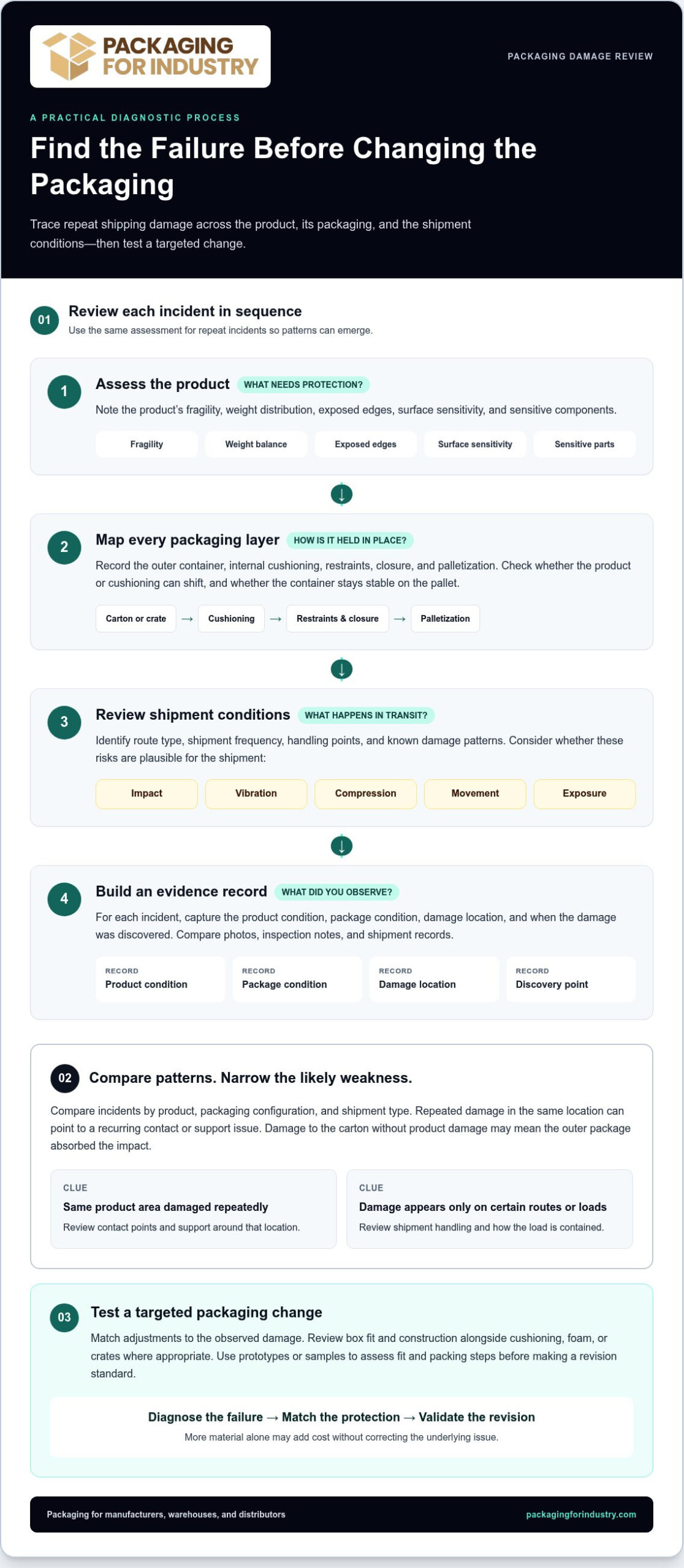
Recurring damage is easier to address when teams assess the product, package, and shipment as one system. Use the same review for repeat incidents so patterns can emerge across orders, rather than relying on a single claim or anecdote.
- Assess the product first. Note fragility, weight distribution, exposed edges, surface sensitivity, and sensitive components. A heavy part concentrated on one side may need different support from a delicate surface that can be scratched or a component vulnerable to movement.
- Map every packaging layer. Record the carton or crate, internal cushioning, restraints, closure, and palletization. Check whether the product can shift inside the package, whether cushioning stays in place, and whether the outer container remains stable on the pallet. Treat the layers as a connected system, not separate purchasing decisions.
- Review shipment context. Identify the route type, shipment frequency, handling points, and known damage patterns. Consider whether impact, vibration, compression, movement, or environmental exposure is plausible for that shipment. The Essential Packing Guide can serve as a general packing reference, but the assessment should reflect the product and its actual shipping conditions.
- Build a record from the evidence. For each incident, capture product condition, package condition, damage location, and when the damage was discovered. Compare photographs, inspection notes, and shipment records. Don’t assume that the same packaging weakness caused every incident simply because a product was damaged.
Use repeat patterns to isolate likely weaknesses
Compare incidents by product, packaging configuration, and shipment type. Damage in the same location may point to a recurring contact or support issue. Carton damage without product damage may indicate that the outer package absorbed the impact. Repeated damage in the same location can help isolate a packaging weakness worth testing. For complex equipment or freight, review the complete load and consider how a custom crate can support the product during transit.
Once the evidence suggests a likely cause, a packaging review can turn observations into a practical design change. PFI’s custom packaging design and review can help assess product and shipment needs. This structured approach to how to avoid shipping damage claims with better packaging gives teams a clearer basis for deciding what to change and evaluate next.
If recurring damage calls for a packaging revision, request a packaging quote with details about the product, current package, and shipment conditions.
Which packaging improvements address common shipping damage?
Choose a packaging change based on the failure pattern, not a general preference for heavier materials. Corrugated box construction and fit should suit the product’s weight, shape, and internal support. A carton that is too large can leave room for movement; a close fit without adequate cushioning can transfer impact directly to the product. PFI’s corrugated boxes for industrial shipments can be selected as part of a system that also accounts for cushioning, closure, and pallet stability.
| Observed failure | Packaging adjustment to assess |
|---|---|
| Product shifts inside an intact carton | Review box fit, internal restraint, and cushioning placement to keep the product in position. |
| Impact damage to a sensitive component | Consider foam inserts or shaped supports that cushion and separate the component from the outer package. |
| Crushed or damaged carton edges | Review box construction and add corner or edge protection where handling or compression is affecting those areas. |
| Damage to a heavy or oversized item | Assess whether a crate can provide suitable structure and containment for the shipment. |
| Package or product shifts on a pallet | Review load arrangement and stabilization so packages remain contained as a unit during handling. |
Choose cushioning and fit for the product
Foam inserts and end caps can support specific product areas and limit movement within a carton. Other cushioning materials can fill or separate spaces, depending on the package design. Protective foam supports or cushions the product; void fill primarily occupies empty space. These functions can overlap, but they aren’t interchangeable. Select the approach based on whether the observed issue is impact, contact, or movement.
Protect edges, closures, and pallet loads
Edge and corner protection can help shield vulnerable areas of a packaged product or load during handling. Secure closures help keep the package intact, while internal restraint prevents contents from shifting. Neither a stronger outer box nor added cushioning can compensate for a package that opens or allows the product to move freely.
For heavy, oversized, or sensitive industrial components, a crate, including a foam-lined configuration, may suit the load better than a carton alone. The full system should also account for how the shipment is arranged and stabilized on a pallet. A practical approach to how to avoid shipping damage claims with better packaging is to match each adjustment to a specific failure, then check that the box, cushioning, closure, and load work together.
How to validate packaging changes before standardizing them
A packaging revision should address an identified problem and fit the actual packing process. Review a prototype or sample before broader production so the team can assess product fit, material use, and the steps needed to prepare each shipment. A controlled evaluation also gives purchasing and operations a clearer basis for comparing packaging pricing and assessing whether a revision could help lower packaging costs without adding unnecessary materials.
Run a practical packaging trial
Select a representative product and shipment configuration. Use the sample to check how the product sits, whether cushioning stays in place, and whether the package closes and stabilizes on a pallet as intended. Record the package configuration, packing steps, shipment conditions, and product condition after transit. Compare the revised package with the previous approach using consistent internal damage and handling records, rather than memory or one isolated result.
Document what changed and train packing teams to follow the same configuration. If the revised package changes material use or order quantities, compare bulk packaging pricing alongside handling and freight considerations. Include storage and local packaging delivery needs in the review so the approved setup works for both shipping and replenishment.
Turn findings into repeatable packaging instructions
When a trial identifies a better-fitting package or packing sequence, update the instructions with clear guidance on material placement, restraint, closure, and pallet preparation. Track damage patterns alongside each packaging revision. This helps teams connect future observations to the configuration actually used and supports a consistent review.
Reassess packaging when the product, shipment method, or recurring damage pattern changes. Prototypes and samples can help refine fit before broader production, while clear instructions make the selected approach easier to repeat across packing runs. The goal is a practical revision that supports product protection and day-to-day operations, not a change made without evidence.
How PFI helps businesses reduce shipping damage with custom packaging
After identifying a recurring damage pattern, operations teams need packaging that addresses the product and shipment rather than relying on a one-size-fits-all setup. Packaging For Industry (PFI) works with manufacturers, warehouses, and distributors, including businesses in aerospace, electronics, and medical device manufacturing. Its industrial packaging range includes corrugated boxes, protective foam, cushioning materials, crates, and related supplies.
PFI combines packaging reviews with custom design support to help businesses assess how materials function as a system. Through custom packaging design services, teams can develop configurations tailored to product fit, shipping methods, and recurring packing needs.
Combine packaging materials around the actual failure point
If a product shifts inside a carton, a custom corrugated box paired with foam inserts or cushioning may address fit and restraint. Corner protection can support packages with vulnerable edges, while a crate may suit heavy, oversized, or sensitive industrial components. Each material should serve a clear purpose, with the overall design accounting for packing steps and freight efficiency.
PFI can review damage patterns and assess corrugated, foam, cushioning, and crate options as an integrated solution. This helps buyers focus on the likely failure point instead of adding materials without a defined reason.
Make damage prevention workable for recurring shipments
Packaging also needs to work consistently across repeat orders. Prototypes and samples let teams assess fit and packing steps before broader production. Once a configuration is approved, clear instructions can help keep packing consistent and make internal damage records more useful for ongoing evaluation.
PFI supports industrial operations with custom and stock packaging, design reviews, prototypes, and samples. This gives businesses a practical way to evaluate a packaging revision around their product and shipping requirements, rather than relying only on catalog choices or assuming a specific outcome. For recurring packaging needs, PFI also offers stocking programs to support replenishment.
To discuss how to avoid shipping damage claims with better packaging, request a packaging quote and share your product and shipment details.
Build a More Repeatable Approach to Damage Prevention
Reducing preventable shipping damage starts with evidence: identify where products or packaging fail, then match protection to the product, shipment, and handling conditions. A better-fitting package isn’t simply a heavier one. Corrugated boxes, foam, cushioning, crates, closures, and pallet stability need to work together as a practical system.
To apply how to avoid shipping damage claims with better packaging, validate revisions with prototypes or samples, compare the new configuration against consistent internal records, and give packing teams clear instructions. This helps make an improvement repeatable across shipments while keeping protection and operating needs in view.
PFI supports industrial packaging reviews for damage reduction and custom design, with prototypes and samples to assess fit before broader production. Its packaging range includes corrugated boxes, foam, cushioning materials, crates, and related supplies. PFI serves businesses in Orange County, Los Angeles, San Diego, and Riverside, with local next-day delivery throughout Southern California.
With a clear diagnosis and a tested process, your team can move toward more reliable shipments and greater confidence in every package.
Frequently Asked Questions
How can better packaging help prevent shipping damage claims?
Better packaging can reduce preventable damage by protecting products against risks identified in transit. To understand how to avoid shipping damage claims with better packaging, review the product’s condition on arrival alongside carton damage, internal movement, and shipment details. Then adjust the package to address the likely weakness. Packaging changes can improve protection, but they can’t guarantee that damage or claims will never occur.
What packaging is best for preventing damage during shipping?
The best packaging depends on the product, shipment, and observed failure. A suitably sized corrugated box may work with cushioning or foam inserts to limit movement, while corner protection can help shield vulnerable edges. Heavy, oversized, or sensitive industrial components may need a crate. Consider the package as a complete system, including internal restraint, closure, and pallet stability, rather than selecting a material in isolation.
Can custom packaging reduce repeat shipping damage?
Custom packaging can address repeat damage by matching box dimensions, foam, cushioning, or crate design to a product and its shipment. For example, an insert can hold a component in a consistent position when movement is the suspected issue. Prototypes and samples let teams assess fit and packing steps before broader production. Results depend on the specific risks and configuration, so review damage records after adopting a change.
How do I find the cause of recurring shipping damage?
Compare shipment records to look for patterns instead of assuming every incident has the same cause. Record the product’s condition, package condition, damage location, and when the damage was discovered. Review photographs and inspection notes alongside product type, packaging configuration, and shipment details. A repeated damage location may point to a support or contact weakness, while carton damage can reveal a separate outer-package concern.
Does a stronger box always prevent shipping damage?
No. A stronger box may not solve damage caused by a product shifting, inadequate cushioning, poor internal restraint, or an unstable pallet load. Start with the observed failure and assess box fit, construction, cushioning, closure, and shipment handling together. A heavier or more substantial outer package can add material without addressing the actual cause. The right box is one part of a coordinated, fit-for-purpose packaging system.
How can foam inserts help protect products in transit?
Foam inserts can support a product, separate sensitive components, and help limit movement inside a package. Custom die-cut foam can be shaped around the product, while foam end caps or pads can support selected areas. Choose foam based on the protection need and packing process, not simply to fill empty space. PFI provides foam packaging for industrial shipments and can use samples to assess fit.
What should a business document when investigating a damaged shipment?
Document the product and package condition, the location and type of damage, and when the issue was discovered. Keep photographs, inspection notes, shipment records, and the packaging configuration together for comparison. Note relevant details such as product, shipment type, and recurring patterns. Consistent records help operations teams investigate likely failure points and compare packaging revisions over time. PFI serves businesses across Orange County, Los Angeles, San Diego, and Riverside.