
Could a precisely fitted insert still leave a sensitive component at risk during shipping? For Los Angeles manufacturers, choosing anti static ESD foam inserts means looking beyond the cutout. Foam type, product handling, and shipping method all affect the packaging design. Anti-static and ESD foam aren’t interchangeable labels, so match the material to the product’s requirements.
When packaging varies between orders, products can be damaged, rework can increase, and repeat shipments may not fit the same way. This article explains what to consider when selecting foam, how to specify a custom insert for your product and shipping process, and what information helps make packaging repeatable.
PFI supplies anti-static foam, ESD cushioning, and custom die-cut foam, with CAD/CAM support, prototypes, and samples to help develop an insert for your application. Foam can also be paired with a corrugated box or crate as part of an integrated packaging solution. These considerations apply to manufacturers in Los Angeles, Orange County, San Diego, and Riverside planning ongoing industrial packaging orders.
Key Takeaways
- Choose anti static ESD foam inserts based on the product’s electrostatic-control needs, not appearance alone.
- Plan cushioning and insert geometry around how the product is handled, shipped, and positioned inside its package.
- Share product details and shipping requirements to develop a custom insert that supports repeatable packing.
- Consider the foam insert and outer box or crate as one packaging system to help reduce product movement and shipping damage.
- PFI offers custom foam design, CAD/CAM support, prototypes, and samples for industrial packaging requirements.
Anti-Static ESD Foam Inserts: What They Do and What They Protect
Anti static ESD foam inserts are fitted packaging components selected to help manage electrostatic risk and hold a product in place. Those are related but separate jobs. An insert may cushion a product against impact, vibration, or movement, while its electrostatic properties address a different protection need. Choose the foam, insert design, and outer package for the product and the way it will be handled and shipped.
“Anti-static” and “ESD” are terms buyers may see together, but they don’t describe identical performance in every material. Anti-static generally refers to limiting static charge buildup. ESD-protective packaging is selected to manage electrostatic discharge risk for susceptible items. The material’s intended use matters, so don’t assume a foam is suitable based on its name or appearance. An antistatic agent is one way materials can be made less prone to static buildup, but that alone doesn’t establish the protection level of a finished insert.
What is the difference between anti-static and ESD foam?
Start with the product’s packaging requirement. The terms may be used differently across materials and suppliers, so identify the electrostatic concern the package needs to address rather than relying on a label. Color isn’t proof of electrical properties. Review the material information and match its stated function to the application. Electrostatic control also doesn’t replace physical cushioning or a secure fit.
Which products may need ESD foam packaging?
Packaging teams may assess ESD foam for electronic components, circuit assemblies, semiconductor-related products, and sensitive equipment. Electronics, aerospace, and medical device operations can have different product sensitivities and handling steps, so the need isn’t determined by industry alone. Consider how the item moves between production, storage, and shipment, along with the outer box or crate. PFI designs custom foam packaging around the product and packaging configuration.
Start with the product’s electrostatic-control needs, then assess cushioning and fit against the shipping process. A component that stays still in a warehouse may face different movement and handling in transit. Packaging design depends on the complete application: the item, how employees pack and unpack it, and the conditions it encounters during shipping. Separating these requirements gives the insert a clear purpose instead of assuming one foam type suits every product.
How ESD Foam Inserts Combine Static Control with Product Cushioning
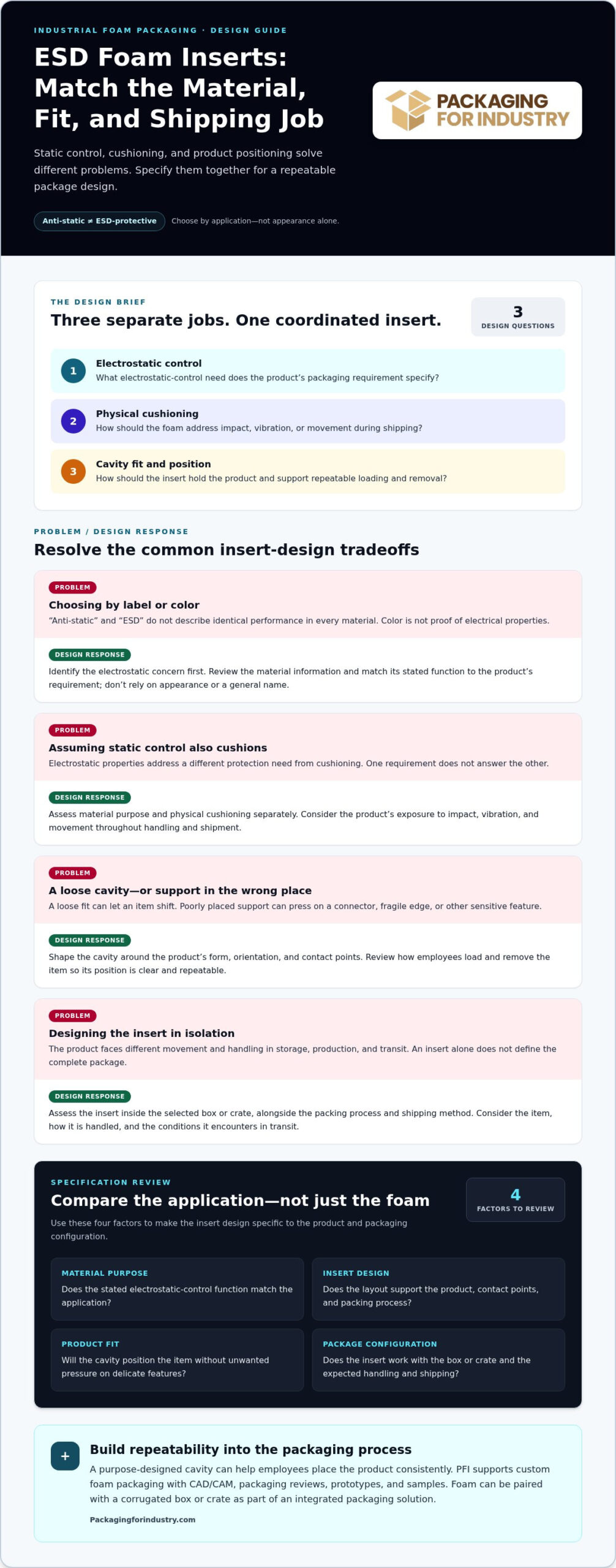
A well-designed insert addresses three separate questions: what electrostatic control the product requires, how the foam should cushion it, and how the cavity should hold it in place. These decisions work together, but one doesn’t answer the others. The ESD Association’s overview of electrostatic discharge explains why static events matter for susceptible electronics. Insert design must also account for physical contact and movement during shipping.
How does insert fit affect protection during transit?
The cavity should reflect the product’s shape, orientation, and contact points. A loose fit can let an item shift inside the package. A poorly placed support can press against a connector, fragile edge, or other sensitive feature. A purpose-designed cavity positions the product and supports it where the packaging design calls for it. Loose-fill or generic padding may cushion a package, but it doesn’t necessarily locate each component consistently.
Review how the item is loaded and removed, too. The insert should support repeatable packing without requiring employees to guess where the product belongs. PFI’s custom foam design, CAD/CAM support, prototypes, and samples help shape an insert around the product and packaging configuration.
What should buyers compare across foam options?
Compare the application requirements rather than relying on a general label or appearance. Evaluate material selection, cavity geometry, product fit, and outer packaging as distinct factors:
Material purpose: Identify the electrostatic-control need, then review material information to assess whether a foam option matches it.
Insert design: Consider how the layout supports the product, its contact points, and the packing and unpacking process.
Product fit: Check whether the cavity keeps the item positioned without putting unwanted pressure on delicate features.
Package configuration: Assess how the insert works inside the selected box or crate and how the complete package will be handled and shipped.
There’s no universal material choice or cavity shape for every shipment. A custom insert should reflect the product and packaging requirements, with any expected performance tied to relevant material information and application review. PFI provides custom foam packaging for industrial applications. To discuss insert design alongside your product and shipping setup, request a foam packaging quote.
How to Specify Anti-Static ESD Foam Inserts for Your Product
A useful foam specification gives the designer a clear picture of the product, its journey, and the packing process. That information helps shape anti static ESD foam inserts around real operating needs instead of relying on a generic size or description. PFI supports custom foam packaging projects with CAD/CAM, packaging reviews, prototypes, and samples.
What product and shipping details should a foam quote include?
Start with the item and how your team handles it. Gather these details before requesting a quote:
- Product: Dimensions, weight, orientation, and fragile features such as edges, connectors, or protrusions.
- Shipping: Shipping lanes, handling steps, and whether the item travels individually or with other products.
- Packing process: How employees load, secure, and remove the product, including any positioning requirements.
- Packaging: The box or crate used now, plus relevant internal dimensions or packaging drawings.
- Repeat orders: Expected reorder needs and requirements for a consistent insert design across future shipments.
Product drawings can help communicate shape and critical features. If drawings aren’t available, a sample can provide a useful reference for a design review. Share what you know, including any current fit issues or damage concerns, to keep the design discussion focused on the application.
When should buyers consider a custom foam prototype?
A prototype or sample lets your team assess fit and packing sequence before broader use. Evaluate it with the intended box or crate, not in isolation. This accounts for the full package configuration and gives packers a chance to check product placement and removal. PFI’s custom packaging design services include design support, prototypes, samples, and packaging reviews.
Use the review to record any changes needed to the cavity, product orientation, or packing steps. Keep approved design information with purchasing and operations so future orders can follow the same packaging plan. The International Electrotechnical Commission develops international standards for electronics; consider applicable requirements alongside the product’s documented packaging needs.
Once the product details and package configuration are clear, request a custom foam packaging quote to discuss an insert suited to your shipping and purchasing requirements.
How to Build ESD Foam into a Repeatable Industrial Packaging Process
A custom insert works best as part of a defined packing process, not as a standalone component. The product, foam, and outer container need to work together through packing, storage, handling, and shipment. A consistent configuration can help employees pack products the same way each time and give purchasing a clear basis for repeat orders.
When should foam inserts be paired with boxes or crates?
The outer package encloses the shipment, while the insert positions and cushions the product inside it. Review both together: the container’s interior dimensions, how the insert sits within it, and how packers load and close the package. For products that need a combined container and cushioning approach, a foam-lined crate may be a suitable configuration. The right setup depends on the product and shipping process.
Include the intended box or crate during packaging reviews and sample evaluations. A foam insert designed without its outer container may not reflect how the complete package is assembled or handled in transit. Reviewing the components as one system helps identify fit or packing-process issues before the design becomes routine.
How can buyers support consistent repeat orders?
Document the approved insert design and the packaging configuration it belongs to. Keep product orientation, packing steps, box or crate details, and any approved sample or drawing accessible to operations and purchasing. This gives teams a shared reference when staff pack shipments or prepare replenishment orders.
Plan replenishment around expected usage, storage space, and supplier lead times. Coordinate insert supply with the outer packaging so both components are available when production or shipping requires them. For aerospace operations, PFI provides aerospace packaging solutions to support broader packaging requirements.
Before requesting pricing, prepare product dimensions and weight, drawings or samples if available, shipping method, handling steps, intended container, expected usage, and repeat-order requirements. These details help frame a practical quote for anti static ESD foam inserts and a repeatable packaging configuration.
Request Custom Anti-Static ESD Foam Inserts from PFI
For Los Angeles manufacturers, the next step is to turn product and shipping requirements into a packaging design that purchasing and operations can use consistently. PFI supplies anti-static foam, ESD cushioning, custom die-cut foam, and custom foam assemblies for industrial packaging. The design can be tailored to the product, how it’s handled, and the box or crate used for shipment.
What PFI can help you plan
PFI’s custom packaging design support includes CAD/CAM, packaging reviews, prototypes, and samples. These resources help develop and review an insert around the product and intended package. Where the application calls for it, foam can be paired with a corrugated box or crate, allowing the components to be evaluated as one packaging configuration.
Share the insert’s purpose, key product features, and how employees pack and unpack it. That context keeps the design discussion focused on your application and ongoing industrial packaging needs.
What to include in a request for a quote
Useful details help PFI understand the job and prepare a practical quote. Include:
- Product information: Dimensions, weight, orientation, and features that require careful support.
- Drawings or samples: Reference material that shows the product’s shape and relevant details.
- Shipping requirements: The shipping method, handling steps, and current box or crate configuration.
- Order pattern: Expected quantities, order frequency, and recurring supply requirements.
- Current packaging concerns: Fit, packing consistency, or shipping damage issues you want the design to address.
Clear order and replenishment information connects the insert design to purchasing plans and repeat orders. If requirements change, such as a product revision or a different shipping configuration, include that context in the quote request so the packaging can be evaluated for the current application.
PFI supports industrial customers in Southern California, including Los Angeles, Orange County, San Diego, and Riverside, as well as businesses with nationwide packaging needs. Share your product details to request a custom foam packaging quote for anti static ESD foam inserts tailored to your product and shipping requirements.
Put a More Consistent Packaging Plan in Place
Reliable protection starts with matching the foam’s intended electrostatic function to the product’s needs, then designing the insert and outer package around real handling and shipping conditions. Specify anti static ESD foam inserts as part of a complete packaging configuration, with fit, packing steps, and repeat-order requirements considered together.
PFI supplies anti-static foam, ESD cushioning, and custom foam inserts, with CAD/CAM support, prototypes, and samples to help develop a practical design. Industrial customers in Los Angeles, Orange County, San Diego, and Riverside, as well as businesses with nationwide packaging needs, can bring product details, drawings or samples, shipping requirements, and order patterns to the quote process.
A clear specification is a practical first step toward repeatable packaging and dependable product handling. Request a quote from PFI to move from packaging requirements to a design that fits your operation.
Frequently Asked Questions
What are anti-static ESD foam inserts?
Anti static ESD foam inserts are foam packaging components used when a product’s packaging plan includes electrostatic-control considerations. Their shape can also help hold an item in place, but static control and physical cushioning are separate design requirements. Specify the product’s dimensions and sensitive features, how staff handle and pack it, and its shipping conditions. These details help determine how the insert and outer package should be configured for the application.
What is the difference between anti-static foam and ESD foam?
Anti-static foam and ESD foam relate to electrostatic protection, but the terms shouldn’t be treated as interchangeable specifications. Anti-static generally refers to reducing static creation or accumulation, while ESD describes electrostatic discharge concerns. The suitable material depends on the product and packaging process. Don’t select foam based on color or a general label alone. Review documented material information against the application’s stated protection requirements.
How do I choose the right ESD foam insert for an electronic component?
Start with the component’s dimensions, weight, orientation, and fragile features, such as edges or connectors. Then describe how it’s handled, packed, and shipped, including the intended box or crate. Product drawings or a sample can inform a design review. PFI’s custom foam design support includes CAD/CAM, prototypes, and samples to help assess insert fit and packing steps before adopting a design for repeat orders.
Can anti-static ESD foam inserts be custom cut?
Yes. Custom foam inserts can be designed around a product’s shape and packaging arrangement. Provide dimensions, drawings or samples, sensitive features, and shipping details to guide the design. A fitted cavity can help position components, while the selected material addresses the application’s packaging requirements. PFI supplies custom die-cut foam and offers design support, CAD/CAM assistance, prototypes, and samples for industrial packaging projects.
Is ESD foam enough to protect a product during shipping?
Not necessarily. Static-control needs and cushioning against impact, vibration, and movement should be assessed separately. The full package also includes the outer box or crate and the way the shipment is handled. Product shape, weight, packing steps, and shipping conditions all inform the design. Review the insert as one part of the packaging system rather than assuming a foam material alone addresses every risk in transit.
What information should I provide for an ESD foam packaging quote?
Share the product’s dimensions, weight, drawings or samples, and features that need careful support. Describe how the item is packed, handled, and shipped, and include the outer box or crate details if available. Note expected order quantities and whether you’ll reorder the packaging. PFI serves industrial customers in Orange County, Los Angeles, San Diego, and Riverside, and supports nationwide packaging needs.