
A repair shipment isn’t protected unless its packaging can handle the journey back, too. The right packaging solutions for repair and return programs protect products on both shipping legs, fit repaired or replacement components consistently, and work with your team’s handling and storage process.
Packaging that performs well on the way to a repair facility may be difficult to reuse, while a reusable format can add return-handling and storage demands. You also need a reliable supply without letting recurring packaging spend or procurement complexity grow unchecked.
This guide compares single-use and reusable approaches, including corrugated boxes, protective foam, and cushioning materials, so you can match the format to your product and return conditions. It also covers how custom design, prototypes, packaging reviews, and managed inventory can support a consistent workflow. PFI supplies custom and stock industrial packaging to manufacturers in Orange County, Los Angeles, San Diego, Riverside, and beyond, helping teams coordinate product protection with their shipping processes.
Key Takeaways
- Assess fragility, weight, geometry, exposed surfaces, and movement risks to identify where protection is needed throughout the service journey.
- Compare single-use, reusable, and hybrid packaging by expected trips, return handling, storage needs, and replacement requirements.
- Use product dimensions, shipment paths, and current damage issues to make packaging solutions for repair and return programs more specific to your workflow.
- Coordinate corrugated boxes, foam, cushioning, and crates to build a protective system suited to the product and shipping conditions.
- Custom design, prototypes, packaging reviews, and managed inventory can help address fit challenges and support recurring packaging demand.
Why packaging solutions for repair and return programs need a two-way view
A product sent for repair faces a different packaging test than a product shipped once to a customer. It must arrive intact, remain accessible during inspection or repair, and then be secured for the trip back. Planning only for the first leg can leave staff at the repair facility without a reliable way to repack the item.
The challenge is protecting the same product across outbound and return handling, even when its condition, contents, or route changes. Repair-and-return packaging is protective packaging planned for the product’s complete service journey. The goal isn’t simply to reuse the original carton. It’s to establish a practical method for protecting the product at each stage and supplying the materials needed to carry it out.
Where standard outbound packaging can fall short
Packaging built for one shipment may depend on a close-fitting insert, a specific component arrangement, or a particular orientation. After inspection, the product may be repacked with removed parts, replacement components, or accessories arranged differently. A carton that fit before repair may no longer hold everything securely or give staff a clear way to close and prepare it for return.
Poor fit can allow movement inside the package, expose surfaces to contact, or make repacking slower and less consistent. If staff improvise with available materials, protection can vary from one return to the next. Custom packaging design can address fit and repacking challenges. For example, custom packaging design can account for product configurations and handling needs across the service cycle.
What a two-way packaging requirement includes
Start with the physical journey rather than choosing a box in isolation. Identify the product and its vulnerable areas, the repair destination, the expected return route, and the handling conditions at each location. Consider who will open and repack the shipment, whether components may be added or removed, and which packaging supplies will be available when the item is ready to ship back.
- Product and contents: Note what travels to repair and what may return with it, including replacement parts or accessories.
- Route and handling: Map the outbound and return legs, transfer points, and repacking steps that affect package fit and protection.
- Materials and workflow: Decide what must be retained, replaced, or supplied at the repair location to make packing repeatable.
Reusable formats can be part of the plan, but they bring return-handling and storage needs. The overview of reusable packaging outlines considerations associated with these systems. The right choice depends on the operating loop, not on a universal package. Packaging solutions for repair and return programs should provide repeatable physical protection while keeping material use and repacking steps manageable. Packaging protects the shipment; separate systems may coordinate records and repair status.
How to build protection into repair and return packaging
Design the package around the product and its handling path. Record the item’s weight, shape, fragile features, exposed surfaces, and parts that could shift or contact one another during transit. Then consider how the package will be lifted, opened, inspected, and repacked. These details help determine whether a stock carton is suitable or a custom combination of protective materials is a better fit.
Protection works as a system. The product needs restraint and cushioning inside the package, while the outer container needs to contain those materials and close securely. If the shipment is prepared as a unit load, stabilization around the package addresses a separate handling need. Evaluating these functions separately makes it easier to identify gaps instead of assuming a stronger box alone will solve every risk.
Match protective materials to the product and journey
Custom foam inserts can provide a shaped, repeatable fit for components that need defined support or separation. Corrugated boxes organize the product and protective materials within an appropriately sized outer package. For heavy or high-value industrial components, a crate may suit shipments that call for a more substantial container. The right arrangement depends on the item, route, and handling process, not on a single material used by itself.
- Restrain the product: Use a fitted insert or cushioning to limit unwanted movement and keep vulnerable areas from contacting other components.
- Contain the assembly: Select an outer corrugated box or crate suited to the product and its packed configuration.
- Close and stabilize: Plan carton closure separately from internal cushioning, and consider how the packed shipment will be secured for handling.
Materials can also support purchasing priorities. If a project considers recovered-content packaging, the EPA’s Comprehensive Procurement Guideline Program provides information about products made with recovered materials. Evaluate those priorities alongside the protection and fit required for the shipment.
Plan for opening, inspection, and repacking
Repair staff need access to the product without removing support in a way that makes repacking difficult. Arrange inserts and cushioning so teams can lift or inspect the item while keeping protective components organized for reuse or replacement. If the repaired product returns with a different component configuration, the package should accommodate that change without relying on improvised filler.
Test the process with a prototype or sample before standardizing a custom configuration. Have the people who pack, open, inspect, and prepare the return shipment walk through the steps. Their feedback can reveal awkward access, loose fit, or components that are easy to misplace. PFI’s design support can help develop and review a coordinated configuration. To scope materials around your product and workflow, request a packaging quote.
Reusable, single-use, or hybrid: compare repair-return packaging options
The best format depends on how reliably packaging moves through the repair loop. A reusable container may suit a controlled route with a clear return process. Single-use packaging may be more practical when returns are irregular or the package is unlikely to come back. A hybrid approach can keep the outer container in circulation while replacing selected protective materials. Compare the full workflow, not just the material used for one shipment.
| Approach | Protection and expected trips | Return handling and storage | Replacement needs |
|---|---|---|---|
| Single-use | Protection is planned for a shipment or service cycle, rather than repeated circulation. | No empty package needs to be returned or stored for another trip. | Packaging is supplied again for each cycle. |
| Reusable | Container and protective components are intended for repeated trips, subject to their condition after use. | Requires a process to return, inspect, and store packaging between cycles. | Damaged or worn components may need replacement. |
| Hybrid | A reusable container can be paired with protective materials replaced as needed. | The return process must account for the container, while teams manage replacement materials. | Selected components are replenished rather than replacing the entire pack. |
When reusable packaging may fit repeated repair cycles
Reusable packaging can make sense when the repair destination and return route support a reliable loop. Include reverse transport, inspection, storage space, and replenishment in the evaluation. Confirm that the container and protective components remain usable after each trip and that teams know how to handle them. PFI supplies reusable packaging as part of its physical packaging solutions, with the format shaped around the program’s requirements.
When single-use or hybrid packaging may be more practical
If packaging doesn’t return consistently, a single-use format can avoid creating a separate collection and storage task. A hybrid design may work when a durable outer container can return, but inner cushioning or other protective parts need replacement after inspection or repair. PFI’s corrugated boxes, crates, foam, and cushioning materials can support different configurations, including projects that call for wooden crates.
Before selecting a model, compare these operating factors across the expected cycle:
- Return reliability: How often does the package come back with the repaired product?
- Condition and inspection: What must be checked before the packaging is used again?
- Handling effort: Who collects, opens, sorts, and prepares the package for its next trip?
- Storage and replenishment: Where will returned containers and replacement materials be kept?
Don’t assume one model is always cheaper. Compare packaging pricing alongside reverse transport, inspection labor, storage, replacement materials, and supply consistency. For packaging solutions for repair and return programs, the practical choice is the format that protects the product and fits the actual return process without adding unnecessary handling.
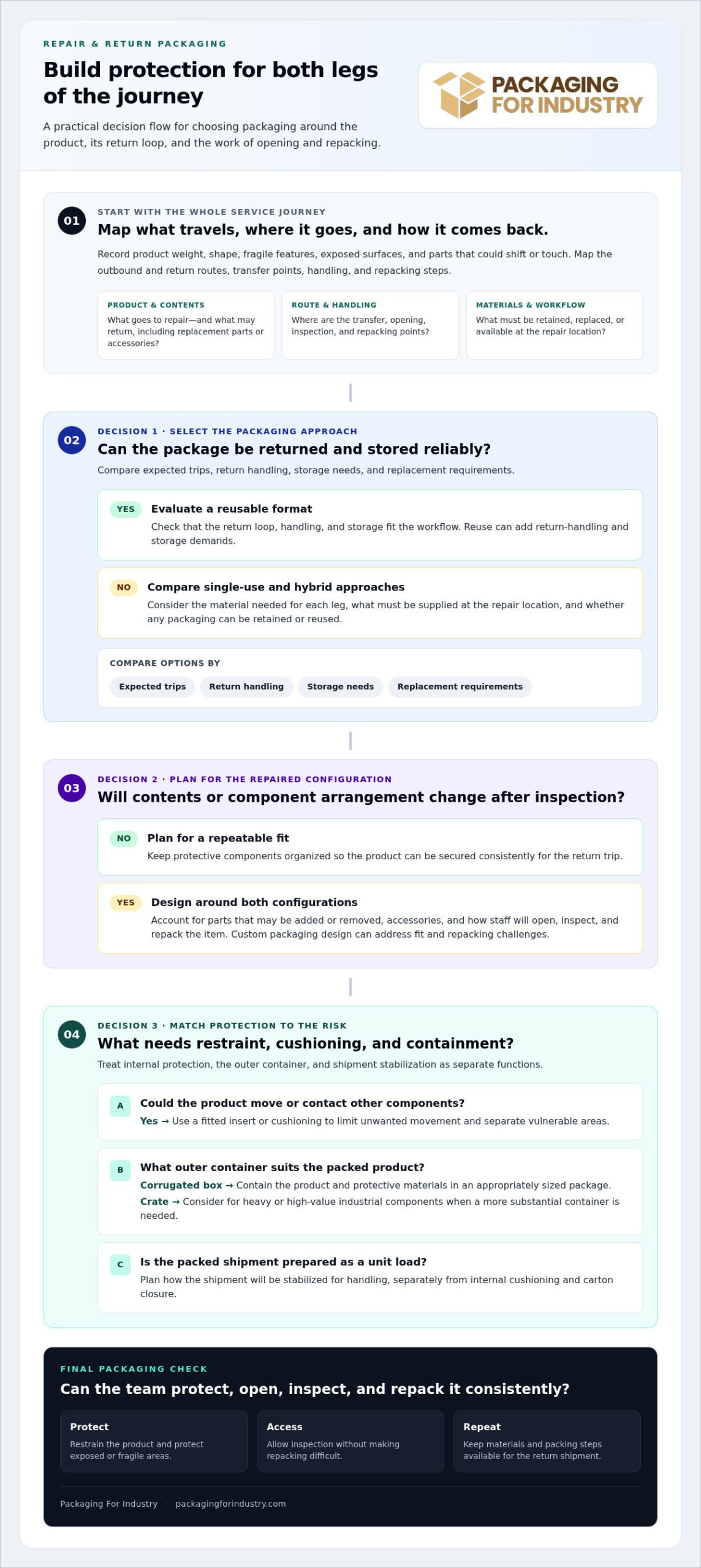
Buyer’s Checklist for Repair & Return Packaging
A well-scoped packaging request starts with the product and the process it moves through. Gather the details below to evaluate fit, protection, repacking effort, and recurring supply. Clear inputs also make it easier to compare packaging configurations on the same basis.
- Document the product. Record dimensions, weight, fragility, exposed surfaces, and any areas that have been damaged in transit. Note whether the product travels with accessories, removed parts, or replacement components.
- Map both shipping legs. Identify the origin, repair destination, return path, shipment method, and known handling points. Include any differences between outbound and return conditions.
- Describe the repair-site process. Explain how staff open, inspect, and repack the item. Note whether the original packaging stays with the product, returns separately, or is discarded.
- Set expectations for reuse. Estimate how often packaging is expected to return and identify who will inspect, store, and prepare it for another trip. Include how damaged or missing materials are handled.
- Review recurring demand and freight factors. Share shipment quantities, return frequency, current packaging formats, and supply requirements. Include package dimensions when reviewing carrier dimensional surcharges and freight impacts, since outer size can affect shipping charges as well as material use.
Information to prepare before requesting a quote
Bring together product measurements, weight, fragility concerns, shipment path, known damage issues, and typical shipment quantities. Add the current box or container format, protective materials in use, and any recurring supply needs. Repair-site details matter too: describe repacking steps, packaging return practices, and whether staff have access to replacement materials. These inputs help scope a packaging request around the actual workflow, rather than an incomplete product description.
How to assess a proposed packaging configuration
Review how the product fits, whether protection stays in place, and whether repair staff can open and repack it consistently. If product variations require different arrangements, check each relevant configuration. Samples or prototypes can help teams evaluate a proposed design before wider rollout. Assess the complete process, including packaging materials, handling steps, replacement needs, and freight considerations, rather than judging a single component in isolation.
Use the checklist to clarify requirements for packaging solutions for repair and return programs. PFI’s packaging reviews, design support, and prototypes can help evaluate physical packaging configurations for your product and workflow.
How PFI supports repair-and-return packaging and recurring supply
PFI supports the physical packaging needs behind repair-and-return workflows, from product protection to recurring supply. Its industrial packaging products include custom and stock corrugated boxes, protective foam, crates, and cushioning materials. These options can be coordinated around a project’s packing and replenishment requirements. PFI serves aerospace and aviation, electronics and semiconductor, medical device, industrial equipment, and other manufacturing operations where packaging must support specific products and shipping processes.
The practical benefits are a better fit between packaging and the product, coordinated materials, and a supply approach that supports ongoing demand. PFI connects packaging design and material selection with procurement and operations, rather than treating every item as a separate purchase. This can support efforts to reduce shipping damage, simplify packaging purchasing, and improve supply reliability.
Combine custom packaging design with the right materials
For products that need a tailored configuration, PFI’s packaging design support includes CAD/CAM, prototypes and samples, and packaging reviews. Custom corrugated boxes can be developed around project requirements, while protective foam can help organize and support components. PFI can coordinate these materials with crates or cushioning as appropriate. Its custom packaging design support helps teams evaluate a configuration as a complete physical packaging solution.
Packaging kitting and assembly can also organize materials for a defined packing workflow, supporting consistent preparation across teams or locations.
Keep recurring packaging available as demand continues
PFI’s vendor managed inventory and just-in-time programs support businesses with recurring packaging needs. A vendor managed inventory program can align packaging replenishment with usage and operational needs, reducing the burden of managing each reorder independently. PFI offers local next-day delivery across Southern California, including Orange County, Los Angeles, San Diego, and Riverside, along with fast nationwide shipping.
PFI brings packaging products, design capabilities, and supply planning together for manufacturers and other industrial operations. Share your product and program requirements to discuss packaging solutions for repair and return programs that fit your workflow.
Put the return loop into your next packaging decision
Use the next repair cycle to turn packaging requirements into a repeatable purchasing specification. Record which product configurations need protection, what materials return in usable condition, and where repacking creates delays or inconsistency. That information gives operations and procurement a shared basis for adjusting the package as products or routes change.
PFI can help translate those requirements into packaging solutions for repair and return programs, with custom and stock options, packaging design, prototypes and samples, and VMI or just-in-time programs for recurring needs. A focused review can help your team assess the physical packaging alongside replenishment, with the aim of reducing shipping damage, supporting reliable supply, and managing packaging spend without adding unnecessary process steps.
Bring your product details and workflow needs together to define a practical next step.
Frequently Asked Questions
How can a return package be matched to the correct repair order?
Use a clear order reference on the package and on the documents traveling with the product. Include a product identifier, such as a part number or serial number, when applicable, and make the repair destination easy to identify. Keep labels visible after handling and avoid relying on carton appearance alone. The packaging identifies and protects the shipment, while your order-tracking process connects it to the correct repair record.
What information should travel with a product sent for repair?
Include the repair order reference, product identification, a concise description of the reported issue, and a list of included components or accessories. Add handling instructions that matter for the item, such as orientation or sensitive surfaces, if the repair team needs them. Place paperwork in a protected document pouch or another designated location so it stays with the shipment and can be found without unpacking every component.
What should happen to packaging when a returned product cannot be repaired?
Follow your company’s disposition process for the product, then assess the packaging separately. If the item is shipped onward or back to another location, use packaging that remains suitable for its new route and condition. Reusable materials can be inspected for damage or contamination before they re-enter circulation. Separate damaged or unsuitable components from ready-to-use stock so they aren’t mistakenly selected for another shipment.
Can repair returns include multiple components in one package?
Yes, multiple components can travel together if the package keeps them organized and prevents contact or movement that could cause damage. Use separate compartments, labeled bags, or fitted cushioning to distinguish parts, and include a contents list for receiving staff. Consider whether one component’s weight or shape could affect another during handling. If the components need different protection or destinations, separate packages may be easier to manage.
How should a company handle packaging for products with different repair outcomes?
Group products by the packaging requirements created by their likely outcomes, rather than assuming every item follows the same return path. A repaired unit, a unit with replacement parts, and a product routed elsewhere may need different pack-out instructions. Packaging solutions for repair and return programs can use a common outer format with clearly differentiated internal components when that fits the product family. Document the distinctions so staff select the right configuration.
Can packaging requirements change when a product is replaced instead of repaired?
Yes. A replacement may differ from the returned unit in dimensions, included components, or the condition in which it ships. Review the replacement’s actual contents and configuration before reusing the original package. If the packaging no longer supports a secure fit, update the pack-out instructions or use a configuration suited to the replacement. This helps prevent teams from treating a repair shipment and a replacement shipment as identical.
What should a business do with packaging between repair cycles?
Set a defined location and status process for packaging that may be used again. Keep inspected, ready-to-use materials separate from items awaiting review or replacement, and identify which components belong together. Track damaged or missing pieces so replenishment reflects usable stock rather than total stock on hand. For returnable containers, record where they are stored and how they re-enter the shipping workflow.