
Designing packaging for easy inspection by customs starts with a practical question: can someone locate and access the shipment’s contents without leaving them exposed or disorganized? Plan access into the package while maintaining product protection. If opening a box disturbs inserts, hides identification, or makes it difficult to close securely again, handling becomes more complicated.
A thoughtful layout makes contents easier to identify and return to their intended positions. This article covers how to plan access points, arrange products in removable trays or inserts, and make important package information easier to find. It also explains how corrugated packaging, foam, and crates can work together to suit the product and shipping workflow.
Start with both physical access and the arrangement of the contents. Clear identification and a consistent internal layout help handlers understand what they are handling. Prototypes and samples let your team review fit, packing, and unpacking before a production run. Packaging For Industry provides custom packaging design, CAD/CAM support, and prototyping to help manufacturers develop packaging that balances access, protection, and efficient handling.
Key Takeaways
- Start with the product, shipment, and handling requirements to determine where inspection access is needed.
- Designing packaging for easy inspection by customs means planning access and clear identification while maintaining product protection.
- Compare corrugated boxes, foam, and crates based on access, protection, reuse, and handling needs rather than defaulting to one format.
- Review package access, component identification, product restraint, and closure as separate checkpoints before dispatch.
- PFI can combine corrugated, foam, and crate components in a custom design and provide prototypes for review before production.
Why Design Packaging for Easy Inspection by Customs?
A shipment can be well protected but still be difficult to understand once opened. Components may sit beneath several layers, look alike, or shift during handling. Inspection-conscious packaging addresses these practical issues by arranging contents so they are identifiable and accessible without treating protection as an afterthought.
The goal of designing packaging for easy inspection by customs is not to predict what an inspection will involve. Packaging design controls the physical shipment: where items sit, how they are restrained, how layers open, and how the package can be closed again. Customs rules, shipment documents, and destination-specific compliance decisions are separate responsibilities. A package can support handling, but it cannot replace accurate paperwork or guarantee inspection results or customs clearance. Customs provides a general overview of customs and its functions.
Planned access and product protection work together when each layer is easy to identify, remove, and restore without leaving the product exposed or unsecured. This helps avoid a false choice between packaging that opens easily and packaging that protects its contents in transit.
What inspection-friendly packaging can, and cannot, do
A well-planned layout can make it easier to find a specific component, understand how parts are grouped, and reach the contents without dismantling unrelated protective layers. For example, a clearly arranged insert can hold separate components in defined positions. A removable tray can provide access to lower layers without requiring the entire package to be rebuilt. Clear labels and a consistent layout also help handlers distinguish similar items.
These design choices support access and organization. They do not determine which items customs will examine or whether a shipment meets destination requirements. Keep regulatory decisions and document preparation within the appropriate shipping or compliance workflow, and focus packaging design on the physical details it can control.
Which shipments benefit from deliberate access planning?
Access planning is useful for industrial shipments with multiple components, nested protective layers, or repeat packing runs. Manufacturers shipping assemblies, replacement parts, or equipment can benefit from layouts that make items easier to locate and return to their assigned positions. A repeatable arrangement can also help warehouse teams opening and resealing similar shipments as part of regular operations.
High-value or fragile products need particular care: opening a package should not make the contents more vulnerable to impact, abrasion, or handling errors. Protective foam, corrugated partitions, or crate components can be designed around how a product needs to be supported and accessed. The right configuration depends on product geometry and the shipping workflow, not on assumptions about special customs rules for a particular item.
PFI’s custom packaging design services help translate access and protection requirements into a practical package layout. Reviewing how the product is positioned, identified, and handled gives the team a basis for designing organized access while maintaining secure handling throughout the shipment process.
How to Design Packaging for Inspection Access and Product Protection
A reliable design process starts with the shipment, not with a box style or opening. For teams designing packaging for easy inspection by customs, the aim is to make contents straightforward to locate while keeping every item restrained and protected through handling. Work through these steps so access decisions fit the product rather than creating weak points in the package.
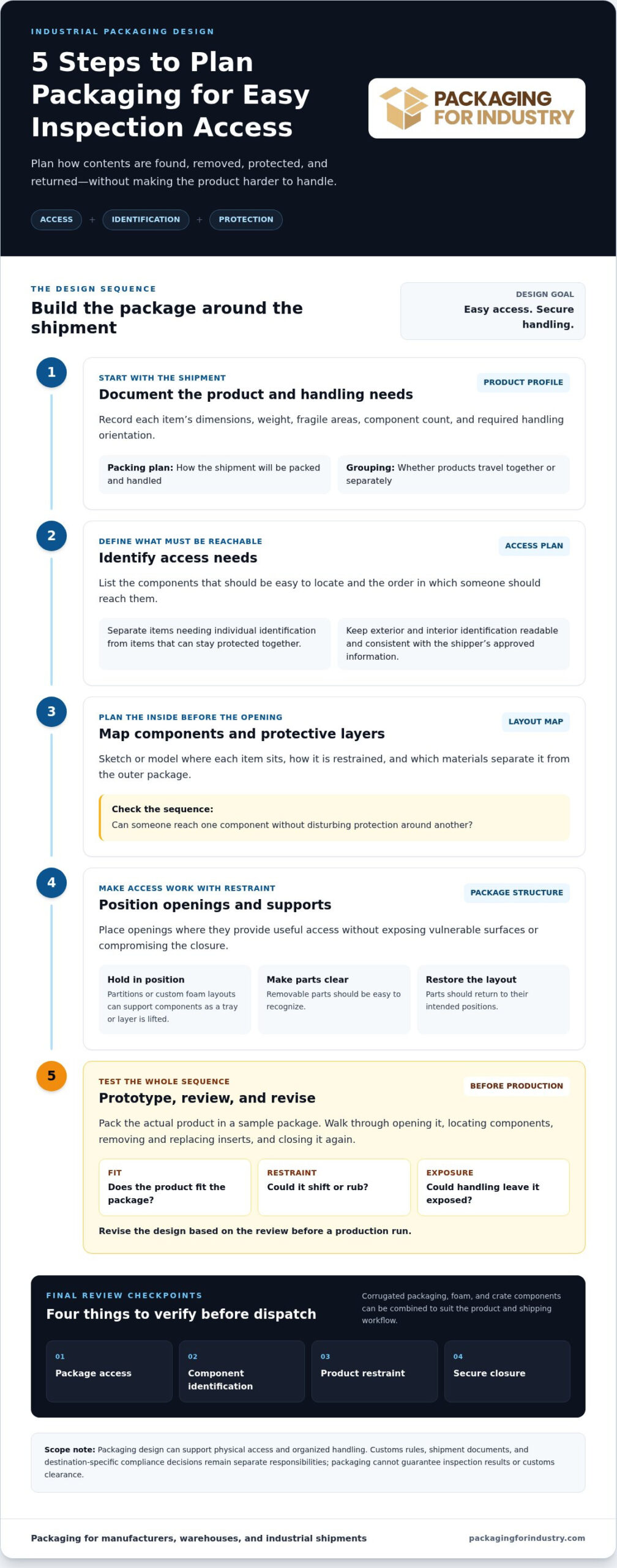
- Document the product and shipment. Record each item’s dimensions, weight, fragile areas, component count, and required handling orientation. Note how the shipment will be packed and handled, including whether products travel together or in separate groups. These details give the design team practical constraints before it plans the package.
- Identify access needs. List the components that should be easy to locate during a shipment review and the order in which someone should reach them. Separate items that need individual identification from those that can remain protected together. Keep exterior and interior identification readable and consistent with the shipper’s approved information.
- Map components and protective layers. Sketch or model where each item sits, how it is restrained, and which materials separate it from the outer package. Plan this structure before choosing openings, partitions, or a box layout. A component map can show whether reaching one part would disturb protection around another.
- Position openings and supports. Locate openings where they provide useful access without exposing vulnerable surfaces or compromising the closure. Partitions or custom foam layouts can hold components in position as a tray or layer is lifted. Make removable parts easy to recognize and return to their intended positions.
- Prototype and review the complete sequence. Pack the actual product in a sample package, then walk through opening it, locating components, removing and replacing inserts, and closing it again. Check the fit and restraint. Look for points where the product could shift, rub, or become exposed during handling. Revise the design before wider production if access is awkward or protection is disrupted.
Planned access must preserve the product’s protective envelope, the continuous arrangement of materials that supports and shields the product through handling. An opening is useful only if the product remains secure while the package is open and can be protected again afterward. Use this principle to balance the outer container, internal supports, and closure.
Use the prototype to catch workflow problems
A prototype review gives packaging, warehouse, and shipping teams a practical way to evaluate the design. Ask someone unfamiliar with the package to follow the intended opening sequence using the approved identification. Check whether they can locate the target component, keep other parts organized, and reassemble the package without forcing inserts or leaving gaps in support. CAD/CAM support, prototypes, and samples help teams assess these details before a production run. PFI’s custom packaging design brings product geometry and access needs into the package plan.
Once your team has defined the product, access points, and protection needs, request a custom packaging quote to move the design toward a practical shipping solution.
Compare Corrugated Boxes, Foam, and Crates for Inspection Access
No single packaging material suits every industrial shipment. Compare options by how the package opens, how well it holds components in position, whether it can be closed securely after access, and how it fits the shipment’s handling needs. The right design may use one material or combine several. For example, a corrugated outer box can provide structure while a fitted insert keeps individual components in place.
- Corrugated boxes: Partitions, pads, or dividers can organize contents. Opening placement and internal layout can make access more direct while the box continues to protect the shipment.
- Foam inserts: Shaped cavities can hold components in defined positions and separate them from one another. The fit should restrain the product without making removal or replacement unnecessarily difficult.
- Crates: A crate may suit shipments whose size, weight, or handling needs call for a different outer structure. Plan access panels or other opening features around the shipment, and consider whether reuse fits the shipping workflow.
When corrugated boxes support straightforward access
Corrugated packaging works well when the design needs to group components and create a clear opening sequence. A custom box can use partitions to separate similar parts, pads to divide layers, or dividers to prevent items from mixing during handling. Place the opening so a handler can reach the intended section without disturbing unrelated contents. The box should fit the product and the way it moves through packing and shipping. Explore custom corrugated boxes for layouts tailored to your shipment.
For repeat shipments, a consistent interior arrangement can make packing and unpacking easier for operations teams. The design should show where each component belongs and allow the package to be closed again without leaving contents loose.
When foam inserts or crates add useful control
Foam inserts can hold individual components in defined positions, which is useful when parts have different shapes or need separation within one package. A removable foam layer can provide access to lower components while keeping upper items organized. Design the insert around the product and removal sequence rather than adding foam simply as filler. PFI’s protective foam packaging can be designed as part of this layout.
Crates are another option when the shipment needs an outer structure suited to its product and handling workflow. They can be paired with foam or corrugated components to protect and organize the contents. Whether a crate is reused depends on the actual handling cycle and package condition, so assess reuse as a project requirement rather than assuming it will happen.
Compare each design using the same practical questions: Can the handler locate the intended component? Can the package open without disturbing other contents? Does the product remain supported during access? Can the package be secured again? This makes designing packaging for easy inspection by customs a shipment-specific engineering decision. It balances access, protection, and handling instead of defaulting to one material.
A Practical Design and Review Process Before Dispatch
A repeatable review helps teams catch packaging issues before a shipment leaves the facility. Check access, identification, product restraint, and closure separately rather than relying on one general review of the finished package. This makes designing packaging for easy inspection by customs a manageable part of packaging development while leaving shipment documentation and destination-specific decisions with the responsible shipping team.
- Write a design brief. Record the product configuration, components, protection needs, shipping route or handling context, and intended access sequence. Note which items should be readily identifiable and who will pack, open, and close the package. Keep customs and trade compliance questions outside the packaging brief unless the responsible team supplies approved instructions relevant to the package.
- Review the proposed layout. Map the outer container, internal supports, removable layers, and closures. Check whether the planned access point reaches the intended contents without requiring unrelated components to be moved. Consider how the package will protect and organize the shipment during ordinary handling.
- Test a prototype with operations and shipping staff. Use the actual product or representative components and follow the intended opening sequence. Have the team locate identified items, remove and replace packaging components, and close the package. Observe where materials shift, obstruct access, or make the sequence unclear.
- Record findings and revise. Document issues specifically, such as an insert covering an item label or a component that is difficult to return to position. Assign each change to the package design, then repeat the review after meaningful revisions. This creates a useful reference for teams packing repeat shipments.
- Complete a pre-dispatch check. Review access, readable identification, product restraint, closure, and overall package condition separately. Confirm that the contents remain supported and the closure is secure after the planned access sequence. The shipping team should handle approved documents and destination-specific instructions through its established process.
Review the prototype with the people who handle it
Packaging, warehouse, and shipping staff can identify different workflow problems. One person may notice that a divider blocks access; another may find the package awkward to close after handling. Keep the test focused on the actual sequence and note which changes improve clarity without loosening product support. PFI’s custom packaging design services include engineering and prototyping support to help teams evaluate packages against product and workflow needs.
Separate package checks from shipping compliance
A package review does not verify customs paperwork or determine whether a shipment meets destination requirements. Before dispatch, the responsible shipping team should confirm that approved shipment information and instructions are in place. Packaging staff can check that exterior identification is legible and consistent with the information they have been given, without making independent compliance decisions.
How PFI Can Engineer Inspection-Friendly Industrial Packaging
Once your team defines its access and protection requirements, PFI can develop packaging suited to the product and shipping workflow. Custom corrugated boxes, protective foam, and crates can be considered together as an integrated package, with each component serving a clear purpose. PFI supports industrial and aerospace shipments, as well as products handled by electronics and medical device manufacturers.
From design brief to packaging prototype
PFI’s CAD/CAM support helps turn product and handling information into a packaging design. A corrugated outer box can organize the shipment, foam inserts can position components, and a crate can provide an appropriate outer structure for the project. When a crate suits the handling needs, PFI offers custom wood crate options.
Prototypes and samples let your team evaluate fit and handling before a wider rollout. Reviewing the assembled package can reveal changes that support product protection, orderly handling, and consistent repeat packing. Packaging reviews can also consider damage reduction and cost, helping businesses evaluate ways to lower packaging costs without sacrificing the protection their products need.
Combining materials around the shipment can simplify packaging management and support a consistent process. PFI’s custom design capabilities help businesses develop practical industrial packaging solutions tailored to the product rather than relying on a one-size-fits-all format. PFI serves manufacturers and warehouses across Orange County, Los Angeles, San Diego, and Riverside, with packaging support for businesses shipping beyond Southern California as well.
Prepare a useful packaging quote request
For a tailored packaging solution, provide product dimensions and weight, identify fragile areas, and describe the shipping method. Include how many components travel together, which items need access, and what protection should remain in place. Photos, drawings, or a sample of the existing package can help clarify the product and current packing process.
Describe how your team handles the package during packing and shipment, too. These details give PFI a practical basis for considering corrugated, foam, and crate components together where appropriate.
Put Inspection Access Into Your Packaging Plan
Make inspection access part of the packaging specification before the next shipment is packed. When purchasing, engineering, and shipping teams work from the same requirements, they can assess the design against actual product needs and the way the package moves through the operation. Shared requirements also help teams make consistent decisions when shipment volumes or workflows change.
Designing packaging for easy inspection by customs is a practical design objective, not a promise about inspection or clearance outcomes. Define what needs to be accessible, what protection must remain in place, and how the package fits your handling process. PFI can use those project details to develop a tailored industrial packaging approach that considers product protection and operational needs together.
Bring your product and shipment requirements into the design process early. A clear brief gives your team a useful starting point for packaging that supports reliable handling and protects the product throughout its journey.
Request a quote to plan packaging around your shipment, product protection, and workflow.
Frequently Asked Questions
Can customs inspect a shipment without removing all of its packaging?
That depends on the inspection and the instructions for the shipment. Packaging design cannot determine how much material will be removed, so plan for the possibility that the package may need to be fully opened. Before dispatch, make sure the shipping team understands how the contents are arranged and can restore the approved pack configuration after handling. Keep repacking instructions within the shipment workflow and separate from product documentation.
Should industrial packaging be transparent to make inspection easier?
Not necessarily. Transparent material does not automatically make contents easy to identify, and it may not suit the product’s protection or handling needs. Consider whether clear exterior markings and consistent internal identification can distinguish components without exposing them. For similar-looking parts, labels or a simple packing diagram can help handlers match items to their intended positions while maintaining the protection selected for the shipment.
Can inspection access be designed into a custom box or crate?
Yes. Access features can be incorporated into a custom package and documented so teams handle repeat shipments consistently. For recurring orders, an approved drawing or packing instruction can help workers follow the same opening and reassembly process instead of making improvised changes at dispatch. This is useful when multiple teams or facilities pack the same product and need a consistent configuration.
What information should a packaging designer receive before designing for inspection access?
Along with product details, share the current packing sequence, recurring damage observations, and any packing-line or warehouse constraints. Note whether the package is opened during routine operations before export and whether components are repacked afterward. These details can reveal where the design creates extra handling or interrupts production, helping the team evaluate the complete packaging process rather than just the container.
Does inspection-friendly packaging guarantee faster customs clearance?
No. Packaging design cannot control clearance timing or guarantee a particular outcome. Treat access and protection as package-design goals, and leave customs documentation and destination-specific decisions with the responsible shipping or compliance team. This keeps responsibilities clear: packaging teams evaluate the physical package, while shipping teams manage the information and procedures required for the shipment.
Can foam inserts protect components while allowing individual items to be accessed?
Yes. Foam layouts can distinguish similar components by giving each part a defined place, which can help reduce mix-ups during handling and repacking. For example, a team can assign a consistent position to each assembly component and match that arrangement to its internal identification system. During design review, check that workers can recognize the intended placement and return each item correctly after handling.