
Should I outsource my packaging design? If shipping damage, excess dimensions, or packaging costs keep creating problems, the answer depends on whether your internal team has the time and engineering capacity to address them. In-house design may suit routine updates, while complex protection, sizing, or production challenges can benefit from dedicated design support.
Your team understands its products and operations. The challenge is finding the capacity to turn that knowledge into packaging that protects products, fits shipment requirements, and works on the production floor. This guide compares in-house and outsourced design, explains when a packaging partner can help, and outlines what to prepare for a focused project brief.
Packaging For Industry (PFI) provides custom packaging design and engineering for industrial buyers, including CAD/CAM support, prototypes and samples, and box, crate, and foam design. Use the steps below to define the problem, share useful product and shipping information, and coordinate design decisions with production and supply needs. The goal is a practical decision based on project complexity, internal capacity, and operational priorities.
Key Takeaways
- Ask “should I outsource my packaging design” when recurring damage, poor fit, unusual dimensions, or changing shipment needs exceed your team’s available engineering capacity.
- A focused design project can move from requirements gathering to CAD/CAM concepts, material selection, prototypes, and design review.
- Compare in-house and outsourced options based on project complexity, available tools and labor, production coordination, and the broader effects of packaging decisions.
- Prepare a clear handoff with current packaging details, product and shipment information, damage history, order patterns, and production or warehouse constraints.
- Match packaging materials to the defined challenge: corrugated boxes, protective foam, crates, and cushioning can support different protection and handling needs.
Should I outsource packaging design? Signs your operation may benefit
Your team knows the product, production line, and shipping routine. But that familiarity doesn’t always come with enough engineering time or specialized design capacity to solve a packaging problem. If you’re asking, “should I outsource my packaging design,” consider the work required, not just who knows the product best.
Consider external design support when you see recurring damage, awkward product fit, unusual dimensions, complex handling, or shipment requirements that keep changing. These signals suggest the current package may need more than a routine reorder. A packaging review can assess the design against the product, shipping conditions, and operational constraints.
When packaging problems exceed routine purchasing
Heavy, fragile, high-value, or irregular industrial products can require careful coordination between the container, cushioning, and handling process. If a product shifts in transit, for example, review how it sits inside the box, where cushioning supports it, and whether the package suits the way it moves through shipping. A custom packaging design project can bring those connected requirements into one evaluation.
Dimensions matter, too. Oversized packaging can affect dimensional-weight calculations, carrier surcharge exposure, and freight planning. Packaging that is too tight may leave little room for protection or efficient handling. Compare the package’s outside dimensions with product fit, shipment method, and damage history. The broader role packaging plays in containing and identifying goods is outlined in Packaging and labeling.
- Recurring damage or repeated product movement inside the package
- Irregular shapes or dimensions that don’t fit standard packaging
- Manual handling, stacking, or shipment conditions that complicate protection
- New products, routes, customers, or order patterns that change packaging needs
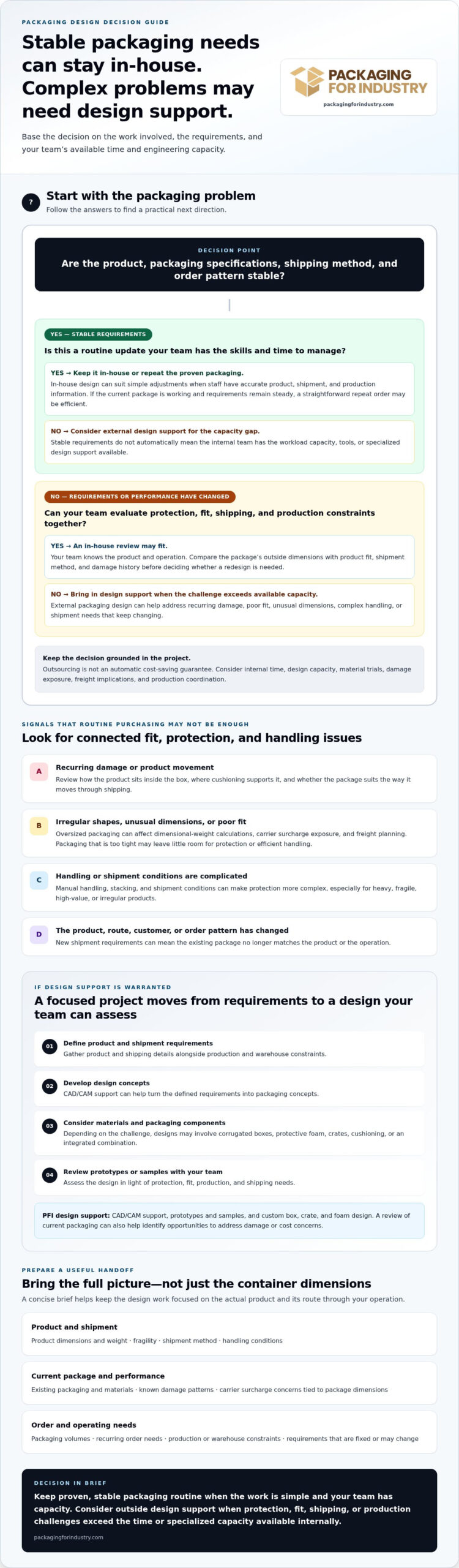
A straightforward repeat order is different. If the product, packaging specifications, shipping method, and order pattern remain stable, purchasing the same proven packaging may be the efficient choice. Custom design and sample review make more sense when the current solution is failing or the requirements have changed.
When an internal team may be better positioned
In-house design can work well for stable requirements and simple packaging adjustments. Staff who know the product and have accurate dimensions, shipment details, and production constraints may be able to manage routine updates efficiently. The decision depends on available skills and workload, not on an assumption that internal design is inadequate.
Outsourcing isn’t an automatic cost-saving guarantee. Consider internal time, design capacity, material trials, damage exposure, and freight implications alongside the project’s scope. External packaging design is most useful when a real protection, fit, or shipping challenge exceeds your team’s available time or specialized capacity. That gives manufacturers a practical basis for deciding whether to keep a project in-house or bring in design support.
What outsourced packaging design includes, from requirements to prototype
Outsourced packaging design is external engineering support that turns product, shipping, and production requirements into a packaging concept. The work can include gathering specifications, developing CAD/CAM designs, considering suitable materials, preparing prototypes or samples, and reviewing the design with your team. It gives manufacturers a structured way to move from a defined packaging problem to a design they can assess in practice.
Start with the shipment, not just the container. A product’s dimensions and weight matter, but so do how it’s handled, how often it ships, and how packaging moves through the warehouse or production area. These details help determine whether a box, foam, crate, or combination of components best fits the requirement. An integrated design can coordinate the outer package and interior support as one system, rather than treating each component as a separate purchasing decision.
PFI’s custom packaging design services include CAD/CAM support, prototypes and samples, and custom box, crate, and foam design. A project can also include a review of current packaging to identify opportunities to address damage or cost concerns. For a broader perspective on the benefits of outsourcing packaging, consider how external expertise and internal capacity fit your operation’s needs.
What information helps a packaging designer scope the work?
Give the designer a concise picture of the product and its route through your operation. Useful inputs include product dimensions and weight, fragility, shipment method, known damage patterns, handling conditions, packaging volumes, and recurring order needs. Also share existing packaging and materials, production or warehouse constraints, and any carrier surcharge concerns tied to package dimensions.
Clear inputs keep the design work focused. Note which requirements are fixed, such as product orientation or available storage space, and which can change. If packaging must work across different order quantities or shipment methods, describe those variations early instead of relying on a single example.
How prototypes and samples support design decisions
A prototype or sample gives the team a physical reference before a broader rollout. Check whether the product fits as intended, how the package assembles, whether employees can handle and store it efficiently, and whether product access suits the workflow. Custom crate design, for example, calls for attention to the product, shipment, and handling requirements together.
Use feedback to identify adjustments before settling on a repeatable design. Operations, production, shipping, and purchasing may notice different issues, so gather their observations in one review. A sample can inform decisions about fit and workflow, but it should not be treated as proof of performance under every shipping condition.
If you’re weighing a design project, bring your product and shipment details together and request a packaging design quote. That gives the design discussion a clear starting point and helps connect packaging choices to production and recurring supply needs.
In-house vs. outsourced packaging design: compare control, capacity, and cost
Choosing between internal and external design isn’t simply a choice between control and cost. Your team can retain product knowledge and approval authority while bringing in design support for work that needs additional capacity or tools. To decide whether to outsource, compare the project’s demands with the resources already available.
Internal capacity: In-house teams can move efficiently on routine updates when staff have time and relevant design skills. Outsourcing adds capacity when existing workloads delay packaging projects.
Project complexity: Stable specifications may suit internal management. A project involving unusual fit, multiple packaging components, or changing shipment requirements may call for dedicated design support.
Design tools: Internal resources may be sufficient for straightforward revisions. CAD/CAM support and prototype development can help teams assess more involved design concepts.
Production coordination: Internal designers often have direct access to operations. An external partner can contribute design support while your team provides production constraints, reviews concepts, and approves the final direction.
Control means having a clear say in requirements, review points, and approvals. It doesn’t require your staff to develop every detail alone. In a hybrid workflow, operations or engineering defines product needs and constraints, an external partner develops or refines the design, and your team checks whether it fits production, handling, and supply needs.
Which packaging design work should stay in-house?
Keep stable specifications and routine replenishment with internal staff when they have the time, skills, and product information to manage them efficiently. Your operations or engineering team should retain product expertise and approval authority, even when a partner supports the design. This keeps straightforward work close to the people who understand the process, while leaving room for specialized help on more demanding projects.
When outsourcing can support cost and operational goals
Consider outside support when recurring damage, complex packaging, or limited staff capacity keeps a project unresolved. Compare the direct project fee with internal labor and the work involved in material trials. Then assess possible downstream effects, including damage exposure, package dimensions, freight planning, tooling needs, and the effort required to maintain repeat supply.
Separate measurable costs from benefits that are possible but not guaranteed. Gather current packaging and shipment information, record relevant damage and labor costs, and compare the existing approach with the proposed design. This gives purchasing and operations a practical basis for evaluating the project without assuming a specific return. PFI’s packaging cost reduction approach considers packaging as part of the broader cost picture.
If your team is weighing internal capacity against a defined packaging challenge, you can request a packaging project quote and outline the requirements for review.
How to prepare a packaging design project for an efficient handoff
A focused project brief helps an internal team and an external packaging designer work from the same facts. It also makes it easier to compare concepts against operational needs instead of relying on broad goals such as “stronger” or “smaller.” Before starting, identify the issue, collect product and shipment information, set constraints, agree on reviews, and plan how to assess samples.
- Define the issue. Describe what needs to change, such as product movement, damage, awkward assembly, excess package dimensions, or a new shipment requirement.
- Collect product and shipment facts. Document the product, current package, shipping method, handling conditions, and order patterns.
- Set constraints. Note production steps, warehouse space, storage, material preferences, and other requirements the design must account for.
- Review concepts. Identify who will assess fit, materials, assembly, and operational impact, and who has final approval.
- Evaluate samples. Gather feedback from the people who handle, pack, store, and ship the product before deciding how to proceed.
Build a brief around the product and shipping conditions
Include the product’s dimensions, weight, fragility, required orientation, and any handling sensitivities. Explain whether shipments move by parcel or freight, how products are palletized, and where packages are stored. Describe current problems with specific examples, such as damage locations or steps that slow packing, rather than assuming a new design will solve every issue.
Record the existing materials and construction, including any box, foam, crate, or cushioning components. Add approximate order patterns and recurring packaging needs, plus production or warehouse limitations such as available packing space or how the package moves through the operation. If corrugated packaging is part of the project, compare custom and stock corrugated box options against those requirements.
Set review points before moving toward production
Agree in advance on who reviews each decision. Operations may focus on assembly and handling, engineering on fit and product requirements, and purchasing on material and replenishment considerations. Set review points for concepts and samples, and specify how the team will collect feedback and approve changes. This helps avoid conflicting direction late in the project.
Rank the project’s priorities. Protection, ease of handling, storage efficiency, and package dimensions may all matter, but the team should know which requirements are essential and where trade-offs are acceptable. Note the target launch timing and expected repeat-order needs so design and supply planning account for the intended rollout.
For recurring packaging, include expected order patterns and how the design should connect with stocking or replenishment needs. Aligning a custom package with ongoing supply planning helps purchasing and operations prepare for repeat demand without treating design and supply as separate decisions.
How PFI supports outsourced packaging design for industrial buyers
Packaging For Industry connects design support with the practical requirements of manufacturing, warehousing, and distribution. If you’re asking, “should I outsource my packaging design,” consider whether a partner can help resolve a defined protection, fit, shipping, or supply challenge. PFI’s custom packaging design includes CAD/CAM support, prototypes and samples, and packaging reviews focused on your project requirements.
The right solution depends on the product and how it moves through your operation. A project may call for corrugated boxes, protective foam, crates, cushioning materials, or a combination of components. Not every shipment needs every material. PFI designs custom boxes, crates, and foam, then reviews the packaging in light of concerns such as product damage, dimensions, or production fit. Prototypes and samples give your team a tangible design to assess before planning broader use.
PFI is a Southern California packaging supplier serving businesses in Orange County, Los Angeles, San Diego, and Riverside. Local next-day delivery is available throughout Southern California, and PFI supports nationwide packaging needs through distribution and manufacturing partners. This industrial focus connects design decisions to production, warehouse handling, shipment preparation, and ongoing purchasing.
Connecting design decisions with packaging supply
Design and supply planning work best when they account for how often packaging is needed and how it fits into production. For recurring demand, discuss expected order patterns and replenishment needs alongside the design. Vendor managed inventory and just-in-time packaging programs can support a coordinated approach to repeat supply.
Coordinating materials can also simplify purchasing. One project might combine a box and foam component into a single packaging solution, while another may use a different combination based on its requirements. Aligning design with repeat supply helps teams plan packaging needs more clearly, without assuming a specific cost reduction or outcome.
What to include when requesting a packaging quote
Share a concise summary of the problem and the product it affects. Include product dimensions and weight, shipment method, current packaging materials, known damage or fit concerns, and any production or warehouse constraints. Estimated order patterns help frame recurring demand; target timing and prototype or sample needs clarify the project’s next steps. If the design needs to work with existing packaging or a current packing process, describe that context as well.
This information gives the project discussion a practical starting point. PFI can use it to understand the requirements, provide design support, and connect packaging decisions with supply needs. Prepare the details you have, including current box, foam, crate, or cushioning components, and note which issues the new design should address.
Discuss your custom packaging requirements with PFI and request a packaging quote.
Turn your packaging challenge into a clear next step
A useful design project starts with one operational priority. Identify the issue that matters most to your team, then decide how you’ll evaluate a proposed change in day-to-day use. That could mean reviewing fit on the production floor, checking how the package moves through shipping, or assessing whether a revised design suits recurring orders.
Ask directly: should I outsource my packaging design, or can our team address this need with its current capacity? If the project needs additional engineering support, PFI can help define a practical scope and assess options against your requirements. The aim is a packaging decision grounded in how your products are made, handled, shipped, and supplied, not a change for its own sake.
Bring your current packaging details and the issue you want to solve. A focused discussion can establish a useful starting point for your design project.
Take the next step with a clear problem and a practical plan. Request a packaging quote from PFI to discuss your design requirements.
Frequently Asked Questions
How much does it cost to outsource packaging design?
Pricing depends on the scope of the engineering work, materials being considered, and whether the project includes design development or samples. A targeted review of an existing package differs from creating a new design for a product family. For a useful comparison, separate the design quote from ongoing packaging purchases, then assess both against the project’s needs. PFI can provide a project-specific quote based on the work described.
How long does outsourced packaging design take?
There isn’t one timeline for every project. The schedule can depend on design complexity, sample development, feedback cycles, and how quickly the team can resolve open technical questions. Projects may also require coordination around a planned product launch or production change. Share any fixed milestones at the outset, and identify who can provide decisions so the work can progress without avoidable delays.
Can I outsource only part of my packaging design work?
Yes. A project can focus on a specific design task rather than transferring the entire packaging program. For instance, a packaging partner might assess whether package dimensions can be revised or develop a concept for one product in a larger range. A defined scope keeps the work aligned with the internal team’s expertise and directs outside support toward the part that needs additional attention.
What information should I provide for a custom packaging quote?
For a clearer quote, identify the business goal and the work you want included, such as a packaging review, design development, or sample creation. Explain whether the request covers one item or a product range, and note any decisions that are still open. If you have an existing packaging specification or item reference, include it so the project discussion can distinguish design work from routine purchasing.
Can outsourced packaging design combine boxes and foam inserts?
Yes. A design may pair a corrugated box with foam inserts when both components suit the product and shipping requirements. For example, the team can assess whether the insert’s shape and placement make packing practical for the intended workflow. The design can also account for how employees remove and replace the product during handling. The material combination should follow the project requirements rather than be assumed for every shipment.
Is outsourcing packaging design worthwhile for recurring orders?
It may be worthwhile if a recurring item needs design work to address a persistent operational concern or a change in the product. Consider whether the design will remain useful across expected product revisions and whether different versions need distinct packaging. That review can help determine whether design work supports repeat purchasing or whether the current specification already meets the operation’s needs.
Does outsourcing packaging design mean losing control of the final design?
No. Outsourcing assigns design work, not your company’s responsibility for deciding what the package must accomplish. Your team can define acceptance criteria such as required product orientation, packing sequence, or compatibility with existing equipment. Put those requirements in the project scope and use them to evaluate proposed work. Clear criteria keep design decisions accountable to your operation’s priorities.