
Will a reusable crate protect your exhibit on the way to the show and still fit the return journey? Reusable crates for trade show logistics can reduce reliance on one-way packaging, but reuse works only when the crate protects components through repeated handling and has a practical path back between events. Return freight, storage, and custom exhibit dimensions all affect whether a reusable design fits your operation.
Choosing packaging for repeat shipments means balancing protection, fit, packing time, and the realities of your event schedule. A crate can combine a durable outer structure with foam and internal supports to help limit shifting in transit. Packaging For Industry (PFI) supplies custom wood crates, foam-lined crates, and packaging design support tailored to exhibit dimensions and handling needs.
This guide compares reusable crate options, explains what to plan for the return journey, and outlines how to specify protection for repeat events. Use the practical checks to assess whether reuse makes sense for your routes, storage capacity, and show calendar, so your packaging decision works beyond the first shipment.
Key Takeaways
- Assess event frequency, return routes, storage capacity, and handling needs before deciding whether reusable packaging fits your trade show schedule.
- Reusable crates for trade show logistics should match the packed exhibit configuration, not just the dimensions of individual components.
- Compare custom crates, other reusable packaging, and one-way options against your protection needs and ability to manage the return journey.
- Gather component dimensions, packing details, handling information, and event dates to guide crate design and review a prototype or sample.
- PFI combines custom wood crates, foam-lined crates, and packaging design support to help build protection around exhibit materials.
When reusable crates make sense for trade show logistics
Reusable crates for trade show logistics are durable transport packages designed to protect exhibit materials through multiple shipment cycles, with a practical plan for their return and storage. The return plan matters as much as the outbound shipment. A crate may be built for repeated use, but your team also needs a way to route it back, store it between events, and prepare it for the next shipment.
Review the full event schedule before choosing packaging. A display traveling to several shows on a predictable circuit presents a different reuse opportunity than a one-time shipment without a planned return route. PFI’s custom wooden crates can be designed around exhibit dimensions and handling needs, rather than requiring unusually shaped components to fit a standard container. For buyers comparing approaches, this overview of reusable packaging explains the broader concept and its applications.
Which trade show shipments benefit from reusable crates?
Reusable crates can suit valuable displays, demonstration equipment, sensitive components, and exhibit materials that travel repeatedly. They are worth evaluating when the same assets attend recurring events and the contents stay consistent enough to support a repeatable packing process. A stable packed configuration makes it easier for staff to load and unload components in the same way each time.
Changing exhibit layouts, one-off events, or varied destinations can make repeat use harder to organize. Focus on business exhibit logistics: protecting company assets as they move between venues, rather than packing household belongings for a residential move.
Reusable crates versus one-way packaging
One-way packaging is used for a shipment and then replaced or discarded. It avoids storing an empty crate or coordinating its return, but replacement packaging becomes part of preparing each new shipment. Reusable options shift the planning work to return handling, storage, inspection, and repacking before the next event.
A custom crate may be a practical fit when an exhibit component is oversized, irregularly shaped, or difficult to secure with standard packaging. Its value depends on the actual shipment cycle, not on an assumption that reuse always costs less. Compare how often the assets travel, whether the crate can return with the freight plan, where it will be stored, and how much protection the contents need. If those conditions support repeat use, a reusable design may reduce the need to rebuild the package for each show. If routes, contents, or schedules change often, one-way packaging may better match the operation. Base the decision on your event calendar and handling workflow.
How crate design protects exhibits through repeated handling
Protection depends on how the exhibit fits inside the package, not simply on the strength of the outer crate. Reusable crates for trade show logistics should be designed around the exhibit in its packed configuration, including protective materials and the way staff load, secure, and remove each component. A crate that fits the display but leaves accessories loose can still allow parts to shift during transport.
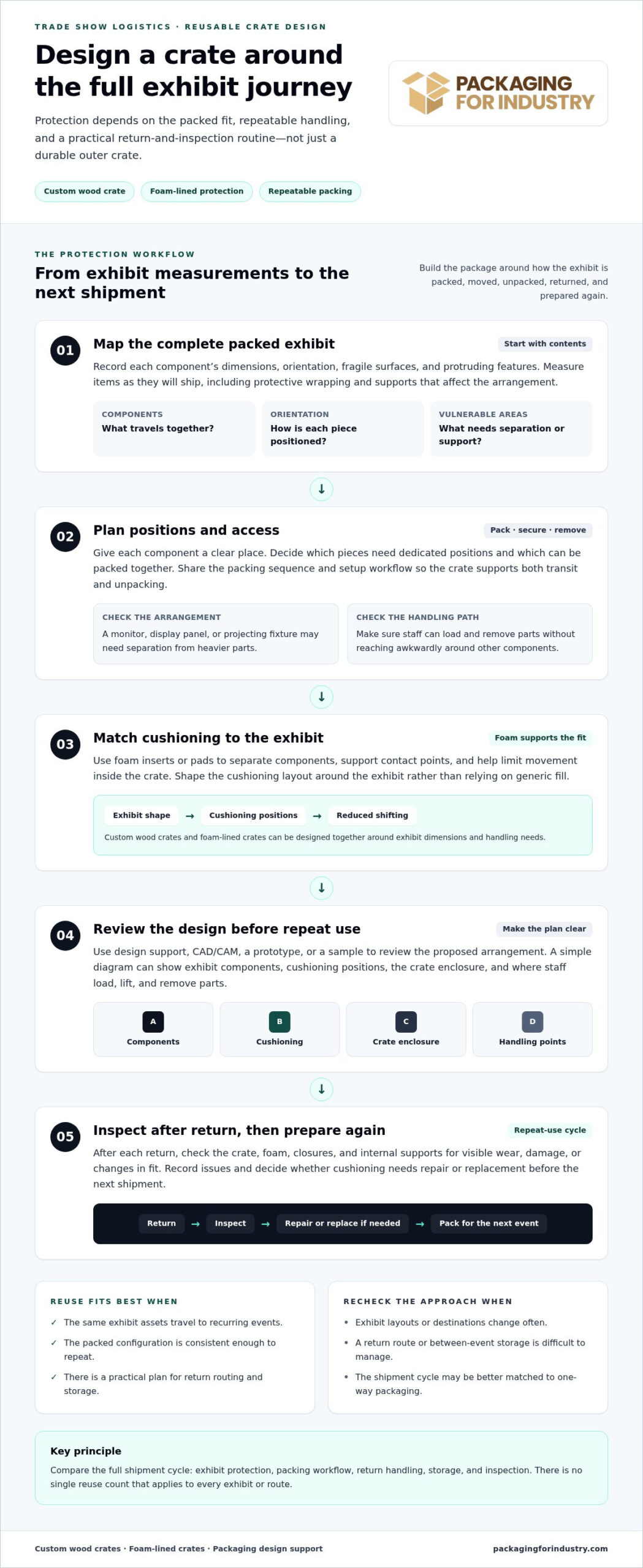
Start with the complete packed arrangement. Record each component’s dimensions, orientation, fragile surfaces, and protruding features. Note whether any parts need to be handled separately during setup. Then consider how the exhibit enters and exits the crate. If staff must lift a panel over other parts or reach around equipment to remove an accessory, the layout may slow setup or complicate handling. Clear placement and access make packing more repeatable from event to event.
Size the crate around the packed exhibit
Measure components as they will be shipped, including protective wrapping or supports that affect the overall arrangement. Identify which pieces need dedicated positions and which can be packed together. A monitor, display panel, or projecting fixture may need separation from heavier parts. Share the intended packing sequence and setup workflow with the packaging designer so the crate supports both transit and unpacking.
Choose cushioning for repeat shipments
Foam inserts or pads can separate components, support contact points, and help limit movement inside the crate. Their layout should follow the exhibit’s shape and handling needs rather than rely on generic fill. Protective foam packaging can be designed alongside a crate as part of an integrated solution.
Include inspection in the reuse process. After each return, staff can check the crate, foam, closures, and internal supports for visible wear, damage, or changes in fit. Record issues and decide whether a cushioning component needs repair or replacement before the next shipment. The inspection routine should reflect actual handling and package condition. There is no single reuse count that applies to every exhibit or route.
Custom wood crates and foam-lined crates are packaging categories, not one-size-fits-all specifications. Design support can account for exhibit dimensions and workflow. CAD/CAM support, prototypes, and samples help teams review the proposed arrangement before relying on it for repeat shipments. A simple design diagram can make the plan easier to communicate by showing exhibit components, cushioning positions, the crate enclosure, and handling points such as where staff load, lift, and remove parts.
The diagram also gives exhibit teams a shared reference for packing and unpacking, reducing guesswork when different staff members handle the shipment. If you are defining a crate around a specific display or equipment set, a custom packaging quote can start with the component layout, packed configuration, and handling workflow.
Compare crate options by return route, storage, and reuse cycle
A packaging choice should account for what happens after the exhibit reaches the booth. Compare shipment frequency, protection needs, storage capacity, return freight arrangements, and the next planned use. A crate that protects components well may still be impractical if your team has no clear way to receive, store, inspect, and prepare it for another event.
Custom reusable crates
Best suited to repeated shipments, valuable or hard-to-fit components, and a planned return route. They require storage space between events and a process for checking their condition before reuse.
Other reusable packaging
May suit components that fit an available reusable format and need less tailored protection. Assess whether the packaging fits the exhibit, works with event handling, and can be returned and stored without disrupting operations.
One-way packaging
Can fit shipments without a planned return journey or ongoing storage capacity. It needs replacement for later shipments, and protection should still match the contents and handling conditions.
Map the return journey before choosing
Trace each leg: outbound shipping, movement through the venue, return freight, receipt at your facility, and the next planned use. Assign responsibility for each transition. For example, decide who receives the empty crate after the show, where it will be held, and how it will reach the next event. Confirm that the return route and receiving process allow the crate to come back intact and be inspected before repacking.
Packaging design is separate from freight booking, event-site collection, and storage. PFI designs packaging around exhibit dimensions and handling needs. Include crate transport and the return process in your event logistics plan so a durable package does not become an unplanned storage or coordination burden.
When custom wood crates are a better fit
Custom wood crates can be appropriate for repeat-shipped, valuable, heavy, oversized, or irregular exhibit components that need a package shaped around their form and handling workflow. Custom wood crates can be combined with foam protection to address fit and support together. For route-specific design decisions, include destinations and handling steps in the packaging brief.
Before settling on a reusable option, compare the space it occupies between events with the work involved in returning and inspecting it. One-way packaging may be more practical for an isolated shipment. A custom crate may better suit a predictable event circuit and a defined storage plan. Choose based on the actual shipment cycle, not a blanket assumption about savings.
Takeaway: Reuse depends on a workable return and storage process, as well as packaging that remains fit for the exhibit and its handling. To discuss a crate designed around your shipment requirements, request a packaging quote.
Specify reusable trade show crates with a practical buyer checklist
A useful crate quote starts with more than an item name or rough size estimate. For reusable crates for trade show logistics, share the exhibit’s packed configuration, how it will be handled, and the event schedule. These details connect packaging design to the shipment cycle and give buyers a clearer basis for comparing options.
Information to prepare for a crate quote
Gather measurements and handling details before requesting a quote. Include the dimensions and weight of each component, what needs extra protection, and how staff will pack and unpack the exhibit. Note quantities, destinations, event dates, expected repeat use, and the planned return arrangement. This information helps the packaging design account for both the contents and the way your team will use the crate.
- Define the shipment. Identify the exhibit pieces and equipment traveling together, the quantity of each, and whether the contents change between events.
- Record component details. Provide dimensions and weight, and flag fragile surfaces, protruding parts, or components that must be packed separately.
- Describe the packed configuration. Explain how parts fit together for transport, including existing wraps, supports, or protective materials that affect the arrangement.
- Explain handling and access. Describe how staff load and remove each component, what needs to remain accessible, and any packing or unpacking constraints.
- Map the event cycle. List planned destinations and dates, anticipated repeat use, and how your team intends to arrange return freight and storage between shows.
- Identify protection needs. Note whether foam inserts, pads, dividers, or other cushioning materials may be needed to separate and support components.
Review the design before production
Before moving ahead, review how the proposed layout fits the components and supports the actual packing sequence. PFI’s custom packaging design services include CAD/CAM support, prototypes, and samples. These tools help your team assess the crate layout, access points, and component fit, then identify needed changes before applying the design more broadly.
Use the review to walk through a real packing and unpacking sequence. Check whether each part has a clear place, whether staff can reach components in the right order, and whether protective materials suit the contact points. Include feedback from the people who handle the exhibit, since their workflow can reveal practical issues that a drawing alone may not show. Set production quantities, schedules, and performance expectations according to the project’s requirements.
Checklist summary: Clear dimensions, packed configuration, handling details, event plans, return arrangements, and protection needs make packaging comparisons and quote discussions more useful.
Build a reusable crate solution with Packaging For Industry
Packaging For Industry brings crate and protective packaging options together for businesses that move valuable equipment and exhibit assets. Custom wood crates, foam-lined crates, reusable packaging, and protective foam can be selected around project needs. Combining these products gives buyers a coordinated packaging approach for fit and protection, rather than separate materials chosen without considering how they work together.
What PFI can tailor to the shipment
PFI’s custom packaging design support serves trade show teams as well as manufacturers and businesses in aerospace, electronics, and other industries that ship equipment or specialized components. CAD/CAM support, prototypes, and samples help teams review a design as the project develops. This industrial packaging experience gives buyers a practical way to address product-specific requirements alongside standard packaging formats.
The result is a packaging plan shaped around the business application and materials involved. A crate and protective foam can be considered together, helping purchasing and operations teams address packaging needs as a coordinated project. PFI provides custom industrial packaging for businesses seeking a suitable fit and protection for recurring shipments.
Request a quote for reusable trade show crates
To start a project-specific discussion, share the exhibit components, quantities, destinations, handling requirements, and intended reuse plan. Include your priorities for protection and packing workflow. These details help PFI develop a packaging recommendation and quote that reflects your shipment needs, without assuming that every exhibit requires the same crate or protective materials.
For trade show teams in manufacturing, aerospace, or electronics, a clear project brief is a practical first step toward packaging suited to the equipment and event program. PFI can bring its crate and foam packaging experience to that review. Businesses in Orange County, Los Angeles, San Diego, and Riverside can work with PFI as a local packaging supplier, while PFI also supports nationwide packaging needs.
Make your next exhibit shipment easier to plan
Use the packaging decision to create a repeatable handoff between the teams responsible for exhibits, shipping, and event preparation. A clear internal specification can help staff understand how the package relates to the exhibit, what information needs updating when components change, and who owns the next planning step. The record can also make future packaging reviews more focused as your event schedule or display lineup evolves.
The practical value of reusable crates for trade show logistics comes from matching the package to how your business prepares and moves exhibit assets. Bring your dimensions, shipment pattern, protection priorities, and reuse plans together before the next event cycle. A project-specific quote gives your team a concrete starting point for evaluating the packaging approach.
With a clear specification and a workable plan, your team can move forward with greater confidence in its exhibit packaging decisions.
Frequently Asked Questions
Are reusable crates a good choice for trade show logistics?
They can be a good choice when exhibit assets form a managed inventory that the business deploys repeatedly. Assigning each crate to a specific display or equipment set can help teams keep components together and reduce last-minute packing decisions. Decide who maintains the packing instructions and confirms the contents after each event. Clear ownership makes the reusable package easier to manage as part of an ongoing exhibit program.
What should a reusable trade show crate protect?
A crate should help keep exhibit components organized as well as shield them during transport. A packing map or labeled component list can help staff check that small accessories and removable pieces are accounted for before a shipment leaves the facility. This is especially useful when several teams handle setup and breakdown. Clear identification supports a consistent handoff without relying on one employee’s memory.
How do we decide between reusable crates and one-way packaging?
Compare the full work involved in each approach, including staff time to pack, prepare replacement materials, and dispose of one-way packaging after an event. Your purchasing team can track those activities alongside packaging orders to understand the operational burden over time. Include internal labor and waste handling in the comparison, rather than treating the crate’s initial purchase price as the only decision point.
What information should I provide for a custom crate quote?
Along with basic shipment details, share photos of the exhibit and any existing packaging, plus notes about damage or packing problems your team has encountered. Identify upcoming changes to the display, such as components being added or removed, so the design can account for the intended configuration. This context helps PFI distinguish a stable packaging requirement from one that may change as the exhibit evolves.
Can a reusable crate include custom foam inserts?
Yes. Foam can be arranged to give individual parts designated positions, helping staff follow the same packing sequence and verify that each space is occupied before closing the crate. For an exhibit with multiple removable pieces, a visual packing reference can make that check more straightforward. The arrangement should reflect how your team identifies and handles those pieces during event preparation.
How should we plan crate returns from trade shows?
Build the return process into the event logistics plan. Assign a freight coordinator and define who takes custody of the crate at each handoff, from event breakdown through receipt at your facility. Record where the crate will be stored and who will inspect it before the next shipment. Clear responsibilities help prevent the crate from becoming an unassigned item after the show.
Can Packaging For Industry support trade show packaging outside Southern California?
Yes. PFI supports nationwide packaging needs through distribution and manufacturing partners. For programs involving several event locations, identify each receiving site and the person responsible for accepting the packaging. If the exhibit travels between venues, note whether the same crate configuration will be used throughout the program. Those details help align the packaging project with the way your team coordinates materials across locations.