
If products arrive damaged, are difficult to unpack, or use more packaging than the shipment needs, reviewing the package design can help identify practical changes. Protective packaging redesign services Los Angeles manufacturers use should address the product, shipping conditions, and recipient workflow together. A confusing opening or poorly secured component can create extra work for both receiving and operations teams.
Protection comes first, but a redesign can also make contents easier to access and identify. Start with the specific problem, then compare changes to the box, interior cushioning, and arrangement of the contents. The right approach depends on what the product needs and how it moves through shipping and receiving.
Here’s how to assess those requirements and plan a redesign with a Los Angeles-area packaging supplier. Corrugated boxes and protective foam can work together, and Packaging For Industry (PFI) provides packaging reviews, CAD/CAM support, prototypes, and samples to help evaluate a design. The goal is a practical balance of product protection, recipient experience, and shipping efficiency.
Key Takeaways
- Start a redesign by documenting the packaging problem, product dimensions, damage observations, and shipping context.
- Compare the current package, revised corrugated designs, and corrugated paired with foam for protection, opening, material use, and repeat supply needs.
- Protective packaging redesign services Los Angeles businesses use can align package design with product requirements and recipient workflows.
- Review samples against defined requirements before planning how the design will fit purchasing and operations.
- PFI’s custom design, CAD/CAM support, prototypes, and packaging reviews give industrial buyers a practical way to evaluate a redesign.
Why redesign protective packaging for a better unboxing experience in Los Angeles?
Protective packaging redesign changes a package’s structure or materials to better suit the product, its shipping journey, and the way the recipient handles it. That may mean revising a corrugated box, adjusting how a component is held in place, or changing the arrangement of the contents. The goal is not simply a different look. It is to solve a functional problem while keeping the package practical to pack, ship, receive, and replenish.
Protective packaging redesign balances product protection, clear presentation, and operational fit. Separate experience goals from requirements the team can document. Experience goals might include a clear opening sequence or contents that are easy to identify. Record practical details such as product dimensions, shipment method, observed damage, current material use, and the steps recipients take to remove and handle items. This gives the team a useful basis for comparing design options.
What makes an industrial unboxing experience effective?
For a business recipient, an effective unboxing experience means a straightforward handoff, not decorative presentation. The package should make it clear where to open and how to reach the contents without unnecessary searching or unpacking. Inside, parts should be arranged so recipients can identify them and handle them in a logical order. This matters when a shipment contains components that need inspection, storage, or use in a work process.
The broader purposes of Packaging include protection, containment, and information. A redesign can account for these functions together: it can secure the product while making the contents and opening sequence easier to understand. The package should support the recipient’s task without treating industrial packaging like retail gift packaging.
When should a Los Angeles business consider a redesign?
Recurring damage is an obvious reason to review packaging, but it is not the only one. Complaints about difficult opening, materials that are awkward to remove, excess packaging, or products that have changed in size or configuration can also signal a mismatch. Operational friction matters too, such as recipients taking extra time to sort contents or packing teams struggling to repeat the pack-out consistently.
A structured packaging review turns these observations into design questions. Document what is happening, where in shipping or receiving the problem appears, and what a better outcome would look like. For example, reports of damaged components can prompt a review of product positioning and restraint. Confusing contents can point to changes in arrangement and access. These specific goals make it easier to judge whether a proposed design addresses the issue.
For buyers seeking protective packaging redesign services Los Angeles, local context matters because a package must work within the company’s shipping and receiving operations. PFI serves Los Angeles County and other Southern California areas, including Orange County, San Diego County, and Riverside. Its packaging reviews help manufacturers, distributors, and warehouse teams identify damage-reduction and cost-reduction opportunities and define what a redesign needs to accomplish.
How protection, presentation, and shipping requirements shape a packaging redesign
A package has to work beyond the moment it arrives. Product shape and fragility, shipping method, handling conditions, and recipient workflow all influence the design brief. A component shipped alone may need a different arrangement from a product packed with accessories or multiple parts. Start by identifying what must be protected, how the shipment is handled, and what the recipient needs to do after opening it.
A redesign should preserve protection requirements while improving access and organization. This keeps presentation goals grounded in operational needs. Dimensions and configuration matter as well: changes to the package’s outer size or the arrangement of contents can affect packing, handling, storage, and freight. Evaluate the complete package, not just the material used for one component.
Match corrugated packaging and cushioning to the product
Corrugated packaging provides an outer structure, while interior cushioning can position or separate products where needed. Custom corrugated box options can suit a product that needs a different fit or shipping configuration. Foam inserts, pads, or end caps can cushion selected areas. A box alone, foam alone, or a coordinated combination may fit the job. Let the product and shipment requirements guide the choice.
For example, a rigid component that shifts inside its box may need a closer-fitting configuration or interior support. A shipment with multiple items may need dividers or cushioning to keep parts separate and accessible. Rather than adding material by default, identify where the package needs structure, cushioning, or both.
Design the opening sequence around handling and access
Map the recipient’s steps: identify the shipment, open it, locate each component, and remove items for handling. This can reveal whether contents are obscured, difficult to lift out, or arranged in a way that complicates receiving. A clear arrangement can make the handoff more usable without adding unnecessary features. PFI’s custom packaging design services help businesses review packaging needs and develop tailored solutions.
Shipment information and labels also belong in the requirements review when a redesign changes what appears on the package. For guidance on packaging and labeling topics, consult the National Institute of Standards and Technology’s Fair Packaging and Labeling Act (FPLA) resource. Applicability depends on the product and packaging context, so treat labeling as a separate design consideration rather than assuming every requirement applies to every industrial shipment.
Buyers comparing protective packaging redesign services Los Angeles can explain the project clearly by documenting product needs, shipment conditions, package dimensions, and recipient handling steps. That gives the design discussion a practical starting point. To share your requirements and get pricing, request a packaging quote.
Compare packaging redesign options without sacrificing product protection
Compare each packaging option against the product, shipping context, and recurring pack-out requirements. A presentation improvement should not replace defined protection or handling needs. The right choice depends on what the business ships and how the package is used, not appearance alone.
Industry context makes the comparison more useful. Aerospace and electronics teams may need packaging arranged around distinct components. Medical device manufacturers and industrial equipment suppliers may prioritize orderly identification and handling at receiving. Construction suppliers shipping building products have different package and shipment requirements. A practical redesign starts with the application rather than a one-size-fits-all formula.
| Option | Protection needs | Opening and presentation | Material use and recurring supply fit |
|---|---|---|---|
| Current packaging | Provides a baseline for comparison with observed damage and handling needs. | May work for the recipient, or may make contents hard to access or identify. | Review existing material use and fit with regular purchasing and packing. |
| Revised corrugated configuration | Adjusts the outer package to suit product dimensions and shipment needs. | Changes to dimensions or access may make contents easier to reach. | Compare stock and custom formats against order patterns and pack-out needs. |
| Corrugated box with foam | Pairs an outer structure with interior cushioning for selected components. | Foam inserts may help separate and organize parts. | Assess the combined materials, packing steps, and recurring supply fit. |
When a corrugated redesign may be enough
Review box dimensions, access, and how items are arranged inside. A stock box may suit a product that fits an available format and an established packing process. When the fit or configuration calls for a different size or structure, custom corrugated packaging can be designed for the application. Choose between stock and custom boxes based on shipment needs and the operation, not a blanket preference for either option.
When to consider coordinated foam and corrugated packaging
Consider both materials when the outer package and individual components have different protection needs. Corrugated provides the outside structure, while foam can cushion or separate selected parts inside. Protective foam packaging can help organize components that need distinct positions. Evaluate the complete pack-out, including how staff handle the contents and whether the configuration works for repeat orders.
For every option, weigh product protection alongside presentation, material use, and supply patterns. A redesign is worth considering when it addresses a specific operational requirement and maintains the protection the shipment needs.
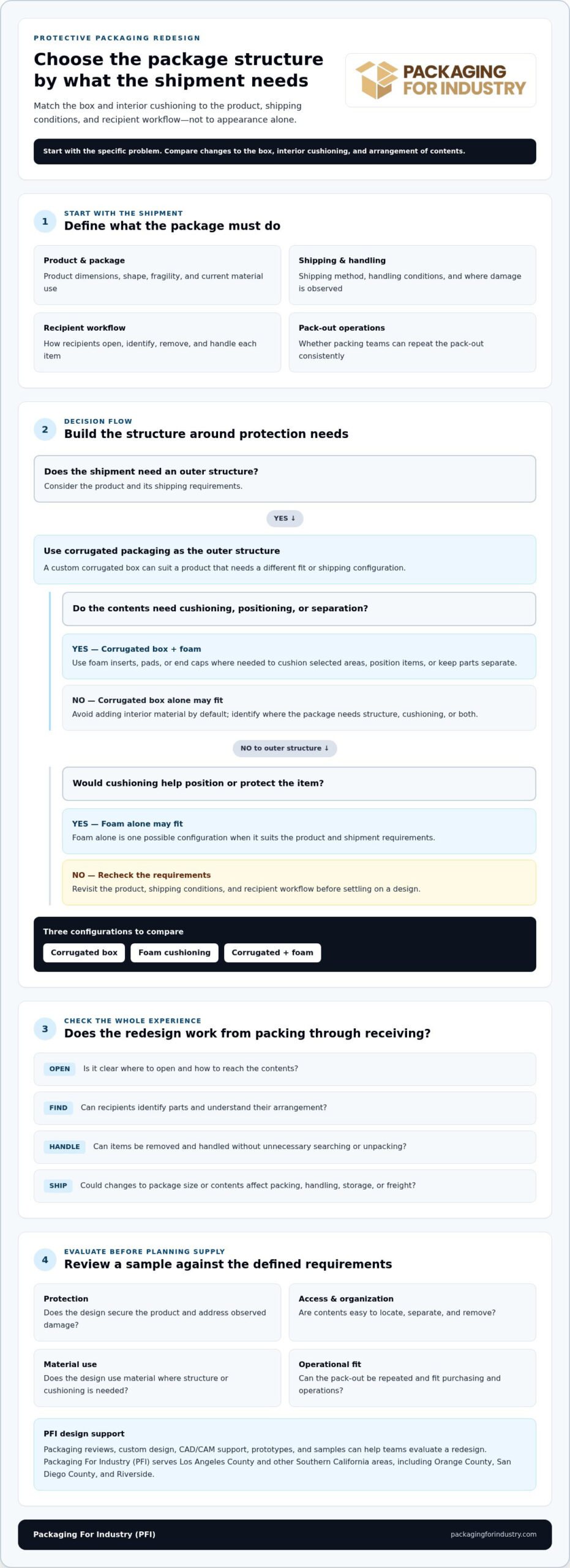
How to plan and evaluate a protective packaging redesign in Los Angeles
A focused redesign starts with evidence from the current pack-out, not assumptions about what a package should look like. Gather the existing packaging, product dimensions, damage observations, and shipping context before discussing changes. This gives operations and purchasing teams a shared basis for defining the problem and assessing whether a proposed design can work in routine use. For purchasing, also note order frequency and the quantities needed for repeat shipments.
- Document the issues. Record damage patterns, difficult opening steps, misplaced or hard-to-identify components, excess material, and concerns from receiving or packing teams. Note where each issue occurs and how often it is reported. Consider other possible causes alongside packaging.
- Define product and shipment needs. Capture product size, fragility, component count, handling conditions, shipment method, and recipient workflow. Include current package dimensions and how the product is positioned inside. Compare custom sizes with current formats for fit and operational practicality.
- Develop a concept. Use the documented requirements to decide whether to change the box, interior cushioning, component arrangement, or a combination. Assess whether the concept supports the packing and shipping process while addressing the identified issue.
- Review samples. Use a prototype or sample to assess fit and practical handling before making a broader change. Compare it with the current packaging against the project’s stated requirements, rather than relying on appearance alone.
- Plan implementation. Consider how the selected design fits recurring orders, purchasing practices, and packaging availability. Compare packaging pricing and, for larger recurring needs, bulk packaging pricing. Include local packaging delivery and replenishment in the supply plan.
Prepare useful requirements for a packaging review
Make the review specific. Include product dimensions, fragility concerns, the number and type of components, handling steps, shipment method, and recipient workflow. Add examples of reported damage or unpacking difficulties, along with current material or freight concerns. For packaging for distribution centers, describe receiving and internal handling steps that affect access to the shipment. Separate essential protection requirements from desired presentation improvements.
Review prototypes before changing recurring orders
A sample lets relevant teams assess product fit, handling, and access to the contents. Include operations, shipping, procurement, and product staff when their workflows are affected. Their perspectives can reveal practical issues that may be missed in a design discussion alone. PFI’s custom packaging design services include CAD/CAM support, prototypes, and samples to help move project requirements into evaluation.
Before changing recurring orders, align on the design, purchasing process, and replenishment plan. For buyers considering protective packaging redesign services Los Angeles, this stepwise review provides a clear path from current problems to a considered packaging decision.
Work with a Los Angeles protective packaging redesign supplier
A redesign should account for how packaging fits the broader operation, not just the product inside it. Packaging For Industry works with industrial buyers on custom packaging design and the materials that support it, including corrugated boxes, protective foam, and crates. This integrated approach connects packaging choices to packing processes, shipping requirements, and purchasing needs.
What PFI can bring to an industrial packaging redesign
PFI’s custom packaging design services help businesses address needs that call for a tailored approach. The work considers how a package protects the product and fits the company’s shipping workflow. PFI also provides packaging reviews to identify damage-reduction and cost-reduction opportunities, giving the redesign a practical operational purpose.
One material may meet a shipment’s needs; another may benefit from corrugated packaging, foam, and crates working together. PFI can bring these materials into one packaging solution built around the shipment and how the business handles it.
Turn a redesign into a practical supply plan
Once a configuration suits the project, consider how it will support recurring orders and production or shipping requirements. PFI offers custom and stock packaging, giving purchasing teams options to compare against operating needs. A redesign can target lower packaging costs and more reliable supply, with results assessed against the business’s actual requirements.
PFI serves Los Angeles County and other Southern California areas, including Orange County, San Diego County, and Riverside. For local manufacturers, warehouses, and distributors, a regional packaging supplier can connect design decisions with ongoing supply needs.
Bring your packaging requirements and purchasing priorities together to set a clear direction for the redesign.
Make packaging improvement part of your next operating decision
A redesign can address a current complaint and give your team a clearer basis for reviewing packaging when products, shipping patterns, or receiving workflows change. Track feedback after introducing a new configuration, including whether recipients can access items as intended and whether packing remains practical. Those observations can guide future adjustments while keeping essential protection requirements in view.
For manufacturers and distribution teams evaluating protective packaging redesign services Los Angeles, the next step is to define the concern and share the details. Explain what the package needs to protect, how it moves through your operation, and what recipients need to do after delivery. PFI supports industrial buyers with packaging design and supply, including local next-day delivery throughout Southern California.
A focused review helps your team make a packaging decision based on real operating needs. Request a quote from PFI to discuss your protective packaging redesign.
Frequently Asked Questions
How can packaging redesign improve the customer unboxing experience?
Packaging redesign can make a shipment easier to identify, open, and process at receiving. For example, a clearly arranged set of machine components can help staff distinguish the main unit from accessories before moving items into inventory or onto a production line. Aim to reduce uncertainty, such as searching for parts or deciding what to remove first, while preserving the package’s protective function.
Can protective packaging be redesigned without increasing product damage?
No redesign can guarantee zero damage, but a proposed change can be evaluated against defined protection needs rather than appearance alone. Keep the current package as a reference and review a sample for product fit, retention, and practical handling before adopting it. If the concept changes materials or configuration, document the reason for each change and have relevant operations and shipping personnel review it before recurring use.
What packaging materials can improve an industrial unboxing experience?
Corrugated boxes, protective foam, crates, and other cushioning materials suit different industrial shipments. A box may fit a routine parcel or distribution flow, while a crate may suit a larger or different shipping configuration. Foam can support selected components inside. Choose materials based on how the product moves and is received, not on which material looks more polished.
How do I start a protective packaging redesign for a Los Angeles business?
For protective packaging redesign services Los Angeles manufacturers can use, start by describing the product and the problem with the current package. Include the affected product line, the damage or receiving concern, and what the recipient needs to do after delivery. PFI serves Los Angeles County and businesses across Southern California, including Orange County, San Diego County, and Riverside.
Does custom packaging redesign make sense for recurring shipments?
Custom redesign can make sense for repeat shipments when the package suits a stable product and repeatable packing needs. Review how the configuration fits order patterns, storage, and the people packing each unit, then align the selected format with purchasing. A recurring design can help standardize pack-out. Assess cost reduction and supply reliability against your operating requirements.
What information should I provide when requesting a packaging redesign quote?
For a quote, share product identifiers or variants, expected order frequency, approximate order quantities, and any packaging cost or supply constraints. Note who packs the item, where it ships, and what changes between shipments. If possible, provide a current packaging sample or photographs showing how the product is packed. These details help scope a custom packaging quote around actual purchasing and operational needs.
Can a packaging redesign combine corrugated boxes and foam inserts?
Yes. Corrugated boxes and foam inserts can form a coordinated configuration when the product and shipment call for both. For instance, an outer box can contain multiple components while foam separates or cushions selected items. Consider whether parts need distinct positions, how staff remove each one, and whether the arrangement is practical to reproduce for recurring shipments.