
A packaging engineer gives notice, and suddenly a box revision, material specification, or approval has no clear owner. If you’re deciding what to do when your packaging engineer quits, first keep production and shipments moving while capturing the decisions that person carried in their head.
Packaging drawings, test results, supplier details, and design rationale may be scattered across files or undocumented. Meanwhile, open projects and recurring packaging orders still need attention. A structured handoff helps protect continuity without rushing into a replacement decision.
This checklist shows how to stabilize urgent packaging needs, record critical specifications and project status, and prioritize work by operational risk. It also helps you assess whether to hire a new engineer, redistribute responsibilities internally, or use outside design support for selected projects. For ongoing packaging needs, custom packaging design, packaging reviews, and inventory programs such as VMI and just-in-time management can connect documented specifications with reliable supply. The goal is a practical system that keeps packaging decisions moving and fits your team’s workload over the long term.
Key Takeaways
- Use a clear response sequence to assign ownership, identify shipment deadlines, and contain immediate packaging risks.
- Organize handoff records by product, approved specification, and open decision so teams can distinguish validated designs from work in progress.
- Decide what to do when your packaging engineer quits by weighing workload, required expertise, continuity needs, and internal capacity.
- Give operations, purchasing, and production teams a shared checklist for active shipments, packaging inventory, long-lead items, and unresolved damage issues.
- See how CAD-engineered design, prototypes, samples, packaging reviews, and inventory programs can support defined projects and recurring supply needs.
Packaging Engineer Quits: Stabilize Operations
When a packaging engineer leaves, the immediate risk is often an unanswered decision tied to a production run, shipment deadline, or packaging change already in motion. Before approving a redesign or opening a replacement search, identify what needs attention now and what can wait. This keeps urgent work moving without prompting unnecessary changes or purchases.
Packaging knowledge continuity keeps production and shipping decisions grounded in proven specifications, helping teams avoid preventable delays and damage.
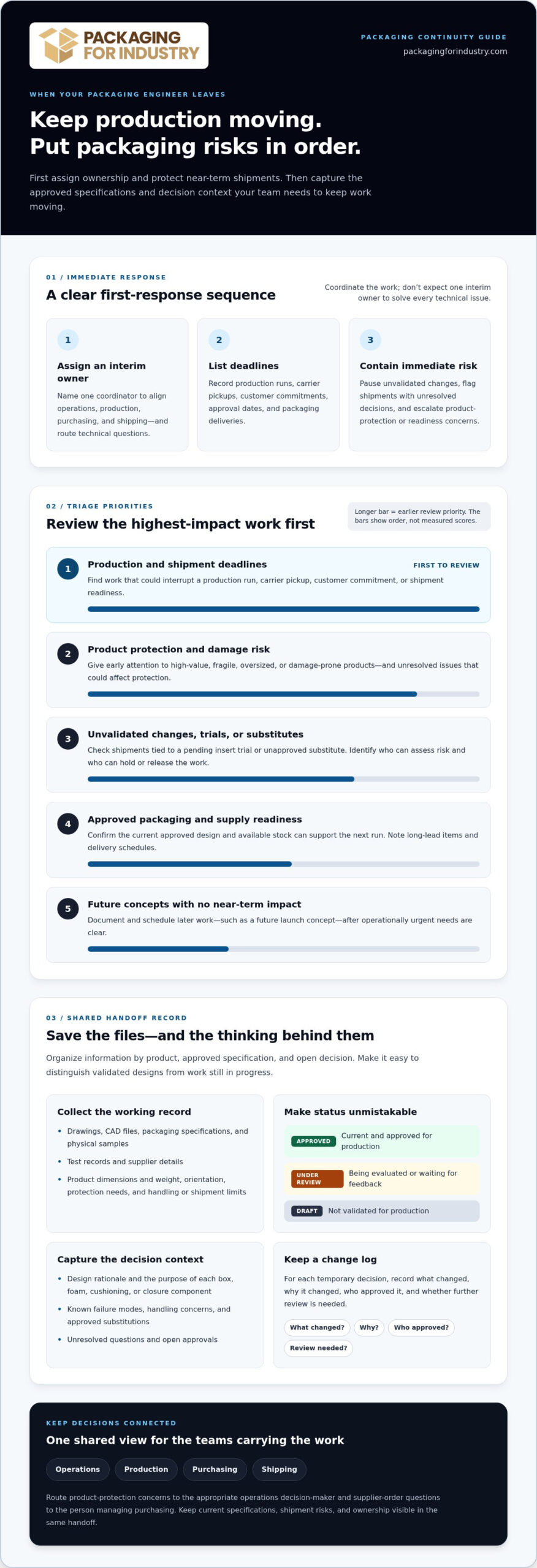
Start with a short response sequence:
- Assign an interim owner. Name one person to coordinate packaging decisions and align operations, production, purchasing, and shipping. This person can gather input and route technical questions without being expected to resolve every engineering issue alone.
- Identify deadlines. List upcoming production runs, carrier pickups, customer commitments, approval dates, and packaging deliveries. For packaging used by manufacturers, warehouses, and distribution centers, note how local packaging delivery schedules and incoming stock affect the next shipment.
- Contain immediate risk. Pause unvalidated changes, flag shipments tied to unresolved decisions, and escalate issues that could affect product protection or shipment readiness.
Triage active packaging work and shipment risks
Build one working list of open designs, packaging changes, pending approvals, trials, and upcoming shipment requirements. Separate work that could interrupt production or shipping from projects with no near-term impact. A shipment depending on a pending insert trial needs prompt review; a concept for a future launch can be documented and scheduled for later.
Prioritize products that are high-value, fragile, oversized, or already prone to damage. Check whether the current approved design and available packaging stock can support the next run. If a shipment depends on a trial or an unapproved substitute, identify who can assess the risk and who has authority to hold or release the work.
Set a clear escalation path. Route product-protection concerns to the appropriate operations decision-maker and purchasing questions to the person managing supplier orders. Once the immediate requirement is clear, purchasing can compare packaging pricing, including bulk packaging pricing where relevant, without choosing a substitute that fails to meet the approved need. Custom sizes may be important for a specific application, but a redesign is not always the fastest or safest response.
Secure the information the team already has
Collect current drawings, CAD files, packaging specifications, physical samples, test records, and supplier details in an accessible shared location. Link each item to the product or packaging application it supports. Clearly mark which documents are current and approved and which are drafts or under review.
Capture design rationale, known failure modes, approved substitutions, handling concerns, and unresolved questions. If a box or protective foam configuration addressed a damage issue, record that context so later changes don’t undermine its purpose. Keep a change log for temporary decisions, including what changed, why, who approved it, and whether further review is needed. That record also helps teams assess whether a packaging change could lower costs without compromising the approved application.
A focused custom packaging design review can help clarify specific packaging questions as the team organizes its next steps.
How to Preserve Packaging Engineering Knowledge During the Handoff
A useful handoff is more than a folder of drawings. It gives the next decision-maker both the approved packaging record and the reasoning behind it, so routine production can continue without treating every open question as a new design project. If you’re weighing what to do when your packaging engineer quits, organize information around three working views: products, packaging specifications, and open decisions.
A useful packaging handoff combines accurate records with the decision context needed to apply them correctly. Drawings can show dimensions and structure, but may not explain why a material was selected, where a product fits tightly, or which shipping constraints shaped the design. Capture that practical knowledge alongside the files.
Build a packaging handoff file for each product
Create a product-level record that connects the item being shipped to its packaging and handling needs. Include product dimensions and weight, orientation, areas needing protection, and any handling or shipment limits. Link the current specification to its approved drawing, revision, and corresponding physical sample so the team can match paperwork to the package in use.
Describe the purpose of each component, such as the box, foam, cushioning, or closure. For example, note whether a foam component protects a particular surface or keeps the product from shifting. That purpose helps a future reviewer assess a proposed substitution without relying on dimensions alone.
Track decisions, validation, and ownership
Give every concept, sample, and proposed change a clear status. Mark whether it is approved for production, under evaluation, or waiting for feedback. Record prototype comments, test outcomes, pending approvals, the next action, and the person responsible. This prevents an unvalidated sample from being mistaken for the production standard.
Also state which changes need technical review before production use. A material substitution, change to product orientation, or altered protective component may affect fit or shipping performance. Document known damage concerns, freight constraints, and relevant customer requirements so reviewers understand the operating conditions behind the specification.
To keep the handoff usable, arrange records consistently and make their current status easy to see. A simple index can point teams to:
- Product: identifying details and handling considerations.
- Approved specification: current drawing, revision, sample, and component purpose.
- Open decision: question, owner, required review, and next step.
Keep concepts and samples separate from approved specifications, with labels identifying the product and status. When feedback changes a design, update the record and retain the prior revision for reference rather than letting multiple versions circulate without context. This helps production and purchasing use the right information, and lets an outside packaging design partner pick up a defined project without confusing a trial with an approved solution.
If the handoff reveals a packaging project that needs defined design support, request a packaging quote to discuss the requirement and supporting information.
Should You Hire, Reassign, or Outsource Packaging Engineering?
The right response to what to do when your packaging engineer quits depends on the work that needs to be done, not just the vacancy. First separate temporary project coverage from the longer-term staffing decision. A pending box revision or foam insert project may need defined technical support now, while a permanent role makes sense only if the workload and expertise needs will continue.
Compare the options against four practical factors: how consistently packaging work comes in, how specialized the decisions are, how much continuity the operation needs, and whether internal staff have capacity. The choice can also be a combination. Your team might reassign routine coordination, get outside design support for a specific project, and then assess whether ongoing demand justifies hiring.
| Path | Benefits | Tradeoffs | Suitable operating conditions |
|---|---|---|---|
| Hire | Builds dedicated internal ownership and retains packaging knowledge within the organization. | Requires time to recruit and onboard; the role needs enough sustained work to justify dedicated capacity. | Packaging engineering is specialized, central to daily operations, and consistently required. |
| Reassign | Uses existing staff and can maintain coordination with production, purchasing, and shipping. | Added duties can compete with current responsibilities, and technical decisions may exceed the person’s expertise or authority. | An employee has relevant skills and capacity, with clear technical oversight and workload limits. |
| Use an external packaging partner | Provides project-based design support and can connect packaging requirements with supply needs. | Internal teams still need to set priorities, share product requirements, and own business decisions. | Defined design work needs attention, or packaging expertise and supply coordination are both priorities. |
When hiring or reallocating work may fit
Consider hiring when packaging design, reviews, and changes create a sustained, specialized workload that affects daily production or shipping. Reassignment may fit when a current team member has relevant technical experience, enough capacity, and access to an appropriate reviewer. Set boundaries: identify decisions they can make, issues that require escalation, and existing duties that must be deprioritized. Without those limits, packaging work can stall while the employee’s other responsibilities suffer.
When an external packaging partner may help
Outside design support can be useful for a defined custom box, foam insert, crate, or packaging review without treating the partner as a staffing placement or employee. Consider whether engineering work and packaging supply should be coordinated, particularly when recurring materials need planning alongside a design change. PFI’s custom packaging design services include CAD-engineered solutions, prototypes, and samples for project needs.
Keep internal ownership of priorities, product requirements, approvals, and operational decisions regardless of the model. A focused project can also clarify the longer-term workload: track recurring requests, unresolved technical needs, and supply coordination demands. If a packaging design or supply requirement is ready to scope, you can request a packaging quote with the project details.
Packaging Continuity Checklist for Projects, Specifications, and Supply
After assigning urgent shipment risks, use a shared checklist to connect engineering decisions with production schedules and purchasing activity. This gives operations, production, and purchasing one view of what is approved, what needs action, and which packaging items could affect supply. It also helps answer what to do when your packaging engineer quits without leaving recurring orders or open projects dependent on informal updates.
Review packaging specifications and open projects
Start with packaging used on active production lines and shipments. Confirm that the specification in use matches the current approved version for each box, foam component, crate, or recurring material. Include the revision or identifying reference your team uses, and note where production and purchasing can find it.
- Active shipments: Check packaging availability against scheduled production and shipment requirements. Flag a shortage or unresolved packaging decision that could delay an order.
- Open design work: List prototypes, samples, proposed changes, and pending approvals. Assign each item an owner, next action, and decision date based on the actual project schedule.
- Damage concerns: Review damage reports and freight constraints before changing a specification. Identify the affected product and shipment conditions so a change addresses the known issue rather than introducing a new risk.
- Custom items: Identify packaging made to a specific design that cannot readily be replaced by an off-the-shelf option. Note its supplier, ordering status, and the production need it supports.
Do not treat every proposed revision as approved for use. Keep the current specification distinct from samples or changes awaiting review, and route technical questions to the interim decision owner. For each open design or sourcing issue, record a specific next step, such as reviewing a sample, checking stock, or resolving an approval.
Protect recurring supply while responsibilities change
Purchasing and production should review packaging usage patterns together. Compare recent consumption with available stock, known replenishment lead times, and the production schedule. This helps distinguish a genuine supply risk from a low-stock item that isn’t needed for an upcoming run. Include custom corrugated packaging, protective foam, stretch film, and other recurring materials where a shortage could interrupt work.
For each item, document who owns ordering, who monitors stock, and who can approve a change in quantity or specification. If the former engineer coordinated purchases informally, make that process visible before the next order is due. Avoid substituting a stock item for custom packaging solely because it appears similar; fit, protection, and handling requirements still matter.
Where recurring replenishment requires ongoing coordination, vendor managed inventory for packaging can connect established packaging requirements with stock oversight. Just-in-time inventory management may also suit operations that need replenishment aligned with planned use.
Close the review by assigning an owner and next action to every open design, sourcing, and inventory item. A short, shared status review helps keep purchasing decisions tied to approved specifications and production needs.
How PFI Can Support Packaging Design and Supply After a Resignation
A packaging engineer’s departure can leave a specific design project without a clear technical path, even when the business doesn’t need a full-time replacement. Packaging For Industry (PFI) supports defined packaging design and supply work as an industrial partner, while your team retains control of priorities, internal approvals, and production decisions.
Match design support to the packaging work in front of you
PFI’s custom packaging design services support tailored packaging needs involving corrugated boxes, protective foam, and crates. CAD-engineered design, prototypes, and samples let teams assess a proposed solution for a specific product before broader production use. When a project needs a protective component, PFI’s foam packaging options can be considered as part of the overall packaging design.
PFI serves manufacturers and other B2B businesses, including aerospace, electronics, medical device, food and beverage, and industrial equipment companies. Packaging requirements vary by product and shipping context, so describe the application clearly to keep design work focused on your operation’s needs. PFI serves businesses in Orange County, Los Angeles, and San Diego, as well as customers nationwide.
Set up a practical next step with PFI
PFI combines custom and stock industrial packaging products with design and recurring inventory services. This gives purchasing and operations a way to discuss packaging requirements and supply planning together, rather than treating every design question as an isolated purchase. VMI and JIT programs can support recurring packaging needs, while packaging kitting and assembly can bring specified components together for an operational requirement.
Your team gets a defined path for addressing the packaging work at hand without assigning the supplier internal employee responsibilities. PFI’s industrial focus and combined design-and-supply capabilities can help keep project requirements connected to purchasing and production needs. To prepare for a useful discussion, gather current drawings or samples, the product application, expected volumes, deadlines, and any shipping or handling concerns.
Turn the Transition Into a Stronger Packaging Process
The decision about what to do when your packaging engineer quits can shape more than the next shipment. Use the transition to make packaging ownership clearer, keep decisions connected to production needs, and build a process that doesn’t depend on one person’s memory. Your next step doesn’t have to be a full redesign or an immediate permanent hire. Start with the packaging issue that needs attention, define what support your team needs, and set a practical path for ongoing work.
PFI works with manufacturers and other industrial businesses on defined packaging design and supply needs. Share the product, current packaging, timing, and operational constraints so the discussion can focus on a workable next step for your team.
A well-managed handoff can become the foundation for more consistent packaging decisions and a steadier flow of materials. Take the next step by documenting the work, assigning ownership, and keeping your operation moving.
Frequently Asked Questions
What should I do first when our packaging engineer quits?
Start by telling production, shipping, and purchasing where packaging questions should go during the transition. Set a temporary process for documenting decisions, including who needs to be informed before a packaging instruction changes. When deciding what to do after your packaging engineer quits, this communication step helps prevent different shifts or departments from working from conflicting directions while longer-term responsibilities are sorted out.
What information should be included in a packaging engineer handoff?
Make sure handoff materials are accessible to the people who need them, not stored only in a former employee’s personal folders or email. Use clear file names that identify the product, document type, and revision, and designate a shared source of truth. If packaging samples are stored physically, label them so a future reviewer can match each sample to its product and related records.
Can production continue while packaging specifications are being reviewed?
It may be possible to continue an unchanged production run while a separate packaging review proceeds. Keep packaging instructions consistent within the run, and make sure any approved change has a clear point of application so employees don’t mix old and revised methods. If the product, shipping conditions, or package handling changes, pause and route the affected work for review before assuming the existing approach still applies.
Should we hire a new packaging engineer or use outside design support?
Before deciding, track the packaging work that reaches the team over a representative operating period. Separate recurring tasks, such as ongoing line or material support, from one-time design projects. That record can help show whether the organization needs a dedicated role or targeted project assistance. Also define which decisions must remain internal, such as product-release approvals, so any support model fits the company’s decision process.
How can we prevent packaging shortages after an engineer leaves?
Set a communication trigger for supply risk, such as a custom item falling below the level purchasing needs to plan replenishment. Make sure production knows how to report unusual usage or schedule changes that could affect demand. For each critical packaging item, identify who receives the alert and who coordinates the next action. This reduces reliance on informal knowledge held by a single employee.
What should I send with a request for a packaging quote?
Clarify whether the request is for a one-time design project, repeat purchasing, or both. If it involves several components, identify which items need to arrive together or be prepared as a kit. Separate required features from preferences, and state what decision your team needs to make from the quote. This helps focus the discussion on the right scope rather than treating a design request and ongoing purchasing need as the same task.
Can a packaging supplier help with both design and recurring packaging supply?
Yes. A packaging supplier can discuss a custom packaging project alongside the purchasing plan for the resulting materials. For example, a team can consider how a newly specified component will be identified in purchasing records and coordinated with its expected use. Packaging For Industry serves businesses in Orange County, Los Angeles, and San Diego, and offers design support as well as recurring inventory programs.