
Your first custom package shouldn’t start with a box size. It should start with the journey your product takes. The first time buying custom engineered packaging can raise practical questions: What details does an engineer need? Will a tailored design add cost or purchasing complexity? And how can you keep packaging supply consistent once the design is approved?
Those are important questions. The right solution depends on the product, how it’s packed, and how it moves through storage, freight, and delivery. This guide explains what to gather for a useful quote request, how to compare stock, adapted, and custom-engineered options, and how to assess protection and freight efficiency together. PFI’s custom CAD-engineered designs, prototypes, and samples help you evaluate a solution before planning repeat supply. A clear project brief gives your team a practical basis for comparing packaging options, not just unit prices.
Key Takeaways
- Start with the product’s handling and shipping challenges, so the packaging brief addresses the real problem rather than just a box size.
- For first time buying custom engineered packaging, assess stock, adapted, and custom options against fit, protection, and your packing workflow.
- Prepare a stronger quote request with product details, shipping context, current packaging, recurring demand, and the improvements you want.
- Review a prototype for product fit and protection before planning a broader rollout.
- Coordinating corrugated boxes, foam, and wood crates can help align product protection with repeatable supply needs.
First-Time Custom Engineered Packaging: Define the Shipping Problem Before the Design
Custom engineered packaging is designed around a product and the conditions it encounters during packing, storage, handling, and shipping. That’s different from choosing a standard carton because its listed dimensions seem close. The package also needs to work for the people who pack it and for the way it moves through the supply chain.
If you’re buying custom engineered packaging for the first time, start by describing the problem rather than deciding in advance that a particular box or material is the answer. Damage can disrupt orders, freight constraints can limit options, and a new design can raise questions about purchasing and ongoing supply. A clear account of the current issue gives the design discussion a useful starting point.
What makes packaging an engineering project?
Design depends on the product’s dimensions, fragility, weight, and handling needs, as well as its route to the destination. A carton may fit the product but still leave it vulnerable to movement or make packing awkward. Packaging engineering brings design and evaluation together. PFI’s custom packaging design is tailored to the product and its use. The goal is a structural solution based on the actual application, not dimensions alone.
Which business problem should the package solve first?
Identify what prompted the project. Explain what happens today, where the current packaging falls short, and what a better result would look like. A specific problem statement helps an engineer weigh product protection alongside freight, warehouse handling, and the packing process.
- Damage: describe what is damaged and when it is discovered.
- Freight: note size, handling, or shipment constraints that affect the package.
- Packing: explain where the current process is inconsistent or difficult.
- Supply: say whether the packaging is needed repeatedly for ongoing shipments.
Brand presentation may matter, but it shouldn’t automatically drive an industrial packaging brief. If a component arrives damaged, describe its condition and the shipment context. If employees pack the same product differently, explain which steps vary. If packaging availability disrupts production, note how often the need recurs. These details help separate the underlying business issue from an early assumption such as “we need a heavier box.”
The right direction depends on the product, shipping method, and repeat demand. A fragile item shipped individually may need different protection from a product packed in batches for freight. Describe the actual use case first. That gives the design process a practical target and keeps the discussion focused on protection, workflow, and reliable supply.
How Custom Packaging Engineering Moves from Requirements to Prototype
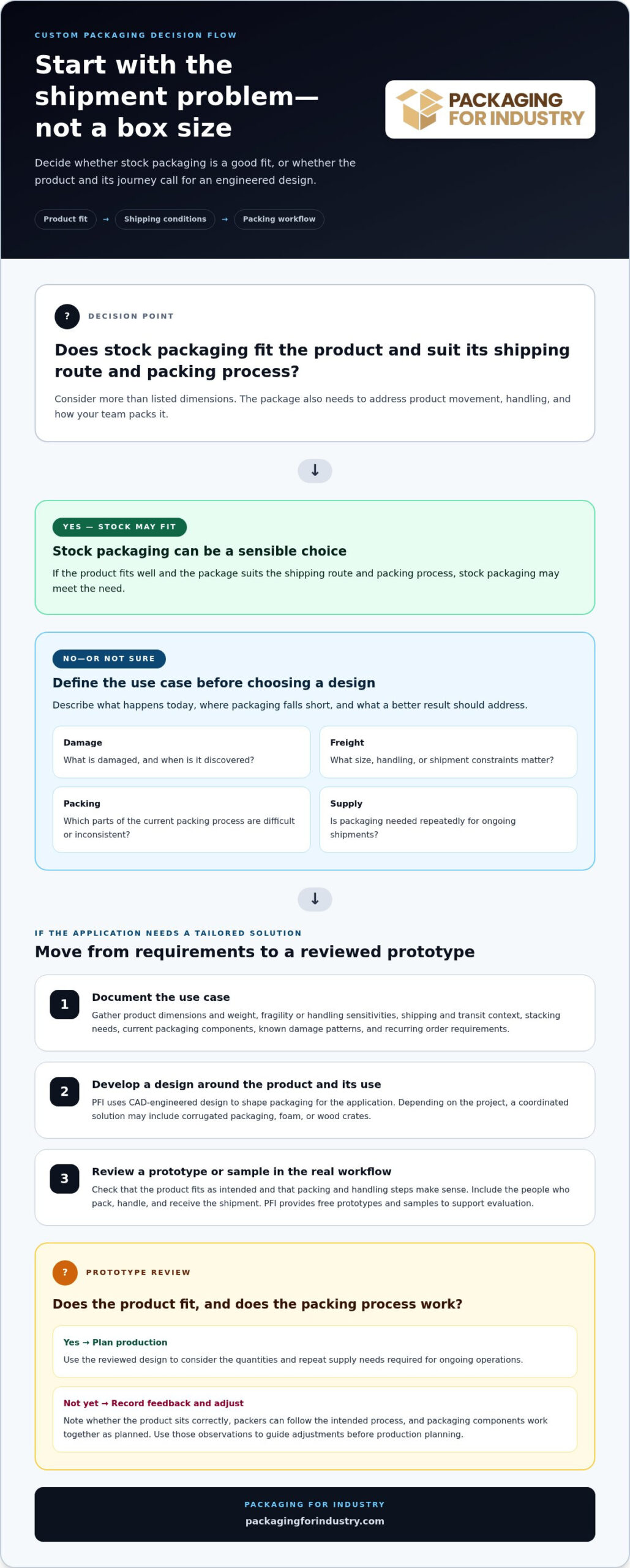
A clear project sequence helps buyers move from a shipping problem to a package their team can use. When you’re first time buying custom engineered packaging, don’t approve a drawing and simply hope it works. Document the application, develop a design, review a prototype, and use what you learn to plan production.
- Document the use case. Gather product details, shipping context, current packaging components, and recurring order needs. Include the issue the new package should address.
- Develop the design. PFI uses CAD-engineered design to shape packaging around the product and its use. Depending on the project, a coordinated solution may include corrugated packaging, foam, or wood crates.
- Review a prototype or sample. Check the product fit and how the package works for the people who pack and handle it.
- Plan production. After reviewing the design, consider the quantities and repeat supply needs required to support ongoing operations.
What information helps an engineer develop a useful design?
Provide the product’s dimensions and weight, and describe its fragility or handling sensitivities. Explain how it ships, how it is handled in transit, and whether it is stacked. Share the current packaging components and any known damage patterns. If the package is used regularly, include recurring order requirements so the design discussion accounts for both the product and the operation.
Why review a prototype before a full rollout?
A drawing shows a proposed structure, but a prototype gives your team something tangible to assess. Check whether the product fits as intended and whether the packing steps make sense in your actual workflow. Invite the people who pack, handle, and receive the shipment to review it. PFI provides free prototypes and samples to support this evaluation.
Record specific feedback during the review. Does the product sit correctly? Can the packer follow the intended process? Do the packaging components work together as planned? Clear observations give the design team a practical basis for adjustments before production planning. Approval of a drawing alone doesn’t show how the package performs in use.
PFI’s custom packaging design services connect project requirements to CAD-engineered designs and prototypes, helping buyers assess a proposed solution before planning repeat supply. Once the design direction is clear, a custom packaging quote can reflect the project details and anticipated demand.
Custom vs. Stock Packaging: Compare Protection, Operations, and Total Fit
Stock packaging can be a sensible choice when the product fits well and the package suits its shipping route and packing process. Engineering isn’t automatically the better answer for every shipment. Compare options across the operation, not just by purchase price or how closely a carton matches the product’s dimensions.
Comparison | Fit | Protection | Process and supply
Stock | Uses available sizes and formats; works when the product fits appropriately. | Suitable when existing packaging meets the shipment’s protection needs. | Often straightforward to order and use if it suits the packing workflow and repeat demand.
Adapted | Combines or adjusts available packaging components to improve fit. | May address a specific gap without a fully engineered design. | Consider whether the change simplifies packing or adds steps and components.
Custom-engineered | Designed around product-specific dimensions and use. | Worth evaluating when fit is unusual or damage recurs. | Can be planned around the packing process, shipping method, and ongoing supply needs.
When can stock or adapted packaging be a practical choice?
If an available carton holds the product securely, works with the shipping method, and can be packed consistently, stock packaging may meet the requirement. An adapted option may also work when existing materials can be combined to address a clear fit or workflow issue. Keep the solution practical: extra components add little value if they create more handling steps without resolving a problem.
Compare the full operational fit. Consider how the package moves through packing, storage, and shipment, and whether the same format will be needed for repeat orders. A box that works for one shipment may be a poor fit if it complicates storage or makes routine packing inconsistent.
When should a buyer consider engineered boxes, foam, or crates?
Consider engineering when the product has an unusual shape, fragile or high-value components, or a history of shipping damage that current packaging hasn’t addressed. If both an outer container and interior cushioning are needed, corrugated packaging can be considered alongside foam. The right combination depends on the product and shipping requirements, not on a blanket preference for custom packaging.
If you’re buying custom engineered packaging for the first time, evaluate whether a tailored design addresses a defined protection or operational issue. Weigh material use, packing steps, storage needs, and repeat-order consistency alongside the quote. PFI’s packaging solutions are designed to help businesses lower packaging costs, but the result depends on the project requirements. Compare pricing against the complete packaging process, including avoidable damage and operational friction, rather than assuming custom or stock packaging will always cost less.
Prepare a Custom Packaging Quote Request: A Practical Buyer Checklist
A useful quote request gives a packaging engineer enough context to address the operating need, not just price a container by size. For a first custom engineered packaging project, you don’t need special terminology. Provide accurate product details, describe the shipping problem, and explain how the packaging will be used and reordered.
What should the packaging brief include?
Build the request in a consistent order. If details are unavailable, identify what you still need to collect instead of guessing at product requirements or future volumes.
- Describe the product. Provide dimensions and weight, and note fragility, sensitive areas, or handling requirements that could affect protection.
- Explain the shipping context. Include the shipment method, destinations, and relevant handling or stacking conditions. Note freight constraints that affect package size or movement through your operation.
- Document the current packaging. List the components used today and explain the specific issue, such as recurring corner damage, a product shifting in transit, or packing steps that vary between employees. State what you want to improve.
- Describe demand and workflow. Explain how the package is filled, sealed, stored, and prepared for shipment. Include expected order patterns or production needs based on what you know, without inventing a volume forecast.
How can teams compare proposals consistently?
Keep the scope consistent across quote requests. Describe the same product, shipping context, packaging components under consideration, and supply expectations in each request. Otherwise, different proposed scopes can make pricing difficult to compare. A quote for a container alone isn’t directly comparable to one that includes interior protection or additional components.
Review each proposal against the same practical criteria: product fit, protection approach, packing workflow, shipping method, and repeat-order needs. Check that the proposed materials and components are clearly described, and note whether a prototype or sample is part of the review process. If a crate is being considered for international transit, include the shipment context and known handling or destination constraints in the brief. Keep the project focused on the packaging need rather than choosing a crate design or material before the use case is understood.
Make the desired outcome explicit. You may be seeking a more consistent packing process, a better fit, fewer damage issues, or a reliable supply of packaging for recurring production. Clear priorities help teams compare like with like and discuss trade-offs without losing sight of the original problem.
From First Design to Reliable Supply: How PFI Supports Custom Packaging Buyers
A packaging design has to work beyond its first shipment. It also needs a clear path to repeat ordering, so purchasing and operations can plan around the packaging they use. For a first custom engineered packaging project, PFI brings custom CAD-engineered design, free prototypes and samples, and supply planning into one practical process.
Depending on the application, a coordinated solution may combine corrugated boxes, foam, and wood crates. The aim is to align the outer package and interior protection with the product and its shipping needs, while keeping the packing process and future supply in view. This can help when multiple packaging components need to be ordered and managed together.
How can custom design connect to repeat packaging supply?
Once a design is established, recurring demand becomes part of the purchasing plan. Boxes, foam, and crates can have different ordering patterns, so share usage and production needs when discussing supply. For packaging that takes longer to plan or replenish, connecting design discussions to inventory planning helps teams consider supply continuity alongside product protection.
PFI’s Vendor Managed Inventory (VMI) uses scheduled reviews and planned replenishment based on actual usage, with a 30-60 day supply buffer. Just-In-Time (JIT) inventory management provides on-demand deliveries, with a 30-60 day buffer for production spikes. These options help buyers align recurring packaging needs with their operating rhythm.
What makes PFI relevant to a first-time industrial buyer?
PFI supports manufacturers and other B2B buyers, including businesses in aerospace, electronics, and medical devices. That industrial focus keeps the discussion grounded in product protection, packing operations, and dependable supply, rather than treating packaging as a presentation decision alone. PFI supports buyers nationwide and provides next-day delivery in Orange, Los Angeles, San Diego, Riverside, and Ventura counties. For manufacturers and warehouses in Orange County, Los Angeles, and San Diego, local delivery can support recurring packaging needs.
PFI states savings of 15%-40% versus national competitors. That positioning reflects the company’s focus on helping customers manage packaging costs, but it isn’t a promise of a specific result for an individual project. Your product, design requirements, order pattern, and supply needs shape the proposal. Share those details when requesting a quote so the discussion can address both the packaging solution and its fit with ongoing operations.
Turn Your Packaging Brief Into a Practical Next Step
Your first packaging project can do more than address an immediate shipping need. It can give your team a reference point for future packaging decisions, helping purchasing and operations assess whether the solution continues to fit as products or workflows change.
When buying custom engineered packaging for the first time, focus on making the next decision clear. Define what a successful outcome means for your operation, then align the people involved in purchasing, packing, and shipping around that goal.
A focused quote request gives the project a practical starting point. Share the information your team has gathered and move the discussion toward a solution suited to your business needs.
Request a custom packaging quote from PFI to discuss product fit, protection, and dependable repeat supply.
Frequently Asked Questions
Does custom engineered packaging make sense for a first order?
It can if standard packaging doesn’t fit the product, damage keeps occurring, or shipping requirements create a specific challenge. Custom design isn’t automatically the right choice. If you’re buying custom engineered packaging for the first time, compare the effort of developing a new design with the actual protection and workflow needs. For example, if a standard carton already holds the product securely and packs consistently, a custom solution may not add practical value.
Can custom packaging combine a box, foam, and a crate?
Yes. Packaging components can be coordinated when the product and shipment call for more than one layer of protection. A corrugated box may contain foam cushioning, while a wood crate can form part of the larger shipping configuration. Consider how each component contributes to the package’s purpose. Assess the product, handling, and shipping method together rather than selecting materials independently or assuming every shipment needs all three.
Do custom engineered packaging projects require printing?
No. Engineering can focus on dimensions, structure, and protection without making graphics a priority. Printing is a separate choice for identification or presentation. PFI offers custom printed boxes with printing up to four colors. First establish what the package needs to do, then decide whether printed information would support handling, identification, or another defined business need.
Can a packaging design be adjusted after a prototype review?
A prototype or sample gives the team a practical opportunity to assess the proposed design before rollout. PFI provides free prototypes and samples for custom designs. During the review, ask employees who pack and handle the product to describe any concerns, such as difficult assembly or a fit that doesn’t suit the workflow. Clear feedback helps the project team consider refinements to the proposed solution.
Can PFI support recurring orders for custom packaging?
Yes. PFI offers Vendor Managed Inventory (VMI) and Just-In-Time (JIT) programs for recurring packaging needs. VMI review cycles can be set weekly, biweekly, or monthly, with replenishment planning based on actual usage. JIT supports on-demand deliveries and a 30-60 day buffer for production spikes. These options can help when custom items such as boxes, foam, or crates are part of regular operations.
Does PFI provide next-day delivery everywhere in the United States?
PFI provides next-day delivery in Orange, Los Angeles, San Diego, Riverside, and Ventura counties, and supports buyers nationwide. For a multi-location operation, plan local delivery separately from packaging supply for facilities elsewhere. Share each location’s packaging needs and timing expectations when planning procurement, so the supply approach accounts for regional delivery requirements.
What should I send when requesting a custom packaging quote?
Share product dimensions and weight, fragility or handling sensitivities, shipping method, current packaging, and the issue you want to address. Add known damage patterns or packing workflow concerns, such as a step that varies between shifts. If packaging is needed regularly, describe the order pattern or production requirement you already know. Accurate details help the packaging team discuss suitable options based on the actual application.