
A supplier’s impressive on-time delivery rate doesn’t necessarily tell you whether packaging will arrive when production needs it. The percentage can hide important details: whether performance is measured against the original promised date, whether orders arrive complete, and how delays are reported. Asking the right questions to ask a supplier about on-time delivery rates helps you compare the method and evidence behind a claim, not just the number.
A late packaging shipment can disrupt production or fulfillment, especially when custom packaging has a long lead time or recurring orders leave little room for gaps. This practical checklist covers delivery definitions, reporting periods, order completeness, early-warning communication, and escalation plans. It also explains how to assess whether planned replenishment can support ongoing demand. PFI’s Vendor Managed Inventory and Just-In-Time packaging programs use a 30-60 day inventory buffer to help support supply continuity. Use the questions below to assess how delivery commitments and inventory planning fit your operation.
Key Takeaways
- Compare delivery performance using the same definition, date range, and order-completeness criteria for every supplier.
- Use these questions to ask a supplier about on-time delivery rates and request evidence by product category, order type, and delivery location.
- Look beyond reported percentages to understand how potential delays are identified, communicated, and managed.
- Assess whether planned replenishment and inventory programs can support your recurring packaging demand.
- PFI’s Vendor Managed Inventory program combines scheduled reviews, planned replenishment, and an on-site supply buffer.
Why packaging buyers should ask about supplier on-time delivery rates
A packaging delay can leave a production line waiting for boxes, slow order fulfillment, or keep finished goods from being ready to ship. For manufacturers, delivery reliability affects more than the arrival date: it influences how purchasing, warehouse, and shipping teams plan their work. An on-time delivery percentage is a useful starting point, but it doesn’t show whether the timing commitments fit your replenishment cycle or how a supplier responds when a shipment is at risk.
The questions to ask a supplier about on-time delivery rates should clarify the commitment, the evidence behind the reported figure, and what happens when packaging is delayed. That context helps buyers distinguish a strong-sounding percentage from a delivery process that supports their operation.
How late packaging deliveries affect operations
Packaging materials are part of the production and shipping workflow. If corrugated boxes don’t arrive, finished products may wait to be packed. A shortage of foam can hold up protective packing, while missing stretch film can disrupt pallet preparation. Teams may need to reschedule labor, adjust shipping plans, or make an emergency purchase.
Those workarounds add pressure and can introduce new risks. An unsuitable substitute may not fit the product or established packing process. For example, if a warehouse’s recurring box order is delayed and stock runs low, staff may have to hold shipments or use a different-size box while waiting for replenishment. Reviewing delivery performance helps buyers assess this risk before it interrupts routine orders.
What an on-time delivery rate can, and cannot, tell you
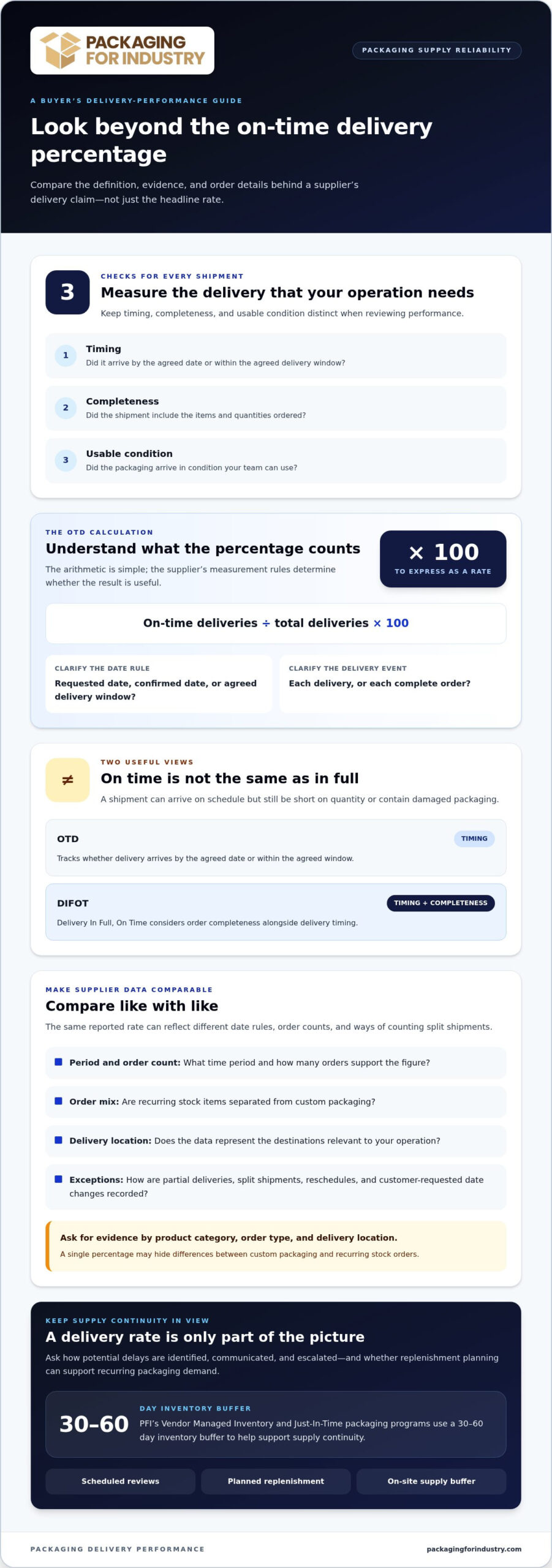
An on-time delivery (OTD) rate measures whether deliveries arrive by an agreed date or within an agreed delivery window. The percentage is meaningful only when the supplier explains how it sets that commitment and records performance. A rate calculated against a revised date, for example, may tell a different story from one measured against the original promise.
Timing also doesn’t establish whether a shipment contained the full order or arrived in usable condition. A delivery could be on time but short on quantity, or some packaging could arrive damaged. Metrics such as DIFOT (Delivery In Full, On Time) consider completeness alongside timing, offering a broader view of delivery performance.
Before comparing delivery claims, define what your operation needs to measure. Consider these questions:
- Did the shipment arrive within the agreed date or window?
- Did it contain the quantities and items ordered?
- Did the packaging arrive in usable condition?
Keeping these measures distinct makes gaps easier to identify. It also gives purchasing and operations teams a practical basis for reviewing delivery commitments, reporting, communication, and shortage response.
How to interpret a supplier’s on-time delivery rate consistently
An on-time delivery rate is usually calculated by dividing the number of on-time deliveries by the total number of deliveries, then multiplying by 100. The arithmetic is straightforward. The measurement rules determine whether the result is useful. Before comparing percentages, establish what counts as a delivery, which date sets the deadline, and which orders are included.
Don’t treat a universal target as a pass-or-fail standard without knowing where it came from and whether it reflects your operation. A supplier handling recurring stock packaging may have a different order mix from one producing custom boxes, foam, or crates. Compare like with like, using the same measurement period, delivery destination, order type, and definition of the promised date.
Which dates and delivery events count?
Clarify whether performance is measured against your requested date, the confirmed date, or an agreed delivery window. Then establish where delivery is considered complete: at your receiving location or at an earlier handoff point. These details show whether a shipment arrives in time for your team to use it, not just whether it moved through a supplier’s process on schedule.
Also establish how records handle partial shipments, split deliveries, rescheduling, and dates changed at your request. A shipment divided into multiple arrivals may be counted as one order or several delivery events. Use the same approach across the data you review.
How to make supplier performance data comparable
Find out what time period and number of orders support the reported rate. A percentage without its underlying period and order count can be hard to interpret. Compare recurring stock items separately from custom packaging, since their ordering and production conditions may differ. Clarify what tolerances apply and which events are excluded, including customer-requested date changes.
Use these questions to establish the basis of the supplier’s figure:
- Which date determines whether a shipment counts as on time?
- Does the metric track each delivery or each complete order?
- What period, order types, and destinations are represented?
- How are partial deliveries, reschedules, and exclusions recorded?
For example, two suppliers could report the same rate while using different date rules or counting split orders differently. Their percentages would look comparable, but the underlying performance might not be. Request a clear explanation of the method and, where available, a report that separates relevant order categories. These questions to ask a supplier about on-time delivery rates help purchasing teams assess whether a claim reflects the packaging orders and receiving conditions they rely on.
For a consistent comparison, define the delivery measure your operation needs and use it across supplier discussions and quote reviews. If you’re evaluating packaging options and replenishment needs, you can request a packaging quote based on your requirements.
Questions to ask a packaging supplier about delivery commitments
A delivery claim is most useful when it reflects the packaging and receiving conditions your operation relies on. Bring these questions to ask a supplier about on-time delivery rates to quote discussions or delivery reviews. Request supporting evidence, not just a verbal assurance or one successful shipment, and record the answers so you can compare performance consistently.
Questions about historical delivery data
Start by clarifying how the reported rate was calculated. The reporting period, number of deliveries counted, and definition of “on time” establish what the percentage represents. Then review data that matches your purchasing pattern. Performance across stock items may not describe custom packaging orders or deliveries to a particular location.
- What reporting period does this delivery rate cover, and how many deliveries were included?
- How do you define an on-time delivery, and what date or window is used for comparison?
- Can you break out results by packaging category, order type, and delivery destination?
- Are recurring stock orders reported separately from custom boxes, foam, or crates?
- What were the main causes of late deliveries, and what corrective actions followed?
Clarify how the report handles exceptions, such as customer-requested changes or split shipments. A clear explanation makes it easier to distinguish routine performance from a figure shaped by exclusions. If only a general percentage is available, review the records or examples behind it and whether they represent your expected order mix.
Questions about order commitments and updates
Next, clarify how a delivery commitment is established and maintained. Stock packaging and custom-designed items can involve different planning steps, so review how timing is confirmed for each. For custom packaging, discuss how design approval, production, and repeat replenishment fit into the schedule. A defined process helps both teams plan around a commitment rather than an informal estimate.
- What confirms the delivery date after an order is placed, and is there an agreed delivery window?
- How are lead times established for stock packaging versus custom-designed items?
- Who contacts us if the schedule changes, and how will the update be sent?
- How early will you notify us when a delivery may miss its confirmed date?
- How do you handle order changes or demand spikes that affect timing or quantities?
Look for specific steps and clear ownership, not broad statements about dependable service. Establish how revised dates are documented and how follow-up works after a schedule change. For custom packaging, PFI’s custom packaging design services can align packaging requirements with the order plan. To discuss your packaging requirements and delivery needs, request a packaging quote.
How to assess delivery risks, escalation, and supply continuity
A delivery commitment matters most when something threatens it. Establish how a supplier identifies risk before the promised date is missed, who owns the response, and what information your team receives. Early notice gives purchasing and operations a chance to adjust receiving plans, prioritize available packaging, or coordinate production before a shortage reaches the floor.
Make the response process specific. For a delayed recurring order of boxes, foam, or stretch film, establish who contacts your team, how revised timing is communicated, and when follow-up happens. Also clarify what happens if the updated date is at risk or similar delays recur.
Questions about delay alerts and recovery
Clarify what triggers a delay alert, which operational contact receives it, and how revised timing is shared. Review what recovery actions may be considered and how progress is communicated. If delays repeat, establish how the pattern is reviewed, contributing factors are identified, and agreed next steps are tracked.
- How will we be notified if an order may miss its delivery window?
- Who communicates updated timing and recovery actions?
- How do you review recurring delays and coordinate follow-up with customers?
Questions about recurring packaging availability
For regularly used materials, consider whether an inventory program fits the way your operation handles recurring demand. Vendor Managed Inventory can support planned packaging replenishment. If production schedules or demand fluctuate, Just-In-Time packaging inventory may help align deliveries with operational needs.
- How will the supply approach account for changes in packaging usage?
- What information should our team share to flag upcoming demand changes?
- How will potential shortages be raised before they affect production or shipping?
Choose safeguards based on each item’s lead time, usage pattern, and impact if it runs short. A frequently used stock item may need a different response plan than a custom package tied to a specific product. Inventory programs can support planning, but they don’t replace clear delivery commitments, timely updates, and an agreed escalation path.
Document notification triggers, responsible contacts, and follow-up steps so both teams have a shared reference when schedules shift. A consistent process helps purchasing and operations respond to risk before it disrupts work.
How Packaging For Industry supports dependable packaging supply
Dependable packaging supply starts with a plan built around the products you ship and the way your operation runs. Packaging For Industry (PFI) supplies custom and stock packaging, including corrugated boxes, foam packaging, and stretch film. Its packaging supports businesses in aerospace, electronics, medical device manufacturing, food and beverage, and other industrial sectors where packaging needs are tied to production and shipping schedules.
Match delivery planning to packaging demand
Usage history, item lead times, available storage, and production schedules help shape a practical supply plan. A recurring need for stock boxes may call for a different approach than custom foam inserts or crates designed for specific products. Reviewing those requirements together can help coordinate replenishment with demand, limit emergency orders, and avoid keeping more packaging on-site than the operation can use or store effectively.
For recurring packaging needs, PFI’s Vendor Managed Inventory and Just-In-Time inventory programs provide options for coordinating supply with operational requirements. PFI’s VMI program includes scheduled inventory reviews and planned replenishment, with a 30-60 day supply buffer. These programs complement clear delivery commitments. Buyers and suppliers still need shared expectations for order timing and communication so teams can plan around production and receiving schedules.
PFI offers next-day delivery in Orange, Los Angeles, San Diego, Riverside, and Ventura counties. This local delivery option serves businesses in those Southern California counties, while PFI also supports packaging needs beyond the region.
Choose the next step for your supply requirements
Prepare a concise view of what your operation uses and where supply planning needs to improve. Include packaging categories, custom or stock requirements, order patterns, delivery locations, and timing needs. Adding storage constraints and production schedules can help define a supply arrangement that fits your workflow.
- Packaging types and specifications, including custom requirements
- Typical usage and recurring order patterns
- Delivery locations and required timing
- Storage capacity and production schedule considerations
These details provide a practical starting point for sourcing custom packaging or planning recurring orders. Use the questions to ask a supplier about on-time delivery rates to align delivery expectations with the packaging your operation depends on. PFI supports manufacturers and operations teams with custom packaging, stock supplies, and inventory programs. For businesses in Orange County, Los Angeles, and San Diego, local delivery can help support regional packaging needs.
Turn delivery expectations into a stronger supply plan
Use the questions to ask a supplier about on-time delivery rates as the start of a practical working agreement, not just a way to compare percentages. Involve purchasing, production, and warehouse teams so delivery commitments reflect how packaging moves through your operation. Agree on who tracks incoming orders, who receives delay updates, and how changes in demand are addressed.
A clear plan gives both sides a shared reference for managing recurring needs and responding to changes. It also helps your team make informed decisions about packaging orders before timing issues affect production or shipment readiness. Review the plan as usage patterns shift, and keep communication open as requirements evolve.
With clear expectations and a supply approach suited to your operation, your team can plan packaging with greater confidence and keep work moving.
Frequently Asked Questions
What is a good on-time delivery rate for a packaging supplier?
There’s no single on-time delivery rate that suits every packaging buyer. Set expectations based on how a late shipment would affect production or outbound orders, then assess performance using consistent counting rules and comparable order types. A high percentage is less useful if it excludes relevant deliveries or measures a different commitment. Review performance trends alongside supporting evidence and the response process before deciding whether the figure meets your needs.
Should on-time delivery be measured by the requested date or the confirmed date?
Use the date your teams and supplier have agreed will govern the order, and document how it relates to your requested date. The requested date reflects operational need; the confirmed date records the supplier’s commitment. For example, if a requested delivery date changes after a production schedule moves, record who requested the change and how it was approved. That record helps prevent schedule adjustments from obscuring delivery performance.
Can a supplier’s on-time delivery rate vary between stock and custom packaging?
Yes. Stock items and custom packaging can involve different planning and production steps, so combined results may not show how well either category performs. A supplier’s rate for standard boxes, for example, may not reflect the schedule for a custom foam insert or crate. Review separate results where available, then consider how each category’s ordering frequency and lead-time requirements match your purchasing needs.
What evidence should a supplier provide to support its on-time delivery rate?
Review a report that shows the measurement period, deliveries counted, date rule, and relevant product categories or destinations. The questions to ask a supplier about on-time delivery rates should also clarify the reasons behind late orders and any corrective steps taken. For a useful review, compare the report with your purchase orders and receiving records. This can reveal differences in how your team and the supplier record delivery events.
What should I do if a packaging supplier reports frequent delivery delays?
Start by identifying which items, locations, and order patterns are most affected. Match delayed orders against production or shipping needs, then establish causes and a documented improvement plan with the supplier. For a recurring box shortage, for instance, review usage and reorder timing before the next production cycle. If the plan doesn’t address the operational risk, reassess how you source that item and whether another replenishment approach fits.
Can on-time delivery include incomplete orders?
It can, depending on the supplier’s measurement rules. A shipment may arrive by the committed date but contain only part of the quantity ordered. Clarify whether the supplier counts that as on time and whether it tracks completeness separately. For packaging operations, record both arrival timing and usable quantity received. This distinction matters if a partial delivery leaves a production or fulfillment team short of the materials needed to complete scheduled work.
How can Vendor Managed Inventory help reduce packaging shortages?
Vendor Managed Inventory can help teams make replenishment decisions using actual packaging use rather than relying solely on purchase orders placed after stock runs low. For example, agreed minimum and maximum inventory levels give purchasing and warehouse teams a shared reference for when to replenish and how much to hold. PFI’s VMI program includes scheduled inventory reviews, planned replenishment, and a 30-60 day supply buffer. This approach can make inventory decisions more consistent while helping avoid excess stock that takes up space or becomes obsolete.