
When you search for a reliable free shipping alternative Los Angeles businesses can use, shipping terms are only one part of the decision. The right packaging supplier should also match your products, protect shipments, and support the way your operation replenishes supplies. For bulky orders or product-specific packaging, compare the full purchasing arrangement, not just a shipping promotion.
For manufacturers, warehouses, and distribution centers, stockouts, poor-fitting cartons, and rush orders can interrupt daily work. Compare suppliers on product fit, delivery options, and supply programs alongside pricing. This guide outlines practical criteria for evaluating packaging options for a Los Angeles operation.
Packaging For Industry (PFI) supplies custom and stock packaging, including corrugated boxes, foam, stretch film, and crates. Los Angeles County businesses can access next-day delivery, and Vendor Managed Inventory (VMI) and Just-In-Time (JIT) programs can support recurring needs. Use the criteria below to compare packaging pricing, fit, and supply reliability against your operation’s requirements.
Key Takeaways
- Compare shipping terms, delivery location, product range, customization, and replenishment, not just an advertised shipping offer.
- Evaluate Los Angeles packaging suppliers against your product requirements, order volumes, and shipping workflows.
- Gather current box dimensions, materials, order quantities, purchasing frequency, and damage concerns before comparing options.
- Test a selected item or application before changing more of your packaging supply, while keeping scheduled work covered.
- Consider whether custom and stock packaging and recurring supply programs could simplify purchasing as your needs change.
Why Los Angeles businesses compare packaging supplier options
A shipping offer can make an order look straightforward, but it doesn’t answer key operational questions. Does the packaging protect the product? Can the supplier replenish recurring items? Will you have enough space to store the order? For Los Angeles manufacturers, warehouses, distributors, and fulfillment operations, those factors can matter as much as the advertised shipping terms.
This is a comparison of supplier models, not of a specific promotion that may change. Catalog ordering can suit standard products and straightforward purchases. A supplier that combines stock packaging with custom design and recurring supply programs may be a better fit when products need a specific configuration or purchasing takes too much time. The best fit depends on your packaging, order pattern, and delivery requirements.
Packaging choices affect purchasing, warehouse space, and outbound shipping. A carton that is too large or lacks suitable cushioning may leave a product more vulnerable to damage. Ordering too much can take up storage space, while ordering too little can lead to shortages and rush purchases. A useful Supply Chain Management Overview explains why supplier decisions connect to the wider flow of materials and products.
- Fit: Do standard sizes suit the product and shipping process, or do you need a custom configuration?
- Continuity: How does the supplier support repeat orders and replenishment?
- Operations: Can your facility receive, handle, and store the order quantities?
- Protection: Do the box, cushioning, and other materials address the product’s handling needs?
When a catalog supplier may fit a Los Angeles operation
Catalog ordering may suit an operation that uses standard packaging sizes, buys familiar items, and prefers to select products and place orders as needed. It can also work for occasional purchases or predictable needs. Compare the current shipping terms with the exact items and quantities in your order. Review the terms for that transaction rather than assuming a promotion applies to every product or order.
When to compare a local packaging supplier
Compare a local supplier when standard sizes don’t fit your products well, repeat purchasing takes too much staff time, or delivery timing affects daily operations. PFI serves Los Angeles County with next-day delivery. Its custom packaging design services can help address product-specific fit requirements, while VMI and JIT programs can support recurring supply needs. Compare those options with your usage, storage capacity, and workflow.
The goal is not simply to find another shipping offer. Compare how each supplier supports the packaging, ordering cycle, and day-to-day work that depends on both.
What to compare beyond free shipping on packaging orders
A supplier comparison should separate delivery terms from whether the packaging does the job. Free shipping by itself doesn’t establish operational fit. Compare the order contents, delivery terms, protection requirements, and replenishment process. For a Los Angeles operation, local business context from Los Angeles Economic Development can help frame the needs of purchasing and distribution.
| Comparison factor | What to assess |
|---|---|
| Shipping terms | Review the terms for the specific order, including its items, quantities, and applicable delivery charges. |
| Delivery location | Compare delivery options and timing for the facility receiving the order. |
| Product range | Check whether the supplier can provide the mix of packaging materials your operation uses. |
| Customization | Determine whether standard sizes fit, or whether the product needs application-specific packaging. |
| Replenishment | Compare how each supplier supports repeat orders and helps maintain supply continuity. |
To assess landed cost, look beyond unit price or a shipping promotion. Consider the items and quantities in the order, delivery terms, potential effects of product damage, and whether a shortage could trigger an emergency purchase. Use your own order history to compare these factors instead of relying on a general savings estimate.
Compare packaging fit and protection
Check whether a standard box suits the product’s dimensions and weight and provides appropriate protection for handling and transit. If a stock carton leaves excessive space or doesn’t fit the item, custom corrugated boxes may provide a better match. Protective foam packaging, including custom foam inserts, can be part of a cushioning solution for products with specific protection needs. The aim is to match the packaging to the application, not simply select the closest catalog option.
Compare shipping, delivery, and supply continuity
Compare delivery coverage and timing with the needs of the receiving facility. Consider lead times alongside the cadence of recurring orders, especially for materials needed to keep production or fulfillment moving. For ongoing demand, VMI packaging can support planned replenishment rather than relying only on one-time purchases. PFI also offers JIT inventory management for packaging.
Review the full packaging program, not just cartons. Foam, stretch film, crates, and other materials can all affect how a product is packed and shipped. If you’re reviewing packaging for a Los Angeles operation, request a packaging quote based on your application and purchasing needs.
Uline vs. a Los Angeles packaging supplier: compare operational fit
Catalog purchasing and working with a local packaging supplier can suit different workflows. Compare each model against your products, order frequency, and delivery location instead of assuming one approach fits every need. The useful question is whether the supplier can support your packaging requirements and keep materials available for the work that depends on them.
| Factor | Catalog ordering | Local packaging supplier |
|---|---|---|
| Ordering | Select listed items and place orders as needed. | Combine stock items with support for application-specific needs. |
| Custom support | Standard options may suit repeatable requirements. | Custom design can address product-specific fit and protection needs. |
| Local delivery | Compare the delivery options and terms for the order. | Local fulfillment may align with nearby operating schedules. |
| Product scope | Review how the available catalog matches your packaging mix. | Assess whether one supplier can coordinate boxes, foam, crates, stretch film, and related materials. |
| Replenishment | Purchasing teams place orders when supplies are needed. | Recurring programs can support planned replenishment for ongoing demand. |
This table compares supplier models, not the terms or capabilities of a specific catalog supplier. For a Los Angeles business, assess whether a packaging supplier can support the full workflow, from product protection to replenishing the materials used at the packing station.
Compare stock packaging with custom packaging support
Stock cartons can work well for repeatable shipments with consistent product dimensions and protection needs. For products that don’t fit standard boxes, PFI provides custom CAD-engineered packaging design for corrugated boxes, foam, and crates. Protective foam packaging can be tailored to applications where cushioning is needed. Stock and custom options can be used across different products and shipping workflows.
For example, a distributor shipping uniform cases and irregular components may use stock packaging for the cases and a designed box or foam configuration for the components. Separating these needs helps purchasing teams avoid trying to use one packaging format for every product.
Compare one-time purchasing with recurring supply programs
One-time purchasing may suit occasional demand or orders that change frequently. For steady usage, consider PFI’s Vendor Managed Inventory (VMI) and Just-In-Time (JIT) inventory management programs. VMI supports planned replenishment based on ongoing packaging needs. JIT can align deliveries with operational demand. Compare the programs with your usage patterns and available storage space to decide what suits your operation.
If you’re evaluating a Uline free shipping alternative Los Angeles businesses can use for recurring or custom packaging needs, compare product categories and delivery models together. A packaging quote based on your operation can focus the comparison on the products and supply requirements you actually have.
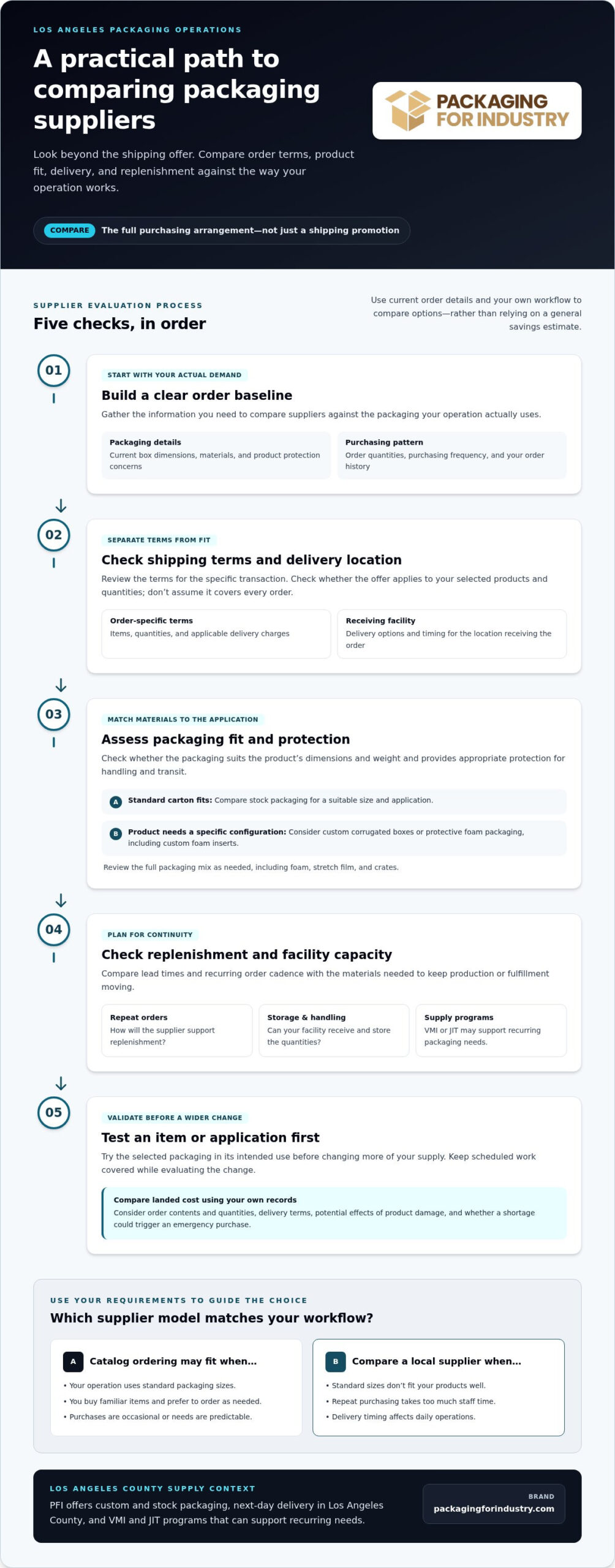
How to evaluate a packaging supplier and change without disrupting Los Angeles operations
Start a supplier review with your current operation, not with a full switch. Document what you buy, how quickly you use it, where it is received, and which packaging issues affect production or shipping. This gives your team a consistent basis for comparing options and helps maintain supply while you assess a Uline free shipping alternative Los Angeles businesses can use.
Prepare a useful packaging and usage profile
Record the materials moving through your facility. Include box dimensions, material types, quantities, order frequency, product sizes, damage concerns, and the Los Angeles receiving locations that need deliveries. Note storage capacity, production schedules, and delivery requirements that affect daily work.
- Stock items: Record standard boxes, stretch film, and other regularly ordered supplies.
- Custom items: Separate custom boxes, foam, or crates that may need design and lead-time planning.
- Operating issues: Note shortages, excess inventory, damage concerns, and rush purchases.
This profile helps distinguish occasional purchases from recurring supply needs. It also gives a packaging supplier useful context for discussing relevant products and delivery requirements, instead of comparing proposals based on incomplete item descriptions.
Compare proposals and plan a practical transition
Use the same item details and quantities to compare proposals. Similar product names don’t always mean equivalent materials or applications, so check the actual packaging requirements. For custom designs, prototypes and samples can help your team evaluate fit before adopting a configuration. Plan changes around existing stock, scheduled production, and replenishment needs.
- Review current items. List packaging by type and application, including dimensions, material, and known performance concerns.
- Map usage. Compare quantities and order frequency with production or shipping activity. Identify items with steady use and those with variable demand.
- Define delivery needs. Record receiving locations, preferred delivery timing, storage capacity, and the lead time needed for custom items.
- Compare supplier options. Evaluate equivalent materials and quantities alongside customization, delivery arrangements, and recurring supply support.
- Pilot a change. Test a selected item or application while keeping existing packaging available for scheduled work. Review fit, handling, and supply coordination before expanding the change.
A controlled transition avoids making a supplier decision all-or-nothing. Include current inventory in the plan, introduce alternatives in a manageable sequence, and align replenishment with actual usage. This gives purchasing and operations time to assess the fit without creating a gap in packaging supply.
Why consider PFI as a Uline free shipping alternative in Los Angeles
Packaging For Industry is a Southern California wholesale packaging supplier serving manufacturers and other B2B operations. For Los Angeles buyers, PFI can bring multiple packaging categories into one discussion and help purchasing teams compare options against their workflows. This is useful when packaging decisions affect product handling, packing steps, and shipment consistency.
Match PFI’s packaging capabilities to the operation
PFI supplies corrugated boxes, foam, stretch film, and crates. Assess how these materials work together in a shipment rather than treating them as unrelated purchases. A corrugated box and cushioning may need to fit the product and its handling requirements. Stretch film can help stabilize palletized loads, while foam packaging can be considered when cushioning is part of the protection plan.
Not every operation needs every category. Start with the products being shipped, the handling process, and the tasks performed by packing staff. This makes it easier to identify which materials belong in the same purchasing plan and whether a change could simplify pack-out or support consistent shipments.
Use local delivery and quote support to plan next steps
Give purchasing and operations teams a shared set of requirements when comparing packaging options. Include the item being packed, the materials under consideration, approximate order quantities, and recurring workflow constraints. This focuses the discussion on practical details that affect day-to-day use, rather than evaluating a supplier by its product list alone.
PFI’s custom and stock packaging options help Los Angeles businesses compare standard supplies with application-specific needs. A focused review can identify which items warrant further evaluation and how to organize purchasing around packaging used in production, warehousing, or distribution.
Turn your supplier comparison into a practical next step
A packaging review doesn’t require a full supplier change at the outset. Choose one category where fit, purchasing effort, or replenishment presents a clear operational concern. Set criteria for evaluating an option, then compare it against the application and share the requirements with potential suppliers. This keeps the decision grounded in your operation, not a promotion alone.
For teams considering a Uline free shipping alternative Los Angeles businesses can compare, a focused review offers a practical starting point: assess one application, evaluate the packaging in use, and decide whether to expand the relationship. PFI can support custom packaging design and recurring supply planning around your requirements.
Bring purchasing and operations priorities together, then outline the packaging, quantities, and delivery needs for your quote request.
Request a quote from PFI to compare packaging options for your Los Angeles operation.
Frequently Asked Questions
Does free shipping always make a packaging order the lowest-cost option?
No. A shipping offer alone doesn’t show whether an order is the most economical choice for your operation. Review the offer’s terms for the items and quantities you need, then consider whether the materials suit your packing process without extra handling or workarounds. The delivered price is one part of the comparison, alongside product fit and operational requirements.
What should I include when requesting a packaging quote?
Include the items, quantities, and relevant dimensions. Clarify whether measurements describe the product or the finished package, and whether dimensions are inside or outside measurements. A drawing or photo can help show unusual product shapes or orientation. Describe how employees currently pack the item, including assembly steps. These details help PFI understand the application and prepare a relevant proposal.
Can a packaging supplier provide both stock and custom packaging?
Yes. PFI provides standard packaging for common applications and custom packaging for needs that call for a designed solution. Identify which items are routine and which need design approval so the two categories don’t get confused during ordering. Clear internal procedures for substitutions and approvals can also help maintain consistent packaging across product lines.
Is next-day packaging delivery available throughout Los Angeles County?
Yes, PFI offers next-day delivery in Los Angeles County. For smoother receiving, confirm your facility’s dock hours, designate who will receive the shipment, and plan where materials will be staged. These steps help the warehouse team put supplies into use and ensure the receiving area is ready.
Can packaging prototypes help before a custom order is produced?
Yes. PFI provides free prototypes and samples for custom packaging design. A prototype lets your team assess the proposed design in the actual packing workflow. Check whether the product loads and unloads smoothly, whether staff can assemble and close the package consistently, and whether the configuration suits your handling process. Record feedback from the people who pack and ship the item to guide design adjustments.
What is the difference between VMI and JIT packaging supply?
VMI and JIT support recurring packaging supply in different ways. VMI includes planned inventory reviews and replenishment, while JIT aligns deliveries with production demand. PFI’s programs include a 30-60 day supply buffer. When comparing the approaches, consider which packaging items are critical, how variable their usage is, and how much on-site storage space your operation can allocate.