
The obvious choice isn’t automatically the most efficient one. Comparing aerospace packaging providers means assessing how each option fits your packaging requirements, inventory approach, and delivery needs. For military marking, MIL-STD-129 is a relevant standard; MIL-STD-2073 addresses preservation and packaging requirements in government packaging.
When evaluating Packaging For Industry (PFI) for aerospace packaging, look beyond the unit cost of a box or protective material. Fit, damage prevention, inventory control, and replenishment all affect how parts move through production and shipping. This guide outlines practical comparison criteria for aerospace and defense packaging, including design support and supply programs, so you can assess which approach fits your operation.
Key Takeaways
- Compare packaging options by total operational fit, including part protection, handling efficiency, and replenishment needs, rather than unit cost alone.
- Account for MIL-STD-129 military marking and MIL-STD-2073 preservation and packaging requirements when they apply to your aerospace or defense shipments.
- Match inventory controls to usage patterns: vendor managed inventory and just-in-time replenishment can help align packaging supply with production demand.
- Assess how packaging materials and capabilities support part protection, shipping workflows, and consistent supply before selecting a provider.
- Explore foam packaging, stretch film, and inventory management options when refining an aerospace packaging program with Packaging For Industry.
Commercial aerospace packaging efficiency
For aerospace purchasing teams, packaging efficiency means protecting components while keeping receiving, storage, production, and distribution moving. A Los Angeles operation shipping machined brackets, for example, needs packaging that fits the part, supports handling, and reaches the next process without unnecessary repacking. Compare the full workflow, not just the quoted price of one item.
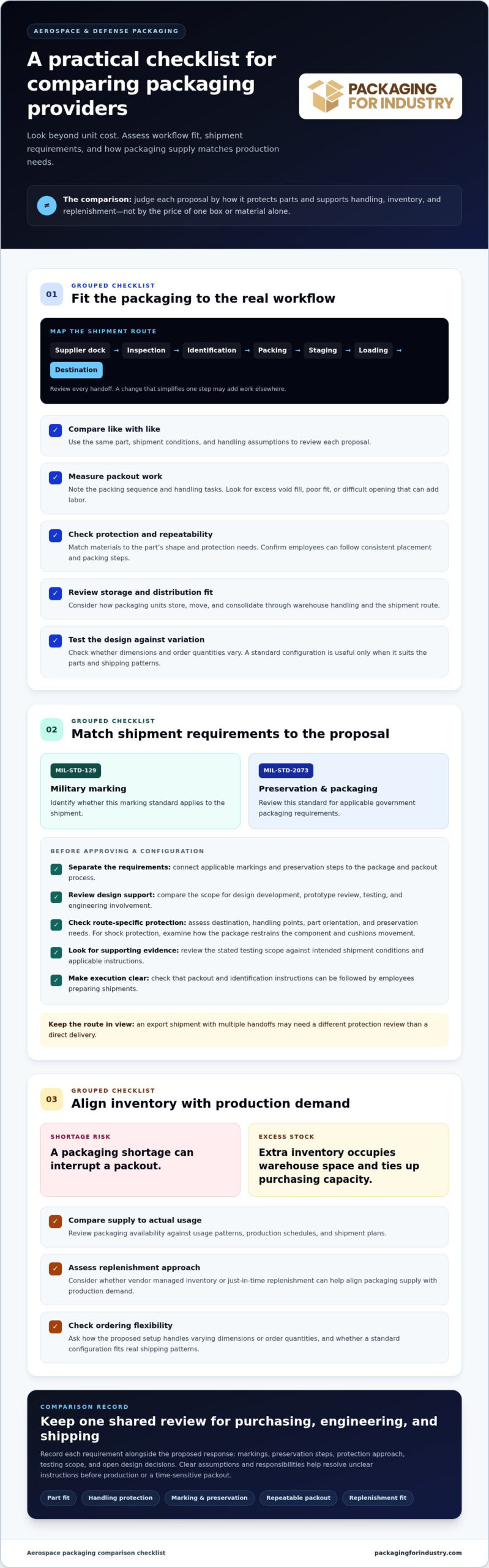
Start with a representative part and map its route from the supplier’s dock to its destination. Record packaging steps at each handoff, including inspection, identification, packing, staging, and loading. This can reveal where a poor fit, excess void fill, or difficult opening process adds labor. A solution that simplifies one step but creates extra work elsewhere may not improve overall efficiency.
Use the same part, shipment conditions, and handling assumptions to compare proposals. Ask each provider to explain the design, materials, packout sequence, and replenishment approach. For a delicate assembly, compare how the package restrains movement and supports consistent placement. For a palletized shipment, review how packaging units consolidate and remain manageable during warehouse handling.
- Measure packout work: Note the sequence and handling tasks required for each sample package.
- Review material use: Compare proposed materials against the part’s shape and protection needs.
- Assess repeatability: Check whether different employees can follow the same packing steps.
- Track distribution fit: Consider storage, movement, and handoffs through the shipment route.
Efficiency also depends on how packaging design fits purchasing. A standard configuration can make ordering and packout easier, but only if it suits the parts and actual shipping patterns. If dimensions or order quantities vary, a rigid setup may leave unused materials or require workarounds. Compare how each proposal handles variation rather than assuming a broad catalog or custom design is automatically better.
For aerospace teams in Los Angeles, the practical next step is to compare packaging proposals against real operating conditions. Review the packaging process alongside the destination, handling sequence, storage demands, and distribution plan. The aerospace packaging requirements and solutions relevant to a program should inform that review. A clear comparison helps purchasing and operations teams identify avoidable handling and choose packaging solutions that support a consistent workflow.
Aerospace and defense packaging requirements
MIL-STD-129 is a standard for military marking in aerospace and defense packaging. MIL-STD-2073 is a standard for preservation and packaging requirements in government packaging. Treat these as distinct considerations when preparing shipment instructions. Identify the requirements that apply to each shipment, then connect them to the package, markings, and packout process before approving the final configuration.
Compare the custom packaging design and engineering support included in each proposal. Review the scope of design development, prototype review, testing, and engineering involvement, then assess each capability against the component and shipment requirements.
Compare export packaging, shock protection, and compliance by reviewing each proposal against the destination, handling route, preservation needs, and applicable marking requirements. For shock protection, examine how the package restrains the component and cushions movement, and what evidence supports the design.
For an export shipment leaving Los Angeles, document the destination, handling points, part orientation, and customer packaging instructions. A route with multiple handoffs may need a different protection review than a direct delivery. Compare the proposed approach with the actual route and receiving process, not just a general description of export capability.
What risks and factors matter most when selecting a packaging provider? Assess part fit, handling protection, correct marking, preservation needs, design support, and repeatable packout instructions. Also review how clearly each proposal records assumptions and assigns responsibility for turning requirements into usable procedures.
- Separate requirements: Review military marking and government preservation requirements as distinct considerations.
- Review design fit: Match the package to the component’s shape, orientation, and handling route.
- Assess validation: Examine the stated testing scope and supporting evidence for intended shipment conditions.
- Control execution: Make packout and identification instructions clear for employees preparing shipments.
Record each requirement alongside the proposed packaging response, including markings, preservation steps, protection approach, testing scope, and open design decisions. This gives purchasing, engineering, and shipping teams a shared review document and helps resolve unclear instructions before production or a time-sensitive packout.
For a project-specific packaging review, request a packaging quote with part details, destination, handling route, and applicable instructions. These inputs help focus the discussion on the shipment’s requirements.
Inventory control and delivery
For an aerospace operation in Los Angeles, inventory control connects packaging availability with production schedules and shipment plans. A shortage of protective material can interrupt a packout, while excess stock occupies warehouse space and ties up purchasing capacity. Compare provider capabilities against actual usage, replenishment processes, delivery coverage, and the items your team uses repeatedly.
Build the comparison around a practical inventory record. List each packaging item, its storage location, the team that uses it, and the production or shipping activity that triggers replenishment. A recurring component packout, for example, may require foam inserts and outer packaging to be available together. If materials arrive separately, staff may need to stage incomplete orders or leave items waiting.
Inventory programs organize replenishment in different ways. Vendor managed inventory (VMI) puts monitoring and replenishment within an agreed process between supplier and customer. Just-in-time (JIT) inventory management aligns packaging deliveries with upcoming operational needs. Neither removes the need for accurate usage information. Review how demand changes, who can see stock levels, and how reorder decisions fit the production schedule.
- Match stock to use: Group packaging items by the operation or shipment that consumes them.
- Set clear ownership: Define who records usage, reviews inventory, and initiates replenishment.
- Coordinate delivery: Align delivery timing with receiving capacity, storage space, and packout schedules.
- Review sustainability: Consider material use, avoidable excess, and the handling implications of packaging choices.
Assess delivery against the receiving operation, not just the dispatch point. A shipment may arrive when a warehouse is busy, fall outside a usable receiving window, or need internal movement before production can use it. Compare delivery arrangements with the facility’s receiving process and the point where packaging is consumed. For aerospace distribution, include destinations and handoffs, especially when materials must reach multiple work areas.
Use the same demand profile to compare proposals. Review recurring order patterns, stock visibility, replenishment responsibilities, and delivery coordination. These details help distinguish a program suited to daily operations from one that looks suitable only on a product list. They also support more sustainable ordering by linking replenishment to actual consumption.
To assess packaging supply needs for a Los Angeles operation, submit a packaging quote request with the items, usage pattern, and delivery requirements your team needs to plan around.
How do aerospace packaging providers compare in capabilities and materials?
Compare aerospace packaging proposals by examining materials, design rationale, and fit with the part and operating process. A machined housing and a delicate instrument, for example, require different restraint and cushioning decisions. Check whether each proposal explains those choices rather than relying on broad descriptions of its packaging range.
Start with the component. Record its shape, weight, sensitive surfaces, orientation, and points requiring protection. Then assess how the design holds the part in place and separates it from surrounding components. Foam, corrugated packaging, and other cushioning materials serve different roles, so the proposal should explain how the material combination suits the part and shipment.
Assess design capabilities through the development process. Review how the packaging concept will be developed, evaluated, and translated into repeatable packout instructions. For an irregularly shaped component, a custom insert may support consistent placement. A standard container may suit a regular shape if its interior protection and handling steps fit the route.
- Material fit: Compare the proposed materials with the component’s surfaces, shape, and handling needs.
- Packout clarity: Check whether employees can follow the instructions consistently.
- Protection approach: Identify how the package limits movement and contact during shipment.
- Operational fit: Consider storage, assembly, and receiving needs at the Los Angeles facility.
Material selection should reflect how packaging moves through the operation. A design that protects a part but is difficult to assemble may complicate production. A package that is easy to handle but allows the component to shift creates a different risk. Compare protection and workflow together, using the same component and shipping scenario for each proposal.
For a useful comparison, give each provider the same component details, destination, handling route, packout sequence, and customer instructions. Ask engineering and purchasing teams to assess proposals against shared criteria. Note whether the design rationale addresses the component’s actual characteristics and whether the materials suit the intended handling process.
Keep the decision tied to documented details. Record selected materials, design assumptions, assembly steps, and any testing described for the intended use. This gives aerospace teams a practical basis for comparing custom packaging without assuming general capabilities suit every part. A strong proposal connects its material and design choices to the specific component and workflow.
Which aerospace quality certifications and industry standards apply to packaging providers?
Aerospace buyers should distinguish a provider’s quality certifications from packaging standards that apply to a shipment. A certification describes a defined quality system or scope; a packaging standard sets requirements for particular packaging activities. Neither automatically proves that every package, facility, or shipment meets every customer requirement.
For each proposal, identify the credentials claimed and the work they cover. Check whether the stated scope relates to the facility, process, or service involved in your program. Then compare it with contract and customer requirements. Do not treat general aerospace experience as evidence of a specific certification.
Standards and customer instructions also require a shipment-level review. Applicable marking and preservation requirements should connect to actual packout procedures and records. A quality review can trace each requirement to the responsible process, work instruction, and shipment documentation, making gaps easier to identify before packaging enters production.
- Identify the requirement: Separate customer instructions, contract requirements, and applicable packaging standards.
- Review credential scope: Relate each stated certification to the relevant facility or process.
- Trace procedures: Connect requirements to written packaging and quality controls.
- Check records: Confirm that documentation supports consistent execution and review.
Apply the same review method to both proposals. Give quality and procurement teams a shared record of requirements, supporting documents, and remaining decisions. If a customer specifies a marking procedure, for example, assess where it appears in work instructions and who performs the check. Keep certification review separate from the technical evaluation of package design.
Do not infer a certification from a supplier’s customer list, industry focus, or general quality statement. Compare the exact credential name, stated scope, and supporting documentation with your organization’s requirements. If a customer contract sets a requirement, use it to determine what the packaging program must address.
A clear comparison documents which requirements apply, how each proposal addresses them, and what records support the process. This helps purchasing, quality, and shipping teams assess the same evidence without assuming one credential covers unrelated activities. It also provides a practical basis for deciding whether a proposal aligns with the quality controls required for your shipments.
Packaging For Industry (PFI): Foam Packaging
Packaging For Industry (PFI) helps aerospace teams protect components with foam packaging and coordinate packaging supply with operational demand. For parts that need shaped support, PFI’s custom packaging design services can tailor foam packaging to the component and support a repeatable packout for handling and shipment.
PFI offers vendor managed inventory (VMI) and just-in-time (JIT) inventory management for packaging. These programs can help coordinate packaging stock with production use. Their suitability depends on your usage patterns, replenishment process, and delivery needs.
Share your component’s packaging requirements and inventory priorities with Packaging For Industry to discuss a practical next step for foam packaging or packaging inventory management in your aerospace operation.
Turn Your Packaging Review Into a Practical Next Step
A useful packaging review turns into clear priorities for your aerospace operation. Identify the part or process that needs attention, then align purchasing, engineering, and shipping teams around the next decision. A focused scope makes it easier to assess a packaging change against daily operating needs.
Packaging For Industry can discuss packaging requirements and inventory priorities for aerospace operations. Share the issue your team wants to address and its context, such as a recurring packout challenge or supply planning concern. This gives the discussion a practical starting point without assuming one solution fits every shipment.
Bring your packaging requirements together and take the next step with a clear project scope.
A considered review can help your team move forward with greater clarity and confidence.
Frequently Asked Questions
What aerospace packaging products and services does PFI offer?
PFI offers aerospace packaging products and services including corrugated boxes, protective foam packaging, stretch film, custom packaging design, vendor managed inventory, just-in-time inventory management, and packaging kitting and assembly. A project might use a custom foam insert to position a component inside a box, with kitting to prepare materials for repeat packouts. The right combination depends on the part, shipping process, and supply needs.
What are the key risks and factors to consider when choosing Landsberg Orora or PFI for aerospace packaging?
Consider part fit, handling protection, correct marking, preservation needs, design support, and repeatable packout instructions. Review each proposal’s testing scope, supporting evidence, assumptions, and responsibility for turning requirements into usable procedures.