
Wood packaging is not the only option for protecting a shipment. To understand how to avoid customs holds due to wood packaging, use wood packaging that has the required ISPM 15 treatment and mark, or consider materials outside the regulated category. According to the U.S. Department of Agriculture’s Animal and Plant Health Inspection Service, wood pieces less than 6mm thick in any dimension are excluded from the definition of wood packaging material.
It’s reasonable to focus on the pallet or crate, but the details matter too: missing, unclear, or inconsistent marks can put a shipment at risk of refusal. Plywood and pressboard can be alternatives to solid-wood packaging, depending on the shipment’s protection and handling needs.
This article explains which wood packaging requirements to check, how to review marks and supplier practices, and when an alternative material may be suitable. Use the practical checks below before dispatch to reduce avoidable customs delays while protecting the product and meeting shipping requirements.
Key Takeaways
- Review treatment and ISPM 15 marks on every wood packaging unit before dispatch, and watch for marks that are missing or difficult to read.
- Inspect packaging for visible pest signs and damage, since a problem with wood packaging can put the shipment at risk of refusal.
- Distinguish regulated solid-wood packaging from exclusions: according to the U.S. Department of Agriculture, Animal and Plant Health Inspection Service, wood pieces less than 6mm thick in any dimension are excluded from the definition.
- Build supplier compliance checks into purchasing and shipment preparation so treatment, marking, and packaging condition are addressed before cargo moves.
- Compare regulated wood packaging with suitable alternatives, including foam packaging from Packaging For Industry, when product protection and shipment requirements allow.
1. ISPM 15 treatment and marking requirements
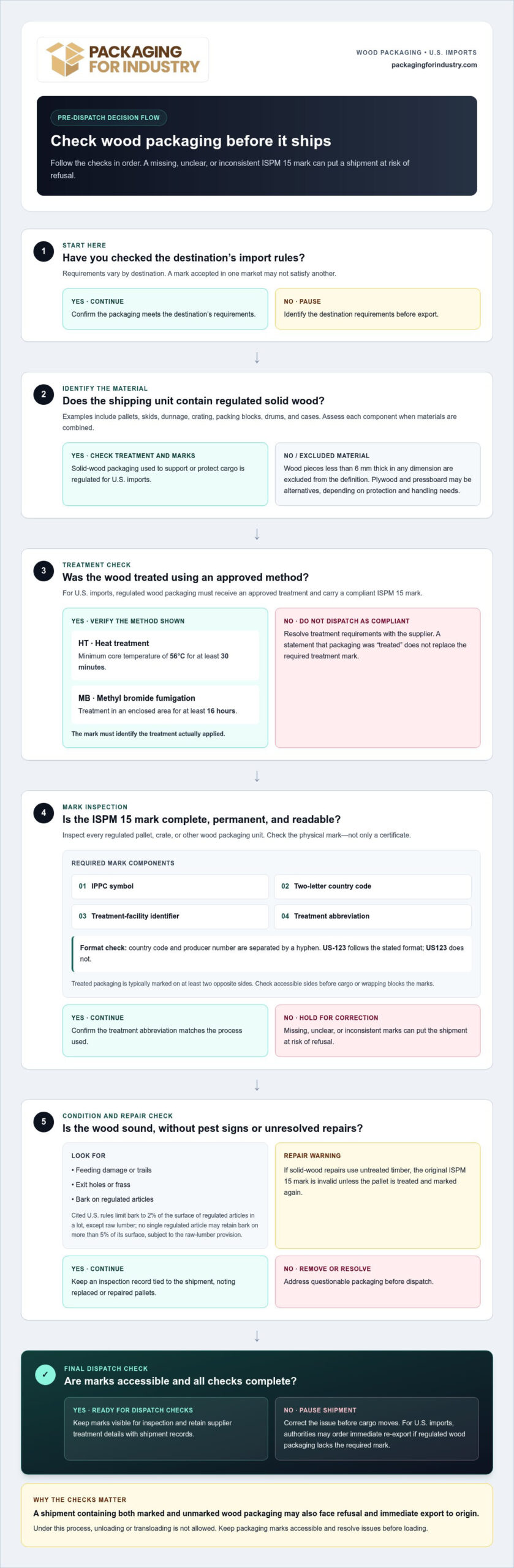
Wood packaging requirements vary by destination because each country sets its own import rules and may accept different treatments or marks. Before exporting, identify the destination’s requirements and confirm the packaging meets them. A mark accepted in one market may not satisfy another.
For U.S. imports, regulated wood packaging must receive an approved treatment and carry a compliant ISPM 15 mark. The mark identifies the treatment, country of origin, and facility responsible for treatment. U.S. requirements use ISPM 15 standards, and 7 CFR 319.40-3 addresses treatment and marking under the general permit.
Heat treatment is one approved option. The wood must reach a minimum core temperature of 56°C for at least 30 minutes. The treatment abbreviation on the mark is HT. Methyl bromide fumigation is another option, identified by MB; the treatment takes place in an enclosed area for at least 16 hours. The mark must identify the treatment actually applied, not simply state that the packaging was treated.
Inspect the physical mark on every pallet, crate, or other regulated wood packaging unit before loading. It must be visible and permanent, with the IPPC symbol, a two-letter country code, a treatment-facility identifier, and the treatment abbreviation. The country code and producer number must be separated by a hyphen, so “US-123” follows the stated format, while “US123” does not. Treated packaging is typically marked on at least two opposite sides, making the mark easier to inspect when cargo is loaded.
Before shipment, confirm the treatment method, compare its abbreviation with the process used, and inspect the full mark for legibility and required components. Check both accessible sides before cargo or wrapping blocks them. Keep the supplier’s treatment details with shipment records, but don’t rely on a certificate instead of the mark. Inspectors use the mark as evidence of treatment.
Repairs can undermine an otherwise compliant pallet. If solid-wood repairs use untreated timber, the original ISPM 15 mark is invalid unless the pallet is treated and marked again. Importers building their own crates also cannot create their own ISPM 15 marks. Address damaged or repaired packaging before export, and include compliance requirements in purchasing contracts so treatment and marking are part of the supplier’s shipment process.
2. CBP inspections and shipment refusals
U.S. authorities inspect regulated wood packaging at the port of first arrival under 7 CFR 319.40-9. If an inspector finds wood packaging without the required mark, immediate re-export may be ordered under 7 CFR 319.40-3(b)(3). A shipment with both marked and unmarked wood packaging may also face refusal and immediate export to origin. Keep packaging marks accessible for inspection when loading cargo.
Noncompliant wood packaging may lead to re-export, and handling options may be restricted. Unloading or transloading isn’t allowed under this process. The importer, carrier, or bonded custodian responsible for the packaging must arrange appropriate handling and cover related disposition costs. The importer may also be responsible for expenses such as separating noncompliant packaging from compliant materials or merchandise.
A wood packaging violation may lead to further action. Corrective options can include safeguarding the packaging, destruction under APHIS supervision, or re-export. APHIS may allow noncompliant wood packaging to be destroyed while the goods remain in the United States, but assesses that option case by case based on pest risk. A violation may also result in seizure or forfeiture.
Inspection, treatment, and re-export costs depend on pallet dimensions, wood type, treatment method, shipment configuration, and required disposition. The price depends on the specific order and is provided after a quote request; lead time depends on sourcing, treatment scheduling, and the cargo’s export deadline. Once a shipment is held, available actions and timing depend on the official disposition instructions.
Before loading, inspect every wood packaging unit for feeding damage, trails, exit holes, and frass, which can indicate pest activity. Check the wood for bark as well: cited U.S. rules limit bark to 2% of the surface of regulated articles in a lot, except raw lumber, and no single regulated article may retain bark on more than 5 percent of its surface, subject to the raw-lumber provision. Remove questionable packaging before dispatch.
Keep an inspection record tied to the shipment and note any replaced or repaired pallets. A mixed less-than-truckload shipment creates additional exposure: if one shipment in the truck or container is noncompliant, authorities may refuse the other shipments and send them back to origin. For packaging decisions before dispatch, you can request a packaging quote based on the shipment’s protection needs.
3. Wood packaging material definition and examples
For U.S. import purposes, wood packaging material includes solid-wood items used to support or protect cargo. Examples include dunnage, crating, pallets, packing blocks, drums, cases, and skids under 7 CFR 319.40-1. Identify the materials in each shipping unit before export. A crate may combine solid-wood framing with panels made from a different material, so assess each component rather than relying on the package’s general description.
There is a key distinction among materials. Solid-wood packaging is regulated; plywood and pressboard can serve as alternatives because they are not subject to APHIS regulation. According to the U.S. Department of Agriculture, Animal and Plant Health Inspection Service, wood pieces less than 6mm thick in any dimension are excluded from the definition of wood packaging material. Don’t assume every engineered-wood product shares plywood’s or pressboard’s status. Record the actual material used and assess it against the applicable U.S. definition.
In the United States, 7 CFR 319.40 governs imported wood packaging material. The rule targets solid wood that can carry timber pests, including wood used as a pallet, crate, or dunnage. Customs and Border Protection and plant health officials may treat unmarked regulated wood or wood showing pest evidence as a violation. For importers, the practical first step is to distinguish regulated solid wood from excluded or alternative materials in the packing specification.
If a shipment contains unmarked or pest-infested material, follow the official disposition instructions. Corrective actions may include safeguarding, destruction under APHIS supervision, or re-export. Keep the affected packaging identifiable and coordinate its handling with the responsible party. Changing paperwork does not correct the physical material or replace compliance with the official order.
Alternative pallet materials can change the compliance work required. Plywood or pressboard pallets avoid the solid-wood treatment and marking requirements described for regulated wood packaging, while still needing to suit the cargo’s weight, handling, and shipping conditions. Compare structural performance, product protection, and compatibility with warehouse equipment. The material must work through packing, transport, and receiving, not just address customs.
Use clear material descriptions in purchasing and packing records. Specify solid wood, plywood, or pressboard rather than using a broad label such as “wood pallet.” For mixed-material crates, document which parts are solid wood and which are panels. This helps importers identify regulated components, assign the right preparation steps, and reduce uncertainty during inspection in the destination country.
4. Checking suppliers’ accreditation and certification
Check suppliers before ordering pallets or crates for international trade. Importers remain responsible for ensuring suppliers understand and follow U.S. wood packaging requirements. A practical step in how to avoid customs holds due to wood packaging is to make compliance part of supplier approval, not just a final shipping check. Ask how the supplier manages treatment, marking, repairs, and inspection throughout production. Before export, establish who handles corrective action if packaging fails review.
Ask whether the wood packaging manufacturer is registered and accredited for the relevant treatment program. Request the facility name and treatment process details, then compare them with the marks on the finished pallets. Review certification provided by the exporting country’s national plant protection organization. Keep these records linked to the supplier, facility, shipment, and packaging batch. This traceability helps purchasing and logistics teams identify orders that may be affected by a reported issue.
Supplier documentation and the physical mark serve different purposes. Records help assess how packaging was produced and treated, while U.S. inspectors examine the mark on the wood packaging material. A certificate does not replace a compliant, legible mark at inspection. Before loading, compare a sample mark with the supplier’s treatment records. If the facility identifier or treatment information conflicts, hold the affected pallets until the discrepancy is resolved.
Set compliance expectations in the purchase contract. Specify that regulated wood packaging must meet U.S. requirements, arrive with readable marks, and match the agreed treatment method. Assign responsibility for correcting noncompliant packaging, replacing affected pallets, and communicating promptly about production or repair issues. Clear terms establish the process for supplier action, while importers remain responsible for managing their shipments.
Check supplier claims through receiving and dispatch controls. For a new order, review a sample mark before dispatch and inspect finished packaging before loading. For repeat orders, compare marks across deliveries and note changes in facility identifiers or treatment abbreviations. If the supplier uses subcontracted facilities, include them in the documentation review rather than assuming the primary supplier’s records cover every source.
For teams deciding how to avoid customs holds due to wood packaging, a consistent record trail matters as much as initial supplier approval. Keep the compliance clause, supplier records, sample-mark review, and shipment inspection notes together. If a discrepancy arises, give the supplier the shipment reference, affected pallet details, and specific issue. A focused report supports a clearer investigation and documents the corrective steps taken.
5. Alternatives to regulated wood packaging
Don’t assume every engineered-wood product is exempt. Its actual composition and construction determine whether it falls within the relevant definition. For example, a crate may combine solid-wood framing with plywood panels. Replacing only the panels does not remove solid wood from the packaging. Identify each component and describe it accurately in the shipment’s customs documents.
Compare alternatives against the load, not just the border requirement. Review the product’s weight and dimensions, how the shipment will be lifted, and how it will be secured in transit. A pallet or crate must support the cargo and work with warehouse handling equipment. Before adopting an alternative across shipments, assess its performance through packing, loading, transport, and receiving.
For a trial, use a representative shipment and document its packaging configuration. Record the pallet or crate material, product arrangement, and any handling issues at dispatch or receipt. Share the material description with the customs broker so shipment documents describe the packaging accurately. If the destination country has separate requirements, account for them before export rather than assuming U.S. exclusions apply abroad.
Alternative materials don’t remove the need to inspect packaging. Before loading, check each unit for damage, unstable construction, or added solid-wood components. If solid wood remains part of the design, handle that component according to applicable requirements. This matters when a plywood crate includes solid-wood skids or blocking. A clear packing specification helps warehouse teams identify those components consistently.
Use a material decision process that connects compliance with operating needs. First, identify where solid wood appears in the pallet or crate. Next, compare plywood or pressboard options with the shipment’s support and handling demands. Then update purchasing specifications and packing instructions so suppliers use the selected materials consistently. Keep material descriptions aligned across purchase orders, packing records, and export documents.
Choosing an alternative works best when engineering, purchasing, and shipping teams use the same specification. That coordination helps prevent an approved design from changing during production or pallet repair. It also gives the broker a clear description to use when preparing shipment information. For custom packaging requirements, request a packaging quote.
Packaging For Industry (PFI): Foam Packaging
Packaging For Industry (PFI) can help businesses assess foam packaging when planning an alternative to solid-wood packaging. Foam cushions products within a shipping unit, while the outer packaging is selected to suit cargo handling and destination needs.
For operations in Orange County, Los Angeles, or San Diego, PFI’s foam packaging can provide product-specific cushioning. Consider it when product shape, fragility, or movement during transit calls for a tailored approach. PFI also offers Vendor Managed Inventory and Just-In-Time inventory management for packaging supply planning.
Contact Packaging For Industry (PFI) to discuss foam packaging for your shipment, or visit packagingforindustry.com.
Build a More Reliable Packaging Plan
Make customs compliance part of packaging decisions before the next shipment is packed. Align purchasing, warehouse, and shipping teams around a clear specification, while accounting for product protection and handling needs alongside destination requirements. Planning ahead gives teams a repeatable process for selecting materials and preparing cargo for export. It’s a practical way to avoid customs holds due to wood packaging, rather than treating packaging as an afterthought.
Packaging For Industry (PFI) supports this broader plan with foam packaging for product cushioning, stretch film for securing loads, and Vendor Managed Inventory for packaging supply coordination. These options help manufacturers connect material selection with day-to-day packing needs and supply planning.
A consistent packaging process helps your team move shipments forward with greater control and confidence.
Frequently Asked Questions
Are There Any Exclusions?
Yes. Some materials and small wood pieces are excluded from the regulated category. According to the U.S. Department of Agriculture, Animal and Plant Health Inspection Service, wood pieces less than 6mm thick in any dimension are excluded from the definition of wood packaging material. For mixed-material packaging, classify each component separately in the packing specification. For example, document solid-wood runners separately from plywood panels rather than describing the whole unit simply as an engineered-wood pallet.
What are WPM Violations?
WPM violations occur when regulated wood packaging fails applicable import requirements. Beyond a shipment hold, violations may carry penalties under 19 U.S.C. § 1595a(b), equal to the value of articles introduced or attempted to be introduced unlawfully. A practical control is to assign one person to review packaging exceptions before cargo release. That creates a clear handoff between purchasing, warehouse, and export teams when a supplier reports a discrepancy.
What are the WPM Requirements?
For U.S.-bound shipments using regulated solid wood, requirements include appropriate treatment and a compliant ISPM 15 mark. Make these conditions part of the purchase order and shipment release process, rather than relying on a general supplier assurance. The destination matters: importers shipping to multiple countries should maintain destination-specific packaging instructions, because acceptance in one market does not establish compliance in another.
Which wood packaging materials are exempt from ISPM 15 rules?
Plywood and pressboard are alternatives that are not subject to APHIS regulation as wood packaging material. The U.S. Department of Agriculture, Animal and Plant Health Inspection Service also excludes wood pieces less than 6mm thick in any dimension. To apply these exclusions consistently, have engineering or purchasing identify materials in drawings and specifications. Don’t infer a whole crate’s status from one panel if its supports or runners use solid wood.
What ISPM 15 marks must appear on pallets and crates imported into the United States?
The ISPM 15 mark identifies the IPPC symbol, country code, treatment-facility identifier, and treatment abbreviation. Check the country code and facility number as separate elements, including the hyphen between them. A mark reading “US-123” uses the required separation, unlike “US123.” Keep a legible sample image with the supplier and shipment records so receiving staff can compare incoming packaging consistently.
How should wood packaging be inspected and documented before shipping?
Inspect and record packaging while each unit is accessible, before cargo or wrapping blocks key surfaces. A useful record identifies the shipment, packaging type, inspection date, and any exception requiring follow-up. Photograph unclear marks or visible damage for internal review, and link each image to the relevant shipment record. This creates a traceable handoff between the person inspecting the packaging and the team authorizing dispatch.
What happens when imported wood packaging is unmarked or noncompliant at U.S. customs?
A wood packaging violation may lead to formal enforcement action. If that happens, keep the notice, shipment records, supplier communications, and transport documents together. Identify the affected packaging units and follow the official disposition instructions. A clear record set helps the responsible importer, carrier, or bonded custodian coordinate handling without confusing affected packaging with compliant cargo.
Can noncompliant wood packaging be repaired, treated, or re-exported?
Yes, the available corrective action depends on the violation and official instructions. Don’t return a repaired pallet to use until its status has been addressed through the appropriate treatment and marking process. Keep it separate from ready-to-ship packaging, and record the repair and subsequent disposition. Re-export is another possible action when required. Importers building their own crates must not create their own ISPM 15 marks.