
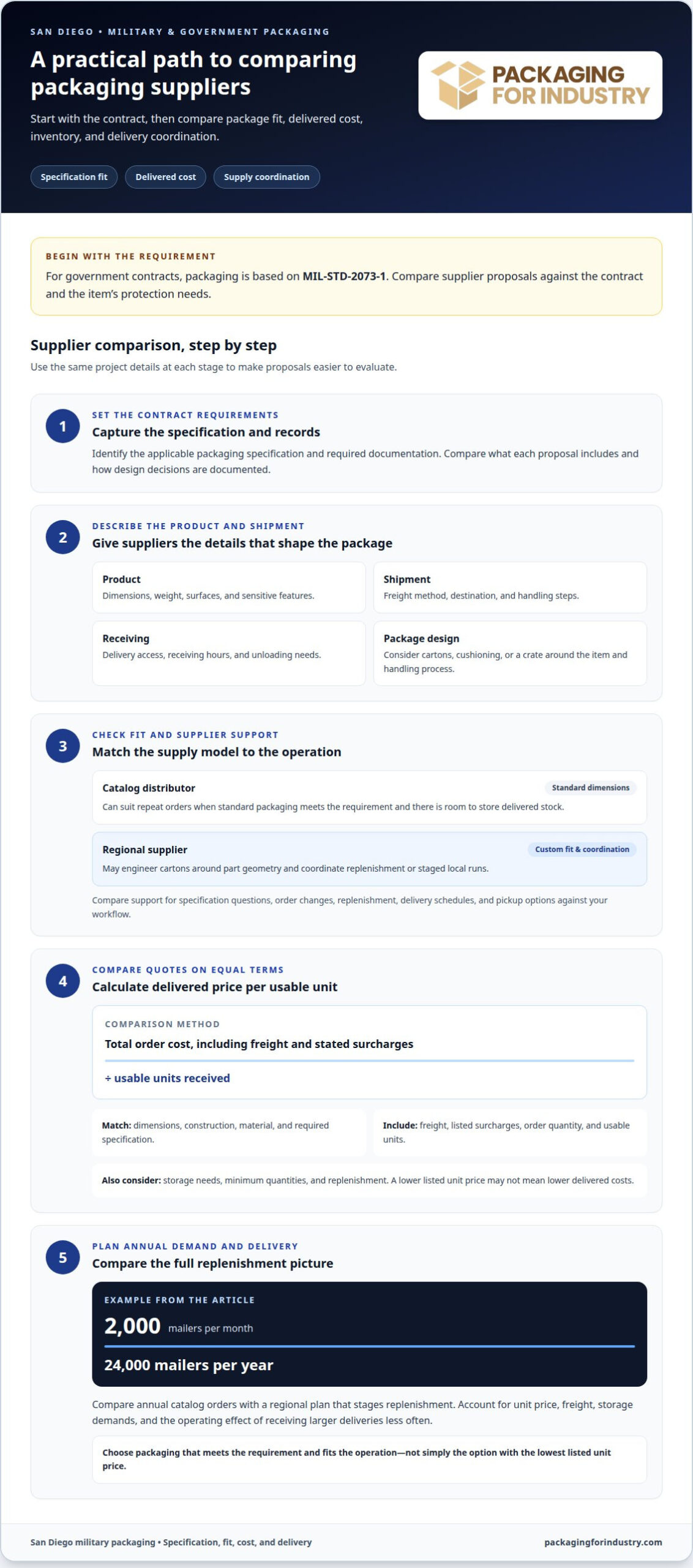
For San Diego military packaging, compare suppliers by specification fit, package design, and delivery coordination. Government contracts require packaging based on MIL-STD-2073-1. Regional suppliers can engineer cartons around part geometry and coordinate replenishment or staged local runs, while catalog distributors typically offer standard dimensions.
A catalog distributor can work well for repeat orders when standard packaging meets the requirement and you have room to store it. For custom protection or coordinated supply, a regional packaging partner may better fit your operation.
This guide compares catalog and regional suppliers for San Diego military packaging, crating, shipping, and specification needs. It covers design fit, inventory management, delivery, and a practical way to test a supplier before expanding orders.
Key Takeaways
- Compare suppliers by packaging fit, replenishment support, and delivery approach, not catalog breadth alone.
- Match carton construction to the load and stacking demands; the Edge Crush Test measures a carton’s stacking strength.
- For military and government shipments, build packaging decisions around the contract’s required specification and the item’s protection needs.
- Reduce switching risk by testing a sample or one case before moving more packaging volume to a new supplier.
- Assess foam, wrapping, and barrier materials alongside the outer carton to build a complete protection plan.
Catalog distributors compared with regional suppliers
San Diego buyers comparing Uline with a regional supplier should look beyond unit price to fit, support, inventory, and freight. Catalog distributors offer standard dimensions and familiar ordering. A regional supplier may be a better fit when manufacturers need custom sizes, support interpreting packaging requirements, or scheduled replenishment. The right choice depends on the application and available warehouse space.
For packaging used in warehouses and distribution centers, compare the full purchasing process, not just the carton. Include order quantities, freight, storage, and replenishment. This helps purchasing teams assess total costs and find practical savings without selecting packaging that fails to fit the product or its requirements.
Regional Suppliers
A regional supplier can design cartons around a part’s geometry and coordinate replenishment to match production needs. This differs from choosing among standard catalog dimensions. For a San Diego operation with limited storage, scheduled deliveries can help align supply with actual use. Share the application, then compare the proposed dimensions and replenishment plan with your workflow.
Local Supplier Customer Service
Local service can include discussing packaging challenges and coordinating deliveries around operating needs. Catalog purchasing may suit routine orders with predictable specifications. Compare support for specification questions, order changes, and replenishment instead of assuming every supplier provides the same service. For San Diego buyers, delivery schedules also affect receiving plans and the amount of packaging kept on-site.
Compare Delivered Price Per Unit
Compare quotes on an equivalent basis. Match carton or mailer dimensions, material, order quantity, and required packaging specification. Divide the total order cost, including freight and stated surcharges, by the usable units received. A lower listed unit price may not mean lower delivered costs if freight, minimum quantities, or excess inventory add expense.
- Confirm identical dimensions and construction.
- Include freight and listed surcharges.
- Compare order quantities and usable units.
- Account for storage and replenishment needs.
Annual Cost Comparison for Mailers
Convert monthly demand into an annual purchasing plan. A business using 2,000 mailers per month uses 24,000 mailers per year. Compare annual catalog orders with a regional plan that stages replenishment. Include unit price, freight, storage demands, and the operating effect of receiving larger deliveries less often.
| Option | Packaging fit | Inventory approach | Price comparison |
|---|---|---|---|
| Catalog distributor | Standard catalog dimensions | Delivered stock may require storage | Compare unit price plus freight and surcharges |
| Regional supplier | Can engineer to part geometry | May coordinate replenishment or staged local runs | Compare equivalent specifications and delivered cost |
Choose packaging that meets the requirement and fits your operation, not simply the option with the lowest listed unit price.
Military and government packaging, crating, and shipping in San Diego
Government packaging decisions should begin with the contract and the item’s handling needs. For government contracts, packaging is based on MIL-STD-2073-1. San Diego defense and aerospace teams can organize the requirements around the item, its route, and the receiving process before selecting cartons, cushioning, or a crate.
Which suppliers offer custom packaging design, testing, and military packaging certifications? For custom designs, consider suppliers that engineer packaging around the product and shipping process. Design, testing documentation, and certification are separate capabilities, so compare each with the exact requirements in your contract.
Which San Diego suppliers serve defense contractors? Look for packaging suppliers with products and design capabilities suited to industrial, aerospace, or defense shipments. Coordinating the package with the part and shipping workflow can help purchasing, warehouse, and logistics teams work from a clear plan.
How do San Diego MIL-SPEC packaging suppliers compare on delivery times and local pickup? Compare delivery schedules, freight arrangements, and pickup options against receiving hours and shipment plans. Third-party LTL or parcel freight may include published surcharges, while regional suppliers may coordinate dedicated delivery routes.
Custom packaging support can help when components do not fit standard cartons or need carefully positioned cushioning. A crate design can account for the item’s support points and loading method. For electronics, aerospace parts, or industrial equipment, matching packaging materials to handling and storage needs can help establish a repeatable process.
- Contract details: Capture the applicable packaging specification and required records.
- Product information: Describe dimensions, weight, surfaces, and sensitive features.
- Shipment plan: Identify freight method, destination, and handling steps.
- Receiving process: Include delivery access, receiving hours, and unloading needs.
Use the same information for each supplier proposal. Compare what the package includes, how design decisions are documented, and whether the delivery plan fits your operation. This makes the comparison useful for procurement and the people who pack, receive, and move the shipment.
A focused military packaging quote can organize project details around the item, its protection needs, and its shipment plan.
Planning should also account for how much packaging the operation needs on hand. A forum member described usually buying enough shipping supplies to fill a pallet or two. Treat that as one purchasing approach, not a standard quantity: the right amount depends on shipment mix, storage capacity, and how often needs recur. Keep demand estimates alongside the package specification so supply planning remains distinct from design and compliance requirements.
When reviewing a proposal, check that it separates package design, materials, documentation, and transportation arrangements. Ask how changes to item dimensions, protection needs, or receiving instructions would affect the plan. A clear handoff from procurement to packing and receiving staff helps teams follow the agreed process and identify missing information before shipment. The goal is packaging and delivery that meet contract requirements and fit the actual workflow.
Samples and switching suppliers gradually
A sample or one-case order lets buyers evaluate a new packaging supplier before changing routine orders. For a San Diego military shipment, use the same part and packing process planned for production.
Start by defining what the test needs to demonstrate. The sample should match the intended package dimensions, materials, closure, and internal arrangement. For example, if a component sits in a fitted insert, check that it stays in position during normal packing and unpacking. Review contract requirements separately, since a sample alone does not establish compliance with a military specification.
Test the sample in your actual workflow. Have the employee who packs the item follow the existing work instructions. Note whether the package closes cleanly, protects exposed surfaces, and moves through the warehouse without special handling. If the shipment uses a crate or pallet, evaluate the complete assembly, not just the inner package.
Use a consistent scorecard to compare a new sample with your current Uline packaging or another supplier’s product:
- Fit: Does the item sit securely without interfering with required packing steps?
- Handling: Can employees pack, close, label, and stage it using the existing workflow?
- Protection: Do cushioning and barriers address the item’s contact points and movement?
- Storage: Does the package arrive and store in a way that suits available warehouse space?
- Documentation: Do the package details align with the job’s specification and internal records?
After testing, record observations alongside the package version and shipment context. Note specific issues, such as a tight closure, a shifting part, or an insert that slows packing. Share these findings with the supplier before approving a larger order. Clear feedback supports a focused design adjustment rather than an open-ended redesign.
Switch one packaging application at a time. Keep the current supply for other items while the new package enters a limited production run. This separates packaging performance from unrelated changes in staffing, freight, or shipment volume and gives purchasing and warehouse teams a clear basis for comparison.
Increase order volume only after the test meets agreed operating and specification criteria. If the sample needs adjustment, revise the package and repeat the same checks. A controlled trial lets buyers compare fit, handling, and replenishment before expanding orders.
Military, government, and ASTM-specification boxes
For a military shipment, the contract identifies the applicable packaging requirements, including MIL-STD-2073-1 where required. The box must be selected as part of that package, with its construction matched to the item, handling, and shipment conditions.
ASTM references and military packaging instructions serve different roles in a purchasing specification. Record the exact requirement from the contract documents, then compare the proposed box construction and supporting records against it. A catalog description alone does not establish that a carton meets every contract requirement.
How can a business verify a supplier’s MIL-SPEC packaging compliance and documentation? Compare the written package description with the contract requirement, then review applicable test records or compliance documents before approval. Keep these records with the purchase and shipment documentation.
What are the risks of using noncompliant packaging for DoD shipments? A mismatch between the contract requirement and the package can result in a rejected shipment, repacking, product damage, or logistics delays. Make specification review part of shipment preparation, not just a final carton check.
Box strength also matters in industrial shipping. Standard 32 ECT single-wall cartons often fail under heavy pallet stacking. Double-wall corrugated constructions rated 44 ECT or 48 ECT handle industrial density. These values inform carton selection, but they don’t replace the shipment’s stated requirements.
The Edge Crush Test (ECT) evaluates stacking strength by measuring the vertical compression a carton sidewall can withstand before failure. Buyers comparing box proposals can use the stated ECT rating to compare stacking performance. The specified rating still needs to suit the shipment and contract.
Use this review sequence before ordering:
- Read the contract: Identify MIL-STD-2073-1 or any other named packaging requirement.
- Identify carton needs: Record the item’s dimensions, weight, handling, and stacking conditions.
- Compare construction: Match single-wall or double-wall proposals and stated ECT ratings to the application.
- Review records: Keep the supplier’s written specifications and relevant test documentation with the order.
For an ASTM-referenced box, use the exact designation in the procurement documents. Ask for a proposal that identifies the carton construction and applicable supporting documentation. This creates a traceable comparison between the requirement, the quoted box, and the shipment record.
Clear records help purchasing, quality, and logistics teams follow the same specification. Keep the approved box description with the item’s packing instructions, then compare incoming cartons with that description before use. This simple check can catch a mismatch before packaging reaches the shipping area.
Follow the packaging requirement identified in the contract, including MIL-STD-2073-1 when required. Select a box construction suited to the item, handling, and shipment conditions, and verify it against the contract and applicable supporting records.
Preservation, cushioning, wrapping, and barrier materials
Military packaging protects more than the outside of a part. Consider contact surfaces, movement, handling, and storage conditions together. A finished metal component, for example, may need surface separation, shaped cushioning, and an outer container that prevents shifting during shipment.
Identify each protection task before choosing materials. A barrier can shield a product from outside exposure, while cushioning helps control movement and contact. Stretch film secures a pallet load, but does not replace cushioning inside a box. Matching each material to its purpose avoids relying on one layer to address every risk.
Start with the item. Note exposed edges, delicate finishes, protruding features, and areas that should not bear pressure. A custom die-cut foam insert can follow the product’s shape and support selected contact points. For a small item, one practical option is two nested foam envelopes, one inside the other.
Use a simple material review for each package design:
- Surface protection: Identify finishes or components that could rub against the carton or another part.
- Cushioning: Map where foam or other cushioning should limit movement and support the item.
- Barrier layer: Consider whether the item needs separation from dust, moisture, or handling contact.
- Load restraint: Decide how the closed package or pallet load stays together during shipment.
Test the assembled package with the actual item. Check whether the product shifts during handling, whether the cushioning stays in position, and whether the closure remains secure. If a foam insert lifts out with the part, for example, the design may need a different fit or removal method. Record each issue against the package version.
Pallet preparation needs a separate check. Apply stretch film to stabilize the load, and inspect exposed corners for contact with nearby freight. If the load contains individual cartons, confirm that the film does not compress or distort them. The right wrapping pattern depends on the load arrangement and handling plan.
Material selection can also affect warehouse work. A complex insert may protect a sensitive component but slow packing if employees must orient it carefully. Include the packer’s steps in the evaluation, then refine the layout for repeatable assembly. Written packing instructions help keep each shipment consistent.
For a project-specific comparison of foam, cushioning, wrapping, and barrier materials, request a packaging quote from Packaging For Industry (PFI).
When selecting barrier materials, include sourcing alongside fit and handling in the review. One industry discussion noted that a high percentage of protective packaging materials can feature recycled content; use this as a prompt to ask about material composition, rather than as an assumption about every order. Packaging For Industry (PFI) lists custom die-cut and fabricated protective foam inserts as packaging capabilities beyond corrugated cartons, offering another option when standard carton protection does not address the item’s contact points.
For small items, a nested approach can use two foam envelopes, one inside the other. Check that the extra layer allows the item to be placed and removed without disturbing protected surfaces. Compare the arrangement with the package’s cushioning and barrier needs, then document the chosen configuration so staff can repeat it consistently. Tie each material choice to a specific contact or handling concern rather than adding layers without a clear purpose.
Packaging For Industry (PFI): Foam Packaging
Packaging For Industry (PFI) supplies protective foam packaging for manufacturers whose parts need cushioning or a more controlled fit. For a component that shifts inside a carton, a custom foam insert can help support its shape and limit movement. Share the part’s dimensions, contact points, and packing process to guide a practical packaging design discussion.
PFI also supplies stretch film for securing palletized loads and offers Vendor Managed Inventory (VMI) and Just-In-Time (JIT) programs for recurring packaging needs. These services can align replenishment with warehouse and production requirements.
For foam protection or packaging inventory coordination, contact Packaging For Industry to discuss your San Diego project.
Put Your Packaging Plan Into Action
For San Diego military packaging, first identify the operational gap: product movement, packaging consistency, or supply timing. Keep contract requirements and approved packaging records central to shipment planning, then identify where material fit or replenishment needs improvement.
Packaging For Industry (PFI) supplies protective foam for cushioning, stretch film for securing pallet loads, and Vendor Managed Inventory (VMI) for packaging replenishment. These offerings can address specific protection and inventory needs while your team follows applicable contract specifications.
Bring together product details, the current packing process, and the supply concern to define a practical next step.
A clear packaging plan can help your operation move forward with confidence.
Frequently Asked Questions
Which San Diego packaging suppliers specialize in MIL-SPEC packaging?
Packaging For Industry (PFI) supplies military-spec packaging for industrial and defense applications in San Diego. Buyers can consider PFI for corrugated boxes and protective foam suited to specific parts and packing workflows. Distinguish military-spec packaging from formal certification: compare the proposed materials and documentation with the requirements in your contract and procurement records.
Which packaging suppliers near San Diego serve defense contractors in Southern California?
Packaging For Industry (PFI) serves aerospace and defense businesses across Southern California, including San Diego, Orange County, and Los Angeles. Its offerings include protective foam, stretch film, and Vendor Managed Inventory for packaging. For a recurring program, map packaging demand by part and production schedule, then consider whether inventory coordination can support purchasing and warehouse operations.
Which local suppliers offer better customer service than Uline for military packaging?
Packaging For Industry can discuss packaging challenges, coordinate deliveries, and align orders with operating needs. Compare its support for specification questions, order changes, and replenishment with the service Uline provides.
Which suppliers offer custom packaging design, testing, and military packaging certifications?
Regional packaging and crating suppliers are the relevant source for custom designs. Compare design, testing documentation, and certifications separately against the contract’s requirements.
How do San Diego MIL-SPEC packaging suppliers compare on delivery times and local pickup?
Compare delivery schedules, freight arrangements, and pickup options with receiving hours and shipment plans. Third-party LTL or parcel freight may include stated surcharges; Packaging For Industry offers next-day delivery in San Diego County.