
Yes, components can be assembled into subassemblies and organized into complete product kits before they reach final production or shipment. For contract manufacturers in Irvine, outsourced sub-assembly packaging can coordinate these steps, reducing repeated parts handling and the inventory, scrap, and rework that fragmented processes can create.
Look beyond the packaging itself. When parts arrive separately, teams must receive, track, pick, and prepare them for each build. A coordinated kitting and assembly workflow can make handoffs more orderly and keep kits aligned with production needs.
This article explains what outsourced sub-assembly packaging for contract manufacturers in Irvine can include, how the process works, and what affects its cost and suitability. You’ll learn how packaging kitting and assembly services can support quality checks, inventory flow, and production planning, and where Packaging For Industry can help with the packaging side of the process.
Key Takeaways
- Complete kits can bring components together before final production, reducing the need to handle and sort separate parts at the assembly line.
- Align kit preparation and delivery with production schedules to support smoother material flow and avoid unnecessary on-site stock.
- Documented inspection steps and consistent assembly processes can help catch issues earlier and limit scrap and rework.
- Assess a partner’s experience, process controls, communication, and ability to manage your production requirements before choosing an outsourcing model.
- Packaging For Industry’s packaging kitting and assembly services, along with VMI and just-in-time packaging inventory management, can support a more coordinated supply process.
Quality improvement by reducing parts handling
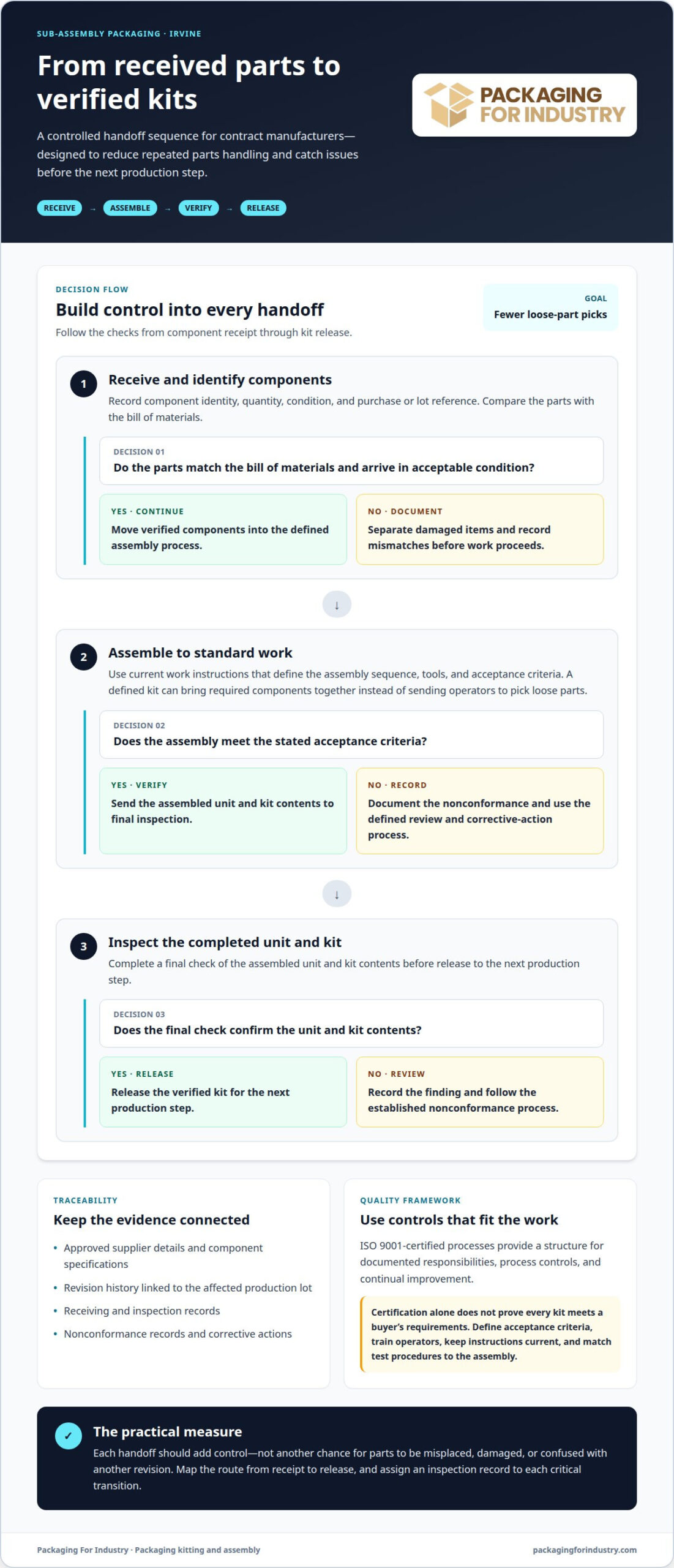
Every handoff creates an opportunity for components to be misplaced, damaged, or confused with another revision. A controlled sub-assembly process limits unnecessary movement by receiving and checking parts, assembling defined units, and preparing them for the next production step. For example, instead of picking loose fasteners and brackets at the line, a technician receives one labeled kit with the required components. Fewer separate picks make the work easier to repeat and inspect.
Quality control begins at receipt. A documented process records component identity, quantity, condition, and purchase or lot reference before work starts. The team can compare parts with the bill of materials, separate damaged items, and record mismatches. Standard work instructions then specify the assembly sequence, tools, and acceptance criteria. A final check verifies the assembled unit and kit contents before release. These steps help pinpoint where a problem occurred instead of allowing it to travel downstream.
Supplier qualification records support process control. Documentation can include approved supplier details, component specifications, revision history, inspection records, and corrective actions. When a component changes, connect the updated drawing or instruction to the affected production lot. Clear records help manufacturing teams trace what they received, assembled, and may need to review. This matters when production volume increases or product variations share similar parts.
ISO 9001-certified quality processes provide a structured framework for documented responsibilities, process controls, and continual improvement. Certification alone does not prove that every kit meets a particular buyer’s requirements. Quality control still depends on defined acceptance criteria, trained operators, current instructions, and test procedures matched to the assembly. A practical evaluation can cover receiving inspection, in-process checks, final inspection, nonconformance handling, and record retention. These checkpoints connect ISO compliance to actual work rather than relying on a certificate alone.
Labor planning also belongs in the operational picture. The California state minimum wage cited for 2026 is $16.90 per hour, according to the California Department of Industrial Relations. That figure is relevant when estimating labor-intensive handling, but process design also affects labor demand. A kit that arrives sorted and labeled can remove repeated component searches and reduce interruptions. The Irvine service-area page describes local packaging support for manufacturers coordinating these workflows: packaging support in Irvine.
For contract manufacturers in Irvine, the key measure is not simply how many parts are handled. It is whether each handoff adds control or creates another chance for error. Map the route from component receipt to final release, then assign an inspection record to each critical transition. This gives production and quality teams a shared view of the process, its evidence, and the next action when a component fails inspection.
Just-in-time delivery and blanket orders
Just-in-time delivery schedules completed kits around production demand, while blanket orders establish recurring supply against planned requirements. Local providers may serve aerospace, electronics, medical, food, and construction manufacturers with component kits, hardware sets, and packaged subassemblies.
For Irvine operations, the central planning task is coordinating sourcing, assembly capacity, packaging, and delivery with the production schedule. Blanket orders can set expected demand, while releases determine when specific quantities move forward.
Capacity and Lead-Time Planning
Scalability depends on component availability, assembly steps, packaging requirements, and the volume requested for each release. Map these inputs against forecast changes, production priorities, and replenishment lead times. This helps teams identify where a sourcing delay could affect a scheduled delivery.
Delivery performance also depends on clear release instructions. Electronic purchase orders or forecasts can communicate revisions, requested quantities, and delivery dates. Set out how changes are shared and acknowledged, then align each release with the finished kit’s required arrival point.
Packaging and Storage Coordination
Packaging and storage choices affect how easily kits move from receiving to production. A labeled container for each work order, for example, can simplify staging, while a larger bulk pack may suit continuously used components. Choose a format based on part protection, handling, storage space, and how operators access materials.
Coordinate packaging specifications with the delivery plan. A kit prepared for immediate line use needs different staging from inventory held for a later build. Packaging kitting and assembly services can connect these decisions to how components are grouped and released.
Blanket orders can make recurring procurement more predictable without requiring every release to arrive at once. The buyer and supplier establish expected items and quantities, then schedule releases as production needs develop. This can support sourcing plans for repeat assemblies and reduce the need to store every component at the manufacturing site.
Just-in-time inventory management focuses on timing. A release should account for component replenishment, assembly, packaging, transit, and receiving schedules. If a step changes, adjust the delivery plan to reflect the new constraint. For instance, an engineering revision may change kit contents, so the current bill of materials should guide the next release.
Accurate forecasts help prevent avoidable surpluses and shortages. Production teams can share updated demand so the supplier can plan component availability and assembly workload. For each release, consistently identify the kit version, quantity, destination, and delivery window.
A comprehensive schedule should also distinguish routine releases from demand changes. That lets operations teams see which orders follow the standard cadence and which require revised planning. Irvine manufacturers considering a packaging quote can describe their release pattern, kit contents, and delivery requirements to shape a practical workflow.
Inventory, scrap, and rework reduction
Separate purchasing, assembly, and distribution systems can leave manufacturers holding excess components while production waits for missing items. A coordinated inventory plan links procurement signals to actual kit demand. For example, a recurring assembly can use a defined bill of materials, scheduled releases, and a shared record of component balances. This helps streamline the supply chain by connecting what is ordered with what production will consume.
Vendor Managed Inventory (VMI) coordinates packaging inventory monitoring and replenishment through the supplier. The process starts by identifying packaging items used for each kit, recording usage, and agreeing on replenishment triggers. The manufacturer can then review inventory status and upcoming requirements through regular reporting. Accurate item identification and usage records are essential: poor data can cause shortages or unnecessary stock.
Just-in-time inventory aligns deliveries with production needs rather than sending every component to the plant at once. For a scheduled build, connect the release date to component sourcing, assembly, packaging, and delivery. If a revision changes kit contents, update the bill of materials before the next release to help keep obsolete parts out of the workflow. The approach works best when production schedules and replenishment signals stay current.
Scrap and rework often start with preventable process gaps. Incoming inspection can catch damaged or incorrect components before assembly. Standard work instructions help operators follow the same sequence, while accurate records link each completed kit to its components and revision. Lot traceability supports a focused investigation when a defect appears, instead of requiring teams to treat every kit as potentially affected. These controls direct attention to the source of the problem.
Inventory visibility helps purchasing distinguish routine use from unexpected changes. Reviewing on-hand materials, open orders, and scheduled builds can reveal whether a shortfall comes from sourcing, inaccurate usage data, or a production revision. For example, if an assembly repeatedly uses fewer fasteners than planned, a documented bill-of-materials update may be needed. Correcting the source record helps prevent repeated over-purchasing and rework.
Inventory efficiency can also release space for more valuable production activity. In a Steelcase customer success example, required warehouse space was reduced by 82%. That result illustrates how coordinated inventory and distribution can affect facility use, but the mechanism matters: align replenishment with consumption, avoid storing unnecessary kit components, and keep records current. For Irvine manufacturers, reviewing packaging demand alongside assembly requirements can show where VMI or just-in-time inventory would streamline procurement and reduce excess stock.
Choosing a contract assembly partner
Sub-assembly and packaging providers serving Irvine can help manufacturers get components assembled, organized, and prepared for production. Choose a partner based on the work’s technical requirements, expected volume, and delivery schedule, not simply available labor.
Start by defining the tasks to outsource. Repetitive, time-consuming assembly may be suitable when instructions and acceptance criteria are clear. Assess experience with comparable components, product variations, and handling requirements. The provider’s capabilities should fit the actual work, whether that means fitting hardware, grouping parts, or preparing a finished kit. Use a sample or prototype to evaluate fit and workmanship before a wider rollout.
Capacity matters as much as technical ability. Review equipment, staffing, production controls, and the ability to handle volume changes. A capable process is useful only if it fits your product and schedule. Discuss how revisions, work instructions, and component substitutions are managed. For example, a drawing update should prompt a review of affected instructions and kits before the changed version enters production.
Communication and visibility help control handoffs. Agree on who provides forecasts, approves revisions, reports shortages, and escalates quality issues. Determine how components and completed kits are tracked and how often inventory information is shared. A practical review can include:
- Experience with comparable products and assembly requirements.
- Available capacity for planned demand and production changes.
- Documented inspection, testing, and corrective-action processes.
- Clear inventory reporting and communication responsibilities.
Outsourcing risks include inconsistent assembly, delayed components, unclear responsibility, and reduced visibility into work in progress. Manage them with controlled instructions, agreed inspection criteria, documented change approval, and regular status reporting. A written agreement can define the work, contract length, payment amount, and services provided. Proposals commonly account for labor, tooling, and materials, so compare scope and cost structure with the work required.
Test procedures should reflect the product’s function and assembly risks. Define what to inspect at receipt, during assembly, and before release, then retain records tied to the applicable revision. A sample run can expose unclear steps or packaging problems before routine production begins. For example, a fit check may show that a component needs a different orientation or separation within its kit.
Finally, assess whether the arrangement supports your operating goals. Outsourcing can free internal teams to focus on core production, but it works best when requirements, quality ownership, and delivery expectations are explicit. For Irvine manufacturers, choose a partner whose capabilities match the specific work and establish practical controls for every handoff.
Contract assembly and sub-assembly
Contract manufacturing assigns defined production work to an external company; sub-assembly prepares components or smaller units for a later build. For contract manufacturers in Irvine, outsourced sub-assembly packaging can connect parts preparation with a kit’s intended use at the next production stage.
Assembly and Packaging Services
Combining assembly tasks with packaging preparation can create a coordinated handoff. A provider can group related pieces, arrange them for the receiving workcell, and package them for operator access. For example, an equipment installation kit could keep fasteners, brackets, and a related subassembly together instead of requiring separate picks.
Define the boundary between the subassembly and the customer’s final build. Specify which parts should arrive joined, which should remain separate, and how the package should present them. This clarifies the handoff for both teams and helps ensure packaging does not obstruct the next assembly operation.
Design-to-Delivery Outsourcing Steps
Start by identifying the product’s assembly interface: the components entering the outsourced work, the unit leaving it, and the next operation that receives it. Provide drawings, the bill of materials, and packaging requirements so the workflow reflects the actual build rather than a generic kit format.
Then define how the finished unit should be presented. Decide whether operators need parts separated by task, grouped by assembly stage, or packed together for a specific destination. These choices shape the package layout and the transfer from the supplier’s work area to the customer’s production floor.
Integration works best when assembly and packaging decisions support each other. A component that protrudes from a subassembly may need a different package orientation; loose pieces may need internal separation to stay organized in transit. Addressing these interfaces together helps avoid an assembly method that later requires repacking or extra handling.
Clarify responsibility for supplied components, packaging materials, and the completed unit. The scope should distinguish work performed from items delivered, so receiving teams know what to expect and purchasing teams can track the right deliverables. This is particularly useful when a product family has configurations with different component groupings.
As a practical starting point, select one assembly family and define its incoming parts, finished subassembly, package presentation, and receiving use. This focused scope gives both operations teams a concrete basis for integrating outsourced work without changing unrelated production lines.
OEMs can begin with assemblies that are time-consuming, simple, repetitive, and separate from their product’s unique value. Sub-assembly services can streamline manufacturing and help production move more efficiently.
Packaging For Industry (PFI): Packaging Kitting and Assembly Services
Packaging For Industry (PFI) supports the packaging and inventory side of your sub-assembly workflow. Turn to PFI when packaging materials need to protect components, secure shipments, or arrive in step with production demand. Foam Packaging helps protect parts during handling, while Stretch Film secures packaged goods for movement and storage.
For recurring packaging requirements, PFI’s Vendor Managed Inventory (VMI) and Just-In-Time (JIT) inventory programs can coordinate replenishment with usage. These services complement your assembly plan without replacing its technical instructions or quality controls. Share the packaging items, usage pattern, and delivery needs relevant to your operation so the supply approach can fit the workflow.
Contact Packaging For Industry to discuss packaging support for your production process.
Set Up the Next Production Step
A useful next step is to map one product family from component sourcing to the point where its kit enters production. Identify the parts, packaging needs, release pattern, and handoffs that create the most friction. This gives your team a focused starting point for outsourced sub-assembly packaging for contract manufacturers in Irvine, without requiring an immediate change across every product line.
Packaging For Industry (PFI) can support the packaging side of that plan with Foam Packaging, Stretch Film, and Vendor Managed Inventory (VMI) for Packaging. Share the packaging requirements and supply challenges you want to address, such as protecting components or coordinating recurring packaging inventory. A focused discussion can clarify a practical next step for your operation.
A clearly defined first step can help your team create a more orderly path from packaged components to production-ready kits.
Frequently Asked Questions
Can you package components into complete product kits?
Yes, Packaging For Industry (PFI) provides packaging kitting and assembly services for manufacturers that need components grouped into complete kits. Kits can be organized around a work order or product configuration, with packaging selected to suit storage and handling needs. For outsourced sub-assembly packaging for contract manufacturers in Irvine, share the bill of materials, product revisions, and packaging requirements so the kit suits its intended use.
What is the typical pricing for outsourced sub-assembly and packaging in Irvine?
Pricing depends on the project and is provided after a quote request. Key factors include assembly complexity, tooling, materials, packaging design, and production volume. A simple kit using readily available components differs from a custom assembly with protective foam or specialized packaging. A clear scope and current product information help establish comparable pricing for the work.
How should I evaluate and compare contract manufacturing and packaging vendors?
Compare the precise work scope, quality controls, production capacity, documentation, and communication process. Determine whether a proposal includes component handling, assembly, packaging, inspection, and delivery, or only selected steps. Review how product revisions are managed and completed work is recorded. Samples or prototypes can help assess fit and workmanship before selecting a provider for recurring production.
What should Orange County contract manufacturers know about shipping, warehousing, and turnaround times?
Packaging For Industry provides next-day delivery in Southern California, including Orange County, Los Angeles, and San Diego counties. Delivery timing for a specific assembly project depends on its materials, scope, and production schedule. For recurring packaging needs, VMI programs use a 30-60 day on-site supply buffer. This can help purchasing teams plan storage and replenishment while keeping packaging available for ongoing production.