
A defense shipment can be well-protected and still miss its packaging requirements. MIL-STD-2073-1 is identified as the standard for military-grade packaging, and mil-spec compliant packaging engineering in Anaheim starts by aligning the design with the applicable requirements, the item’s protection needs, and its shipping conditions.
Those requirements affect more than the outer container. Interior cushioning, preservation, handling, and documentation all help determine whether packaging protects the item through its supply chain and meets DoD or DLA expectations.
This guide explains how military packaging standards influence design decisions, what MIL-STD requirements and protection levels mean for a project, and how interior protection fits into the package. It also covers documentation needs that may arise in DoD and DLA shipments, so you can understand the engineering considerations before selecting a packaging solution.
Key Takeaways
- Identify which military packaging standards apply to the shipment, including how MIL-STD-2073-1, MIL-STD-129, and MIL-STD-3010 inform different packaging needs.
- Match interior protection to the item’s vulnerabilities and shipping conditions to help limit movement and damage in transit.
- Understand how the required protection level shapes packaging design, materials, and preparation.
- Account for DoD and DLA documentation needs, including WAWF and IUID, as part of the packaging process.
- See how an Anaheim-area packaging partner can support project needs through foam packaging, stretch film, and inventory management options.
Military packaging standards and specifications
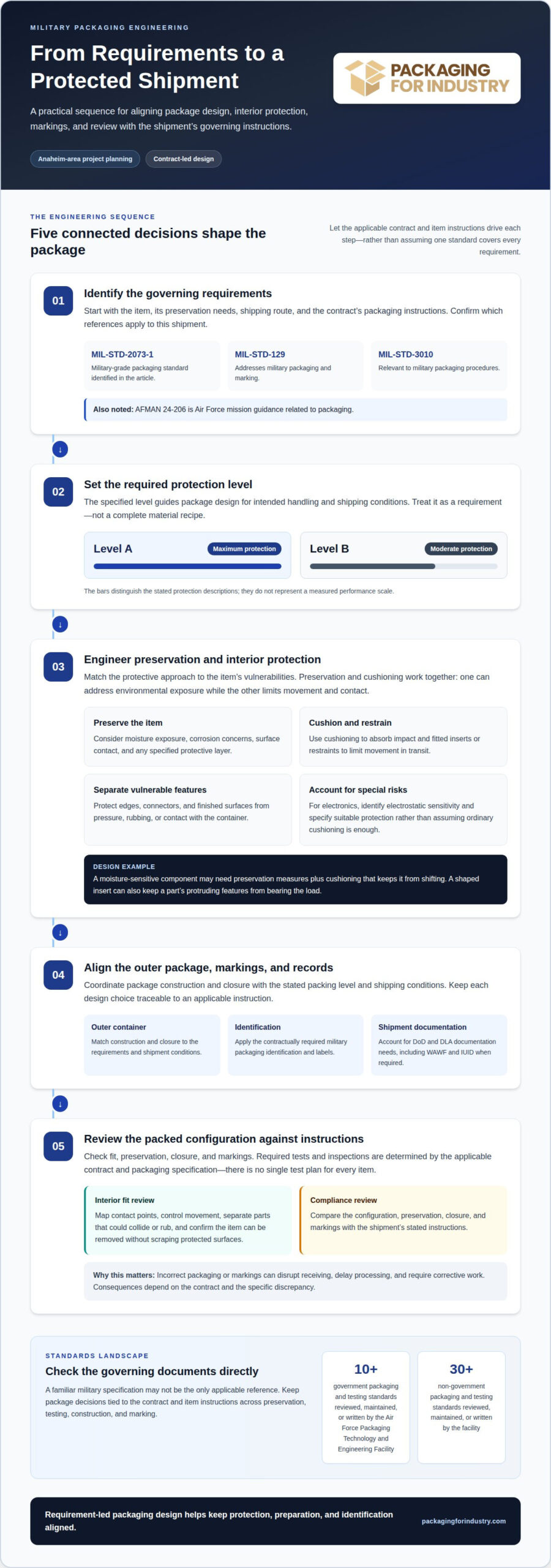
Military shipments can involve several specifications, each addressing a different part of packaging. MIL-STD-2073-1 is identified as the standard for military-grade packaging. MIL-STD-129 addresses military packaging and marking, while MIL-STD-3010 is relevant to military packaging procedures. The applicable contract and item requirements determine which specifications guide a particular shipment.
These standards shape packaging from preservation through identification. Start by identifying the item, its preservation needs, its shipping route, and the contract’s packaging instructions. Then map each instruction to package construction, interior protection, and required markings. For example, a moisture-sensitive component may need preservation measures as well as cushioning to limit movement. A robust outer container alone may not meet every requirement.
Military packing levels indicate different protection needs. Level A is described as maximum protection, while Level B is moderate protection. The level affects how the package is designed for its intended handling and shipping conditions. It should be treated as a specification decision, not a label that automatically determines every material or package feature. AFMAN 24-206 is named as Air Force mission guidance related to packaging.
- Preservation: Select protection for the item’s vulnerabilities, such as moisture exposure, corrosion concerns, or surface contact. The required method comes from the applicable packaging instructions.
- Interior protection: Use cushioning and restraint to control movement. A shaped insert, for example, can keep a part from shifting inside its container.
- Identification: MIL-STD-129 is associated with military packaging marking. Apply the contractually required identification and labels so receiving personnel can process the shipment accurately.
- Package design: Align the outer container and closure with the stated packing level and shipment conditions. Keep design choices traceable to the applicable instructions.
What packaging tests and inspections are required for military shipments? The applicable contract and packaging specification determine the required tests and inspections. A packaging review can assess the configuration, preservation, closure, and markings against those instructions. No single test plan applies to every item.
What are the risks and penalties of noncompliant military packaging or labeling? Incorrect packaging or markings can disrupt receiving, delay shipment processing, and require corrective work. Consequences depend on the contract and the specific discrepancy. Reviewing requirements carefully helps prevent avoidable handling and reshipping problems.
For projects coordinated in Anaheim, the Anaheim packaging service area provides a local point of reference for packaging needs.
The Air Force Packaging Technology and Engineering Facility reviews, maintains, or writes 10+ government packaging and testing standards. It also reviews, maintains, or writes 30+ non-government packaging and testing standards. This breadth underscores why a shipment’s governing documents should be checked directly: a familiar military specification may not be the only applicable reference. Confirm the standards identified by the contract and item instructions, and keep package decisions tied to those requirements rather than assuming a single standard covers preservation, testing, construction, and marking.
Interior protective packaging
Interior packaging controls how an item moves inside its outer container. For an aerospace actuator, the design may need to support the component’s weight, protect exposed surfaces, and prevent contact with nearby parts. Start with the item’s shape, fragile features, and likely handling stresses. Then determine where cushioning, separation, and restraint are needed.
Shock and vibration call for different design responses. Cushioning can absorb impact, while a fitted insert can limit movement during transport. For a metal assembly with protruding connectors, cutouts can keep those features from bearing the load. Dividers can separate multiple parts in one container and reduce rubbing. The package should hold each item securely without putting pressure on delicate edges.
Choose materials based on the item and packaging instructions, not habit. Foam can be shaped around an irregular component, while a protective layer can separate finished surfaces from a harder container. Electronics also require attention to electrostatic sensitivity. Identify that risk in the packaging plan and specify suitable protection rather than assuming ordinary cushioning is enough.
Preservation and cushioning work together. A sealed protective layer can address environmental exposure, while an insert keeps the item from shifting. For example, a machined component with a finished face may need both a surface barrier and a cavity that holds it away from the container wall. If the barrier is punctured or the insert fits poorly, the combined design may not protect the vulnerable area.
- Map contact points: Identify surfaces, edges, connectors, and delicate features that must not bear impact or pressure.
- Control movement: Position inserts and restraints so the item stays seated through handling and transit.
- Separate components: Use divided cavities when multiple parts could collide, scratch, or become mixed.
- Review the packed item: Check fit, closure, and access for removal without scraping protected surfaces.
A useful design review also considers packing labor. An insert that accepts the part in one clear orientation can reduce handling errors on a production line. A complex assembly may need labeled cavities or a fixed loading sequence. These details should make packing repeatable while maintaining the required protection.
Foam packaging can be part of this engineered interior when a component needs shaped support or separation. A project-specific foam packaging design can account for the item’s geometry and handling needs. To discuss a packaging configuration, request a packaging quote with the part dimensions, weight, sensitive features, and applicable packaging instructions.
MIL-STD packaging requirements
MIL-STD-2073-1 is identified as the standard for military-grade packaging. Applying it begins with the specific item and the packaging instructions governing that shipment. The standard’s presence alone does not define every design choice. The contract, item data, and required protection level shape the actual packaging configuration.
A practical engineering review translates instructions into decisions that production and shipping teams can repeat. First, identify the item and its packaging data. Then connect each stated requirement to a package feature, such as preservation, cushioning, closure, or identification. For a machined aerospace component, the plan might address a protected surface, secure restraint, and correct exterior markings as separate requirements.
Mapping each requirement helps prevent gaps between design and packing. A useful review record links each instruction to how it will be implemented and inspected. For example, a requirement for a specific preservation method should identify where it appears in the packing process. A marking instruction should specify a label location or package surface. This makes omissions easier to catch before a shipment leaves the facility.
- Capture the governing instructions: Record the applicable contract details, item information, and referenced military packaging standards.
- Translate requirements: Assign each instruction to a material, package feature, packing step, or marking action.
- Review the configuration: Confirm the planned components work together, including the interior support and outer package.
- Control revisions: Keep the packing instructions aligned with approved design changes and the current item configuration.
Change control matters when a product or shipment changes. A revised connector, surface finish, or shipping configuration can affect fit and protection needs. Compare the current item with its approved packing instructions during the packaging review. This helps prevent use of an insert or process designed for an earlier configuration.
Verification should focus on observable requirements. A packing review can confirm that the correct materials are present, the item is positioned as planned, closures are applied, and required labels are legible and correctly placed. For repeat shipments, these checks also help maintain consistency between operators and production runs.
MIL-STD-3010 is also identified as relevant to military packaging. Keep references to standards distinct from the project’s specific instructions, so teams don’t assume that citing a standard alone proves every requirement has been met. A controlled packaging plan should show how each applicable instruction is addressed, who performs the packing steps, and what the final review examines.
For projects involving multiple parts or changing configurations, organize packaging requirements before releasing the packing process. A clear map linking requirements to package features gives engineering, procurement, and shipping teams a shared working document and makes discrepancies easier to resolve before dispatch.
Packaging for DoD and DLA
DoD and DLA shipments connect the physical package with identification and transaction records. WAWF means Wide Area Workflow, and IUID means Item Unique Identification. Both are relevant to packaging documentation. When they appear in shipment instructions, packaging data, item identity, and shipping records need coordinated handling.
Start with the contract and shipment documents. Identify the item, destination, packaging instructions, and required records before preparing the package. Then align information across package markings and accompanying documents. For example, a serialized aerospace component should have a clear link between its physical identification and the records traveling with the shipment.
Treat the exterior label as part of the receiving workflow, not a last-minute task. A damaged or unreadable label, or one obscured during handling, can slow identification. Plan a visible location that remains accessible after the package is closed and prepared for transport. Keep the package contents and identifying details consistent with the applicable shipment information.
- Review shipment instructions: Capture applicable packaging, marking, and documentation details from the contract.
- Connect item identity: Match the item’s identifying information with the package and related records.
- Coordinate data: Keep the information used for WAWF and IUID documentation consistent with the shipment details.
- Inspect before dispatch: Review label legibility, placement, package closure, and the completed documentation together.
These steps help distinguish packaging errors from documentation gaps. If a label identifies one configuration but the package contains a revised component, the mismatch can complicate receiving and traceability. Include a final comparison of the packed item, its identification, and the shipment paperwork in the controlled packing process.
DoD and DLA workflows can involve different destinations and receiving processes, so follow the shipment’s actual instructions rather than relying on a generic label template. A repeat shipment may use an established packing record, but a changed item, destination, or contract instruction can require a fresh review. Keep current packing instructions accessible to operators and shipping staff.
Packaging engineering should also account for handling at the receiving end. A package that protects the item but hides its identification creates avoidable work during intake. Place labels where personnel can find and read them without opening the package or disturbing its protection. For multi-part shipments, clear separation and identification can help receiving teams reconcile contents with documentation.
Before release, review the package and paperwork as one shipment unit. Confirm that the correct item is packed, required markings are present, and referenced records match the shipment. This final coordination helps prevent receiving delays and supports accurate handling across DoD and DLA supply workflows.
Which Anaheim-area companies provide MIL-SPEC compliant packaging engineering?
Anaheim-area buyers should distinguish packaging engineering from material supply. An engineering-focused provider translates project requirements into a practical package and repeatable packing process. A materials supplier can meet purchasing needs, while a project may also call for design decisions, documentation coordination, or production planning.
Define the project before comparing providers. Consider whether you need support for a one-time shipment, a new product launch, or recurring aerospace orders. The item’s dimensions, weight, fragility, handling constraints, and destination all shape the work. A small electronic assembly, for example, may require different design attention from a large machined component with exposed surfaces.
Review the outputs of the provider’s engineering process. Useful deliverables may include a packaging concept, material recommendations, a packing sequence, and production review points. The scope should state which tasks are included and how the design relates to the item and its shipping context. This gives purchasing a practical basis for comparing proposals.
Production fit matters too. A configuration that works for one carefully packed sample may be awkward for regular line work. Consider whether operators can position the item consistently, close the package efficiently, and follow instructions without relying on informal knowledge. A straightforward packing sequence supports consistent execution across shifts.
- Match project experience: Look for familiarity with the item category and its handling needs, such as aerospace assemblies or electronic components.
- Clarify the scope: Separate design work, material supply, documentation support, and ongoing replenishment needs.
- Assess operational fit: Consider packing labor, available workspace, and how the package will move through shipping.
- Plan for revisions: Product or destination changes may affect packaging decisions and require updated instructions.
Compare proposals by deliverables and project assumptions, not broad descriptions alone. One proposal may cover design recommendations, while another may include production instructions or recurring supply planning. A clear scope helps engineering, purchasing, and shipping teams understand responsibilities and identify gaps before work begins.
For a mil-spec compliant packaging engineering project in Anaheim, choose a provider whose process fits the shipment and operating workflow. Share the project scope to request a packaging quote and begin a focused discussion about the work involved.
Give documentation a clear place in the project scope alongside design and production planning. WAWF means Wide Area Workflow, and IUID means Item Unique Identification; both are relevant to packaging documentation. Determine whether either applies to the project and whether the proposed work addresses the related needs. Specify which documents are included, who prepares or reviews them, and how revisions will be handled if the package or shipment requirements change. These questions can reveal gaps before a design enters regular use.
When reviewing proposals, distinguish a general promise of documentation support from a defined deliverable. Ask the provider to describe what the project team will receive and how it supports the agreed packing process. Purchasing can then compare proposals consistently, while engineering and shipping confirm that responsibilities are clear. If documentation falls outside the provider’s scope, define that boundary early and coordinate the work with the appropriate project stakeholders. This keeps the packaging plan, operating instructions, and documentation expectations aligned without assuming every shipment has the same needs.
Packaging For Industry (PFI)
Packaging For Industry (PFI) helps connect packaging needs with practical supply planning for defense and aerospace operations. Foam Packaging, including custom foam inserts, can provide fitted interior support for components during handling and transit. Stretch Film helps unitize packaged loads, while Vendor Managed Inventory (VMI) and Just-In-Time (JIT) inventory management coordinate packaging supply with operating needs.
Turn to PFI when you need to align protective materials with recurring production or shipment requirements. Share the item’s dimensions, handling concerns, shipment context, and applicable packaging instructions so the project discussion can focus on the right packaging and supply flow.
Contact Packaging For Industry (PFI)
Move your packaging plan toward the next shipment
Use the next shipment as an opportunity to align packaging decisions across engineering, purchasing, and shipping. A clear handoff helps teams account for product changes, assign documentation responsibilities, and keep packing instructions practical for daily operations. For mil-spec compliant packaging engineering in Anaheim, establish that coordination early so each team understands its role before the next production or dispatch cycle.
Bring your project details and priorities to Packaging For Industry (PFI) to discuss a practical path forward for your packaging needs.
A well-coordinated next step can help your team move forward with clarity and confidence.
Frequently Asked Questions
Need Compliant Packaging for a Defense or Aerospace Project?
Start by gathering the project’s packaging instructions and item details. The applicable contract requirements guide the package, so identify any stated preservation, protection, marking, and documentation needs. For mil-spec compliant packaging engineering in Anaheim, share those requirements along with the item’s dimensions, weight, sensitive surfaces, and shipment conditions. Packaging For Industry (PFI) offers custom foam packaging and can discuss how it may support interior protection for your project.
What military packaging standards apply, including MIL-STD-2073-1 and MIL-STD-129?
The standards that apply are the references specified in the contract or shipment instructions. MIL-STD-2073-1 and MIL-STD-129 are identifiers to include when they appear in those documents. For a quote discussion, provide the exact references and any related item packaging data. This helps define the project scope from its governing documents, rather than relying on a broad “military packaging” description that may leave specific instructions unclear.
What information is needed to request a military packaging quote in Anaheim?
Provide the item’s dimensions, weight, quantity, and any handling or protection concerns. Include the destination, shipment conditions, recurring order needs, and applicable packaging instructions or contract details. Note special sensitivities, such as a finished surface or exposed connector, because these can affect interior protection. If you need foam packaging, explain how the item is packed now and what problems the current configuration creates. This helps focus the quote discussion on your project’s actual requirements.