
Transit damage to high-value goods can cost businesses far more than the product itself. Custom protective packaging for sensitive equipment helps reduce that risk by matching cushioning and inserts to the product’s shape, fragility, and shipping journey.
Packaging can’t prevent every impact, but a well-designed system can limit movement and absorb shocks during transport, storage, and handling. Material selection also depends on equipment sensitivity, shipping conditions, and cost efficiency.
This article explains how packaging design, foam inserts, and cushioning work together to protect delicate equipment. You’ll learn what to consider for electronics, medical devices, and other precision products, and how a tailored fit can support safer handling and more reliable shipments.
Key Takeaways
- Build protection in layers, matching surface protection, cushioning, and the outer package to the equipment’s handling and shipping demands.
- Account for industry-specific risks, including electrostatic discharge for electronics and environmental exposure during storage or transport.
- Use product geometry, weight distribution, and fragile features to guide a packaging design that limits movement without stressing components.
- Choose foam inserts and cushioning based on how the equipment will be transported, stored, accessed, and handled.
- Explore custom packaging design and foam packaging from Packaging For Industry when standard protection doesn’t fit your equipment or shipping process.
Need Custom Protective Packaging for Your Product?
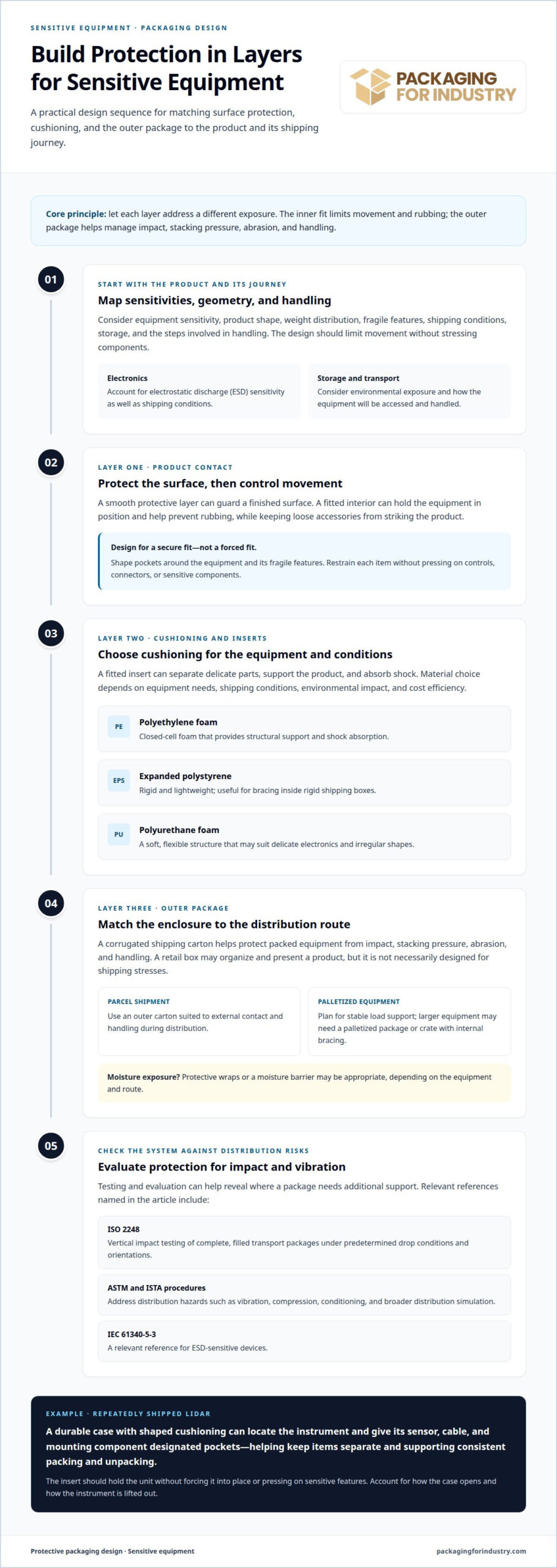
Protective packaging works as a connected system, from the equipment’s surface to the shipping carton. Its design should account for product sensitivity, shipment handling, storage conditions, and environmental impact.
Protection Across Packaging Layers
Layered protection uses different materials to manage surface contact, movement, and external impact. A smooth protective layer can guard a finished equipment surface, while custom foam holds the product in position. A corrugated shipping carton helps protect the packed equipment from impact, stacking pressure, abrasion, and handling throughout distribution. Each layer addresses a different exposure instead of asking one material to do everything.
This distinction matters when a product has delicate surfaces or limited compression strength. A retail box may organize accessories and present a brand, but it isn’t necessarily designed for shipping stresses. The outer carton should suit the distribution route, while the inner fit prevents the equipment and accessories from shifting or rubbing. This coordinated design helps keep the shipment secure.
Cases for Repeatedly Shipped LiDAR
A custom case for repeatedly shipped LiDAR equipment pairs a durable enclosure with shaped cushioning that locates the instrument and its accessories. For each shipment, designated pockets can keep a sensor, cable, and mounting component from contacting one another. The arrangement also gives handlers a clear place for each item during packing and unpacking.
Repeated use changes the design priorities. The insert must hold the LiDAR unit consistently without forcing it into place or pressing on sensitive features. Design should account for how the case opens, how the instrument is lifted out, and where it needs support. These details can limit movement and simplify handling between shipments.
Foam Shippers for Sensitive Products
A foam shipper combines a fitted interior with an outer package to cushion sensitive or high-value products. Polyethylene foam is closed-cell and provides structural support and shock absorption. Expanded polystyrene is rigid and lightweight, making it useful for bracing inside rigid shipping boxes. The right choice depends on the equipment and the conditions it will encounter.
For electronics, foam selection should account for device sensitivity, shipping conditions, environmental impact, and cost efficiency. An insert can separate a display from heavier components, while dedicated compartments keep loose accessories from striking the housing. Foam should restrain each item without pressing on controls or connectors.
Retail presentation and shipping protection serve different purposes. A branded electronics retail box may organize accessories, present the product, and provide space for printing. A corrugated shipping carton addresses external impact, compression, abrasion, stacking, and handling throughout distribution. If a retail box has limited compression strength, placing it inside a suitable corrugated outer carton adds a protective shipping layer.
Shipping conditions also shape the package. Parcel shipments call for a carton that protects contents from external contact, while palletized equipment needs stable load support. Moisture exposure during storage or transport may call for protective wraps or a moisture barrier, depending on the equipment and route. Environmental impact belongs in the same design discussion: material use, packaging waste, and the protection needed for each shipment all influence the final system. Balancing these factors helps avoid both inadequate protection and unnecessary packaging.
Packaging for electronics, medical devices, aerospace, and defense
Options include fitted foam inserts, protective cases, corrugated cartons, crates, wraps, and moisture barriers, selected for equipment dimensions and shipping conditions. Relevant references include IEC 61340-5-3 for ESD-sensitive devices, ISO 2248 for package drop testing, and ASTM and ISTA procedures addressing distribution hazards.
Packaging for Portable and Large Equipment
Packaging for portable electronics prioritizes a secure fit, organized accessories, and manageable handling. Large equipment needs support suited to its size, weight, and movement through distribution. A portable calibration instrument, for example, can sit in a shaped insert with separate slots for cables. A larger electronics assembly may need a palletized package or crate with internal bracing.
Matching the package to product dimensions helps prevent shifting without applying pressure to connectors or controls. For aerospace and defense equipment, packaging design should also account for storage and transport conditions, as well as the handling steps between manufacturing and final delivery.
Impact and Vibration Protection
Impact and vibration protection uses cushioning and restraint to limit movement and absorb energy during distribution. Foam around a control unit can separate it from the carton walls, while fitted compartments keep loose components from striking a screen or housing. This matters because repeated movement can cause abrasion or stress delicate connections.
Testing should reflect the distribution risks the package will face. ISO 2248 describes vertical impact testing of complete, filled transport packages under predetermined drop conditions and orientations. ASTM and ISTA procedures address vibration, compression, conditioning, and broader distribution simulation. These evaluations help reveal where a package needs additional support.
Polyurethane Foam for Delicate Electronics
Polyurethane foam’s soft, flexible structure may make it a suitable option for protecting delicate electronics. It can cushion irregular shapes, while shaped pockets help keep each component in position. The insert should support the equipment without pressing on sensitive controls, displays, or connectors.
Electronics packaging may also need static protection. Anti-static foam can help protect sensitive electronic components from electrostatic discharge, while the required protective properties depend on the device and handling environment. Evaluate material selection, product dimensions, manufacturing fit, and how the complete package performs in distribution.
Available Packaging Types and Standards
Custom packaging types range from foam inserts and cases to corrugated shipping cartons, moisture barriers, protective wraps, pallets, and crates. For ESD-sensitive devices, IEC 61340-5-3 defines protective packaging properties during production, transport, and storage. The applicable design depends on the equipment, its route, and its handling environment.
To find a U.S. custom packaging manufacturer, look for engineering support that considers dimensions, fragility, shipping conditions, and testing needs together. Ask for a design that addresses the complete package, not just the foam. For a project-specific design and custom packaging quote, share the equipment type, dimensions, and shipping use.
Custom packaging design for product geometry and protection needs
A custom package matches physical dimensions, fragile features, product weight, and transport conditions. Design and manufacturing timelines depend on package complexity, material selection, prototype revisions, and approval of the final layout.
Designing Around Dimensions and Fragility
Packaging design translates each device’s shape and vulnerable points into a stable fit. A projecting connector, uneven weight distribution, or delicate display can change where cushioning and support belong. For example, a control unit with exposed ports needs clearance around those connections, while its heavier base may need additional support. Accurate dimensions help prevent movement without forcing fragile devices into the insert.
Design Inputs and Layout Review
A useful design review brings product details and handling needs into one layout. Consider the device’s dimensions, weight distribution, fragile areas, accessories, shipping method, and storage conditions. A sensor shipped with cables, for instance, needs separate spaces to keep cable ends away from its lens. Reviewing the layout also clarifies how operators load and remove each component.
Prototyping and Approval
A prototype turns the proposed layout into a physical fit that can be assessed before manufacturing. The review can show whether a device sits securely, operators can remove it easily, and accessories remain separated. For a fragile instrument, the team can refine pocket shape or support placement after examining the fit. Approval then establishes the design for production.
Design, prototyping, and manufacturing form a connected process. A packaging engineer translates product and shipping requirements into a layout, selects suitable materials, and prepares a prototype. Feedback can guide adjustments to pocket positions, access points, or cushioning areas. This sequence reduces the risk of producing a full run with a layout that doesn’t fit the equipment or packing workflow.
Manufacturing considerations also shape the design. A layout with many unique cavities may require different tooling or assembly steps than a simpler insert. Standardizing repeated components across related devices can make packing more consistent, while retaining model-specific pockets where dimensions differ. These tradeoffs connect protection with production efficiency, especially for recurring shipments.
There’s no single lead time for every custom packaging project. Complexity, material selection, prototype revisions, approval timing, and manufacturing requirements all affect the schedule. Sharing device dimensions, fragile areas, accessories, and shipment conditions helps define the design scope early. For a project-specific discussion, request a custom packaging quote with those details.
Foam case inserts for transport, storage, and handling
Foam inserts organize equipment inside a case and help control movement during transit and routine handling. Their fit and material should reflect the product, its cushioning needs, and whether the package will be reused.
Insert Fit and Product Movement
An insert supports equipment by holding it in place inside the case while leaving appropriate cushioning space around vulnerable areas. A fit that’s too loose can allow movement; one that’s too tight can press against controls, connectors, or delicate surfaces. For example, a case for a handheld inspection instrument can support stable sections of the body rather than putting pressure on its buttons.
Cushioning with Custom Foam
Custom foam inserts use shaped cavities and support areas to cushion equipment during transport and storage. The design can account for product weight distribution and expected shipping forces. Custom die-cut foam pack-outs can match shock absorption to specific drop-height and G-force thresholds. That makes the insert’s shape and cushioning part of the protection design, not just an organizer.
Insert Materials and Trade-Offs
Material selection affects support, cushioning, and performance with repeated use. Closed-cell polyethylene foam provides structural support and shock absorption, and can retain its shape and protective properties after repeated impacts. Expanded polystyrene is rigid and lightweight, with compressive strength useful for bracing. Flexible polyurethane foam suits delicate, lightweight items that need a softer support surface.
Fitted Pockets in Foam Inserts
Fitted pockets give each instrument and accessory a defined place in the case. A camera sensor, power cable, and connector can occupy separate cavities to limit contact during handling. Pocket depth and shape should make components accessible without forcing them into place. This layout also helps operators return parts to their intended positions after inspection or service.
For storage between shipments, an insert can keep equipment organized and shield exposed surfaces from contact with other items. A removable tool or calibration device, for example, can return to its fitted pocket after use, reducing loose components inside the case. Reconfigurable foam designs can accommodate changing equipment layouts while maintaining distinct spaces for fragile parts.
Handling details matter during packing as well as transit. Finger access points can make it easier to lift a compact device without pulling on a cable or connector. A clear pocket layout also helps staff identify missing accessories before closing the case. Matching these features to the equipment and workflow makes the insert practical for recurring storage and shipping.
Custom cushioning for sensitive equipment
Custom cushioning controls how industrial equipment responds to impact, vibration, and movement in transit. Its performance depends on the product’s weight, vulnerable points, package orientation, and shipping journey. Custom cushioning is a core part of custom protective packaging for sensitive equipment because it supports the product while managing shipping forces.
Start With Weight and Support Points
Weight distribution determines where cushioning must support the product and where it must absorb movement. A compact instrument with a heavy base, for example, needs support that prevents the base from shifting into lighter components. A long assembly may need separate support zones along its frame. This approach reduces concentrated pressure on lenses, screens, connectors, and other vulnerable features.
Orientation matters too. If an industrial part ships upright, its cushioning layout should maintain that position inside the package. If operators may pack it in different orientations, the design needs clear placement cues and stable support for each intended position.
Manage Movement Without Over-Restraining
Cushioning should limit unwanted movement without forcing equipment into a tight fit. A restraint that presses against a control knob or cable connection can create another handling risk. For a sensor with a projecting connector, the design can support the sensor body while leaving clearance around the connector. Separate support areas also help prevent components from contacting one another.
Internal movement can happen in several directions during distribution. The cushioning layout should account for side-to-side travel, vertical movement, and contact with package walls. Consider how the product rests, where it could shift, and which surfaces can safely bear pressure.
Match Cushioning to the Distribution Task
A shipment’s handling path influences how cushioning should work. Parcel shipments may involve repeated handling, while palletized equipment may require stable support within a larger load. Depending on the equipment and distribution conditions, a design can combine fitted cushioning with a shipping carton or crate. The goal is to manage impact without adding material that serves no clear purpose.
Custom die-cut foam pack-outs can match shock absorption to specific drop-height and G-force thresholds. This connects cushioning design to the equipment’s protection requirements instead of relying on a generic insert. A delicate instrument and a rugged industrial component may need different support, even when their outer dimensions are similar.
Balance Protection and Packing Efficiency
A practical cushioning design must also work for the people packing and unpacking equipment. Defined support points can make the correct orientation clear and reduce handling steps. For example, a fitted recess can show where a removable sensor belongs, while a separate area keeps its accessory away from the instrument. This organization supports repeatable packing and helps components arrive together.
Material selection, product weight, reuse, and package size all affect the final design. A well-engineered system of custom protective packaging for sensitive equipment can help reduce damage without unnecessary bulk. A well-matched cushioning system supports the equipment, shipping process, and receiving operation.
Packaging For Industry (PFI): Custom Packaging Design Services
Packaging For Industry (PFI) provides Custom Packaging Design Services for manufacturers and industrial businesses that need packaging tailored to their products and workflows. Relevant products include Foam Packaging and Stretch Film, while Vendor Managed Inventory (VMI) for Packaging can support recurring supply needs. PFI serves equipment and production operations across Orange County, Los Angeles, and San Diego.
PFI connects packaging design with practical purchasing and supply needs. A tailored design can support product protection and efficient handling, while managed inventory helps keep recurring packaging materials available. This combination suits manufacturers, aerospace companies, and electronics businesses managing ongoing shipments.
Contact Packaging For Industry (PFI) to discuss your equipment packaging needs.
Plan the Next Shipment With Protection in Mind
Packaging decisions affect more than the condition of equipment on arrival. They also shape how teams prepare orders, handle products, and maintain packaging supplies for recurring shipments. Treat custom protective packaging for sensitive equipment as part of the shipping workflow, so product protection and day-to-day operations support the same goal.
Packaging For Industry (PFI) offers Custom Packaging Design Services and Foam Packaging for equipment-specific protection. Stretch Film can help secure loads, while Vendor Managed Inventory (VMI) for Packaging organizes replenishment around recurring needs. Discuss your equipment, handling process, and shipment requirements together to determine the right next step.
A thoughtful package design makes protection easier to apply consistently. Put your equipment and shipping requirements at the center of your next design conversation.
Frequently Asked Questions
How do you choose the right cushioning material for fragile or sensitive equipment?
Choose cushioning by matching material support and protective properties to the equipment and shipping conditions. Polyethylene foam provides structural support and shock absorption, while flexible polyurethane foam can suit lightweight delicate items. For electronics sensitive to static electricity, anti-static foam may help protect components. Also consider expected handling, storage conditions, environmental impact, and cost efficiency. A single material may not suit every part of a multi-component assembly.
How is custom packaging designed using equipment dimensions, weight, and fragility?
Designers use equipment dimensions, weight distribution, vulnerable areas, accessories, and shipping conditions to shape the package layout. Include protrusions and access points, such as a sensor lens or connector, because these affect where supports and clearances belong. The design positions cushioning around stable areas and accounts for how the equipment is packed and removed. A prototype lets the team assess fit and handling before approving the production design.
How do foam-in-place, molded foam, corrugated inserts, and reusable cases compare?
These options differ in fit, structure, and reuse. Foam-in-place forms around a product during packing, while molded foam provides a shaped cushion designed for a particular product. Corrugated inserts can separate or brace components inside a carton. Reusable cases combine an enclosure with an interior layout for repeated transport and storage. Selection depends on product geometry, shipping conditions, packing workflow, and whether the package needs to serve repeated trips.
How do vibration, shock, moisture, static electricity, and temperature affect packaging requirements?
Each exposure may call for a different protective feature. Shock and vibration may require cushioning and restraint; moisture may call for a barrier or protective wrap. Static-sensitive electronics may need low-charging, dissipative, conductive, or shielding packaging properties, depending on the device and handling environment. Temperature conditions can influence material selection and storage requirements. Consider the full route, including transit, staging, and destination storage.
What tests verify that custom protective packaging can withstand shipping and handling?
Testing can evaluate how the complete package responds to impacts, vibration, compression, and environmental conditioning. ISO 2248 describes vertical impact testing of complete, filled transport packages under predetermined drop conditions and orientations. ASTM and ISTA procedures address vibration, compression, conditioning, and broader distribution simulation. The relevant evaluation depends on the distribution route and package design. Testing a filled package can reveal how the product and cushioning work together.
What information should you provide when requesting a custom packaging quote?
Provide the product’s dimensions, weight, vulnerable areas, and any accessories that need separate compartments. Describe the shipping method, handling process, storage conditions, and whether the package will be reused. Photos or drawings can help show unusual shapes, protruding components, and surfaces requiring protection. Include relevant packaging or testing requirements and expected order patterns. These details help define the design scope and support a useful quote discussion.