
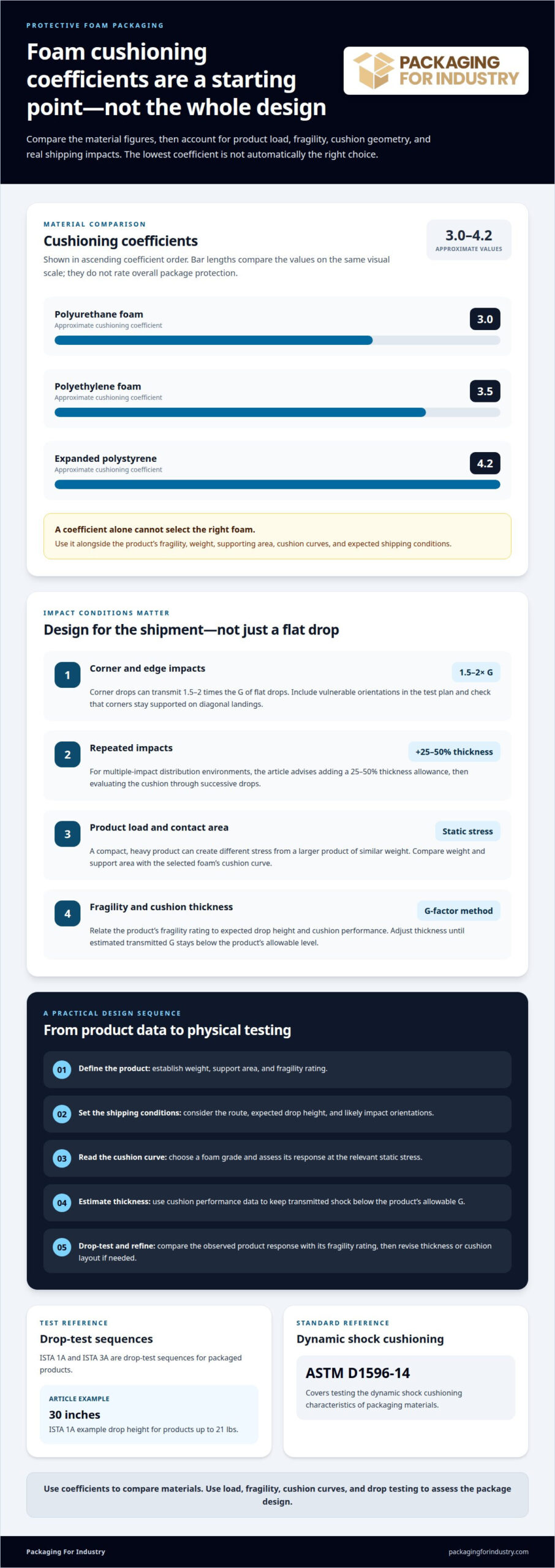
A foam cushioning coefficient can help narrow material options, but it can’t design a protective package on its own. Effective drop-tested foam cushion engineering in Southern California also accounts for product fragility, weight, static stress, cushion curves, and the drops a shipment may face. Polyurethane foam has an approximate cushioning coefficient of 3.0, compared with 3.5 for polyethylene foam and 4.2 for expanded polystyrene, but the lowest figure isn’t automatically the right choice for every product.
It’s easy to focus on foam type or thickness and overlook how a product’s load and shipping conditions affect cushioning performance. This guide explains how cushion curves and static stress inform foam selection, how the G-factor method relates cushion thickness to product fragility, and how cushioning coefficients help compare materials. It also covers common design mistakes to help manufacturers make informed decisions about protective foam packaging and reduce shipping damage.
Key Takeaways
- Use cushion curves alongside static stress to guide foam grade and density selection for the product’s load.
- Relate cushion thickness to product fragility and expected shipping conditions, then use physical drop testing to assess the design.
- Compare cushioning coefficients as one part of material selection, not as a stand-alone measure of package performance.
- Align protective foam packaging with the product, shipping needs, and warehouse workflow to help reduce damage and avoid unnecessary material use.
- Explore how custom foam packaging, stretch film, and packaging inventory services can support more consistent operations across manufacturing and distribution.
Impact-Force and Vibration-Energy Dissipation
Cushion design must manage impact and vibration across the distribution route, not just a single flat drop. In Southern California, Packaging For Industry (PFI) provides custom foam packaging, including foam inserts and cushions designed around products and shipping needs. Assess a design by its fit, material selection, and test conditions.
Impact Stress Distribution
A cushion spreads impact stress across its contact area, but the load may not be distributed evenly beneath the product. Contact points, cushion geometry, and product position all affect where stress concentrates. During design, map likely contact zones and check that the cushion supports the product without creating pressure beneath vulnerable areas. This helps identify weak points before shipment.
Drop Orientation and Corner Impacts
Drop orientation changes where impact energy enters the package. A face-first drop loads a broader support area, while an edge or corner drop concentrates force. Corner drops can transmit 1.5-2 times the G of flat drops, so test plans should include vulnerable orientations. For example, confirm that corners remain supported when the package lands diagonally, rather than assuming a flat-drop result covers every impact.
Thickness for Multiple Impacts
Repeated impacts can use up cushioning capacity before a shipment reaches its destination. For multiple-impact distribution environments, add 25-50% thickness as an allowance, then evaluate how the cushion performs through successive drops. The required protection depends on the route and package design. A single-impact test may not represent handling that exposes the same package to repeated impacts.
Impact-Energy Absorption
Foam absorbs impact energy by compressing and slowing the product’s deceleration. Cushion thickness and material response determine how much compression occurs before the product bottoms out against the package. A useful test sequence matches the distribution environment: ISTA 1A and ISTA 3A are drop-test sequences for packaged products. An example ISTA 1A drop height is 30 inches for products up to 21 lbs.
Cushion Curves and Static Stress
Cushion curves connect foam grade and thickness with expected shock performance. Published curves show how a foam grade responds across different static stress levels. Designers use them to identify suitable material and thickness for the product’s load. This avoids choosing foam by density alone, since different grades can behave differently under the same load.
Static stress is the load carried across the cushion’s supporting area. A compact, heavy product creates different stress conditions from a larger product of similar weight. To assess the design, compare the product’s weight and contact area with the selected foam’s curve. Then check whether the expected shock response suits the product’s fragility and planned package layout.
For example, if a product presses into a small cushion area, its static stress rises. A curve can show whether that foam grade is suited to the load or whether another grade or cushion thickness deserves analysis. The curve also helps compare design options before producing a package. ASTM D1596-14 covers testing dynamic shock cushioning characteristics of packaging materials.
Use a consistent sequence: establish product weight and support area, select a foam grade, then read its curve at the relevant static stress. Evaluate the resulting shock performance alongside package geometry and intended distribution. This keeps material selection tied to the actual product rather than a generic specification. A custom packaging quote can start a discussion about cushion design for a specific product and load.
G-Factor Method for Cushion Thickness
The G-factor method links transmitted acceleration to a product’s fragility rating. The design objective is to keep the shock reaching the product below its allowable G level. A precision instrument with a low tolerance needs a different cushion response from a robust industrial component. The rating sets the protection target, while foam behavior and package geometry shape the design.
Start by establishing the product’s fragility rating and expected shipping drop height. Drop height depends on the distribution environment, such as parcel, LTL, or export shipping. Use cushion performance data to estimate transmitted G at the product’s weight and support conditions. Adjust foam thickness until the estimated shock stays below the product’s rating. This ties thickness to a measurable protection requirement.
Designers commonly add a 25-50% safety factor to the calculated foam thickness. That allowance helps account for variation between the model and real handling conditions. It is not a substitute for testing. A package can behave differently across drop orientations, and the product’s position or cushion fit can affect the result.
Close the design loop with physical drop testing. Compare the observed product response with its fragility rating, then revise the thickness or cushion layout if needed. For example, if a test transmits more G than the product can tolerate, increase or reposition the cushioning and test again. This calculation-and-test process makes the thickness decision traceable instead of relying on a generic foam size or guesswork.
Product Fragility Classifications
A product’s fragility rating describes the shock level it can tolerate, expressed in G. Cushion design uses that rating alongside product weight and expected shipping drop height. The classification is a useful starting point, not a complete foam specification. A precision instrument rated for a lower shock level needs a different protection target from a more robust product.
Common classifications range from extremely fragile at 15-25 G to moderate at 60-85 G. Very delicate products fall within 25-40 G, while delicate products fall within 40-60 G. These ranges help organize design requirements, but the actual product rating should guide the package. Consumer electronics typically survive 25-50 G, while precision instruments may only tolerate 15 G.
- Extremely fragile: 15-25 G, a classification for products with low shock tolerance.
- Very delicate: 25-40 G, a range that calls for careful impact protection.
- Delicate: 40-60 G, a category for products with moderate sensitivity to shock.
- Moderate: 60-85 G, a higher tolerance range that still requires suitable cushioning.
For a practical design review, pair the rating with the product’s weight, support points, and distribution route. For example, two products with the same rating may need different cushion layouts if their weights or contact areas differ. Expected drop height also affects the shock the cushion must manage. Consider classification, weight, and shipping conditions together when comparing package designs; treating the G range alone as a foam choice can lead to an unsuitable cushion.
Foam Material Cushioning Coefficients
A cushioning coefficient helps compare foam materials, but it cannot determine package performance on its own. Pair it with the product’s load, required protection, and test conditions.
Cushioning Coefficients by Foam Material
Approximate coefficients are 3.0 for polyurethane foam, 3.5 for polyethylene foam, 3.8 for cross-linked polyethylene foam, and 4.2 for expanded polystyrene. A lower coefficient isn’t a complete performance, durability, or cost comparison. The figure supports cushioning analysis, while durability depends on the foam grade and its use. Material cost also varies with specifications and package design, so compare options against the full application rather than the coefficient alone.
Foam Types and Densities
Impact-absorbing cushion designs may use PE, EVA, EPS, or ESD foam. Density is selected according to the product’s load and required cushioning performance; the material name alone does not specify a suitable density. Compare grades using published cushion data, then evaluate the selected design through testing. For example, an ESD-sensitive electronic product requires consideration of both impact protection and static-control needs.
For a foam cushion engineering quote, provide the product’s dimensions, weight, fragility rating, shipping environment, likely drop orientations, and required order quantity. These details help define the design and testing scope.
Custom foam cushion design, prototyping, and testing follow a project schedule shaped by design complexity, prototype revisions, and the selected test sequence. Clear product and distribution details help establish the work plan.
Foam Packaging and Related Products
Packaging For Industry (PFI) helps businesses in Orange County, Los Angeles, and San Diego match protective foam packaging to how products are packed, handled, and shipped. Its foam packaging includes custom inserts shaped around an item and its packaging workflow. This can help when standard fill allows product movement, leaves edges exposed, or leads to inconsistent packing steps.
Foam selection should account for product fragility, weight, geometry, and shipping conditions. PFI’s custom packaging design service can translate those requirements into a packaging concept. Packaging kitting and assembly can organize components into a repeatable packing setup. For electronics, an insert layout can position an item and its accessories; the appropriate foam type and dimensions depend on the application. Explore foam packaging options as part of the overall package design.
Foam cushions products inside a package, while stretch film helps secure palletized loads for handling and distribution. Using both addresses product cushioning and load containment as separate packaging needs. PFI also offers vendor managed inventory (VMI) and just-in-time (JIT) inventory management for packaging. These services can support supply planning when material availability and replenishment matter alongside cushion design.
For a useful discussion, gather the product’s dimensions, weight, fragility rating, shipping route, and current packaging concerns. Those details help frame practical options for foam, stretch film, and packaging inventory. Contact Packaging For Industry (PFI) to discuss your operation’s packaging requirements.
Industries Served
Protective packaging requirements differ across manufacturing, warehouse, and distribution operations in Orange County, Los Angeles, and San Diego. Packaging For Industry serves aerospace, food, medical, electronics, construction, and other industrial businesses, as well as distributors and fulfillment centers. Each industry ships products with different fragility, shape, and handling needs, so cushion design should reflect the item and its route rather than rely on a generic package.
Aerospace companies and electronics manufacturers may ship precision components that need controlled support inside a package. Medical businesses also handle products where secure positioning during transit matters. Aerospace packaging requirements can vary by product dimensions, weight, fragility, and shipment conditions. These details help define how cushioning fits around the item and how the package supports it during handling.
Food companies, construction suppliers, and industrial manufacturers also move products through regional supply chains. Product shape, load, and packaging workflow all influence whether foam cushioning suits a shipment. For example, a component with exposed edges may need support positioned around those areas, while a product packed repeatedly on a production line benefits from a consistent insert layout.
Warehouses, distributors, and fulfillment centers need packaging that fits their handling and packing processes as well as the product. Businesses shipping across Anaheim, Orange County, Los Angeles, and the wider Southern California region can assess cushioning alongside box fit and palletized-load needs. Aligning protective design with the actual product and operation helps packaging teams reduce damage and avoid unnecessary packing steps. A useful design discussion starts with the product, its route, and where damage has occurred.
Benefits of Drop-Tested Foam Cushion Engineering
Drop-tested foam cushioning evaluates how a package protects its product under defined impact conditions. The results help identify where the design needs adjustment, such as support placement, cushion thickness, or product restraint. The aim is practical: reduce shipping damage by matching protection to the product and its distribution environment rather than relying on a generic packing approach.
A tailored cushion can support a product at key contact points and limit unwanted movement inside the package. This matters for items with delicate surfaces, irregular shapes, or components that could shift during handling. A stable fit also gives packing teams a more repeatable process, reducing reliance on improvised fillers or inconsistent placement.
A better fit can help lower packaging costs by avoiding unnecessary material and excess package volume. The right design balances protection with efficient use of foam and space. For example, an insert shaped around a product may replace loose cushioning that requires extra adjustment during packing. The appropriate design still depends on the product’s fragility, load, and shipping conditions.
Testing also gives operations teams a basis for reviewing packaging changes before wider use. If a product or shipping route changes, reassess the package against those conditions. This supports a more controlled transition and helps purchasing and warehouse teams work from a consistent packaging specification.
For manufacturers and distribution centers, reliable protection helps prevent damage-related interruptions and clarify packaging processes. Pairing an engineered cushion with a repeatable packing method can help teams maintain product protection as orders move through Southern California supply chains.
Why Choose Packaging For Industry
Packaging For Industry supports businesses in Orange County, Los Angeles, and San Diego with foam packaging designed around product protection and shipping requirements. Its custom packaging design services account for product dimensions, weight, fragility, and packing workflow. This helps manufacturers and warehouse teams consider protective fit alongside the practical steps staff follow at the packing station.
For shipments requiring product-specific cushioning, foam packaging can be selected and configured around the item and its support points. Stretch film addresses a different need by securing palletized loads for handling and distribution. Using the right material for each function helps businesses build a packaging approach around actual shipping conditions instead of relying on one material to solve every problem.
Supply planning matters too. Packaging For Industry offers vendor managed inventory and just-in-time inventory management for packaging. These options are relevant when packaging availability and replenishment need to match ongoing production or warehouse demand. Vendor managed inventory can connect supply oversight with day-to-day operational requirements.
Next-day delivery in Orange, Los Angeles, and San Diego counties supports businesses that need packaging supplies for regional operations. Buyers can discuss foam packaging, stretch film, and inventory needs together, rather than treating each requirement as an isolated purchase. Useful details include the product being shipped, its fragility, package dimensions, shipping conditions, and expected usage. This information helps focus the discussion on suitable packaging and supply options.
For packaging support tailored to your product and operation, contact Packaging For Industry to discuss your requirements.
Put Your Cushion Design to Work
The next step is to connect packaging decisions to the product’s actual shipping workflow. For drop-tested foam cushion engineering in Southern California, a useful design discussion starts with the item, its handling route, and the damage patterns your team wants to address. Include how the product is packed today and whether packaging changes could affect warehouse operations or order fulfillment.
Packaging For Industry can discuss foam packaging alongside related needs such as stretch film and vendor managed inventory for packaging. Bringing those requirements together helps purchasing and operations teams consider product protection and supply planning in the same conversation. The result is a clearer starting point for evaluating custom packaging choices against the demands of your shipments.
Share the product and packaging details that matter to your operation, then develop a practical plan to improve protection and keep supplies aligned with demand.
A considered design is a practical next step toward more dependable shipping.
Frequently Asked Questions
What are common mistakes when designing cushioning foam packaging?
Common mistakes include choosing foam by material name alone, ignoring the product’s support points, and designing around flat drops only. A heavy component with a small contact area can load its cushion differently from a broad, lightweight item. Another mistake is changing the product or package layout without reassessing protection. Treat product fit, load distribution, shipping orientation, and packing consistency as connected design decisions.
Does foam thickness scale linearly with drop height?
No. Foam thickness does not increase in a simple one-to-one relationship with drop height. Cushion response depends on the foam grade, the product’s weight and support area, and how much compression occurs during impact. A greater drop height changes the energy the cushion must manage, but doubling thickness does not automatically produce a directly proportional change in protection. Use cushioning performance data and test the finished package.
How can I replace my foam?
To replace a foam insert, document the product’s shape, dimensions, weight, and position inside the current package. Note wear, compression, poor fit, or damage locations on the product. Then specify the shipping and handling conditions so the replacement can be designed for the actual application. If the product or package changes, assess the new configuration as a whole rather than swapping in foam with a similar appearance.
How can I test my foam?
Test foam as part of the complete packaged product, since insert fit and package construction affect the result. Select a drop-test sequence that reflects the distribution environment, then test the package in relevant orientations. Inspect the product and cushioning after each test for movement, damage, excessive compression, or loss of support. Record the configuration and results so design adjustments can be compared consistently.
What G-factor should I use for my product?
Use the product’s fragility rating as the maximum shock target, not a generic G-factor that applies to every shipment. The suitable target depends on the item’s sensitivity and how it is supported inside the package. For instance, a precision instrument and a rugged machine component require different protection criteria. Apply the product rating to the full package design, then assess transmitted shock through testing.
What is the ASTM standard for cushioning foam testing?
ASTM D1596-14 covers testing the dynamic shock cushioning characteristics of packaging materials. It relates to evaluating cushioning response under impact, rather than providing one universal foam specification for every product. ASTM D3574-17 is a separate standard test method for flexible cellular materials, including urethane foams. The appropriate method depends on whether the evaluation concerns package cushioning performance or foam material properties.
What is drop-tested foam cushion engineering?
Drop-tested foam cushion engineering is the design and evaluation of foam cushioning within a packaged product, using drop testing to assess protection. The work connects product characteristics, foam selection, insert geometry, and shipping conditions. For example, a component that shifts inside its box may need revised restraint or contact points, not simply a different foam thickness. Testing helps assess the complete package configuration under planned handling conditions.
How are foam cushions tested for impact attenuation and drop performance?
Testing evaluates how a packaged product responds to impact and whether the cushion limits transmitted shock. The package is configured for its intended use, exposed to a relevant test sequence, and inspected for product damage, movement, and cushion deformation. Test orientation matters because face, edge, and corner impacts load the package differently. Comparing results across design changes helps determine whether the insert geometry or material needs adjustment.