
When cartons arrive open or damaged, the wrong sealing tape can add cost and disrupt deliveries. PFI supplies packaging tape and other packaging supplies for manufacturers, warehouses, and distribution centers, with options to match carton surfaces and shipping conditions. Request a packaging quote to compare tape options and bulk packaging pricing for your operation.
Tape is only one part of the sealing system. Temperature, application, tape choice, carton pressure, and freight handling can all affect seal performance. This article covers common causes of seal failure, including why household tapes can struggle on corrugated boxes, and ways to improve adhesion and alignment. Use these points to identify likely causes, choose suitable packaging supplies, and reduce shipping damage without treating every failed seal as a tape problem.
Key Takeaways
- Improve tape contact by applying firm, even pressure and aligning the seal with the carton seams.
- Match adhesive and tape strength to carton surfaces, load pressure, storage conditions, and temperature changes.
- Look beyond the tape when seals fail: carton quality, packing method, vibration, and handling all affect package performance.
- Choose packaging around the shipment and operating needs to help reduce damage, avoid rework, and control supply costs.
- Packaging For Industry can support custom packaging design, foam packaging, stretch film, and inventory programs for manufacturers and other industrial operations.
Application pressure, tape alignment, and unwind tension
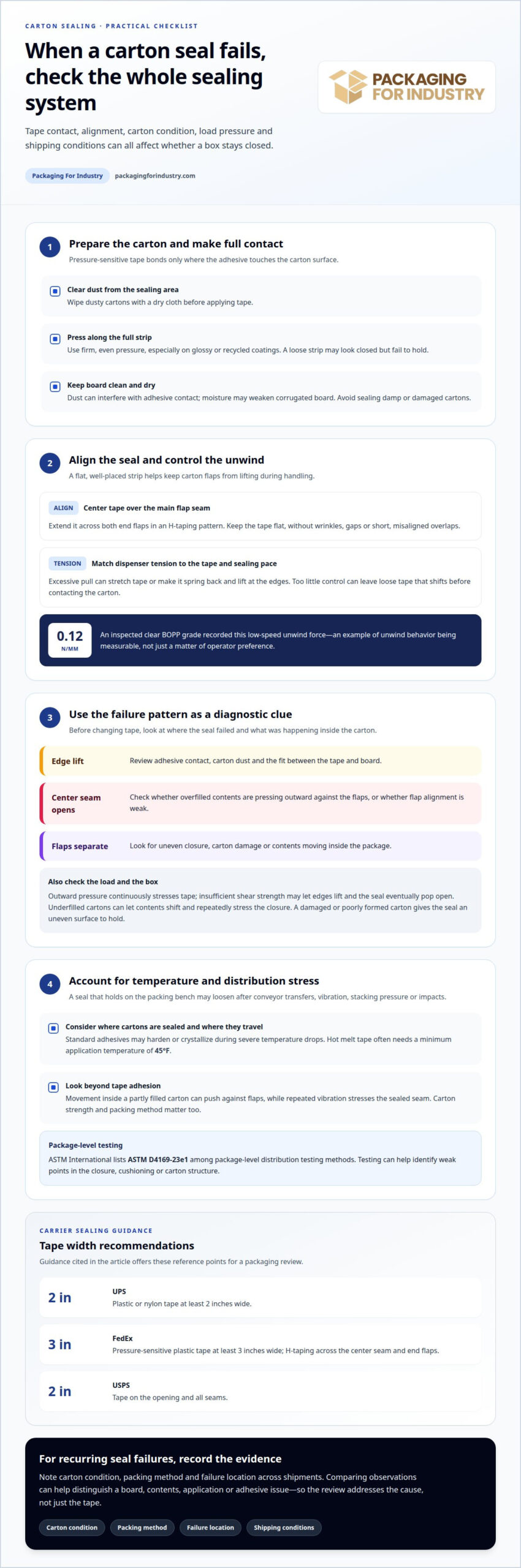
Tape bonds only where its adhesive contacts the carton surface. On dusty cartons, wipe the sealing area with a dry cloth before taping. Apply pressure-sensitive tape with a tape gun and press along the full strip, especially over glossy or recycled coatings. Firm, even pressure helps the adhesive contact the board; a loose strip may look closed but fail to hold. PFI supplies packaging tape in grades for different cartons and shipping needs, so buyers can compare options for their operations.
Alignment matters just as much. Center the tape over the main flap seam, then extend it across both end flaps in an H-taping pattern. FedEx recommends this method for sealing the center seam and end flaps. Keep the tape flat against the corrugated board, without wrinkles, gaps, or short, misaligned overlaps. A strip that misses an edge gives the flaps room to lift during handling.
Unwind tension affects placement and bonding. If a roll pulls too hard from the dispenser, the tape can stretch or spring back after application, lifting its edges. Too little control can leave loose tape that shifts before it contacts the carton. An inspected clear BOPP grade recorded low-speed unwind force of 0.12 N/mm, illustrating that unwind behavior is measurable, not just a matter of operator preference. Match dispenser tension to the tape and sealing pace, and compare tape grades when reviewing your packaging supplies.
Typical budget and heavy-duty tape prices vary with roll size, backing, adhesive, and order quantity; pricing depends on specifications and is provided after a quote request. A [packaging tape range](https://packagingforindustry.com/products/tapes/) can include grades for different cartons and shipping needs. Contact PFI to compare packaging tape pricing or request a packaging quote based on your specifications and order quantity. If a carton opens, contents may be lost or damaged, and the shipment may be delayed. According to UPS packaging guidelines, packaging is the shipper’s responsibility, and UPS is not liable for damage resulting from improper packaging.
Carton-seal failure patterns and their likely causes
A seal that lifts at the edges may indicate poor contact or an adhesive mismatch. A carton that opens along the center seam may be under outward pressure from overfilling, weak flap alignment, or both. These patterns can help distinguish a tape issue from a packaging issue. Carton quality, packing method, and sealing approach work together, so changing tape alone may not address the cause.
Pay attention to how the failure develops. If a loaded box pushes its flaps outward, the tape is under continuous stress. Tape with insufficient shear strength may lift at the edges and eventually pop open. If the carton is underfilled, contents can shift during handling and repeatedly stress the closure. A damaged or poorly formed carton also gives the seal an uneven surface to hold.
- Edge lift: Review adhesive contact, carton dust, and the fit between tape and board.
- Center seam opening: Check for overfilled contents pressing against the flaps.
- Flaps separating: Look for uneven closure, carton damage, or internal movement.
Temperature can contribute to these patterns. Standard adhesives may harden or crystallize during severe temperature drops. Hot melt tape often needs a minimum temperature of 45°F, so a cold application environment can undermine initial bonding. Consider where cartons are sealed and the conditions they encounter in transit, not just the temperature at dispatch.
Record the carton condition, packing method, and failure location for recurring incidents. Comparing those observations across shipments can reveal whether the cause is board, contents, application, or adhesive. For a shipment with outward pressure, review carton capacity and closure together rather than adding tape without addressing the load. If a packaging review would help identify weak points, request a packaging quote with details about the carton and shipment.
Vibration, handling, and impact during shipping
Transit subjects cartons to repeated vibration, stacking pressure, and sudden impacts. A box that stays closed on a packing bench may loosen after conveyor transfers or rough handling. Movement inside a partly filled carton can push against the flaps, while vibration repeatedly stresses the sealed seam. When requesting a packaging quote, review how tape, carton strength, and the way contents are packed work together.
Package-level testing helps assess how a complete package responds to distribution hazards. ASTM International lists ASTM D4169-23e1 among package-level distribution testing methods. Testing can help identify weak points in the closure, cushioning, or carton structure before shipping conditions expose them. PFI can review these areas when evaluating custom packaging solutions, offering a more useful performance picture than judging tape adhesion alone.
Carrier packaging guidelines give practical sealing recommendations to consider in a packaging review. UPS recommends plastic or nylon tape at least 2 inches wide. FedEx recommends pressure-sensitive plastic tape at least 3 inches wide and advises H-taping across the center seam and end flaps. USPS recommends 2-inch-wide tape on the opening and all seams.
Surface condition and humidity can affect seal performance before a shipment leaves the warehouse. Dust on corrugated board can interfere with adhesive contact, while moisture may weaken the carton. Keep sealing areas clean and dry, and avoid packing cartons with damp or damaged board. A well-aligned seal also reduces exposed edges that can catch during handling. Reviewing carton and tape choices with a packaging supplier can help address these issues.
For recurring failures, record where the tape lifts, whether flaps separate, and whether contents shift. Compare those observations across handling routes and carton types. If impacts damage products despite an intact seal, review the cushioning and fit inside the carton, not only the tape. A packaging quote can help assess packaging needs for a specific shipment and identify practical ways to reduce avoidable damage.
Why common household tapes fail on corrugated boxes
Masking, cellophane, and duct tape are designed for different jobs than sealing shipping cartons. Their adhesives may grip smooth paper but struggle to hold corrugated board through flexing, vibration, and temperature changes. For example, cellophane tape can split as carton flaps move during handling. For packaging buyers, choosing carton-sealing tape suited to shipping conditions can help prevent failures in transit. PFI supplies packaging tape alongside custom and stock corrugated boxes, and can help you request a packaging quote for supplies that fit your operation.
Corrugated cartons also vary in surface quality. Recycled board can have shorter fibers and lower surface energy, making it harder for standard adhesives to bond. Dust creates another barrier: tape applied over particles may stick to the dust instead of the board, then peel away as the carton shifts. When comparing packaging pricing, consider how the tape performs on the board you use, not just its unit cost.
Temperature changes can expose the mismatch. A package may ride in a 95°F truck bed before entering a cooler warehouse, stressing an adhesive that is not suited to changing conditions. Masking, cellophane, and duct tape are not strong enough to withstand temperature fluctuations during transit. Tape that works for an office envelope is not automatically suitable for a corrugated shipping carton.
Choose carton-sealing tape suited to the board and shipping environment. For highly recycled corrugated, natural rubber or high-tack hot melt adhesives can help bond to dense, short fibers. Wipe dusty sealing areas with a dry cloth before applying tape, then press the strip firmly onto the board. PFI can help buyers compare packaging supplies and request a quote for tape and corrugated boxes, including custom sizes available for packaging operations.
Cheap vs. Premium Packing Tape: Strength and Adhesion
When comparing packaging tape for a purchase, consider tensile strength and adhesion alongside price and appearance. Tensile strength describes resistance to pulling; adhesion describes how firmly tape bonds to a surface. Tape can resist stretching yet still peel from corrugated board if its adhesive cannot grip the fibers. Request a packaging quote to compare grades for your cartons and sealing needs.
Economy tapes may use film around 1.6 mils thick. Serious packaging grades are described as roughly 2.5 mils or more for film plus adhesive. Thickness alone doesn’t prove performance, but it can indicate a difference in material construction. Check the tape’s test data and intended carton application before comparing grades or bulk packaging pricing.
One inspected clear BOPP grade recorded tensile strength of 39 N/cm and elongation of 152%. Its 180-degree peel value was 5.62 N/25 mm under normal condition and 5.06 N/25 mm after aging. These are recorded results for that grade, not universal values for premium tape. Test conditions matter: the grade was tested at 23 C and 52% RH.
For corrugated cartons, peel adhesion and holding performance help explain whether tape stays bonded as flaps flex. ASTM D2860/D2860M-18(2024) evaluates pressure-sensitive tape adhesion to fiberboard at a 90-degree angle under constant stress. ASTM D3330/D3330M-04(2025) and ASTM D4332-22 are also relevant test methods for assessing tape adhesion or package performance.
Choose tape according to the load and sealing conditions. A light carton in stable storage may not need reinforced tape. Heavy loads, overfilled cartons, or automated sealing may call for hot melt or reinforced filament tape. Compare performance on the actual board type, since recycled fibers can be harder to bond to. PFI can supply packaging tape and help you compare options for your cartons. Request a packaging quote to review tape grades and pricing for your order.
Industries Served
Packaging For Industry supports manufacturers, warehouses, distributors, fulfillment centers, aerospace companies, food companies, medical companies, electronics companies, construction suppliers, and other industrial businesses. Each operation moves different products through storage and shipping, so packaging needs vary with product shape, handling, and supply flow. A manufacturer shipping components, for example, may need packaging that keeps parts organized and protected between production and delivery.
Warehouse and distribution teams often manage a mix of carton sizes, picking schedules, and outbound shipments. Consistent packaging supplies and dependable replenishment help keep packing operations moving. For fulfillment centers, the right packaging approach can also support efficient order assembly while helping limit product movement inside cartons. PFI’s manufacturing packaging support is relevant to businesses coordinating packaging with production and shipping processes.
Aerospace and electronics shipments may contain products that need carefully planned cushioning and a precise fit. PFI offers foam packaging and custom packaging design services to tailor protection to a product’s shape and handling requirements. Food and medical businesses also rely on organized packaging operations to prepare products for storage and distribution. Packaging decisions should account for the product and shipping conditions, rather than applying one standard format to every order.
Construction suppliers and industrial businesses may ship bulky or irregular items alongside standard cartons. Their packaging plans can involve different materials and replenishment patterns across departments. Vendor Managed Inventory and Just-In-Time inventory management for packaging can help align replenishment with operational demand. Packaging kitting and assembly services can support repeatable packing workflows. Across these industries, the practical goals are to protect products, keep packaging available, and reduce avoidable handling or rework. A plan built around actual products and shipping routines helps purchasing and operations teams make consistent decisions.
Benefits of Choosing the Right Packaging
Suitable packaging matches the product, shipment, and handling process. A carton that fits its contents helps limit movement, while appropriate cushioning absorbs shocks during loading and delivery. For fragile components, protective foam packaging can hold the item in position and reduce contact with carton walls. These choices can help reduce shipping damage and the rework, replacement shipments, and customer delays that may follow.
Packaging also affects labor and material use. A consistent carton size can make packing more repeatable, while a poor fit may require extra void fill or handling. Custom packaging design can align the box and interior protection with the product instead of relying on a generic setup. Review the full package, including closure, cushioning, and load stability, to identify where material use or packing steps can improve.
Operational benefits extend beyond individual shipments. Packaging kitting and assembly can group the materials needed for a repeatable packing task, helping teams follow a consistent process. Vendor Managed Inventory or Just-In-Time packaging management can align replenishment with usage. These approaches support supply reliability and help reduce avoidable stock interruptions without requiring every operation to manage packaging in the same way.
For manufacturers, warehouses, and distribution centers, the right packaging depends on product dimensions, shipping conditions, storage needs, and packing workflow. Review damage patterns alongside material consumption and labor demands. This broader view helps teams assess packaging costs against total operational needs, not just the price of an individual item. Savings can come from balancing product protection, material use, and supply consistency.
Packaging For Industry (PFI)
Packaging For Industry (PFI) helps businesses connect packaging choices with product protection, shipping conditions, and supply needs. Contact PFI when cartons repeatedly open, products shift during transit, or packaging problems continue after sealing practices improve. Reviewing the full shipment can help identify whether the issue involves cushioning, load stability, or packaging availability.
For products vulnerable to impact or movement, foam packaging can provide cushioning and support inside the package. The right configuration depends on product shape, handling, and how the item is positioned for shipment. This complements a sound carton closure by addressing movement and contact inside the box.
Packaging performance also depends on how materials move through the operation. Stretch film helps secure packaged loads, while Vendor Managed Inventory (VMI) and Just-In-Time (JIT) inventory management for packaging can support supply planning. These programs are useful when packaging shortages disrupt production or packing schedules, or when purchasing teams need replenishment coordinated with usage.
To make a discussion productive, describe the recurring failure pattern, the product being shipped, and the packaging process. Details such as whether damage occurs inside an intact carton or follows a lifted seal can clarify the broader packaging need. PFI can assess related packaging requirements and identify practical ways to improve protection and supply reliability, rather than treating tape as the only factor.
Contact Packaging For Industry (PFI) to discuss your packaging needs.
Turn Seal Failures Into a Better Packaging Plan
Understanding why cheap box tape fails in transit is a starting point, not a complete diagnosis. Use each damaged or opened carton to identify where the packaging system needs attention. A recurring failure can reveal a mismatch between the carton, product, packing process, or shipping conditions. Tracking these patterns helps purchasing and operations teams make better-informed packaging decisions.
Describe what the shipment contains, how it is packed, and what happens when it fails. That context helps Packaging For Industry assess the wider packaging need and discuss practical options for your operation. The goal is a consistent approach that supports product protection, efficient packing, and reliable supply.
A considered packaging plan can help your team work toward dependable shipments and smoother operations.
Frequently Asked Questions
Can cold weather cause packaging tape to fail?
Yes, cold can reduce an adhesive’s ability to form a reliable bond, especially if tape is applied to cold cartons. Acrylic tape is recommended for temperatures around 32°F and above, while hot melt tape often needs at least 45°F. Let cold tape and cartons acclimate in a room-temperature area for at least 24 hours before use. This can help the adhesive bond more evenly.
Does Thicker Packing Tape Prevent Failure During Transit?
Not by itself. Thickness can affect tape construction, but it doesn’t show how well the adhesive bonds to a specific carton or whether the tape suits the shipment. Compare adhesion and tensile performance alongside the board surface, load, and shipping conditions. For example, thick tape with a poor bond to dusty recycled fiberboard may still peel during handling.
Does thicker packing tape stop a carton from opening?
No. A thicker strip cannot correct a carton that is overfilled, damaged, or poorly assembled. If contents press outward against the flaps, the closure remains under stress regardless of tape thickness. Check the carton’s condition and how the load fits before changing tape. A suitable closure is part of the package, not a substitute for a properly packed box.
First Things First: Is It the Tape or the Box?
Look at where the failure starts. Tape peeling cleanly from intact board suggests a bonding or application issue; torn, crushed, or delaminated board points to carton damage or inadequate board performance. Also inspect the contents: a product pressing against the flaps can strain the closure. Comparing an unopened carton from the same shipment with a failed one can help narrow down the cause.
How Can You Confirm the Cause of a Failed Carton Seal?
Document the failure before changing the packing setup. Note whether the tape lifted at an edge, split across the seam, or stayed attached while the board tore. Record the carton type, product fit, storage conditions, and sealing method. Then compare a controlled trial that changes one factor at a time, such as tape grade or carton condition. This helps distinguish a tape issue from a broader packaging problem.
How Do Moisture and Temperature Changes Affect the Seal During Transit?
Temperature swings can change adhesive behavior, while moisture can weaken corrugated board and make its surface less reliable for bonding. A carton sealed in a dry warehouse may face different conditions in a damp loading area or cold freight space. Store tape and boxes in the same climate-controlled area, and keep carton sealing surfaces dry. Inspect both the adhesive bond and board condition after shipment.
How Should You Select a Clear BOPP Carton Sealing Tape Grade?
Choose a grade based on carton surface, shipment weight, storage duration, and temperature exposure. Compare adhesive type and test data, not just film thickness or clarity. Common finished widths include 48 mm, 60 mm, and 72 mm, while standard-grade clear BOPP tape is typically 40-55 um total thickness. These dimensions describe the tape, but don’t alone establish its suitability for a particular carton.
How Should a Carton-Seal Trial Be Run Before Shipment?
Use cartons, products, and sealing equipment that represent the actual packing line. Keep the carton style, fill, and application method consistent, then change one tape variable at a time. Mark each test carton and inspect the seal after handling that reflects the intended distribution conditions. Include shipments for Orange County, Los Angeles, and San Diego in planning when storage or transit conditions differ.