
A medical device kit works best when its components, configuration, and packaging are planned as one system. Packaging kitting services for medical device manufacturers in Carlsbad can bring multiple products or components together into a ready-to-ship unit stocked under a single SKU before an order arrives.
That coordination matters: each kit must be complete, clearly identified, and packaged for the product and its distribution needs. Assembly, packaging, and kitting all contribute, from checking components against the required configuration to choosing protective materials and preparing finished kits for fulfillment.
This article explains medical device kitting, how documented procedures and quality checks support consistent work, and what to consider when planning custom configurations. It also covers packaging, fulfillment, distribution, and how a packaging partner can connect these steps. Use these considerations to plan kits for reliable handling and a more organized supply chain.
Key Takeaways
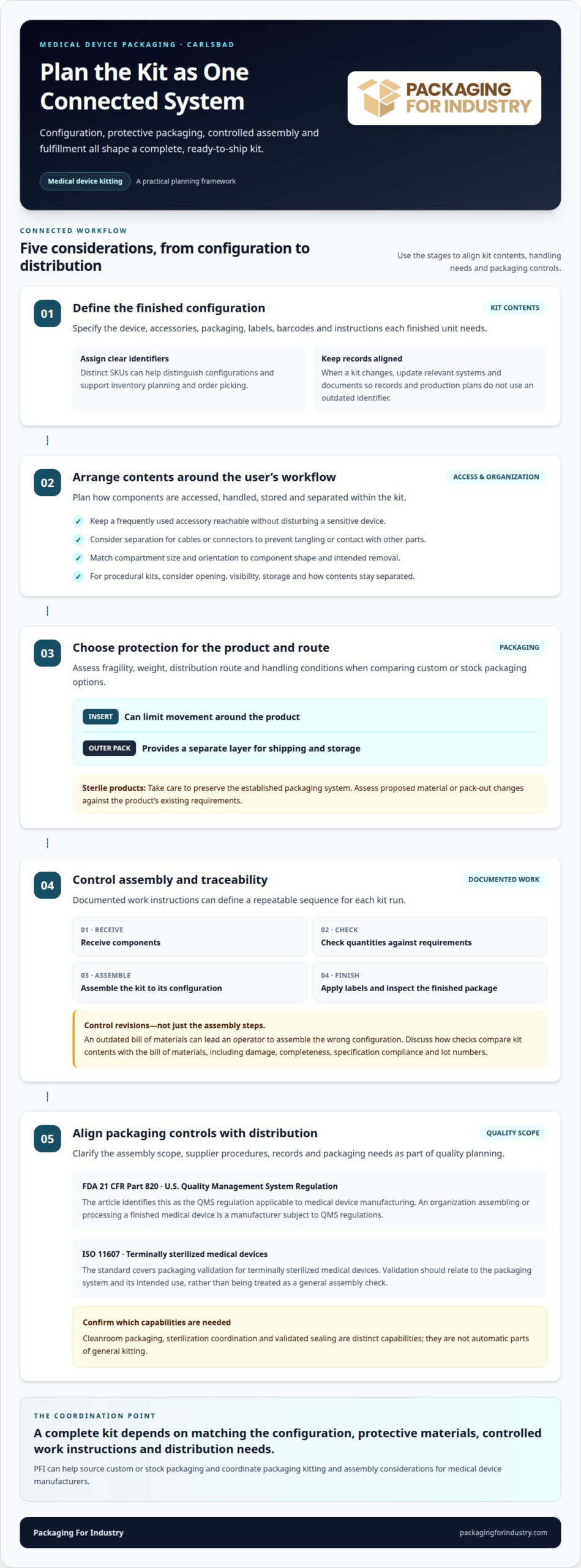
- Plan kit configurations around the devices, accessories, packaging, labels, barcodes, and instructions each finished unit needs.
- Use documented work instructions and component checks to support consistent assembly and traceability.
- According to the Electronic Code of Federal Regulations, FDA 21 CFR Part 820 is the U.S. FDA Quality Management System Regulation; according to the International Organization for Standardization, ISO 11607 covers packaging validation for terminally sterilized medical devices.
- Account for product protection, sterile packaging needs, and distribution handling when designing a kit workflow.
- Explore how PFI’s packaging kitting and assembly services, foam packaging, stretch film, and VMI for packaging can support coordinated operations.
Medical Device Packaging and Kitting Products
Medical packaging workflows connect kit assembly with product handling, storage, and distribution. Manufacturers seeking packaging kitting services for medical device manufacturers in Carlsbad can work with a packaging supplier to source custom or stock packaging suited to sterile and nonsterile products and their movement from production to fulfillment.
Labels, Barcodes, and Printed Instructions
Label placement affects how easily warehouse staff can identify and scan a package. PFI can help source packaging formats that make key identifying information easy to find and keep barcodes accessible after closure. Printed instructions should remain legible and protected from abrasion, folds, or contact with components during handling.
For healthcare kits, consistent label placement across package versions helps staff find familiar information. Match the layout to the packaging format and the manufacturer’s controlled labeling process when requesting a packaging quote.
Kit Labeling and SKU Assignment
SKU structure can support inventory planning and order picking. Distinct identifiers help manufacturers review demand by product family, coordinate replenishment, and distinguish active configurations from discontinued ones. This information can also help align packaging orders with purchasing and production plans.
When a kit changes, update relevant systems and documents as part of the operational handoff. Coordinating these changes helps reduce the risk that warehouse records or production plans continue to use an outdated identifier.
Device and Accessory Kitting
Arrange components for the way staff will access and handle them. A frequently used accessory may need to be reachable without disturbing a sensitive device, while cables or connectors may need separation to prevent tangling or contact with other parts. PFI can help source custom or stock packaging to organize kit contents.
For products with different shapes, consider compartment size and orientation. Packaging options can be assessed for how the device sits, how accessories fit around it, and whether removal involves unnecessary handling.
Packaging Service Options
Choose packaging based on product fragility, weight, distribution route, and handling conditions. A fitted insert can limit movement, while the outer package provides a separate layer for shipping and storage. PFI can help compare custom and stock packaging options for the product and its shipping needs.
Sterile products require particular care in preserving their established packaging system. Assess packaging changes against the product’s existing requirements before substituting materials or pack-out methods. Defined packaging kitting workflows can coordinate the relevant handling steps. Request a packaging quote to discuss kit requirements and supply options.
Custom Kit Configurations
Plan custom procedural kits around the workflow they support, including how contents are accessed and used. Consider how the package opens, whether components are visible, how it is stored, and how items stay separated. These details help identify practical custom packaging solutions for the intended healthcare setting.
Manufacturers can also match packaging formats to distribution channels and warehouse constraints. A configuration suited to handling at each supply-chain stage can help reduce unnecessary repacking and keep the process organized. Contact PFI to compare packaging pricing for custom or stock kit packaging.
Medical Kitting Compliance and Quality Management
When sourcing medical kitting and packaging, discuss how the supplier’s procedures, records, and packaging support your finished device requirements. In the United States, according to the Electronic Code of Federal Regulations, FDA 21 CFR Part 820 is the Quality Management System Regulation (QMSR) applicable to medical device manufacturing.
According to the Electronic Code of Federal Regulations, under 21 CFR 820.3, an organization assembling or processing a finished medical device is a manufacturer subject to Quality Management System regulations. Buyers should clarify the assembly scope with a supplier as part of quality planning.
When comparing providers, ask about documented procedures, staff training records, revision controls, and the work their quality system covers. Evaluate an ISO 9001-compliant process through its controlled records and process controls, not its label alone. Confirm whether cleanroom packaging, sterilization coordination, or validated sealing is needed, as these are distinct capabilities and not automatic parts of general kitting.
For sterile products, discuss packaging validation requirements with the supplier. According to the International Organization for Standardization, ISO 11607 is the standard for packaging validation of terminally sterilized medical devices. Validation should relate to the packaging system and its intended use, rather than being treated as a general assembly check.
Controlled Assembly and Traceability
Ask how documented work instructions support repeatable assembly across kit runs and operators. Instructions can specify the sequence for receiving components, checking quantities, assembling the kit, applying labels, and inspecting the finished package. Confirm how revisions are controlled: an outdated bill of materials can lead even a careful operator to assemble the wrong configuration.
Discuss how quality checks compare kit contents with the bill of materials. Checks can cover damage, completeness, specification compliance, lot numbers, expiration dates, and quantities. Recording lot and expiration details supports traceability if a finished kit needs review. Confirm that the label, assembly record, and contents match the same configuration.
Packaging Risks and Validation
Review how the provider addresses risks such as missing components, incorrect labels, untracked revisions, damaged packaging, and gaps in lot traceability. For sterile products, packaging failure can affect the product’s protected condition, so agree on ownership of validation requirements and handling procedures. Match the provider’s capabilities to the packaging and assembly tasks in scope.
Ask how packaging procedures maintain conformity during storage, handling, and distribution. Controlled procedures should explain how to protect finished kits and record exceptions. These steps connect assembly quality with delivery controls and keep documented processes aligned with each kit’s requirements.
Confirm that medical kitting assembly follows documented work instructions, giving operators a consistent basis for each run. Good Manufacturing Practices (GMP) are practices for ensuring quality and safety in medical device manufacturing, making them relevant to kitting procedures. Their application should be reflected in controlled handling and records, not assumed from a quality label.
ISO 13485 Clause 7.5.11 requires documented procedures for preserving product conformity during processing, storage, handling, and distribution. For kitting, these procedures can support consistent care of components and finished kits at each stage. Discuss medical device kitting quality controls for tracking lot numbers and expiration dates for traceability, so records connect kit contents with the relevant component details.
Packaging Options for Medical Device Manufacturers in Carlsbad
Medical device manufacturers in Carlsbad may need custom packaging solutions and reliable supply for different product families. Diagnostic instruments, surgical devices, and replacement accessories can require different protection and pack-out arrangements. PFI can help buyers compare packaging options, request a packaging quote, and coordinate packaging supplies for warehouse or distribution workflows.
For procedural products, a custom kit configuration can bring devices and specified accessories together for a particular use. Manufacturers can define which components ship together, how they are separated, and where instructions go inside the package. PFI can support packaging kitting with configurations that give production and fulfillment teams a repeatable setup for picking and shipping.
Delicate or irregularly shaped products may need protective foam packaging that limits movement during handling. Custom foam inserts can separate an instrument from its accessories in the same package. Consider product dimensions, component arrangement, and the shipping container together when requesting a foam packaging quote. This can help reduce contact between items and support consistent packing across production runs.
Manufacturers with multiple product versions may need a distinct kit configuration for each model or procedure. A configuration record can specify the parts, quantities, packaging, and printed materials for each finished kit. Keeping requirements separate by version helps prevent components intended for one kit from going into another. It also gives operations and fulfillment teams a clear reference when planning packaging supplies as demand shifts.
Packaging requirements may extend beyond the primary device. Replacement parts, cables, adapters, and protective components might ship with the main product or as separate replenishment units. For example, a manufacturer can pack an instrument with its accessory set and prepare replacement components for separate distribution. PFI can help buyers select a pack-out structure based on how customers receive, store, and handle each item.
Carlsbad manufacturers can coordinate packaging with production schedules and inventory flow. A defined kit bill of materials helps align assembly with available components, while finished units can be prepared for storage or shipment. Products requiring sterile packaging need workflows that meet their validated requirements. Standard protective packaging and sterile packaging serve different purposes, so the product’s intended condition determines the process.
The practical packaging scope varies by product and distribution route. A device shipped individually may need a different outer package from one supplied as part of a procedural kit. Map each product family from component supply through finished packaging, identifying where assembly, protection, labeling, and inventory coordination belong. PFI can help manufacturers compare packaging options and plan supply around production and fulfillment needs.
Benefits of Medical Device Packaging Kitting
Kitting coordinates related assembly and packaging steps. Rather than picking a device, accessories, and protective materials separately for each order, a manufacturer can prepare a defined configuration in advance. For example, a device and its designated accessory set can move through assembly and packing as one planned unit. This avoids repeated handling between production, inventory, and fulfillment tasks.
A consistent configuration gives production teams a repeatable pack-out process. Staff can follow the same component arrangement and packaging sequence for each approved version. Clear handoffs follow: assembly prepares the kit, packaging protects it, and fulfillment handles the finished unit. When a configuration changes, updating work instructions and component requirements helps keep versions distinct.
Prepared kits can simplify inventory movement. A warehouse can store and pick a finished kit as one defined item, rather than gathering each component after an order arrives. This can streamline order preparation, especially when a procedural kit combines a device, accessories, and printed materials. Accurate inventory records remain essential: a kit is useful only when all required components are available together.
Coordinated packaging supports consistent handling throughout the facility. A protective insert, for instance, can separate a device from smaller accessories inside its package. Defined placement also helps staff avoid putting components in unsuitable positions. Packaging should suit the device and distribution route, limit unnecessary movement, and keep the kit practical to handle.
Kitting helps manufacturers plan labor and materials around actual product configurations. When recurring kits have documented contents and pack-out instructions, teams can stage the right components and packaging for each production run. This clarifies which materials belong to each configuration before assembly starts and helps operations identify where packaging choices or component availability may affect the schedule.
Kitting also supports supply planning. Manufacturers can forecast demand by kit configuration and coordinate replenishment for the parts and packaging each version requires. Vendor Managed Inventory or Just-In-Time packaging arrangements can help when replenishment is part of the operation. The aim is to match supply to the planned workflow, not to hold every packaging item at the same inventory level.
For medical device manufacturers, the practical benefit is a connected process: defined configurations, planned assembly, protective packing, and organized fulfillment. These steps can reduce avoidable rework, clarify responsibilities, and support consistent product handling. Results depend on aligning kit design with the actual production sequence, warehouse flow, and distribution requirements.
Why Choose Packaging For Industry (PFI) Kitting & Assembly
Packaging For Industry (PFI) provides packaging kitting and assembly services for manufacturers coordinating devices, accessories, and protective packaging. For medical device operations in Carlsbad, this service brings kit preparation into a defined workflow rather than leaving pack-out tasks spread across production and fulfillment. The work can be tailored to each kit’s configuration, handling needs, and specified packaging materials.
A defined kitting process links component preparation to finished packaging. Manufacturers provide the product configuration and requirements, and assembly follows the specified arrangement. This clarifies handoffs between component staging, packing, and inventory handling. It also gives operations teams a practical way to organize recurring configurations, rather than treating each device and accessory as an unrelated shipment.
Foam packaging can protect devices and accessories inside a package. The right configuration depends on the product’s shape and how components need to be separated or held in place. Cushioning, for example, can create distinct spaces for a device and its accompanying parts. This supports orderly packing and limits movement during handling, while keeping the kit configuration clear and usable.
Stretch film serves a different purpose in the packaging flow: it secures packaged goods during handling and movement through storage or distribution. Alongside protective packaging, it can help keep prepared loads together as they move through a facility. Its use depends on the load and handling process, so it complements rather than replaces the packaging around an individual device or kit.
Vendor Managed Inventory (VMI) for Packaging can help coordinate packaging supply. When demand changes with production schedules, inventory planning links material availability to planned use. This gives purchasing and operations teams a clearer way to manage replenishment rather than relying only on separate purchasing decisions. The right scope depends on the packaging items the workflow requires.
Kitting and assembly, foam packaging, stretch film, and VMI address connected needs: preparing defined kits, protecting contents, securing packaged loads, and coordinating supply. Manufacturers can consider these services when separate purchasing and pack-out processes create extra handoffs. The right combination depends on the products, configurations, and supply workflow, not a one-size-fits-all package.
For medical device manufacturers planning packaging kitting in Carlsbad, provide your kit configuration, required packaging materials, and packaging workflow details when you request a packaging kitting quote from Packaging For Industry (PFI).
Frequently Asked Questions
What standards apply?
Applicable standards depend on the device and packaging process. According to the Electronic Code of Federal Regulations, FDA 21 CFR Part 820 is the U.S. FDA Quality Management System Regulation for medical device manufacturing. For terminally sterilized medical devices, ISO 11607 is the packaging validation standard, according to the International Organization for Standardization. Manufacturers should map each standard to the specific assembly, packaging, and validation activities in scope.
What FDA requirements apply to medical device packaging, labeling, and kitting?
FDA requirements can apply to the organization performing the work, not only the device’s original producer. Under 21 CFR 820.3, an organization assembling or processing a finished medical device is a manufacturer subject to Quality Management System regulations, according to the Electronic Code of Federal Regulations. Under 21 CFR 807.20(a)(3), a U.S. establishment that repackages or relabels a medical device must register with FDA and list that device. The work performed determines which requirements matter.
How much do medical device packaging and kitting services cost in Carlsbad?
Project pricing is provided after a quote request. Costs depend on the kit configuration, component types and quantities, packaging materials, labeling or instructions, and assembly steps. A device requiring a fitted protective package involves different materials and work from a straightforward kit assembly. A clear scope helps define the work and prepare a useful quote for Carlsbad operations.
What minimum order quantities and turnaround times do Carlsbad medical device packaging providers offer?
Minimum quantities and turnaround depend on the configuration, component availability, packaging materials, and production schedule. A repeat kit with established components follows a different workflow from a new configuration that requires design and process setup. Order size also affects staging and material planning. For Carlsbad manufacturers, coordinating planned kit quantities with component supply and packaging needs helps shape a workable production schedule.
Which medical device packaging providers serve Carlsbad and nearby North County San Diego?
Packaging For Industry (PFI) offers packaging kitting and assembly services for medical device manufacturers in Carlsbad. Request a quote from PFI for Carlsbad medical device kitting needs.