
Tube boxes and tube containers generally describe protective packaging, while cardboard cores support materials wound around them. Heavy-duty cardboard tubes can protect long industrial products during individual shipment or palletized transport. The best choice depends on whether the tube encloses a product or serves as a production core.
That distinction affects more than terminology. A mailing tube for a rolled print has different requirements from a core used with film or textiles. For shipping, consider product fit, handling, and storage alongside tube construction.
This guide explains how tube packaging and cores differ, when custom dimensions may help, and how materials and wall construction relate to the application. It also compares cardboard, plastic, and metal tubes for industrial use in Orange County, Los Angeles, and San Diego.
Key Takeaways
- Identify whether the tube will protect a shipment or serve as a winding core before choosing its design.
- Match dimensions, end styles, and exterior finish to the product and its handling requirements.
- Consider wall construction and dimensional consistency when planning production, storage, and fulfillment.
- Compare cardboard, plastic, and metal based on the strength and cost needs of the application.
- Coordinate protective foam, stretch film, and inventory management to support dependable packaging operations.
Are Cardboard Tube Boxes and Cardboard Tube Containers the Same Thing?
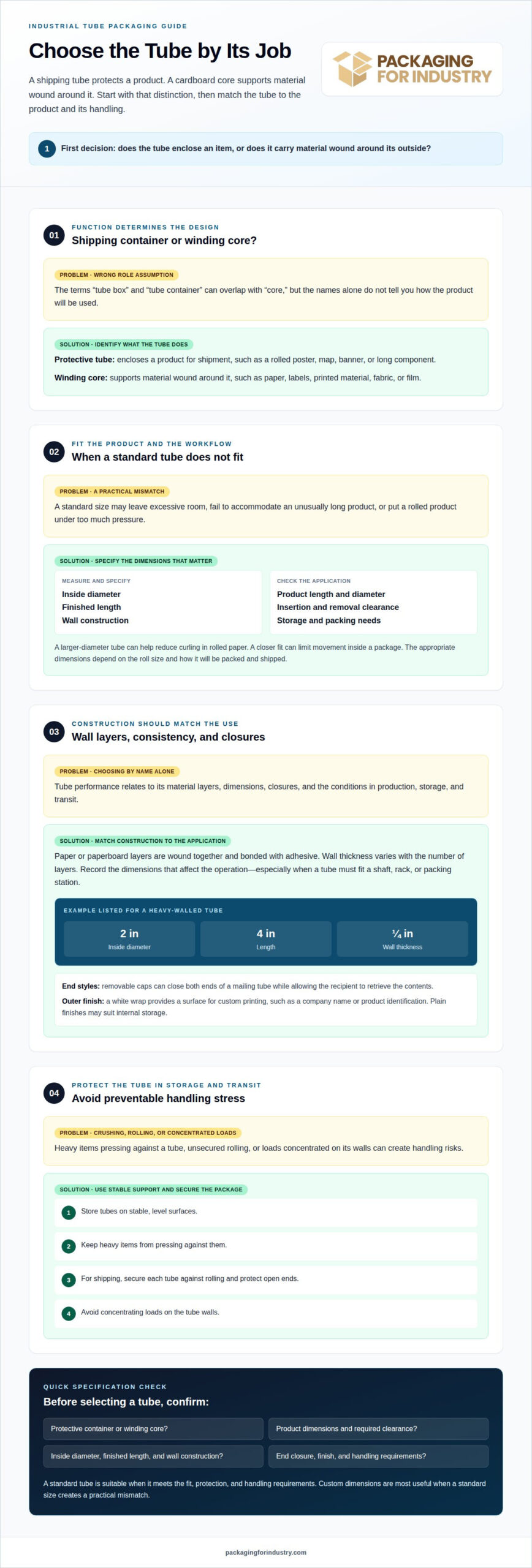
The terms often overlap, but the tube’s job makes the difference clear. A mailing tube encloses a product for shipment, while a cardboard core holds material wound around it. For example, a tube can protect a rolled poster in transit, while a core supports film during storage and use. The name alone does not identify its intended role.
To help prevent crushing, store tubes on stable, level surfaces and keep heavy items from pressing against them. For shipping, secure each tube against rolling, protect open ends, and avoid concentrating loads on its walls.
In printing, a core supports rolls of paper, labels, and printed material. Textile operations use cores to wind and store fabric. Film producers and converters use paper cores for wound film, where consistent dimensions support handling and storage. These are working components, not simply containers for shipping finished goods.
Mailing and shipping tubes serve a different purpose. They hold long, slender items or rolled products such as maps, banners, and posters. A larger-diameter tube can help reduce curling in rolled paper. Retail businesses can use tubes to ship posters or display graphics, protecting them between packing and delivery.
Corrugated tubes can protect long products, support shipping loads, and separate items during storage or transit. Heavy-duty cardboard tubes can package industrial products such as pumps or auto parts for individual delivery or palletized truckload shipment. Product length, weight, and handling route determine whether a tube acts as a protective container or supports a load.
For warehouse storage, distinguish a shipping tube from a winding core before selecting packaging. A shipping tube surrounds an item, while a core carries material wound around its exterior. Large inside-diameter cores can support materials transported on the tube’s outside. Paper cores are used predominantly in flooring, textile, and film industries.
In short, “tube box” and “tube container” commonly describe protective packaging, while “core” describes a winding or storage component. Reinforced paper tubes suit shipping items such as pumps and auto parts, while core strength and dimensional consistency matter for wound materials. Match the tube’s role to the product and its route through shipping or storage.
When Should I Choose Custom Paper Tube Packaging Instead of a Standard Tube?
Choose a made-to-order cardboard tube when a standard size cannot provide the required fit, protection, or presentation. Customization is most useful when the product’s dimensions or packaging requirements create a practical mismatch.
Custom Sizes and Specifications
Start with the product’s length and diameter, then allow clearance for insertion and removal. A wide-format print, for example, may need a larger-diameter tube to hold the roll without pressing its edges inward. Made-to-order dimensions can also suit unusually long products that do not fit standard mailing tubes.
Specify the tube’s inside diameter, finished length, wall construction, and intended use. A tube for storing rolled material has different requirements from one protecting a long component during shipment. These details help align tube dimensions with the product, packing process, and available storage space.
End Styles and Outer Finishes
End closures affect access and containment. For a mailing tube, removable caps can close both ends while allowing the recipient to retrieve a poster or document. For other packaging uses, consider how the ends will be closed, opened, and handled during packing and transit.
A white outer wrap provides a clean surface for custom printing, such as a company name or product identification. Choose the finish based on how the tube will be presented and handled. A printed tube can help distinguish product types in a warehouse, while a plain finish may suit internal storage.
Custom sizing is useful when a standard tube leaves excessive room around a product or cannot accommodate its shape. For a rolled banner, compare the roll’s width and diameter with the tube’s usable interior. For a long part, consider whether its ends need protection and whether the package must be easy to open.
Large diameters can matter for rolled paper and other broad materials. A wider tube can reduce tight curling, while a closer fit can limit movement inside the package. The appropriate dimensions depend on the material’s roll size and how it will be packed and shipped.
Custom cardboard tube packaging can coordinate dimensions, closures, and printed surfaces in one specification. Keep the design focused on its purpose: protect the product, fit the packing workflow, and make identification clear. If a standard tube meets those needs, customization may add complexity without solving a practical problem.
Tube Materials, Wall Construction, and Dimensional Consistency
Material layers, dimensions, and closures affect a tube’s performance in storage, production, and transit. Match these details to the product and handling conditions rather than choosing construction by name alone.
Materials and Wall Construction
Paper tubes are made by winding paper or paperboard layers together and bonding them with adhesive. Manufacturers can wrap cardboard ribbons around a mandrel to produce required dimensions. Wall thickness varies with the number of layers. One listed heavy-walled example has a 2-inch inside diameter, a 4-inch length, and a 1/4-inch wall.
Dimensional consistency matters when a tube must fit a shaft, rack, or packing station. Record the inside diameter, length, and wall thickness that affect the operation. Repeatable dimensions help keep rolls aligned on winding equipment and allow warehouse teams to use consistent handling setups across incoming batches.
Load Capacity and Material Comparisons
Capacity depends on diameter, wall construction, length, and how the tube is supported. A tube carrying material on its exterior faces different forces from one protecting an item inside. Reinforced paper tubes can provide impact resistance and stacking strength, but the load arrangement determines the appropriate construction.
Cardboard, plastic, and metal suit different operating demands. Compare reuse, exposure, handling, and load direction instead of selecting by material alone. A plastic sleeve that returns to a workstation may suit repeated use, while a metal tube may suit a rigid industrial application. A one-way shipping package has different requirements.
Paperboard tubes can be recyclable, depending on coatings, adhesives, closures, and local recycling options. Standard paperboard may lose strength when wet, so it is not dependable for prolonged outdoor exposure. For exterior storage, consider moisture protection alongside wall construction and the storage environment.
Closures affect product retention and handling. Plastic end caps cover openings, while anti-roll plugs can help prevent a cylindrical package from moving on a flat surface. Match the closure to the tube diameter and how the package must open. For fulfillment, group matching sizes and closures to simplify packing and storage.
Before shipment, secure tubes against rolling and avoid concentrating package weight on unsupported walls. During fulfillment, consistent specifications help teams select the correct tube and closure for each order. The best construction is the one suited to the actual product, load, and handling method.
Industrial Cardboard Tubes and Winding Cores
In manufacturing, a core is a structural component in the winding process, not merely a shipping sleeve. A converting line can wind paper, film, or labels around a paper core for storage and subsequent processing. The tube’s inside diameter must fit the equipment’s shaft, while its length must support the full roll width without interfering with handling.
Dimensional repeatability matters across production runs. If a core’s inside diameter varies, it may fit loosely or bind on a winding shaft. If its length varies, a roll can overhang the core or sit unevenly. Buyers should define key dimensions and tolerances for the specific line, material width, and winding method.
Core performance also depends on the material being wound and how operators handle the roll. A roll of stretch film, for example, places different demands on its core than a roll of textile fabric. Consider the roll’s weight, storage orientation, and movement between winding, staging, and converting operations when specifying construction.
Large inside-diameter cores serve another purpose: some materials travel on the tube’s exterior. In that arrangement, the core supports the wound product from within while the material remains accessible around the outside. Define where the product rests and how it will be lifted, stored, or processed. Those details influence the required dimensions and construction.
Industrial storage introduces practical fit requirements beyond the production line. A paper roll staged on a rack needs a core that works with the support points and handling equipment. A textile roll moving between departments needs repeatable dimensions for consistent storage. Matching core specifications to racks, shafts, and handling procedures helps avoid interruptions.
For a new application, document the material, roll width, core length, inside diameter, and process steps. Then assess how operators load, move, and store each roll. This sequence helps distinguish a winding core from protective tube packaging and focuses purchasing on production-critical dimensions. It also gives procurement a repeatable specification for comparing future orders.
Heavy-duty cardboard tubes provide impact resistance and stacking strength for products exposed to rough handling or that are valuable or delicate. When specifying a tube for these products, consider those qualities alongside the application’s dimensions and handling needs, so the construction suits both the product and its use.
How Do Cardboard Tubes Compare with Plastic or Metal Tubes for Strength and Cost?
Cardboard, plastic, and metal tubes suit different loads and operating conditions. A rolled poster needs different protection from a steel shaft or reusable production sleeve. Compare the materials by load direction, exposure, reuse, weight, and purchasing cost. The strongest option on paper may add unnecessary expense if the application needs only protective shipping packaging.
Cardboard tube strength depends on wall construction, diameter, length, and how loads reach the tube. A listed extra-heavy-duty Kraft mailing tube measures 6 inches by 73 inches and has a 0.250-inch wall. That example shows why a buyer should specify dimensions and wall thickness together, then match construction to the product and handling route.
Plastic tubes can suit applications that need moisture resistance or repeated use. For example, a reusable sleeve moving between workstations may benefit from plastic construction. Compare its purchase cost with expected reuse, cleaning needs, storage space, and handling. Plastic’s performance still depends on its design, so the material alone does not establish suitability for every load.
Metal tubes can provide rigidity for demanding industrial applications, such as supporting equipment components. Their weight and handling requirements affect how they fit into shipping and production workflows. Compare the full packaging cost, including protection, transport, storage, and reuse. A rigid metal tube may make sense for a durable component, but not for a one-way poster shipment.
For a paper roll or banner, cardboard may provide practical protection without adding a permanent, reusable structure. For a component repeatedly moved through a production cell, plastic or metal may better suit the cycle. Compare the tube’s function, service life, required strength, and replacement frequency before selecting a material.
Assess costs by comparing equivalent applications, not material names alone. Include tube dimensions, wall construction, closures, packing labor, storage footprint, and damage exposure. A 6-inch-diameter tube, for example, uses more material than a narrower design, while a reusable tube may serve repeated movements. Select the construction that meets the load requirement without adding unnecessary material or handling steps.
Packaging For Industry (PFI)
Packaging For Industry (PFI) helps manufacturers connect packaging decisions with the broader needs of shipping, production, and inventory operations. After defining a tube’s role, dimensions, and handling requirements, buyers can also assess how surrounding protection and material replenishment affect the complete packaging workflow.
For a delicate component shipped inside a tube, foam packaging can provide additional cushioning around the product. The right configuration depends on the item’s shape, contact points, and how it moves during packing and transit. This can help address damage risks that tube construction alone may not resolve.
Stretch film helps unitize packaged goods for storage or shipment. For example, a warehouse may use it to secure packed products on a pallet. Film selection and application should suit the load and packing process. Used alongside a properly designed package, stretch film can help keep shipments organized during handling.
Packaging supply interruptions can also disrupt manufacturing and fulfillment schedules. PFI’s Vendor Managed Inventory (VMI) for Packaging supports inventory planning and replenishment for packaging materials. It can help businesses improve visibility into routine material usage and coordinate supply with operational demand.
Just-In-Time (JIT) Inventory Management for Packaging provides another way to align packaging replenishment with production needs. It can suit operations where storage space, usage patterns, and delivery timing affect purchasing decisions. VMI and JIT address supply planning rather than tube engineering, so they complement a tube specification instead of replacing it.
PFI helps connect packaging requirements to practical decisions across the operation. A manufacturer shipping long components may need to consider product cushioning, pallet stability, and material availability together. A warehouse handling varied shipments may prioritize consistent packaging workflows and dependable replenishment. The right combination depends on the product and process.
Consider PFI when protective foam, stretch film, or packaging inventory management can improve the surrounding workflow. Start with the products being packed, how they move, and where material supply creates operational friction. These details help focus packaging decisions on damage prevention, efficient handling, and supply reliability.
Request a packaging or tube quote from Packaging For Industry for custom packaging solutions, local delivery across Southern California, or nationwide shipping.
Frequently Asked Questions
What Are Big Cardboard Tubes Used For?
Large cardboard tubes package long products that are awkward to fit into rectangular cartons. Floor lamps, desk lamps, golf clubs, rolled architectural plans, and wide-format graphics are examples. Their cylindrical shape can simplify packing products with a long profile. For purchasing, compare the item’s length and widest point with the tube’s usable interior, then consider how the package will be handled and stored.
What makes one paper tube supplier better than another for long-term sourcing?
A dependable supplier supports consistent specifications and repeat orders. Evaluate minimum order requirements, tooling flexibility, and production lead-time reliability. These factors matter when a plant needs a particular tube configuration for recurring production runs. Also consider whether the supplier can maintain dimensional consistency between orders, since variation can create fit problems on winding equipment or at packing stations.
What should I ask cardboard tube suppliers before requesting pricing?
Provide the intended use, product dimensions, required inside diameter, tube length, wall thickness, closure style, and order quantity. Clarify whether the tube protects a product or supports material during winding. Include delivery frequency and receiving requirements, such as whether tubes arrive individually packed or grouped for warehouse handling. These details help suppliers price the same specification, making comparisons more useful.
What’s the maximum weight a big cardboard tube can hold?
There is no single maximum weight that applies to every large tube. Capacity depends on its diameter, length, wall construction, support points, and whether the load presses along the tube or across its wall. A tube carrying a component horizontally faces different forces from one holding material wound around it. Define the load arrangement and handling conditions before selecting a construction.
What are heavy-duty cardboard tubes used for?
Heavy-duty cardboard tubes protect long, substantial products when ordinary mailing tubes may not meet handling demands. Industrial components, shafts, and equipment parts are possible applications. Tubes can also support shipment preparation where products are grouped for freight handling. Choose a tube based on the product’s contact points, movement during transit, and how the package will be supported in storage.
What sizes and wall thicknesses are available for heavy-duty cardboard tubes?
Sizes and wall thicknesses vary by manufacturer and intended application. Common specification fields include inside diameter, length, and wall thickness; a custom tube can be designed around a particular product or process. For repeat purchasing, record approved dimensions as a controlled specification. This gives receiving and production teams a clear reference for checking incoming tubes or matching them to equipment.
How much weight can heavy-duty cardboard tubes support?
Weight capacity is application-specific, not a universal rating for all tubes. A core supporting a roll, a sleeve carrying a part, and a tube bearing stacked freight experience different loads. Specify the product weight, support locations, storage orientation, and handling method. Those conditions determine the appropriate construction. Avoid using a tube beyond its intended role or treating a shipping load as a core rating.
How are heavy-duty cardboard tubes made and what materials are used?
Manufacturers form paper tubes by winding paper or paperboard layers and bonding them with adhesive. The selected material and number of layers influence the finished wall construction. For an industrial order, specifications should identify the intended use and critical dimensions. This helps distinguish a tube designed for a winding operation from packaging intended to protect a product during shipment.