
The right protective bubble wrap depends on the item, packing process, and shipment, not simply the roll size. It uses air-filled pockets between polyethylene film layers to cushion products from impact. For manufacturers, warehouses, and distribution teams in Orange County, Los Angeles, and San Diego, choosing the right format can support consistent packing and limit excess material.
This guide explains how bubble packaging works, what its polyethylene construction does, and how rolls, pre-made bags, sheets, and mailers differ. It compares small bubbles, typically 3/16 inches in diameter, with big bubbles, typically 1/2 inch or larger. You’ll also learn when Protective bubble wrap may need an anti-static specification for electronics, and what to consider when evaluating storage, handling, and shipping protection. Use these distinctions to choose a format that fits your operation.
Key Takeaways
- Match rolls, bags, sheets, or mailers to your packing workflow and the shape of the products you ship.
- Choose bubble size based on the item’s weight and cushioning needs, and specify anti-static film for sensitive electronics.
- Compare packaging options by format, dimensions, order quantity, and how they fit your packing process, not just by unit price.
- Pair cushioning with foam packaging or stretch film where the shipment needs a broader protection and stabilization plan.
- Packaging support, including vendor managed inventory and just-in-time inventory management, can help improve supply reliability for Southern California operations.
What Is Bubble Packaging?
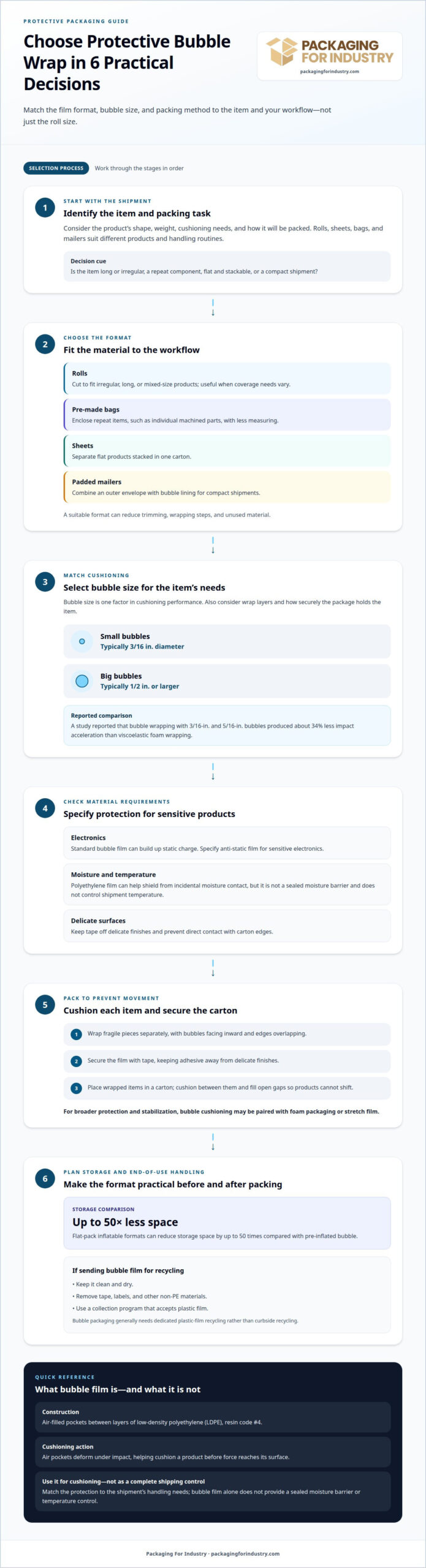
Bubble packaging uses air-filled pockets between layers of polyethylene film to cushion goods from handling impacts. Rolls, sheets, bags, and mailers adapt the material to different packing tasks.
Bubble Packaging Formats
Bubble packaging formats are ready-to-use shapes made from air-pocket film, and the format affects packing speed and fit. Rolls let packers cut material around long components, such as metal shafts. Sheets separate stacked parts, while bags enclose small components with less measuring. A padded mailer combines an outer envelope with bubble lining for compact shipments. Choose a shape that covers the item without leaving loose film to manage.
Wrapping Fragile Items
Wrapping fragile items means cushioning each piece and limiting movement inside its shipping carton. Wrap glass components separately, with bubbles facing inward and edges overlapping. Secure the film with tape, keeping adhesive off delicate finishes. Place wrapped items in a carton with cushioning between them, and fill open gaps so products cannot shift in transit. This helps prevent contact between fragile surfaces during handling.
Shipping and safety requirements depend on the carrier, destination, and shipment contents. Use bubble film as cushioning, then follow applicable carrier and contents requirements for packing and labeling.
Bubble packaging generally needs dedicated plastic-film recycling rather than curbside recycling. Keep film clean and dry, removing tape, labels, and other non-PE materials. Use a collection program that accepts plastic film.
Storage planning can be considered alongside the packing task, rather than after a format has been chosen. Flat-pack inflatable formats can reduce storage space by up to 50 times compared with pre-inflated bubble. When selecting between these options, compare how much room can be set aside for protective material with how the material will be used at packing time. The choice should fit the available packing area and the items being prepared, while preserving the ability to use a shape suited to the task. Treat storage and use as linked considerations, so the selected format is practical both before packing and while cushioning goods. If requirements vary among items, assess the format for each task instead of assuming one shape is suitable for every shipment.
End-of-use handling can also inform format selection. Bubble packaging intended for film recycling generally needs to be clean, dry, and free of tape, labels, or other non-PE materials. Keep that condition in mind while packing: tape and labels added during use may need to be removed before film enters a collection program, and damp film does not meet the stated preparation condition. Set aside only material that can be prepared accordingly, and use a collection program that accepts plastic film. This connects the packing decision to the film’s eventual handling, rather than treating recycling as an afterthought. When several pieces of film are used, check each piece before placing it with recyclable film instead of assuming all protective packaging is ready to collect together.
Bubble packaging materials and cushioning
Bubble film is made from low-density polyethylene, identified by resin code #4. Its air pockets deform under impact, helping cushion a product before force reaches its surface. Cushioning performance depends on bubble size, wrap layers, and how tightly the package holds the item. For a machined component, the film should protect exposed edges without allowing the part to shift inside its carton.
Bubble wrap, foam wrap, packing paper, and air pillows serve different roles. Bubble film conforms around individual products, while foam can provide a closer-fitting cushion. Packing paper is useful for wrapping surfaces or filling gaps; air pillows fill larger voids around boxed goods. A study reported by Elsevier found bubble wrapping with 3/16-inch (5 mm) and 5/16-inch (8 mm) bubbles produced about 34% less impact acceleration than viscoelastic foam wrapping.
Moisture, static, and temperature need separate consideration. Polyethylene film can help shield a product from incidental contact with moisture, but bubble film does not create a sealed moisture barrier. Standard bubble film can build up static charge, which may damage sensitive electronics, so specify anti-static film for those applications. Bubble cushioning also does not control shipment temperature.
For a specific transport application, the CDC advises placing bubble wrap between diluents and coolant materials as an insulating barrier. That use does not make bubble film a substitute for temperature-controlled packaging. For electronics, address static protection first; for delicate surfaces, prevent direct contact with tape and carton edges. Match cushioning to the shipment’s actual exposure and handling needs.
Bubble packaging’s early concept was not a shipping cushion. In 1957, engineers Alfred Fielding and Marc Chavannes created a sheet of air bubbles while attempting to make textured wallpaper in Hawthorne, New Jersey.
Rolls compared with pre-made bags and sheets
Choose the format that fits the item’s shape, packing volume, and handling routine. A roll suits irregular products or mixed-size orders because packers can cut it to fit. Pre-made bags work well for repeat items, such as individual machined parts. Sheets help separate flat products stacked in one carton. The right format can reduce trimming, wrapping steps, and unused material.
Rolls are flexible for long or unusually shaped products, such as narrow metal components or curved assemblies. Packers can cut each piece to the coverage needed, avoiding the need to store multiple pre-cut sizes. Bubble packaging rolls are typically more economical per square foot than pre-made bags or sheets. That can matter for operations wrapping varied items throughout a shift.
Pre-made bags offer a consistent enclosure for repeat products. A warehouse packing the same small component into separate cartons can place each unit in a bag without cutting and taping a custom wrap. Sheets provide a flat layer between stacked parts, such as finished panels, and can be lifted into place quickly. Neither format requires measuring a new piece for every item.
To choose bubble wrap for packing or shipping, consider whether the product repeats, varies in shape, or needs separation inside a carton. A standard-size component packed continuously may suit bags; varying dimensions favor rolls. Use sheets for layer separation, then assess whether the wrapped item can move inside its carton. Match the format to the packing station’s workflow as well as the product’s protection needs.
For a mixed production line, keep rolls available for unusual parts and use bags or sheets for repeat packing tasks. Giving each format a clear purpose avoids forcing one option across every product.
Small and big bubble sizes
Bubble diameter affects how cushioning fits a product and responds to pressure. Compare the item’s dimensions and weight before selecting a size.
Small Bubble Sizes
Small-bubble polyethylene packaging is typically 3/16 inches in diameter and suits lightweight, small items. For example, a compact electronic component or small finished part can be wrapped with a close-fitting layer. The smaller pockets help conform around products with narrow edges and detailed surfaces. This size is useful when larger bubbles would leave excessive space around a small item, making it harder to pack neatly inside its carton.
Big Bubble Sizes
Big-bubble polyethylene packaging is typically 1/2 inch or larger in diameter, making it a better fit for larger products and broader surfaces. For example, a substantial component may need larger air pockets to create cushioning around its edges. Big bubbles are more resistant to popping under sustained weight than small bubbles. That distinction matters when packed products press against cushioning during storage or shipment.
Size selection should reflect the item’s scale, weight, and contact points. A lightweight small part may fit a 3/16-inch bubble layer, while a larger product may call for bubbles measuring 1/2 inch or more. Consider whether the wrapped item will bear pressure from other packed goods. The goal is a close, stable fit, rather than choosing the largest bubble size for every shipment.
How much does bubble wrap cost in the United States?
Bubble wrap has no single U.S. price that fits every purchase. Total cost depends on format, roll dimensions, bubble size, material type, order quantity, and delivery needs. A warehouse buying rolls for mixed products has different requirements from a shipping line using pre-made bags for one repeat part. Compare the cost against the material used per packed item, not just the package price.
Rolls are typically more economical per square foot than pre-made bags or sheets. They let packers cut material to fit different products, although trimming can create offcuts. Pre-made bags may simplify repeat packing because each part uses a ready-sized enclosure. Sheets can suit layer separation, such as protecting flat panels. Compare format and workflow, not price alone.
Bubble size affects the specification and intended cushioning. Small bubbles are typically 3/16 inches in diameter, while big bubbles are typically 1/2 inch or larger. A buyer comparing those options should consider product dimensions, weight, and pressure during handling. Anti-static film for electronics is another material requirement that changes the product specification. Each choice can affect the final quote.
Pricing depends on the application and is provided after a quote request; key factors include format, dimensions, bubble size, material type, quantity, and delivery requirements. A recurring order of bags for one component differs from a mixed-size roll order. Share the packing application and expected quantities to compare options consistently. Assess material use, packing time, and fit alongside the quote when evaluating total packaging cost.
Packaging Products
Bubble cushioning can be one part of a shipping system, rather than the only material protecting a product. Foam packaging provides another cushioning option for items that need a shaped fit or support around specific surfaces. For a fragile assembly, foam can hold the product in position while cushioning protects less delicate areas. Matching materials to the product can help reduce damage without adding unnecessary layers.
Foam packaging is useful when a product needs cushioning tailored to its shape or contact points. A component with exposed corners, for example, may need support that keeps those areas from striking the carton. The material and design should suit the item’s size, handling, and shipping environment. This approach complements bubble film when a loose wrap alone doesn’t provide enough positioning or support.
Stretch film serves a different purpose: it secures grouped goods, especially cartons or products arranged on a pallet. It helps keep a load together during storage and movement, while cushioning materials protect individual items from impact. Separating these functions helps teams choose material for each risk instead of expecting one product to do every job.
Packaging supply programs can support operations beyond material selection. Vendor managed inventory (VMI) helps coordinate packaging supply with usage, while just-in-time (JIT) inventory management aligns availability with operating needs. These approaches can be useful when manufacturers or distribution centers need reliable packaging access without disrupting workflow. The right combination of cushioning, load stabilization, and inventory management depends on products, packing processes, and supply patterns.
Industries Served
Packaging needs differ across manufacturing, warehousing, distribution, aerospace, food, medical, electronics, and construction businesses. Product shape, handling steps, storage conditions, and shipping routes all influence material selection. A packaging plan should protect goods while fitting the pace and practical demands of the operation.
Manufacturers may pack components at production lines, where consistent materials help keep work moving. Warehouses need packaging supplies organized for routine picking and packing, while distribution centers handle products moving through multiple transfer points. Cushioning can protect individual items; stretch film can secure palletized loads. Matching material to each task helps reduce shipping damage and unnecessary packing steps.
Aerospace shipments may include components with unusual shapes or sensitive contact points, making fit and cushioning important. Aerospace packaging needs can call for tailored protection around a specific part. Food companies need packaging suited to their products and shipping process. Medical businesses may ship delicate equipment or components, while electronics operations must account for static-sensitive items. Construction suppliers often move bulky or heavy products that need stable containment and edge protection.
For each industry, the right packaging mix depends on what the business ships and how its teams pack it. A manufacturer shipping a small component has different needs from a construction supplier moving long materials. Reviewing product dimensions, handling points, and packing workflow helps identify suitable cushioning and load-stabilizing materials. This industry-focused approach supports reliable supply planning across production floors, warehouses, and distribution operations.
Benefits of Working with a Packaging Supplier
An industrial packaging supplier can help align material specifications with purchasing and shipping needs. A manufacturer shipping recurring orders, for example, can review how packaging dimensions, order quantities, and packing routines affect material use. Clear specifications help purchasing and operations teams evaluate the same requirements and maintain consistent supplies across production and warehouse workflows.
To lower packaging costs, compare pricing against the amount and type of material each shipment requires. Bulk pricing may be relevant for steady-use items, while mixed product lines may need different formats and quantities. A packaging review can identify where the current specification fits the application and where a different size or material could reduce unnecessary use. Describe the products and packing needs clearly when requesting a quote.
Damage prevention depends on packaging choices suited to the shipment. Teams can review product contact points, carton fit, and packing steps to identify where protection needs adjustment. This helps address the actual source of movement or contact, rather than adding material without a defined purpose.
Supply reliability also matters when packaging is needed to keep orders moving. Purchasing teams can consider replenishment planning, order patterns, and local packaging delivery needs alongside product specifications. Clear coordination around recurring materials helps operations plan for routine packing demand and gives warehouse teams a more consistent supply process. The resulting packaging plan can support smoother purchasing and more predictable shipping workflows.
Packaging For Industry (PFI)
Packaging For Industry (PFI) helps businesses in Orange County, Los Angeles, and San Diego assess how packaging materials and supply processes fit their shipping needs. If current cushioning does not suit a product’s shape, PFI’s foam packaging offers another option. Stretch film serves a different need by helping secure shipments during handling and storage. Reviewing materials by their role helps teams build an approach around actual products and workflows.
For manufacturers shipping recurring orders, packaging choices affect both packing procedures and replenishment planning. PFI offers foam packaging and stretch film, along with vendor managed inventory (VMI) and just-in-time (JIT) inventory management for packaging. VMI and JIT can help align packaging availability with ongoing operations. Teams can assess which materials and inventory approach best address their supply challenges.
The next step depends on the issue your operation needs to resolve. Consider foam packaging when a product needs cushioning tailored to its form, or stretch film when shipments need load stabilization. If recurring packaging supplies are difficult to coordinate, PFI’s VMI or JIT inventory management can help address that planning need. Match the solution to the application to keep the discussion focused on practical operating requirements.
Share the products you ship and the packaging or supply challenge you want to address. Request a packaging quote from Packaging For Industry (PFI) to discuss the appropriate next step.
Frequently Asked Questions
What is protective bubble wrap and how does it work?
Protective bubble wrap is a flexible cushioning material used to help shield shipped products from handling impacts. It works best when the packaging plan accounts for the product’s surface, carton fit, and packing sequence. For a finished instrument, define how packers apply and secure the material, then keep the method consistent across orders. This makes the packaging specification easier to follow on a busy production or warehouse line.
What are the different types and sizes of bubble wrap?
Types vary by format, bubble profile, and specialized film treatment. To select a specification for recurring shipments, consider the product range and packing station workflow. A business shipping several part sizes may need a flexible approach, while a standardized product line can benefit from a consistent specification. Documenting the selected material and application helps purchasing and operations teams maintain repeatable packaging across shifts and replenishment cycles.
What are alternatives to bubble wrap for protective packaging?
Corrugated partitions, pads, and dividers can serve as alternatives when products need separation inside a carton. A carton holding several components, for example, can use dividers to keep pieces in assigned spaces during handling. This approach suits repeat shipments with a stable product layout. The choice depends on whether the main concern is protecting a surface, separating multiple items, or arranging components consistently for packing and unpacking.