
The right protection depends on a shipment’s shape, weight, and handling needs, not just its outer box. Custom tubes and corner protection for Los Angeles, Orange County, and San Diego businesses can be tailored for long products, carton edges, palletized loads, furniture, and appliances.
It’s reasonable to expect packaging to fit the product and work with your shipping process. This guide explains tube materials and thickness options, custom dimensions, delivery coverage, and how corner protection can support different loads. Paperboard corner guards are made from recycled paper fibers and are recyclable. You’ll also learn what details shape a practical packaging specification, so you can pursue a fit that helps reduce shipping damage without adding unnecessary material or handling steps.
Key Takeaways
- Match tube material, thickness, and custom dimensions to the product’s shape and shipping requirements.
- Use corner protection to help reduce damage to boxes, palletized loads, furniture, and appliances in transit.
- Plan packaging supply around Southern California delivery coverage, including Los Angeles, Orange County, and San Diego.
- Bring product and shipping requirements into a custom packaging design discussion to identify a practical protection approach.
- Consider related packaging options, including foam, stretch film, and inventory management services, to support supply reliability.
Custom Tube and Corner Protection Products
Custom tubes and corner protection for Los Angeles, Orange County, and San Diego shipments should match the product’s shape, handling, and storage conditions. Paper tubes and cardboard tubes suit long, narrow items, while corner guards reinforce exposed edges on cartons and palletized loads. Material, wall thickness, length, and leg width determine how the packaging fits and performs.
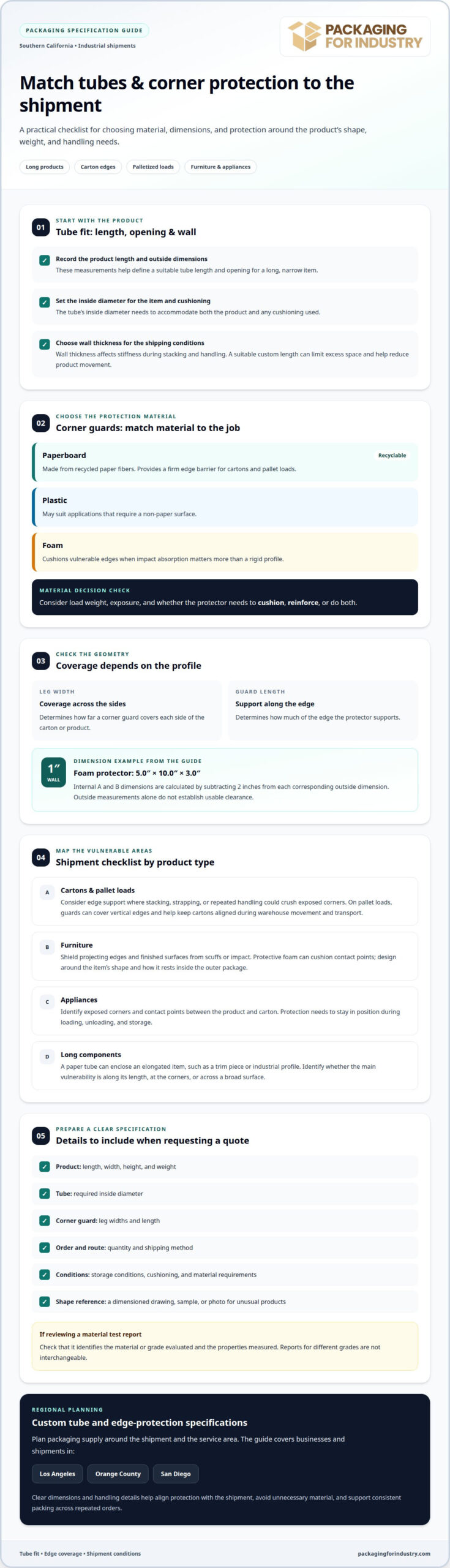
Start tube specifications with the product’s length and outside dimensions. The tube’s inside diameter must accommodate the item and any cushioning, while wall thickness affects stiffness during stacking and handling. A suitable custom length can limit excess space around long components, and a close fit helps reduce movement that may damage the product.
Corner protectors may be made from paperboard, plastic, or foam. Recyclable paperboard guards provide a firm edge barrier for cartons and pallet loads. Plastic may suit applications that require a non-paper surface, while foam cushions vulnerable edges where impact absorption matters more than a rigid profile. Choose based on load weight, exposure, and whether the protector needs to cushion, reinforce, or do both.
Thickness and geometry matter as much as material. Leg width determines how far a corner guard covers each side of a carton or product, while length determines how much of the edge it supports. A foam protector example measures 5.0 inches by 10.0 inches by 3.0 inches and has a 1-inch wall. Its internal A and B dimensions are calculated by subtracting 2 inches from each corresponding outside dimension. This illustrates why outside measurements alone cannot establish usable clearance.
Durability, dimensions, and material documentation
Durability depends on the material, protector profile, load, and shipping conditions. A thicker wall may add structure, but a larger profile can affect the fit inside a carton or around a product. When reviewing a material test report, check that it identifies the material or grade evaluated and the properties measured. Reports for different grades are not interchangeable.
For a quote, provide the product’s length, width, height, and weight, along with the required tube inside diameter or corner-guard leg widths and length. Include the order quantity, shipping method, storage conditions, and any cushioning or material requirements. A dimensioned drawing, sample, or photo can clarify unusual shapes and help define a practical specification.
Across Los Angeles, Orange County, and San Diego, custom tube and edge-protection specifications can be tailored to different industrial loads. The corner and edge protection options include solutions for protecting carton corners and palletized goods. Clear dimensions and handling details help align the product design with the shipment, reduce unnecessary material, and support consistent packing across repeated orders.
Industries and Products Protected
Packaging requirements vary with the product, shipment configuration, and handling route. For tubes and corner protectors, base the specification on the shipper’s and receiver’s requirements, carrier handling, and the load being protected.
Protection for Different Shipments
Corrugated boxes need edge support when stacking, strapping, or repeated handling could crush exposed corners. Corner guards reinforce carton edges and help distribute strap pressure. On pallet loads, guards can cover vertical edges and help keep cartons aligned during warehouse movement and transport.
Furniture presents a different challenge: finished surfaces and projecting edges can be vulnerable to scuffs and impact. A corner protector can shield a table edge or cabinet corner, while protective foam cushions contact points. Design the package around the item’s shape and how it rests inside the outer packaging.
Appliances combine broad panels with edges and corners that may be exposed to contact during handling. For example, a refrigerator or washer shipment may need protection at vulnerable corners and where the product meets the carton. Protective material must stay in position during loading, unloading, and storage.
Long components need a different approach. A paper tube can enclose an elongated item, such as a trim piece or industrial profile, while corner protection addresses exposed edges on the outer carton or pallet. Identify where the shipment is most vulnerable: along its length, at the corners, or across a broad surface.
Available Custom Products
Custom tube and corner-protection options for Los Angeles, Orange County, and San Diego shipments can suit different product profiles and load configurations. The tube’s length and opening should fit the item, while corner guards can protect cartons, pallet loads, furniture, or appliances. Product dimensions and handling points guide the specification.
For boxed shipments, pair a corrugated carton with corner guards where edges face stacking or strapping pressure. For a pallet, protection can extend along exposed carton edges to support a stable load. The right arrangement depends on the pallet pattern, contact points, and movement through the warehouse.
For furniture and appliances, design the protective layout around vulnerable surfaces. A cabinet with projecting corners needs a different arrangement from a flat appliance panel. Cushioning at likely contact points can complement edge protection, while the outer package helps keep components in position during transport.
Industrial manufacturers and distributors should also consider repeatability. When the same component ships regularly, consistent tube lengths or corner coverage can make packing easier to standardize across orders. A specification matched to the product and shipping process can avoid excess packaging while protecting the areas most likely to be damaged.
There is no one-size-fits-all solution. A shipment’s weight, shape, packaging configuration, and handling route determine where reinforcement is needed. Match protection to those factors to safeguard boxed goods, palletized freight, furniture, appliances, and long industrial components in storage and transit.
Benefits of Southern California Delivery Coverage
Custom production timing depends on design, material, order quantity, and destination. Local next-day delivery is available in Southern California, including Orange County, Los Angeles County, and San Diego County. Custom orders also require production planning, so account separately for manufacturing and transportation time.
Printing and die-cut features depend on the packaging product and design. Printing may be used on an outer carton, while die-cutting shapes a component or opening. Material, dimensions, and intended use determine which features suit the specification.
Southern California coverage and delivery planning
Local packaging delivery can support replenishment for manufacturers, warehouses, and distribution centers in Los Angeles County and Orange County. A shipment to Carson, Torrance, or Santa Fe Springs has different routing needs from one headed to Anaheim, Irvine, or Costa Mesa. Destination, order size, and receiving arrangements all shape the delivery plan.
Orange County locations include Anaheim, Brea, Costa Mesa, Fountain Valley, Huntington Beach, and Irvine. Los Angeles County locations include Carson, San Pedro, Santa Fe Springs, and Torrance. For example, an operation receiving corner protection in Anaheim can plan inventory differently from a facility coordinating packaging delivery in Torrance. The Anaheim packaging service area is one local point in this regional footprint.
San Diego County is another destination for businesses shipping across Southern California. Companies with facilities in Los Angeles, Orange County, and San Diego can coordinate packaging specifications across sites. Consistent requirements and planned replenishment help keep protective packaging aligned, even when locations have different receiving schedules and storage constraints.
Production timing and regional replenishment
Timing for custom tubes and corner protection depends on design complexity, material, order volume, and destination. A repeat order and a newly engineered profile require different production planning. Local delivery affects transportation, but custom specifications still need production time.
Packaging tubes and corner protection serve a different purpose from metal tube swaging. Swaging forms or reduces metal tubing, while cardboard tubes and corner guards protect products in storage and transit. The materials and processes differ, so specify the protective packaging required rather than metal tube forming.
Regional delivery can help businesses coordinate stock replenishment with warehouse demand. It supports recurring packaging supply when receiving schedules and inventory needs are planned together. Custom production depends on design and order details, so account for both manufacturing and transportation when planning delivery.
Regional service considerations
For operations in Los Angeles County, Orange County, and San Diego County, the receiving location affects routing and replenishment coordination. A business shipping from Irvine to a distribution facility in San Diego, for example, may need packaging staged to match its production and dispatch schedule. Clear destination details help align supply with each site’s workflow.
Local coverage is most useful when delivery is coordinated with storage capacity, order frequency, and production schedules. A warehouse with limited floor space may prefer planned replenishment to storing excess corner protection. A distributor serving Los Angeles and Orange County may prioritize consistent product specifications across shipments. These details make local supply practical, beyond proximity alone.
Packaging For Industry (PFI): Custom Packaging Design Services
Packaging For Industry (PFI) provides custom packaging design for businesses that need packaging suited to a product, shipping process, or recurring operational issue. Consider a design service when standard packaging allows too much movement, misses vulnerable areas, or slows packing. The design connects product requirements with a practical specification for industrial shipping and handling.
Design starts with the operating need. PFI considers the product, its movement through the facility, and where damage or packing delays occur. Share useful details such as product dimensions, weight, orientation, shipping method, storage conditions, and receiving environment. Drawings, photos, or product samples can clarify unusual shapes and help account for contact points and packing workflow.
For a manufacturer shipping long components, the design can address how each item is contained and supported in transit. For a warehouse handling boxed goods, priorities may include consistent packing and protection for exposed edges. Furniture and appliance shipments have different needs. The design should reflect the actual product and handling conditions, avoiding material that does not address a defined risk.
Related products can complement a custom design when they address a specific operational need. Foam packaging cushions delicate surfaces or components, while stretch film secures palletized loads during movement and storage. Choose materials based on the package configuration and workflow. Integrating suitable materials can simplify packing and support damage reduction.
Purchasing teams can assess a custom packaging quote against product requirements, order volume, and repeat-use needs. Describe the current packaging, the problem to solve, and the expected purchasing pattern. For bulk pricing, specify quantities and repeat-order needs so purchasing and operations teams can compare options using consistent project details.
Supply planning remains important after the packaging specification is set. Vendor Managed Inventory (VMI) for Packaging can help businesses coordinate replenishment for materials they use repeatedly. This can suit operations where packaging availability affects production or dispatch. Linking inventory planning to the selected design helps teams manage supply alongside the packaging itself.
For businesses in Los Angeles, Orange County, and San Diego, the design discussion can account for each shipping site and its workflow. A manufacturer may focus on packaging-line efficiency, while a distribution center may prioritize storage and dispatch. Sharing these requirements gives the design process a clear basis for assessing fit, packing steps, and supply needs.
When recurring damage, inefficient packing, or a need for a tailored specification creates a packaging challenge, PFI can discuss the project requirements and quote scope. Request a packaging quote from Packaging For Industry (PFI) to discuss your design needs.
Frequently Asked Questions
Which local companies manufacture custom tubes and corner protectors in Southern California?
Packaging For Industry (PFI) serves commercial and industrial buyers in Los Angeles, Orange County, and San Diego with packaging products, including tubes and corner protection. Its custom packaging design services suit products or shipping processes that need a tailored approach. Describe the shipment type, whether the item is a recurring production need, and how the packaging fits into your operation.
What materials and sizes are available for custom shipping tubes and corner guards?
Custom options can be developed around the product’s shape and packaging configuration. If a product has multiple versions, identify whether each needs its own packaging or whether one design can accommodate the range. Consider storage and handling too, including whether the tube or guard must fit an existing carton, pallet pattern, or packing-line process.
How can suppliers assess and document the strength and sustainability of custom tube and corner protection products?
Assess performance in the actual packing and shipping workflow, then retain an approved packaging sample and its specification for repeat orders. A controlled shipment can show whether the packaging suits normal handling and arrival. For a sustainability review, document the packaging components and materials, then evaluate the disposal or recovery options available to your business. This keeps performance records and environmental claims specific to the selected design.
What shipping and packaging standards apply to tubes and corner protectors?
Specifications should reflect the shipper’s and receiver’s requirements, carrier handling, and the load being protected. Match tube dimensions and thickness, or corner-guard material and geometry, to the product and shipping conditions.