
A precision-cut insert does more than hold a part in place. Custom die-cut foam for electronics and aerospace gives fragile components a shaped space that helps limit shifting, rubbing, and impact during transit.
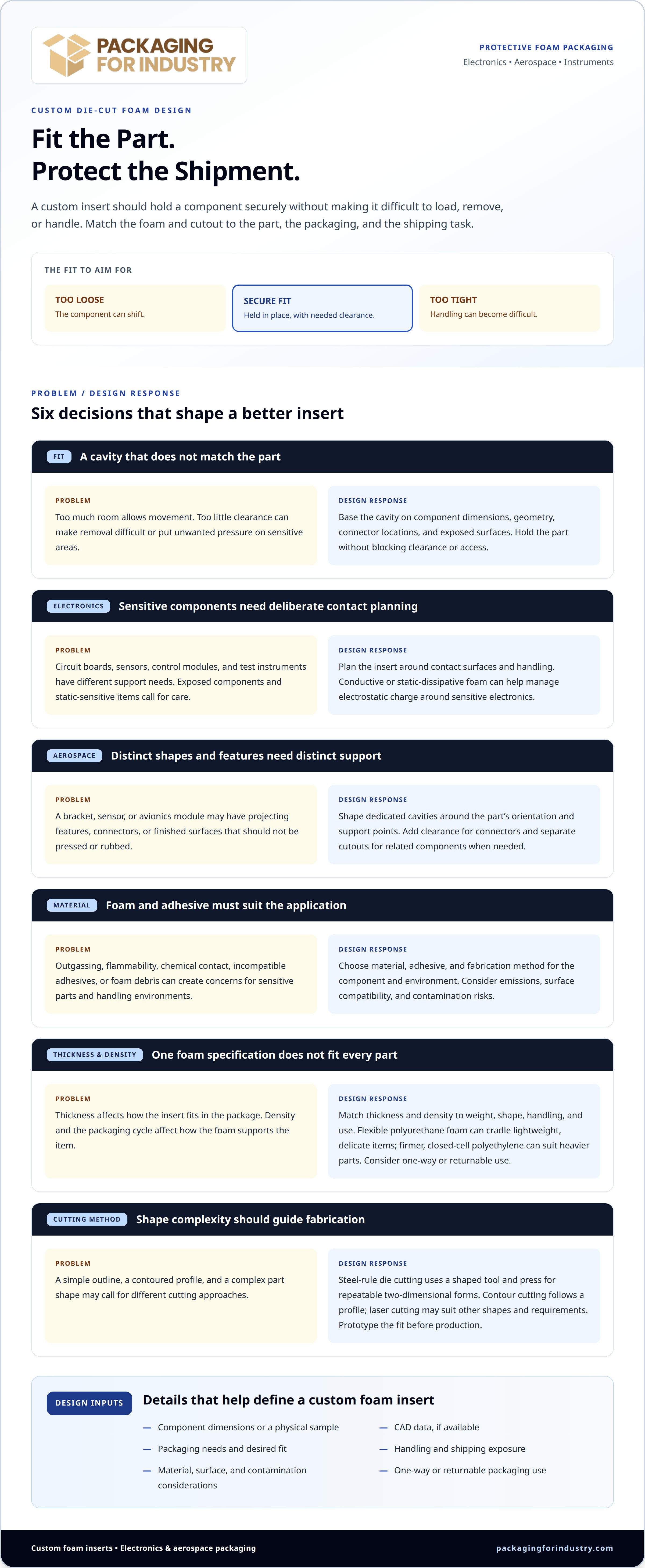
Foam die cutting uses shaped steel tools and a press to cut foam into custom sizes and two-dimensional shapes. The right design depends on the part and how it will be packaged, so thickness, density, shape, and adhesive backing all matter. A loose fit can let a component move; an overly tight fit can make handling difficult.
When sourcing custom foam inserts for electronics or aerospace parts, define the component dimensions, packaging needs, and desired fit before requesting a foam packaging quote. These details help a packaging supplier recommend custom foam packaging solutions suited to your parts and handling requirements. Share your requirements to compare options and pricing for protective foam packaging that helps reduce shipping damage.
Key Takeaways
- Foam thickness, density, and cutout shape should match the part’s geometry and handling needs to help keep it secure in transit.
- Aerospace and electronics components can have different protection requirements, making the packaging design specific to the part and shipping conditions.
- Material selection affects how foam cushions impact and vibration, limits surface abrasion, and performs in reusable packaging.
- Adhesive backing and other design details can help foam fit into a broader packaging setup, so consider the insert alongside the complete shipment.
- PFI’s foam packaging, custom packaging design, stretch film, and vendor managed inventory can support a more coordinated packaging supply.
Foam Packaging Products and Customization
Custom die-cut foam for electronics and aerospace applications is shaped to fit specific parts and packaging requirements. The design matches material, thickness, density, and cut geometry to how each component is handled and shipped.
Protective Packaging for Electronics and Instruments
A foam insert can hold a circuit board, sensor, test instrument, or delicate assembly in a defined position. Conductive and static-dissipative foams help manage electrostatic charge around sensitive electronics. The U.S. Environmental Protection Agency notes that electrostatic discharge can damage electronic components. Design the insert around the component’s contact surfaces, handling, and shipping exposure rather than relying on a generic cavity.
Aerospace and Defense Packaging
Aerospace and defense packaging may use shaped foam to separate components, cushion contact points, and limit movement inside a case or container. A bracket, instrument, or sensor can require a distinct cavity based on its geometry and surfaces. Custom die-cut foam for electronics and aerospace can be designed around these different part profiles and handling needs. Aerospace packaging solutions address packaging needs for these applications.
Foam Compatibility and Contamination Risks
Foam selection should account for outgassing, flammability, chemical contact, and contamination risks. Material emissions may affect nearby sensitive components, while incompatible foam or adhesive can react with a part’s surface. Foam debris can also introduce contamination. Hot-wire cutting expandable polystyrene can release decomposition products, including volatile organic compounds, carbon dioxide, styrene, carbon monoxide, and soot, according to the National Institute for Occupational Safety and Health (NIOSH). Choose materials and fabrication methods that suit the application and handling environment.
Contour and Custom-Shape Cutting
Contour cutting follows a part’s profile, while straightforward die cuts produce repeatable two-dimensional outlines. A custom insert may include a component cavity and cutouts for connectors or access points. Adhesive backing can secure a foam layer within an assembly. Match dimensions and contours to the part without obstructing surfaces that need clearance.
Die and Laser Cutting Methods
Steel-rule die cutting uses a shaped steel tool and press to cut foam into repeatable forms. Other methods, such as laser cutting, may suit different shapes and design requirements. A packaging supplier can develop a design from dimensions, CAD data, or a physical sample, then prototype the fit before production. When comparing U.S. suppliers, consider whether they can work from your available design inputs and match the cutting method to the material and application.
Thickness and Density Options
Thickness determines how a foam layer fits inside a package and how much space surrounds the component. Select density for the part and packaging cycle, including whether the insert is intended for one-way or returnable use. Flexible polyurethane foam can cradle lightweight, delicate items, while firmer, closed-cell polyethylene can suit heavier parts. Base specifications on the item’s weight, shape, and handling conditions.
Cavities Shaped to Part Geometry
A cavity shaped to a component’s geometry helps position it inside the package and limits room for shifting. CAD dimensions or a physical sample can define the cavity and its clearance areas. Connector locations, protrusions, and exposed surfaces all affect the cut. The fit should hold the part without making removal difficult or placing unwanted pressure on sensitive areas.
Custom Shapes and Complex Geometries
Custom foam shapes can combine cutouts, layered designs, and cavities for parts with uneven profiles. For example, an instrument with a projecting connector may need a shaped recess that protects the connector while supporting the instrument body. Account for how components are loaded and removed, too. These details help create a durable insert suited to the packaging task.
Industries Served
Aerospace and aviation parts often have distinct shapes, finishes, and handling needs. Foam packaging should account for the component’s contact surfaces and its route between operations.
Aerospace and Aviation Components
An aircraft sensor, avionics module, or machined bracket may need a dedicated cavity that supports its body without pressing on connectors or projecting features. Separate cutouts can keep related components apart inside a case or shipping container. Consider how technicians remove and return each part, since difficult access can slow handling and increase the risk of contact.
Custom die-cut foam for electronics and aerospace components should account for the part’s orientation and support points. A connector may need clearance around its pins, while a finished panel may need broad, even support. The layout should limit shifting without making loading or removal difficult. These choices matter when parts move between manufacturing, inspection, and service operations.
Electronics and Test Instruments
Electronics manufacturers may package circuit boards, sensors, control modules, and test instruments with different support needs. A board with exposed components calls for careful contact planning; a handheld instrument may need a cradle around its body and controls. Static-sensitive items also require suitable foam selection, so the package addresses electrostatic concerns alongside movement and impact.
Instruments moving between production, calibration, and service locations can use inserts that organize accessories with the main unit. A layout may separate cables, probes, or removable modules from the instrument. Custom die-cut foam for electronics and aerospace can keep these items organized for handling instead of letting loose accessories shift against sensitive surfaces.
Defense and Industrial Applications
Defense equipment can include sensors, communication components, and precision assemblies that need organized protection in transit. Separate cavities help prevent items from contacting one another, while a defined loading orientation supports consistent packing. Packaging requirements depend on the component’s geometry, handling route, and whether the insert is for a one-way shipment or a return cycle.
Similar design questions arise in medical-device manufacturing and HVAC production. A diagnostic instrument may need protected controls, while an HVAC sensor or electronic assembly may need a stable position in its package. Automotive suppliers also ship fragile electronic modules and precision components. For each application, identify which surfaces need support, separation, or clearance.
Design Requirements and Fit
No single tolerance value suits every die-cut foam part. Requirements depend on component dimensions, material, cutting method, fit, and clearance around sensitive features. A supplier can use CAD dimensions or a physical sample to define the cavity, then assess whether the part seats securely and can be removed without catching.
For aerospace components, define contact points, fragile areas, connectors, and handling sequence before finalizing the insert. A prototype can reveal fit issues that a drawing alone may not show. The finished design should balance retention with access, especially when a case or container holds several components. This makes the packaging practical for transport and the work that follows delivery.
Benefits of Custom Die-Cut Foam
For a circuit board or aircraft sensor, cushioning matched to the part can limit movement and protect exposed surfaces. There is no single aerospace standard or material certification for every foam part; project specifications determine which requirements apply.
Impact and Vibration Protection
Impact and vibration protection starts with the part’s weight, shape, and shipping conditions. Soft, open-cell polyurethane can cradle lightweight, delicate items, while firm, closed-cell polyethylene can suit heavier parts and damp vibration. Because material choice affects how an insert supports an item, designers consider both the contact area and the available cushioning space.
Consider a fragile instrument with a protruding control. A shaped cavity can support the instrument body while keeping pressure off the control. For an assembly exposed to repeated movement, polyethylene’s resilience can help maintain support during handling. Material and fit work together: foam that is too soft may not hold a heavier component, while a firm insert needs carefully placed support points.
Surface condition matters, too. Fine-celled cross-linked foam is used for high-value or Class-A surfaces where avoiding marks is a priority. A smooth finished panel, for example, needs support that limits rubbing as the package moves. Shape the insert to prevent the surface from sliding against the package while allowing workers to load and remove the item without scraping it.
Aerospace and Military Equipment Protection
Aerospace and military equipment can include sensors, avionics assemblies, and precision instruments. A custom insert can separate components, support vulnerable edges, and provide clearance around connectors. For a kit with multiple parts, individual cavities help prevent components from striking each other. Plan the layout around the handling sequence so the correct part can be removed without disturbing nearby equipment.
Material requirements depend on the application, not the industry label alone. A lightweight instrument and a heavier machined part may need different cushioning and support. Aerospace buyers should specify the component’s sensitive surfaces, contact points, and packaging conditions. They should also distinguish material or packaging requirements from certifications that apply to the component itself.
A generic foam selection does not establish compliance with an aerospace or military requirement. Identify the standards and material documentation required by the contract or engineering specification, then evaluate the proposed foam against those criteria. This keeps packaging decisions aligned with stated program requirements instead of assuming one certification applies to every part or shipment.
Reuse changes the design decision, too. Polyethylene foam used in returnable packaging is described as holding up over hundreds of trips. A reusable insert should account for repeated loading, unloading, and storage, since wear can affect cavity fit and support. For a one-way shipment, priorities may differ. Matching the material and design to the packaging cycle helps balance protection with practical use.
Why Choose Packaging For Industry (PFI)
Packaging For Industry (PFI) supplies protective foam packaging and supports packaging design and supply planning for aerospace and electronics businesses. Manufacturers in Los Angeles, Orange County, and San Diego can work with PFI on custom packaging and recurring material needs.
Design Around the Part and Its Packaging
PFI’s foam packaging and custom packaging design services are suited to projects where standard packaging doesn’t match the product or shipping process. The team can tailor the packaging approach to the application, including custom sizes for a specific part or shipment. Custom packaging design services help align the package with operational requirements, not just the product’s dimensions.
This is especially useful when a packaging change affects purchasing, storage, or shipping routines. Describe the current package, the issue to address, and any recurring requirements. That context helps focus the discussion on practical options and supports a more informed comparison of packaging costs.
Coordinate Protection With Shipping Materials
Foam and stretch film play different roles in a shipment. Foam packaging protects products inside a package, while stretch film secures packaged goods for handling and transport. Considering both can help teams assess supplies as a connected system and identify ways to lower packaging costs without overlooking shipment requirements.
For businesses purchasing in volume, bulk pricing and custom sizes can inform planning. The right combination depends on the products, shipping process, and purchasing needs. PFI supplies foam packaging and stretch film, giving buyers one place to discuss these packaging categories.
Support Packaging Supply Planning
Recurring packaging needs can add purchasing work and put pressure on storage space. PFI’s Vendor Managed Inventory (VMI) for Packaging helps businesses coordinate packaging inventory through a managed program. It is most relevant when operations use packaging repeatedly and want supply planning based on actual usage.
For manufacturers and warehouse teams, planned inventory can organize replenishment and reduce reliance on last-minute purchasing. Combining supply planning with local delivery can help businesses in Los Angeles, Orange County, and San Diego coordinate packaging with operating needs. The approach should reflect usage patterns and available storage.
Move From Packaging Need to Next Step
PFI can be a practical fit when an operation needs tailored foam packaging, wants to review its packaging approach, or needs help coordinating recurring supplies. Start with the item being packaged, the current shipping setup, and the purchasing challenge. This gives the discussion a clear focus, whether the priority is product protection, supply planning, or comparing packaging options.
Sharing these details helps purchasing teams assess custom packaging solutions alongside their existing materials and processes. Businesses looking to reduce damage, improve supply reliability, or compare packaging costs can outline their requirements and order needs. For a custom packaging quote, include the application and relevant packaging details in your request.
To request a packaging quote, contact Packaging For Industry (PFI).
Frequently Asked Questions
Can die cut foam be customized to specific dimensions?
Yes. A custom insert can be sized to fit the available space inside a box, case, or crate, as well as the part it holds. During design, distinguish the package’s outside dimensions from its usable interior space, which walls, liners, or other materials can reduce. These details help ensure the finished insert does not interfere with closure or take up needed room.
Which custom die-cut foam product is right for your application?
Choose the format based on where protection is needed. An insert organizes components inside a container, a foam pad cushions a broad face, and an end cap protects an item’s end. A gasket serves a different role as a shaped layer between surfaces. For shipments with several parts, the number and arrangement of cavities can help determine whether one insert or multiple pieces is more suitable.
Can die cut foam be reused?
Yes, an insert can be reused as long as it remains suitable for its packaging task. For recurring shipments, operations teams can assign inserts to specific part numbers and keep them with the matching returnable container. This helps prevent mix-ups between packages designed for different components. A brief inspection during repacking can identify inserts that should be taken out of service before they cause handling problems.
Is die cut foam environmentally friendly?
Environmental impact depends on the foam type, how long it remains in use, and whether an appropriate end-of-life option is available. Reuse can reduce the need to replace inserts while they remain serviceable. Recycling acceptance varies by material and local facility, so separate foam from other packaging and follow local recycling guidance. Don’t assume every foam is recyclable or biodegradable.
What are the common applications of die cut foam?
Die-cut foam can protect parts during shipping, storage, or movement between work areas. Common uses include equipment-case inserts, separators for components packed together, shaped pads for finished surfaces, and foam-lined containers. Foam can also organize kits so parts are arranged consistently. Design the layout for the handling task, such as removing one component without disturbing the others.
What materials can be used for die cut foam?
Options include polyethylene, polyurethane, expanded polyethylene or polypropylene, expanded polystyrene, cross-linked polyethylene, and conductive or anti-static foam. Some designs also use adhesive-backed foam or combine foam layers. These terms describe different material families and constructions, not interchangeable products. For purchasing, identify any required material by its full specification or approved designation instead of relying on a general label such as “packing foam.”
Which foam materials are suitable for electronics and aerospace applications?
Suitable choices depend on the application’s written requirements and the component’s handling environment. Electronics packaging may call for conductive or anti-static foam, while aerospace packaging may require a particular material specification or supporting documentation. Procurement teams should distinguish packaging-material criteria from requirements for the part itself. If a drawing or purchase order names a specific foam grade, include that designation in the packaging request.
What information is needed to request a quote for custom die-cut foam?
Along with part and package details, include the expected order quantity, repeat-order frequency, and whether the insert is for one-way or returnable packaging. Identify any required material designation or documentation, as well as the container format the insert must fit. If replacing an existing design, note what works and what causes problems during packing or shipping. These details help define production and purchasing needs.