
Custom pink anti-static foam packaging can be designed to adapt as product needs change. Pink foam gradually dissipates electrostatic charge, offering short-term static-discharge protection during shipping. Pick-and-pull grid foam lets packers shape compartments around different components.
Choosing foam involves more than color. Cushioning needs, component shape, insert design, sheet dimensions, and how often the package configuration changes all affect fit and protection.
This guide explains how pink anti-static foam manages charge and what to consider when specifying cushioning, custom inserts, and sheet sizes. It also covers pick-and-pull grid foam and when its removable sections can make packaging more adaptable for electronics and other static-sensitive parts. Use these points to plan foam packaging that protects products in transit and fits your packing operation.
Key Takeaways
- Pink anti-static foam dissipates charge during shipping, making foam selection part of protecting static-sensitive electronics.
- Match cushioning to the component’s shape, impact exposure, and packaging configuration to support a secure fit.
- Custom inserts, trays, sheets, and roll stock can be tailored to product dimensions and packing needs.
- Pick-and-pull grid foam offers adaptable compartments for operations that package items with changing shapes or sizes.
- PFI’s foam packaging, custom packaging design, stretch film, and inventory services can support a more coordinated packaging supply.
Electrostatic charge dissipation
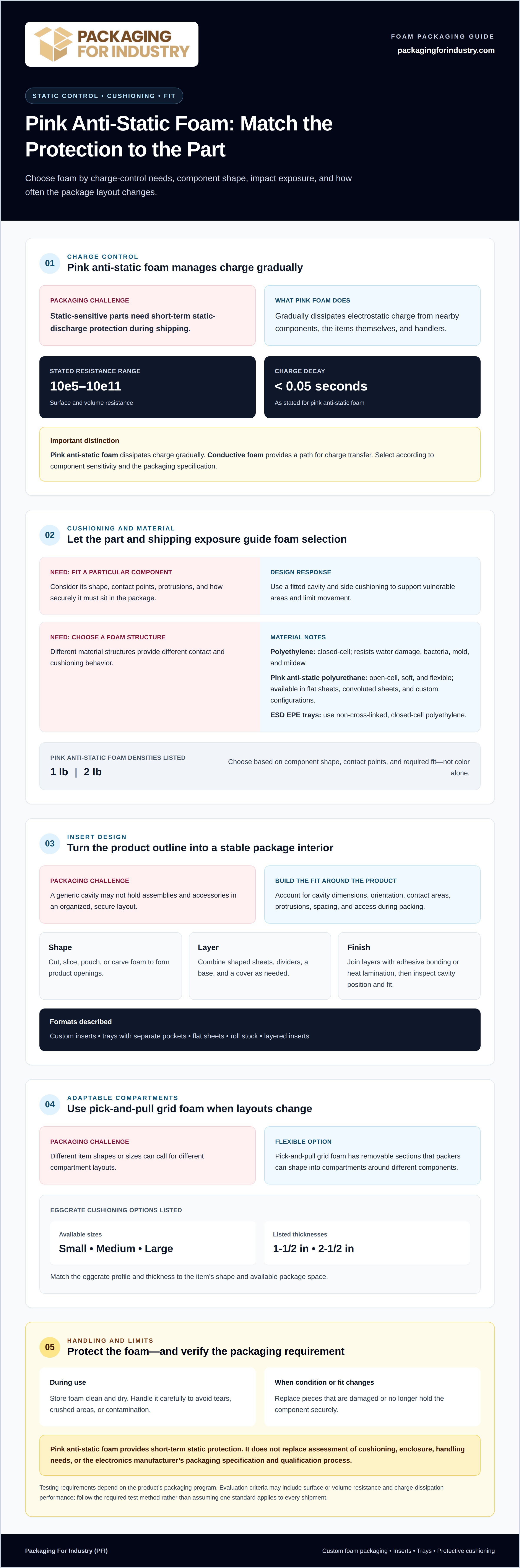
Pink anti-static foam gradually dissipates electrostatic charge from nearby components, the items themselves, and handlers during shipping. Its protection is intended for short-term static-discharge control.
Charge Dissipation for Electronics
Pink foam has stated surface and volume resistance ranges of 10e5-10e11, with charge decay below 0.05 seconds. These properties help manage charge rather than provide a conductive path designed to transfer it quickly.
Conductive foam and pink anti-static foam protect in different ways. Conductive foam provides a path for charge transfer, while pink foam dissipates charge gradually. The right option for an electronic assembly depends on component sensitivity and the protection required by the packaging specification.
ESD Boxes and Shipping Applications
Inside an ESD box, foam can separate circuit boards, modules, and other electronic components to prevent them from shifting against one another during shipment. A fitted base and top cushion an assembly, while shaped spaces keep individual parts organized.
Combining foam components lets a package protect several surfaces: a base supports the assembly, side pieces limit movement, and a top layer cushions the enclosure. Custom pink anti-static foam packaging can suit shipping layouts for electronics, including circuit boards and LCD modules. U.S. buyers can source custom foam through industrial packaging suppliers; lead times depend on design, quantity, and production requirements.
Testing, Handling, and Limitations
Testing requirements depend on the electronics manufacturer’s packaging specification and qualification process. Common evaluation criteria include surface or volume resistance and charge-dissipation performance. Follow the test method required by the product’s packaging program instead of assuming one standard applies to every shipment.
Store foam clean and dry, and handle it carefully to avoid tears, crushed areas, or contamination. Replace pieces that are damaged or no longer fit the component securely. Pink anti-static foam provides short-term static protection; it does not replace assessment of cushioning, enclosure, and handling needs across the shipping route.
Foam selection and cushioning considerations
Pink anti-static polyethylene and polyurethane offer different cushioning behavior for electronic equipment. ESD EPE trays use non-cross-linked, closed-cell polyethylene. When specifying protection, consider foam structure, component geometry, and shipping exposure.
Foam Types and Selection
Polyethylene foam has a closed-cell structure and resists water damage, bacteria, mold, and mildew. Pink anti-static polyurethane is open-cell, soft, and flexible, and is available in flat sheets, convoluted sheets, and custom configurations. Each material suits different contact and cushioning needs.
Pink anti-static foam is offered in 1 lb and 2 lb densities. Choose based on the component’s shape, contact points, and required fit. Cross-linked and non-cross-linked describe distinct foam structures. The ESD EPE tray uses non-cross-linked polyethylene, so that example shouldn’t be mistaken for cross-linked foam.
Impact Cushioning and Component Protection
During transport, cushioning should limit movement and help absorb impact around vulnerable areas. A fitted cavity can support a delicate electronic assembly, while side cushioning helps prevent it from shifting inside the package. Material flexibility matters too: EPE foam can bend to absorb and disperse impact force.
Eggcrate cushioning provides a shaped surface for equipment that needs contact across a broader area. Pink anti-static eggcrate foam is available in small, medium, and large sizes, with listed thicknesses of 1-1/2 inches and 2-1/2 inches. Match the profile and thickness to the item’s shape and the available package space. A foam base and top can add cushioning around the equipment, while a close-fitting layout helps control movement through shipping and handling.
Custom die-cut inserts, trays, and sheets
Custom foam layouts translate an electronic product’s shape into a stable package interior. Design decisions include cavity dimensions, component orientation, and how separate foam layers fit together.
Custom Insert Design
A custom insert can hold one electronic assembly or organize several components in a tray. The design should account for each item’s outline, contact areas, protrusions, and required access during packing. These details determine cavity shape and spacing.
Foam sheets can be cut, split, or laminated into layered inserts. For example, a lower sheet can hold shaped cavities while an upper layer provides support. A tray can also group components in separate pockets, reducing contact between parts during handling.
Cutting and Shaping Foam
Production starts by cutting a foam sheet to the required dimensions. The material is then shaped by cutting, slicing, pouching, or carving to create openings for the product. These processes let the insert follow an assembly’s form instead of relying on a generic cavity.
After shaping, layers can be joined with adhesive bonding or heat lamination, then inspected for quality. Inspection checks the finished form against the intended layout, including cavity position and fit. For an electronics tray, this process turns flat sheets into a formed component holder.
Combining shaped layers can create a complete insert from a base, dividers, and a cover. Each piece has a distinct role, from supporting a board to separating accessories. Clear drawings and product dimensions guide repeatable production throughout a packaging run.
Foam thicknesses and sheet sizes
Pink anti-static foam is available as flat sheets and roll stock. Thickness and format affect how the foam fits the product and package.
Listed sheet thicknesses range from 1/8 inch to 1 inch, including 1/4, 3/8, 1/2, and 3/4 inch. Choose thickness based on the space available and the cushioning layer required. For example, a 1/4-inch sheet is 6.35 mm thick.
Flat sheet formats include 12-by-12-inch pieces at 0.5-inch thickness. Roll stock provides continuous material for wrapping or cutting. One listed roll measures 12 inches wide by 75 feet long; another measures 24 inches wide by 150 feet long, both at 1/8-inch thickness.
For custom anti-static foam packaging, provide the product’s length, width, and height, along with the required foam thickness. For an insert, include each component’s dimensions, orientation, cavity layout, and clearance needs. Specify the package’s usable interior dimensions, whether you need a flat sheet or shaped insert, and the required quantity. A drawing or sample can clarify complex outlines and protrusions.
Custom sizes can be tailored to the product and package instead of being limited to listed sheet formats. Full-sheet pricing depends on dimensions, thickness, material, and order quantity. These details help define the material format and reduce avoidable trimming or unused foam in production.
Listed roll options also vary in thickness and price, so compare specifications when choosing material for a wrapping task. Width, length, thickness, and cost are useful details to consider together.
Compare listed sheet prices with the intended format and thickness to narrow the material choice before ordering. Roll and sheet listings provide different options for packaging needs, with dimensions and stated thicknesses to consider.
Pink anti-static pick-and-pull grid foam
Pick-and-pull grid foam combines pink anti-static material with removable sections, allowing packers to configure protection for sensitive items. Its practical advantage is adaptability: one foam format can accommodate different component outlines without designing each cavity as a separate die-cut.
A listed grid configuration uses 1/2-inch sections. The planned cavity should fit the item while leaving enough surrounding foam to hold it in place. For an electronic module, the layout can provide a separate space for the module and its accessories, helping prevent loose parts from contacting each other during shipment.
Grid foam works best when the package contents and arrangement are clear before configuration. Dimensions, protruding connectors, handling orientation, and the carton’s usable space all affect compartment design. A packaging professional can use these details to lay out openings that support the item, not merely match its outline.
For example, an assembly with a projecting connector needs clearance for that feature, while a small sensor may need a more compact cavity. The goal is controlled positioning, with foam around the item and compartments sized to the actual contents. If the product changes, the layout may need to change too.
Listed pick-and-pull formats include 24-by-24-inch sheets with 0.5-inch pop-out squares, available in 1-inch or 2-inch thicknesses. These concrete dimensions help frame the design discussion. Grid foam is adaptable, but it doesn’t automatically provide a precise fit or replace a purpose-designed insert for components needing specialized support.
Products
Pink anti-static foam packaging can be specified as sheets, roll stock, trays, or shaped inserts for electronics. The right format depends on the component layout, packing method, and shipping container. For a close-fitting interior, custom foam packaging can be designed around product dimensions and packaging workflow.
Foam is one part of a complete shipping setup. A corrugated carton contains the packed assembly, while stretch film secures palletized shipments. Cushioning materials can fill surrounding space, and corner or edge protection can support loads moving through warehouse handling.
- Foam inserts and sheets: organize sensitive components and support consistent packing.
- Corrugated boxes: provide an outer shipping container for packaged electronics.
- Stretch film: wraps pallet loads for handling and distribution.
- Cushioning and edge protection: address voids and exposed package edges.
Pairing compatible materials can simplify purchasing and keep packaging components aligned. A production line, for example, may use a foam insert inside a corrugated box, then group finished cartons on a pallet secured with stretch film. Packaging kitting can bring components together for a defined packing operation, while inventory management supports planned replenishment. Product dimensions, packing method, order volume, and storage needs help determine the right mix. This coordinated approach can reduce unnecessary material use and make packaging easier to manage for manufacturers and distribution centers.
Industries Served
Electronics manufacturers ship circuit boards, modules, and other static-sensitive components. Packaging may require anti-static foam, organized separation of components, and a carton suited to the product’s size and handling route. Custom layouts help keep assemblies arranged consistently for production transfers or outbound shipments.
Aerospace businesses move precision parts and assemblies through manufacturing and distribution workflows. Packaging must account for component geometry, handling, and shipping exposure. For aerospace operations, coordinated aerospace packaging solutions can support product protection alongside broader packaging requirements.
Medical companies package equipment and components that need orderly handling and secure transit. Food companies and their suppliers also rely on packaging suited to their products and shipping operations. In both settings, the design should reflect the item, packing process, and route rather than use a one-size-fits-all layout.
Manufacturers, distributors, and fulfillment centers manage varied product sizes and recurring packing work. Foam inserts can organize specific items, while corrugated packaging and pallet protection support movement through storage and distribution. Packaging for warehouses should also suit available space and packing workflows.
Construction suppliers and industrial businesses ship parts, tools, and materials through demanding supply chains. Their packaging may need cushioning for delicate components and robust outer protection for heavier goods. Matching the interior support and shipping container to the product helps reduce handling issues and supports dependable deliveries across Los Angeles operations.
Benefits
Pink anti-static foam packaging can match cushioning to component geometry and shipping needs. A shaped insert can limit product movement without filling every open space with extra material. This fit helps standardize packing for repeat shipments and maintain a consistent pack-out process across production runs.
Preventing damage starts with controlling movement inside the package. A component held in a fitted cavity is less likely to slide against other parts or the carton during handling. The right layout also provides clearance for delicate edges and connectors. Matching the insert to the product and outer container helps address shipping risks without adding unnecessary layers.
Packaging costs depend on more than the unit price of foam. Excess material, complicated packing steps, product damage, and replacement shipments all affect the overall expense. A design that uses the required cushioning and fits the packing workflow can help reduce waste and handling friction. Packaging cost savings come from considering material use and operational needs together, not simply choosing the lowest-cost component.
Supply reliability improves when packaging materials and replenishment align with production demand. Planned inventory management can help keep foam and related packaging available for recurring orders, while kitting can group materials for a defined assembly or packing task. For manufacturers and warehouses, coordinated packaging helps reduce last-minute substitutions and makes pack-out procedures more predictable. A strong design balances fit, cushioning, handling efficiency, and dependable supply.
Packaging For Industry (PFI): Foam Packaging
Packaging For Industry (PFI) helps Los Angeles businesses plan foam packaging around product dimensions and shipping workflows. Custom packaging design can account for how a component is packed, protected, and prepared for shipment. This is useful when standard materials create fit problems or add avoidable handling steps.
For a foam packaging quote, provide useful project details such as the product’s dimensions, order quantity, packaging configuration, and shipping requirements. These inputs help define a tailored solution and make it easier to compare pricing on a like-for-like basis. PFI’s custom packaging design services can address requirements that stock formats do not meet.
Stretch film can complement inner cushioning by securing grouped cartons for pallet movement. Considering both the product-level package and the outer shipment helps purchasing and operations teams assess packaging as one workflow instead of making separate material decisions.
For recurring packaging demand, Vendor Managed Inventory (VMI) can support replenishment planning based on usage and supply needs. This approach suits businesses seeking a more organized purchasing process for repeat materials. PFI serves businesses in Orange County, Los Angeles, and San Diego, supporting local packaging needs alongside inventory and shipment planning.
Share the product dimensions, required quantity, and shipping setup when you’re ready to discuss pricing. Request a packaging quote from Packaging For Industry.
Frequently Asked Questions
How do I request a custom pink anti-static foam packaging quote?
Custom pink anti-static foam packaging is polyethylene protective packaging designed around a product’s dimensions and packing configuration. The pink material is used for electronics and other static-sensitive components, where packaging must address both product fit and static control. A custom format can account for the item’s assembled shape and how it sits inside its shipping container, giving purchasing teams a specification they can use for repeat orders.
How can I compare pricing for pink anti-static foam packaging?
Pink anti-static foam has stated surface and volume resistance ranges of 10e5-10e11, with a charge decay time below 0.05 seconds. Surface and volume resistance describe different electrical properties, so product specifications may call for one or both values. Packaging teams can use the required resistance criteria to distinguish suitable foam from materials intended for a different static-control role.
Can a packaging supplier provide custom foam sizes for my product?
Foam selection considers product weight alongside fragile surfaces, contact points, and how the packed item will be supported. A delicate instrument and a heavier electronic assembly may need different combinations of cushioning and structure, even if their outer dimensions are similar. Product orientation and packaging configuration also inform the design, aligning material choice with the shipment rather than dimensions alone.
What custom foam fabrication options can I include in a quote?
Options include die-cut inserts, foam end caps, pads, planks, convoluted foam, and custom foam assemblies. Inserts can be used independently or integrated into foam-lined boxes and crates, depending on the shipping configuration. PFI provides CAD/CAM support to develop a design for the product and package. These formats let manufacturers choose between supporting a product’s ends, lining a container, or organizing components in an insert.
How can I compare prices for custom pink anti-static foam packaging?
Custom pink anti-static foam packaging has no single typical price because each order depends on its specifications. Pricing factors include foam material, dimensions, thickness, fabrication complexity, and order quantity. A quote can account for the full design and production requirements instead of relying on a generic per-piece estimate. For an accurate comparison, provide the desired configuration and quantity when requesting pricing.