
How much is a 1% product damage rate actually costing your operation once you factor in return freight, replacement manufacturing, and diminished client trust? Many logistics managers treat transit damage as an unavoidable tax on doing business. You’ve likely experienced the frustration of over-paying for bulky void fill that still fails to secure sensitive components. Partnering with the die cut foam fabricators Anaheim manufacturers trust, such as Packaging For Industry (PFI), transforms your protective packaging from a recurring expense into a strategic asset.
We’re here to show you how precision-engineered foam inserts eliminate transit damage while lowering your total dimensional weight shipping costs. This article outlines our process for developing mil-spec compliant solutions and rapid prototypes that move your project from design to delivery faster. You’ll discover how our Southern California facility supports both local next-day delivery and scalable nationwide distribution to keep your supply chain resilient and cost-effective. We’ll examine the specific materials and fabrication techniques that ensure your high-value parts arrive in perfect condition every time.
Key Takeaways
- Learn how custom-engineered foam inserts reduce dimensional weight and transit damage to lower your total cost of ownership.
- Identify the optimal material for your application by comparing the durability of closed-cell polyethylene with the cushioning of open-cell polyurethane.
- Partner with experienced die cut foam fabricators Anaheim to access rapid prototyping and local next-day delivery for urgent manufacturing schedules.
- Discover specialized packaging solutions designed to meet the rigorous vibration and protection requirements of the aerospace and medical device sectors.
- Streamline your logistics with a supplier capable of providing both high-volume production and nationwide shipping for multi-site industrial operations.
Understanding Precision Die Cut Foam Fabrication
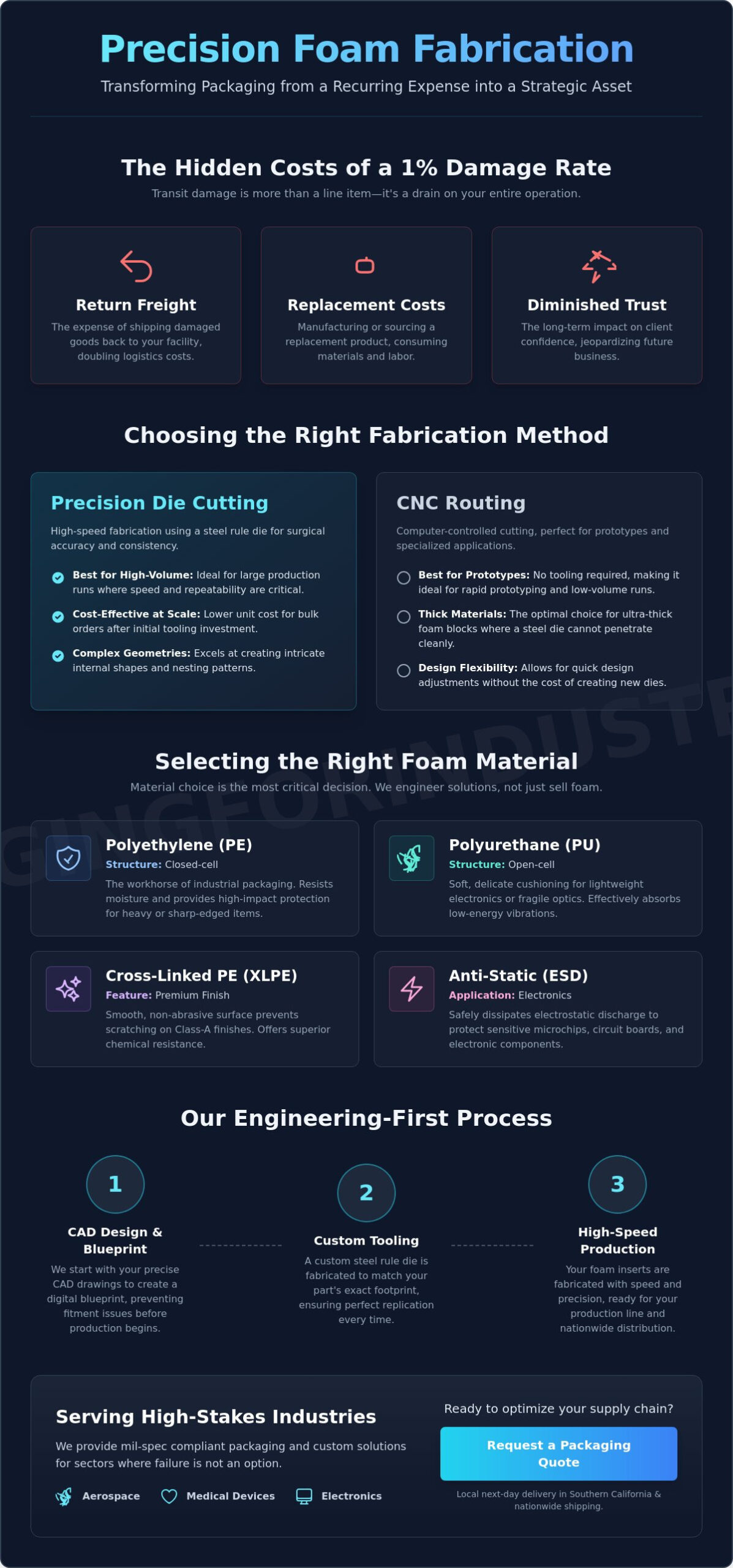
Protecting high-value industrial components requires more than just standard cushioning; it demands a precise fit that eliminates movement within the shipping container. Precision Die Cut Foam Fabrication is a high-speed fabrication process for uniform protective inserts that utilizes a steel rule die to punch out shapes from foam sheets with surgical accuracy. For the die cut foam fabricators Anaheim manufacturers rely on, this method represents the gold standard for high-volume consistency. It allows for complex internal geometries and nesting patterns that standard cutting methods simply can’t replicate at scale without significantly increasing labor costs.
In mission-critical sectors, dimensional accuracy isn’t a luxury. It’s a requirement. Maintaining strict tolerances ensures that sensitive parts, such as aerospace sensors or medical instruments, remain suspended and secure during the most rigorous transit conditions. When tolerances are loose, parts shift, leading to surface abrasions or structural fatigue. Die cutting provides the repeatability needed to ensure the ten-thousandth unit is identical to the first. Beyond precision, the primary advantage is economic efficiency. While there’s an initial investment in custom tooling, the unit cost for large production runs is significantly lower than other methods. This makes it a preferred choice for businesses looking to scale their operations while maintaining a predictable budget.
Die Cutting vs. CNC Routing: When to Choose Which?
Choosing the right fabrication method depends on your specific volume, material thickness, and lead time requirements. CNC routing is often the better choice for low-volume prototypes or ultra-thick foam blocks where a steel die can’t penetrate cleanly. However, for bulk orders, die cutting offers superior speed and repeatability. At PFI, we evaluate your specific project requirements to recommend the most cost-effective fabrication method. We don’t just sell materials; we provide a logistical advantage by ensuring you aren’t over-paying for unnecessary production time on the factory floor.
The Engineering Process: From CAD to Production
The process starts with accurate CAD drawings that serve as digital blueprints for your protection system. These drawings prevent fitment issues before the first sheet of foam is even loaded into the press. Once the design is finalized, custom steel rule dies are created to match your part’s exact footprint. This tooling ensures every foam packaging insert fits your product perfectly, which also helps in reducing the overall footprint of your shipping box. If you’re ready to optimize your current design and reduce waste, you can request a packaging quote to see how our engineering-first approach improves your supply chain reliability.
Selecting the Right Foam Material for Your Application
Material selection is the most critical decision in the engineering process. Choosing the wrong foam leads to either damaged products or excessive packaging costs. As experienced die cut foam fabricators Anaheim manufacturers rely on, we categorize materials based on cell structure and load-bearing capacity to ensure your components are secured correctly. We prioritize materials that meet current regulatory standards, including EPA-compliant polyurethane and high-performance polyethylene; just as Third Coast Spray Foam leverages specialized foam properties for superior building insulation, we focus on maximizing material performance for industrial protection.
Polyethylene (PE) serves as the workhorse of industrial packaging. It’s a closed-cell foam that resists moisture and provides high-impact protection for heavy or sharp-edged items. Because it doesn’t absorb liquids, it’s ideal for parts that might be exposed to oils or outdoor elements during transit. Polyurethane (PU) offers a softer, open-cell alternative. It’s best suited for lightweight electronics or fragile optics that require delicate cushioning rather than rigid support. PU foam effectively absorbs low-energy vibrations that could otherwise dislodge internal components.
For projects requiring premium aesthetics or superior chemical resistance, Cross-Linked Polyethylene (XLPE) is the preferred choice. Its smooth surface prevents scratching on Class-A finishes and sensitive surfaces. Additionally, sensitive circuits require Anti-Static (ESD) foams. These materials are chemically treated to dissipate static electricity, preventing costly discharge damage during handling and assembly.
Material Density and its Impact on Protection
Density is measured in pounds per cubic foot, and it’s the primary factor in determining load-bearing capacity. A 1.2lb foam behaves differently than a 2.0lb foam under pressure. If the density is too low for the product weight, the foam will “bottom out” during a drop, transferring the full impact force directly to your part. Matching foam density to your product’s static loading ensures the material actually cushions the blow. Increasing thickness also improves shock absorption, but only if the density is high enough to support the load without collapsing.
Specialty Foams: ESD and Mil-Spec Compliance
Meeting military packaging standards requires specific material certifications and rigorous testing. Defense and aerospace contracts often mandate flame-retardant or low-outgassing properties to ensure safety in pressurized environments. In the electronics sector, color-coding is a standard safety measure; pink foam usually signifies anti-static properties. This visual cue helps warehouse teams quickly identify ESD-safe materials and prevents the use of standard foams that could generate static. If you’re unsure which material meets your contract requirements, you can request a packaging quote to receive expert guidance on material selection and compliance.
Custom Foam Inserts for High-Stakes Industries
In high-stakes manufacturing, the cost of a single component failure often dwarfs the entire packaging budget. Professional die cut foam fabricators Anaheim specialists like PFI understand that for sectors like aerospace and medical device manufacturing, standard void fill isn’t an option. We design inserts that provide a secure, immobile environment for delicate parts, ensuring they survive high-G impacts and constant transit vibrations. This precision engineering is what separates a reliable supply chain from one plagued by frequent insurance claims and production delays.
Medical device packaging requires more than just physical protection; it demands organization that maintains sterile barrier integrity. Our custom layouts allow clinicians to identify components instantly, reducing the risk of contamination or assembly errors during critical procedures. In the electronics and instrumentation sector, we shield delicate sensors from both mechanical impact and the static risks inherent in industrial handling. For automotive Tier 1 suppliers, our focus shifts to high-volume JIT delivery and durable, reusable dunnage. These custom-fit solutions keep assembly lines moving without the interruption of damaged sub-assemblies or poorly organized parts containers.
Aerospace Packaging and Mil-Spec Standards
Engineering inserts for aerospace components requires a deep understanding of zero-fail protection. Avionics and precision-machined flight hardware are susceptible to microscopic damage from harmonic vibrations during long-range transport. We specialize in creating packaging that meets strict military specifications for long-term storage and environmental resistance. This ensures your components remain flight-ready even after months in a warehouse. By partnering with the die cut foam fabricators Anaheim businesses trust, you gain access to materials tested for low-outgassing and flame retardancy, which are essential for pressurized cargo environments.
Kitting and Tool Control (Shadow Boards)
Efficiency on the factory floor is often a matter of visual organization. We produce two-tone foam shadow boards that provide an instant visual inventory of tools and parts. If a slot is empty, a high-visibility bottom layer reveals the missing item immediately; this is a critical requirement for Foreign Object Debris (FOD) prevention in aviation. This level of organized part kitting improves assembly line efficiency and reduces labor costs in warehouse and distribution environments. By streamlining the pick-and-pack process, custom foam layouts allow your team to work faster with fewer errors, directly impacting your operational bottom line and improving overall supply chain reliability.
Maximizing ROI Through Custom Engineering and Prototyping
Investing in custom engineering is a strategic move to lower total operational costs. While off-the-shelf options seem cheaper initially, they often lead to wasted space and higher shipping fees. As leading die cut foam fabricators Anaheim businesses rely on, we focus on the intersection of engineering and economics. Every millimeter of excess foam is a cost; every cubic inch of empty space in a shipping box is a logistical failure. We focus on optimizing your packaging footprint to ensure you aren’t paying to ship air.
Custom-fit foam allows for smaller, more efficient shipping boxes. By reducing the external dimensions of your package, you significantly lower dimensional (DIM) weight shipping costs. This is particularly critical for high-volume e-commerce and industrial distribution where carrier rates are heavily influenced by package size. Simultaneously, precision fitment eliminates the primary cause of damage claims: internal movement. Reducing your damage rate by even a small percentage can recover thousands in lost revenue and replacement freight. We also design for sustainability by creating high-quality foam inserts for closed-loop supply chains, allowing for multiple reuses and lower long-term material spend.
The Role of Prototyping in Risk Mitigation
Digital models are useful, but they don’t account for real-world physics. Physical testing is superior for verifying impact protection and ensuring the foam reacts correctly under stress. Our free prototyping process allows you to test fit and function before committing to full production. Prototyping eliminates the financial risk of improper fitment in bulk orders. This proactive approach accelerates your time-to-market by catching design flaws early in the development cycle, ensuring your production run is flawless from day one.
Optimizing the Total Packaging System
A truly efficient system integrates foam inserts with custom corrugated boxes for a unified solution. We design ‘drop-in’ inserts that require zero assembly on your production line, saving valuable labor hours. This holistic approach balances material costs with the specific level of protection required for your shipping environment. You don’t need to over-engineer for a short local trip, but you can’t afford to under-engineer for international freight. If you’re ready to stop overpaying for shipping air and start protecting your bottom line, request a packaging quote to begin your custom design today.
Strategic Sourcing: Nationwide Capabilities and Southern California Logistics
Efficient logistics are just as vital as precision engineering. While many die cut foam fabricators Anaheim businesses encounter are limited by their local delivery radius, PFI bridges the gap between local specialized service and national distribution requirements. We understand that your warehouse floor space is at a premium. By leveraging our strategic location and robust supply chain, we provide a reliable flow of materials that keeps your production lines running without the burden of excessive on-site inventory.
Wholesale pricing is standard for our partners, whether you require custom-engineered inserts or stock foam materials. We offer competitive rates that reflect our high-volume sourcing power, ensuring your cost per unit remains stable even as raw material prices fluctuate. Beyond just providing materials, we specialize in Vendor Managed Inventory (VMI) and Just-in-Time (JIT) solutions. These programs allow you to reduce your warehouse footprint and reallocate that space to revenue-generating manufacturing activities. We take full accountability for the end-to-end experience, from the initial design phase to the final delivery at your facility.
Why PFI is the Preferred Die Cut Foam Fabricator in Anaheim
Our decades of experience serving the Orange County and Los Angeles industrial corridors give us a unique understanding of the local manufacturing landscape. Being a local partner means we can provide rapid design iterations and on-site visits that remote suppliers simply cannot match. If a design needs a sudden adjustment or a new prototype is required for a pilot run, our proximity allows for immediate response. For Southern California businesses, our next-day delivery capabilities ensure that urgent orders don’t result in costly assembly line stoppages. We aren’t just a vendor; we’re a steady and dependable partner positioned in the heart of the region’s industrial hub.
Scalable Solutions for National Distributors
National operations require a level of consistency that smaller, local-only fabricators often struggle to maintain. We provide scalable solutions that ensure the same high quality control across multi-state rollouts. Procurement teams can streamline their operations by using a single vendor for foam, custom boxes, and stretch film. This consolidated approach reduces administrative overhead and ensures that your brand’s protection standards are uniform across all locations. If you’re managing a complex, multi-site manufacturing operation, we invite you to request a packaging quote to compare our bulk pricing and lead times against your current suppliers. We’re ready to demonstrate how our integrated system of protection and logistical optimization improves your total supply chain reliability.
Secure Your Supply Chain with Precision Engineering
Operational efficiency depends on the reliability of your protection systems. We’ve demonstrated how precision engineering and strategic material selection transform packaging from a sunk cost into a logistical asset. By choosing the correct density and fabrication method, you eliminate the financial burden of transit damage and inflated shipping fees. As the die cut foam fabricators Anaheim manufacturers depend on, PFI provides the technical expertise needed to navigate complex aerospace and mil-spec requirements with ease.
Our process is built on tangible results and fiscal responsibility. Whether you’re optimizing a high-volume automotive line or securing sensitive medical optics, our free prototyping ensures your design is perfect before production begins. We combine this engineering-first approach with practical logistics; we offer next-day delivery in Southern California and scalable shipping nationwide. It’s time to stop settling for generic void fill and start using custom solutions that protect your bottom line. Request a Custom Foam Quote Today to begin optimizing your protection strategy. We look forward to helping you streamline your operations and improve your supply chain reliability.
Frequently Asked Questions
What is the typical lead time for custom die cut foam inserts?
Lead times generally fall between 7 and 10 business days once the final design is approved. The initial prototyping phase usually requires 48 to 72 hours to produce physical samples for your review. These timelines remain consistent for both local and national orders. We focus on maintaining predictable schedules to help you avoid assembly line stoppages and logistical bottlenecks.
Do you offer anti-static foam for electronics packaging?
We supply anti-static (ESD) foam designed specifically to protect sensitive circuitry from electrostatic discharge. This material is chemically treated to prevent charge buildup during transit and handling. Most of our ESD solutions are pink for easy identification in your warehouse. This visual cue ensures that your staff always selects the correct material for electronics packaging.
Can you provide free prototypes for my custom foam project?
Yes, we provide free physical prototypes for custom foam projects to verify fit and function. Digital modeling is a helpful starting point, but physical samples are necessary for accurate impact testing and drop verification. This service eliminates the risk of ordering bulk quantities that don’t meet your exact specifications. It’s a proactive step to ensure total reliability in your protection strategy.
What is the minimum order quantity (MOQ) for die cut foam?
Minimum order quantities vary based on the material type and the complexity of the die. We specialize in bulk packaging pricing for high-volume manufacturing, but we also accommodate smaller runs for specialized industrial needs. You can request a packaging quote to get specific MOQ details tailored to your current project and budget requirements.
How do I choose between polyethylene and polyurethane foam?
Polyethylene is a closed-cell foam that provides rigid, moisture-resistant support for heavy equipment and sharp-edged parts. Polyurethane is an open-cell, softer foam intended for lightweight items like medical instruments or fragile electronics. As the die cut foam fabricators Anaheim businesses rely on, we match foam density to your product weight to prevent bottoming out during drops.
Do you offer nationwide shipping for bulk foam orders?
We offer comprehensive nationwide shipping for all bulk foam and protective packaging orders. While we provide next-day delivery for Southern California businesses, our logistics network reaches multi-site operations across the United States. This allows you to consolidate your procurement with a single vendor for consistent quality and lead times across all your manufacturing facilities.
Can you engineer foam inserts that meet mil-spec requirements?
We design and fabricate inserts that meet strict military specifications and aerospace-grade outgassing standards. Our team selects materials that provide long-term environmental resistance for defense contracts and specialized aviation hardware. We ensure your packaging complies with all necessary regulatory requirements for high-stakes transport and long-term storage in demanding conditions.
How does custom foam help reduce my shipping costs?
Custom foam reduces your total shipping spend by optimizing the package’s dimensional weight. By engineering a precision fit, we allow you to use the smallest possible corrugated box for your product. Partnering with professional die cut foam fabricators Anaheim specialists also lowers costs by virtually eliminating replacement freight and the administrative overhead associated with damage claims.