
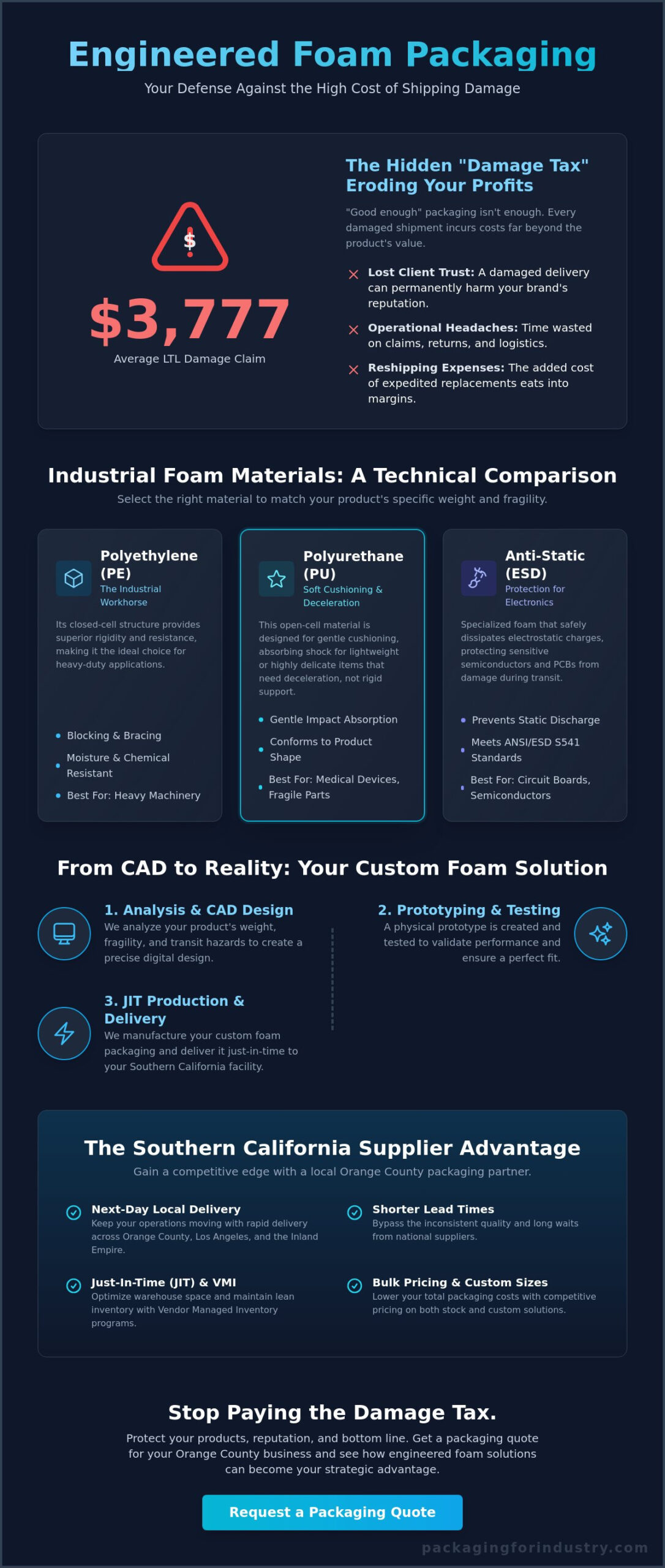
With the average LTL damage claim now reaching $3,777, relying on “good enough” cushioning is no longer a viable business strategy. You likely recognize that every returned unit due to vibration or impact damage represents more than just a lost sale; it’s a hit to your brand reputation and a logistical headache for your operations team. When you’re managing tight margins, finding reliable foam packaging solutions in Orange County is the only way to bypass the long lead times and inconsistent quality often found with national suppliers.
This guide will show you how to select, engineer, and procure the right protective materials to eliminate shipping damage and optimize your local supply chain. You’ll learn how to choose foam densities that meet Mil-Spec requirements for aerospace or medical components while reducing volumetric weight to offset the 5.9% general rate increases implemented by major carriers in 2026. We will also preview how a local partner can support your just-in-time delivery needs to keep your warehouse lean and your shipping cycles damage-free. By focusing on precision engineering and local procurement, you can turn your protective packaging from a overhead cost into a strategic advantage.
Key Takeaways
- Identify the specific protective qualities of polyethylene and polyurethane foam to ensure your material choice matches your product’s weight and fragility.
- Explore how custom CAD-designed inserts eliminate product movement within the container, effectively neutralizing the risk of impact damage.
- Learn how sourcing foam packaging solutions Orange County through a local partner provides the advantage of next-day delivery and significantly shorter lead times.
- Understand the economic benefits of bulk procurement and just-in-time delivery to maintain optimal inventory levels without sacrificing shipping protection.
- Review specialized material requirements for sensitive industries, such as anti-static foam for electronics and high-density solutions for aerospace components.
The High Cost of Shipping Damage in Orange County Logistics
Shipping in Southern California presents a unique set of stressors for industrial products. When goods move through the Port of Long Beach or the Port of Los Angeles, they enter a high-velocity handling cycle that rarely stops until the final mile. This “Orange County Reality” involves multiple transfers between ships, trucks, and regional sorting facilities. Each touchpoint is an opportunity for mishandling. Without robust foam packaging solutions Orange County businesses often find themselves paying a hidden “damage tax” that erodes their bottom line.
This tax isn’t just the cost of a broken part. It includes the administrative burden of filing claims, the expense of expedited reshipping, and the long-term loss of client trust. Industry data indicates that LTL shipments experience a damage rate between 2% and 5%, with the average claim reaching $3,777. For manufacturers of medical instruments or precision electronics, standard void fill options like paper or loose-fill peanuts aren’t sufficient. These generic materials lack the engineered structural integrity required to absorb specific G-force impacts. High-performance Package cushioning materials are necessary to provide the deceleration needed to keep sensitive internal components intact.
Regional Logistics Pressure Points
The congestion at Southern California ports often leads to rushed loading and unloading cycles. When freight is moved quickly to clear backlogs, the probability of vibration damage increases significantly. Parcels moving through regional hubs in cities like Anaheim or Santa Ana are subjected to automated sorting systems that can be incredibly physical. Additionally, the regional climate plays a role. Intense Southern California heat can cause inferior adhesive-backed foams to fail, leading to internal load shifts. Using high-quality foam packaging ensures your bracing stays exactly where it was designed to be.
Industry-Specific Protection Requirements
Different sectors in the region face distinct challenges. In the aerospace sector, precision-machined parts are vulnerable to even minor surface abrasions and high-frequency vibrations. Medical device manufacturers must ensure their sterile packaging remains uncompromised by sharp edges or rough transit. Meanwhile, the electronics corridor in Irvine requires specialized Electrostatic Discharge (ESD) protection. Implementing specialized foam packaging solutions Orange County manufacturers can rely on ensures that these technical requirements are met without compromise. By stabilizing the load from the start, you protect both the product and your professional reputation.
Industrial Foam Materials: Comparing PE, PU, and ESD Solutions
Selecting the correct material for your foam packaging solutions Orange County strategy requires a technical understanding of how different resins react to stress. It’s not enough to simply fill a box; you have to match the material’s physical properties to the specific fragility of your product. Polyethylene (PE) foam serves as the industrial workhorse for blocking and bracing heavy machinery. Its closed-cell structure provides excellent resistance to moisture and chemicals. This makes it the ideal choice for long-duration transit or storage where environmental factors are a concern.
In contrast, Polyurethane (PU) foam is an open-cell material designed for soft cushioning. It’s the preferred choice for lightweight or highly delicate items that require gentle deceleration rather than rigid support. For the tech-heavy Irvine corridor, specialized foam packaging solutions Orange County electronics firms utilize must adhere to the ANSI/ESD S541 standard. This ensures that static discharge doesn’t destroy sensitive semiconductors or PCBs during handling. Additionally, Expanded Polystyrene (EPS) provides rigid, high-volume protection for appliances and heavy gear. While it’s less flexible than PE, its compressive strength is superior for heavy, stackable loads.
Material Density and Fragility Ratings
Engineers use a “G-Factor” to rate a product’s fragility. A lower G-Factor indicates a more delicate product that needs thicker, softer cushioning. Foam density refers to the mass per unit volume of the material and determines how effectively the foam can decelerate a product during an impact event. Closed-cell foams generally offer better moisture and chemical resistance, whereas open-cell foams provide superior shock absorption for lightweight goods that are sensitive to vibration.
Specialty Applications: Mil-Spec and Anti-Static
Defense contractors in Southern California must adhere to strict military packaging standards. These specifications often require cross-linked polyethylene, which offers a smoother finish and higher durability than standard PE. For high-end electronics, anti-static foam is a non-negotiable requirement for PCB and sensor shipping to prevent latent defects that can lead to field failures. You can compare packaging pricing for these specialized materials to ensure your protection levels match your technical requirements and budget goals.
Engineering Your Custom Foam Solution: From CAD to Prototype
Moving from material selection to the actual design phase is where engineering meets economics. For businesses seeking reliable foam packaging solutions Orange County, the engineering process must be transparent and precise to avoid costly errors in mass production. At PFI, we follow a rigorous five-step workflow to move your project from a concept to a finished protective system:
- Step 1: Product Assessment: Our engineers perform a fragility analysis to determine your product’s G-factor and surface sensitivity.
- Step 2: CAD/CAM Design: We create detailed digital models for precision-cut inserts that eliminate internal movement within the box.
- Step 3: Free Prototyping: We provide a physical sample to ensure a perfect fit before you commit to a full production run.
- Step 4: Material Selection: We finalize the foam type based on product weight, required surface finish, and the intended transit method.
- Step 5: Final Production: We utilize CNC routing for complex geometries or die-cutting for high-volume efficiency to maintain consistent quality.
Precision engineering ensures that every cubic inch of your packaging serves a functional purpose. When you use foam packaging that is designed specifically for your component, you don’t just protect the item; you optimize your entire shipping spend.
The Value of Precision Fit
Custom-cut inserts allow for a smaller overall footprint, which directly lowers your dimensional weight (DIM) costs. Many carriers charge based on the space a package occupies rather than its actual weight; therefore, reducing box size is a primary driver for cost reduction. We also specialize in kitting solutions that organize multiple components into a single, secure foam tray. This streamlines your assembly line and ensures that your end-user receives a professional, organized package. For high-volume needs, die-cutting provides a cost-effective path, while CNC routing allows us to handle complex shapes without the need for expensive custom tooling.
Eliminating Risk with Free Prototyping
Prototyping is the most critical step in the procurement process, yet it is a service many national suppliers overlook. We offer free prototypes to Orange County manufacturers because it eliminates the risk of ordering thousands of units that don’t fit. Once you have the prototype, you can perform your own drop tests and vibration simulations to verify performance. We use this phase to refine the design, adding “easy-out” finger grips or adjusting the cavity depth for better component access. This collaborative approach ensures that the final foam packaging solutions Orange County businesses receive are ready for the rigors of any supply chain.
Procurement Strategies: Bulk Ordering and JIT Delivery
Efficient design is only half of the equation; the other half is a streamlined procurement strategy. Once your custom inserts are engineered, you must determine how to integrate them into your production cycle without inflating your carrying costs. Procurement teams often struggle with the balance between unit price and warehouse space. By leveraging foam packaging solutions Orange County businesses can access bulk pricing while utilizing local storage to maintain a lean operation. This approach maximizes your ROI on foam packaging by lowering the cost per unit through volume commitments.
Vendor Managed Inventory (VMI) takes this a step further. We monitor your stock levels and replenish your supply automatically, which removes the administrative burden from your purchasing department. This ensures you never face a production halt due to a packaging shortage. For manufacturers in high-rent districts, Just-In-Time (JIT) delivery is a critical tool for operational efficiency. Utilizing JIT delivery allows Irvine-based manufacturers to reallocate warehouse floor space from bulky packaging storage to active revenue-generating production lines.
Optimizing Your Packaging Spend
Choosing between stock foam sheets and custom-fabricated inserts is a decision driven by both labor and material costs. While stock sheets have a lower entry price, the labor required to cut and fit them often exceeds the cost of a pre-fabricated custom insert. Precision forecasting is also essential. By predicting your quarterly usage, you can avoid the emergency shipping surcharges that often occur during peak demand periods. If you’re ready to see how these strategies impact your bottom line, you can request a packaging quote to compare your current costs against a localized VMI program.
Local vs. National Suppliers
The physical nature of foam makes it expensive to transport over long distances. National vendors often advertise “free shipping,” but these costs are typically hidden within the material’s markup. Sourcing from a local foam packaging solutions Orange County provider eliminates these inflated logistics fees. Our Anaheim headquarters provides immediate access for businesses in Anaheim, Irvine, and Santa Ana, allowing for next-day delivery on stock items. Supporting a regional logistics partner doesn’t just reduce lead times; it strengthens the Southern California industrial base by ensuring your supply chain is responsive to local market fluctuations. We understand the specific needs of SoCal manufacturers because we operate within the same regulatory and economic environment every day.
Why PFI is the Preferred Foam Packaging Partner in SoCal
PFI operates as more than a vendor; we act as a specialized extension of your engineering and procurement departments. Choosing the right foam packaging solutions Orange County provider involves finding a partner who can integrate disparate materials into a cohesive protection system. We don’t just sell foam; we provide the technical expertise to combine it with heavy-duty corrugated boxes or custom crates to ensure total product safety. Our Anaheim facility is stocked with both custom-engineered inserts and standard stock options to meet any industrial requirement.
This holistic approach is particularly vital for the aerospace, medical, and electronics sectors. These industries don’t have room for error or inconsistent material quality. We understand that a medical device manufacturer in Irvine has different compliance and protection needs than a defense contractor in Huntington Beach. By maintaining a deep inventory of polyethylene, polyurethane, and ESD-safe materials, we ensure that your specific foam packaging solutions Orange County requirements are met with competitive bulk pricing and the reliability of local service.
The PFI Solution-Oriented Approach
Our sales team consists of experienced professionals who understand the nuances of industrial operations and purchasing. We don’t just take orders; we solve logistical problems. For instance, we’ve successfully assisted local electronics manufacturers in reducing their return rates by redesigning internal cushioning to better absorb high-frequency transit vibrations. By adding corner and edge protection to their existing setups, we help them stabilize their loads and eliminate the “damage tax” on their bottom line. This fixer mindset is what differentiates PFI from national catalog companies that lack regional context.
Get Started with a Custom Quote
Securing the right protection starts with precise data. To provide you with a fast and accurate quote, we recommend having your product dimensions, weight, and fragility G-factor ready. If you’re unsure of these technical specs, our team can guide you through the assessment process. We offer fast nationwide shipping for your satellite facilities and reliable local delivery for your Southern California headquarters. When you work with PFI, you’re choosing a partner committed to your supply chain’s reliability and your company’s fiscal health. Request a custom foam packaging quote today to see how our engineering-driven approach can optimize your packaging spend.
Secure Your Supply Chain with Precision Engineering
Effective industrial protection requires a shift from viewing packaging as a commodity to treating it as a precision-engineered asset. You’ve seen how matching material density to product fragility and utilizing custom CAD designs can neutralize the high-velocity handling risks inherent in Southern California logistics. By implementing localized foam packaging solutions Orange County manufacturers can simultaneously reduce dimensional weight costs and eliminate the administrative burden of damage claims.
Partnering with PFI gives you access to specialized expertise in Aerospace and Mil-Spec packaging; this ensures your most sensitive components meet rigorous transit standards. We provide free prototyping for custom designs to guarantee a perfect fit before mass production. Our local next-day delivery in Southern California keeps your operations running without interruption. It’s time to stop paying the “damage tax” and start optimizing your bottom line through better supply management.
Request a Custom Foam Packaging Quote for Your Orange County Business
We look forward to helping you build a more resilient and cost-effective shipping cycle.
Frequently Asked Questions
What is the best foam for shipping heavy industrial parts in Orange County?
Polyethylene (PE) foam is the superior choice for heavy industrial parts due to its high-density, closed-cell structure. It provides the necessary compressive strength for blocking and bracing heavy machinery during transit. Unlike softer foams, PE resists bottoming out under significant weight; this ensures your equipment remains stabilized within its crate or box throughout the entire Southern California logistics cycle.
How do custom foam inserts help reduce my overall shipping costs?
Custom foam inserts reduce costs by allowing for smaller box dimensions, which lowers the dimensional (DIM) weight of your shipments. When you eliminate the need for excessive void fill, you decrease the overall footprint of the package. This strategy directly counters the 5.9% rate increases implemented by major carriers in 2026. Precision-cut inserts also virtually eliminate product damage, saving your business the high cost of reshipping.
Can I get anti-static foam for shipping sensitive electronics in Irvine?
We provide specialized anti-static (ESD) foam designed specifically for the electronics and semiconductor manufacturers in the Irvine tech corridor. This material prevents the buildup of static electricity that can cause latent defects in sensitive PCBs or sensors. It’s an essential component for any foam packaging solutions Orange County electronics firms require to meet the ANSI/ESD S541 industry standard for safe handling and transit.
Does PFI provide free prototypes for custom foam packaging designs?
PFI provides free physical prototypes for custom foam packaging designs to ensure a perfect fit before you commit to a full production run. This service allows your engineering team to perform drop tests and verify component access without financial risk. By testing a prototype in your actual supply chain environment, you can refine the design to optimize protection and assembly speed before placing a bulk order.
What is the typical lead time for custom foam orders in Southern California?
Typical lead times for custom foam orders generally range from one to two weeks depending on the complexity of the design and material availability. Because we operate locally in Anaheim, we bypass the long transit times associated with national suppliers. Our proximity allows us to respond quickly to production spikes or design changes; this ensures your manufacturing schedule remains on track without the delays typical of out-of-state vendors.
Is there a minimum order quantity for custom-cut foam inserts?
Minimum order quantities depend on the manufacturing method used, such as die-cutting versus CNC routing. While high-volume die-cut runs typically require a minimum to offset tooling costs, CNC routing offers more flexibility for smaller batches or complex shapes. We recommend that you contact us to discuss your specific volume needs; we can then determine the most cost-effective production path for your operation.
How does polyethylene foam compare to polyurethane for shock absorption?
Polyurethane (PU) foam is superior for absorbing shock for lightweight or highly delicate items because its open-cell structure provides gentle deceleration. Polyethylene (PE) is better suited for heavier items that require rigid support and vibration dampening. Choosing the right material depends on your product’s fragility rating. Our team helps you select the correct density to prevent your product from bottoming out during a drop event.
Can PFI deliver foam packaging next-day to businesses in Anaheim or Santa Ana?
We offer local next-day delivery for stock foam packaging solutions Orange County businesses frequently utilize, including standard sheets and rolls. For customers in Anaheim, Santa Ana, or Orange, our proximity allows for rapid replenishment of critical supplies. This local advantage is a core part of our JIT delivery model; it helps you maintain lower inventory levels and frees up valuable warehouse floor space for your primary business operations.