
A packaging prototype isn’t a marketing tool; it’s a functional engineering requirement that separates profitable logistics from operational chaos. For manufacturers seeking packaging prototypes Los Angeles and Orange County, the goal isn’t just a sample box, but a validated solution to high product damage rates and expensive freight surcharges. You’ve likely realized that generic catalog supplies often lead to excessive dimensional weight costs and long lead times that stall your operations.
We’ll show you the exact steps to secure a functional prototype that eliminates shipping risks and streamlines your industrial supply chain. This guide covers everything from CAD/CAM design to local production, providing a roadmap for zero-damage delivery and reduced shipping costs. By the end, you’ll understand how a reliable local partner can help you move from initial concept to a final, optimized product with speed and precision.
Key Takeaways
- Distinguish between marketing mockups and engineering-grade prototypes to ensure your packaging survives the industrial supply chain.
- Learn how to integrate corrugated outer shells with protective foam cushioning when developing packaging prototypes Los Angeles and Orange County.
- Follow a proven five-step process to move from an initial design inquiry to a physical, functional model delivered directly to your facility.
- Use the “Fit, Form, and Function” principle to test your prototype for operational efficiency and zero-damage shipping.
- Leverage local Southern California expertise to minimize lead times and optimize your logistical costs through custom-engineered solutions.
What is an Industrial Packaging Prototype and Why Do You Need One?
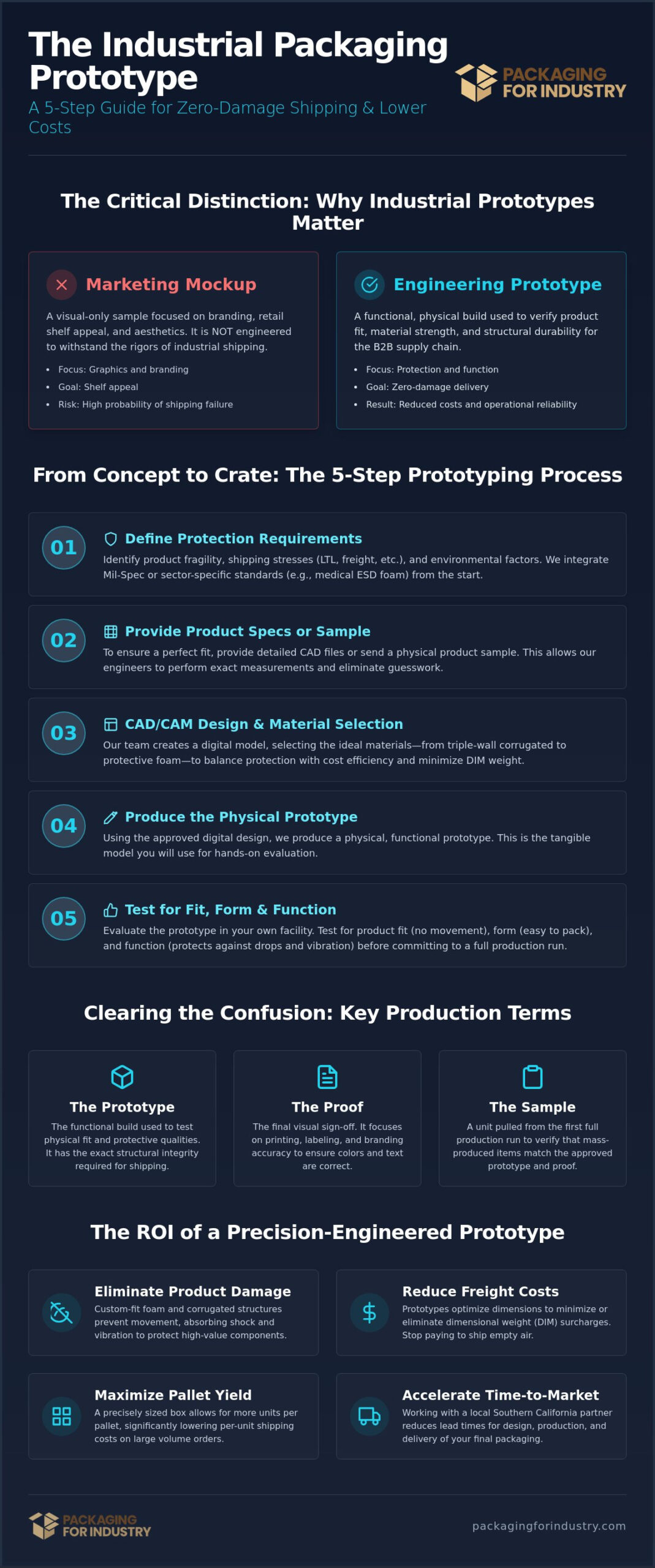
In industrial logistics, the physical sample serves as the ultimate insurance policy. A packaging prototype is a physical sample used to verify product fit, material density, and structural durability before mass production. Unlike a marketing mockup, which focuses on branding and retail shelf appeal, an engineering prototype is designed for the rigors of the B2B supply chain. For companies sourcing packaging prototypes Los Angeles and Orange County, this distinction is critical for ensuring that high-value components arrive at their destination without compromise.
The process of designing, evaluating, and producing packages involves balancing protection with cost efficiency. One of the most significant financial drains on a warehouse operation is the dimensional weight (DIM) surcharge. If your outer corrugated boxes are even slightly oversized because of a “close enough” fit from a generic catalog, you’re paying for shipped air. A custom prototype allows for precision measurement, ensuring the smallest possible footprint while maintaining necessary impact resistance.
The ROI of Prototyping for Southern California Manufacturers
Southern California is a hub for specialized sectors such as aerospace and medical device manufacturing. In these industries, a single damage claim can cost thousands of dollars and jeopardize critical contracts. Prototyping allows engineers to test specific material densities, such as protective foam inserts, to guarantee zero movement during transit. Beyond protection, optimizing the prototype dimensions improves pallet yields. Fitting just two more units per pallet can significantly reduce freight costs over a long-haul shipping cycle. It’s about moving away from the “catalog trap” where you pay a premium for standard sizes that don’t actually suit your specific product dimensions.
Prototype vs. Proof vs. Sample: Clearing the Confusion
To manage a successful packaging project, you must understand the specific terminology used in the design phase. Confusion here leads to missed deadlines and incorrect orders. Each stage serves a distinct purpose in the production timeline:
- The Prototype: This is the functional build. It’s used to test the physical fit of the product and the protective qualities of the materials. It might not have final graphics, but it has the exact structural integrity required for shipping.
- The Proof: This is your final visual sign-off. It focuses on printing, labeling, and branding accuracy. It ensures colors and text are correct before production begins.
- The Sample: This is usually a random pull from the first production run. It’s used to verify that the mass-produced units match the approved prototype and proof.
By investing in professional packaging prototypes Los Angeles and Orange County, you eliminate the guesswork that leads to shipping failures. You gain a physical tool that validates your engineering assumptions before you commit to a full production run.
How to Get a Packaging Prototype: A 5-Step Step-by-Step Guide
Securing functional packaging prototypes Los Angeles and Orange County requires a disciplined approach to design and data sharing. It’s a collaborative effort between your operations team and our engineering staff. The goal is to move from a concept to a physical, tested model that fits your workflow. Providing precise weights and dimensions early in the process prevents costly revisions later. While digital templates are the starting point, the physical prototype is what verifies your logistical assumptions.
Step 1: Define Your Protection Requirements
We begin by identifying the fragility of your product and the environmental stresses it will face. A medical device may require specialized anti-static (ESD) foam to protect sensitive electronics. Conversely, heavy industrial components often need the structural rigidity of triple-wall corrugated boxes. We also consider the shipping method. A package designed for local LTL delivery faces different vibration profiles than one destined for international ocean freight. If your sector requires military or aerospace compliance, we integrate those Mil-Spec standards into the initial design phase.
Step 2: Provide Product Specs or a Physical Sample
The most effective way to ensure a perfect fit is to send a physical product to our Anaheim design center. This allows our team to perform exact foam contouring and verify clearances. If a physical sample isn’t available, providing 3D CAD files allows us to build a digital twin for the initial design. During this stage, we also address Material Integration for regulated industries, ensuring all components meet safety and compliance standards from the start. If you have a complex part, you can request a packaging quote to begin the specification process.
Step 3: Engineering and CAD/CAM Development
Once we have your specs, our engineers use CAD software to develop a multi-component design. This often includes a corrugated outer shell combined with custom protective foam inserts. We focus on optimizing material usage to reduce waste and lower your total unit costs. A critical part of this step is designing for the economics of shipping. We engineer the prototype to stay under UPS or FedEx Large Package thresholds whenever possible. This proactive design work prevents the massive surcharges that often plague manufacturers using generic catalog boxes. For businesses needing packaging prototypes Los Angeles and Orange County, this phase is where we solve the intersection of physics and fiscal responsibility.
Material Integration: Designing Prototypes for Complex Products
Industrial equipment rarely fits into a standard catalog container without significant risk. Effective protection requires the strategic integration of various materials into a single, cohesive unit. For manufacturers developing packaging prototypes Los Angeles and Orange County, the design process must account for the synergy between the outer shell and the internal suspension system. PFI’s ability to prototype across multiple material categories simultaneously ensures that every component fits perfectly before mass production begins.
This multi-material approach is what separates an engineered solution from a basic shipping container. By Evaluating Your Prototype through the lens of material science, you can determine exactly how different densities of foam interact with the structural rigidity of corrugated board. This level of detail is essential for high-value sectors where a single failure can lead to thousands of dollars in losses.
Custom Corrugated and Heavy-Duty Boxes
When protecting heavy industrial equipment, our engineers evaluate whether double-wall or triple-wall Industrial Corrugated Boxes provide the necessary burst strength for your specific load. For high-volume parts, we prototype custom partitions and dividers that prevent part-on-part contact during transit. These structural prototypes are designed to withstand the vertical compression of warehouse stacking while maintaining a minimal footprint to reduce freight costs.
Precision Foam Inserts and Cushioning
The internal cushioning is where the most critical engineering occurs. We prototype die-cut polyethylene for rigid support or polyurethane foam for products requiring softer, more flexible impact absorption. In the Los Angeles electronics sector, designing anti-static (ESD) foam prototypes is a standard requirement to prevent latent electrical damage from static discharge. Our Protective Foam Packaging solutions are tailored to the exact G-force sensitivity of your product, ensuring it remains immobilized and safe.
Custom Wood Crates and Pallets
There are instances where a corrugated box simply isn’t enough to support the weight or dimensions of oversized machinery. In these scenarios, we prototype foam-lined crates that offer maximum structural integrity. These prototypes are often used for aerospace components that require specialized cradles to survive heavy vibrations. We also ensure these designs meet ISPM-15 compliance for international export. You can explore more about these heavy-duty solutions in our article on Engineering Custom Crates for International Transit. Securing packaging prototypes Los Angeles and Orange County that include wood, foam, and corrugated elements allows you to test the entire logistical assembly at once.
Evaluating Your Prototype: 4 Critical Tests for Operations Managers
Receiving your packaging prototypes Los Angeles and Orange County is a milestone in the procurement process, but it is not the final step. This phase requires a rigorous functional assessment based on the “Fit, Form, and Function” (FFF) principle of industrial engineering. Unlike a marketing review, an operational evaluation focuses on how the packaging performs under stress and how it integrates into your existing fulfillment workflow. You must involve your floor supervisors and shipping team during this stage; their hands-on experience provides insights into packing speed and ergonomic challenges that a digital CAD file cannot reveal.
The Fit Test: Precision and Ease of Packing
The first test is a physical audit of the internal clearances. Does the product slide into the custom foam inserts with ease, or is the fit so tight that it puts unnecessary stress on the component? If there is excessive “void space,” the prototype has failed to optimize material usage and will likely require expensive secondary fillers. We recommend a 60-second packing benchmark. If a warehouse worker cannot securely pack the unit in under one minute, the design is too complex and will lead to labor inefficiencies during high-volume production runs.
The Protection Test: Impact and Vibration Resistance
We encourage operations managers to perform a controlled “drop test” using a non-functional, weighted sample that mirrors the actual product. You are looking for “bottoming out,” a failure where the cushioning is too soft and allows the product to strike the outer corrugated wall. Pay close attention to Corner and Edge Protection. Since most shipping damage occurs at the corners during transit, these areas must be sufficiently shielded from side impacts. If the prototype shows signs of structural collapse after a standard drop, the material density needs adjustment before you commit to bulk production.
The Logistics Test: Weight and Dimensions
The final test is a fiscal one. Weigh the fully packed unit to calculate the actual shipping costs and compare them against your initial projections. Measure the exterior dimensions with precision to ensure they match the original quote and avoid carrier “Large Package” surcharges. Finally, test the pallet stability by stacking several prototypes together. If the units lean or shift, it indicates a lack of structural integrity that could lead to a pallet collapse in a trailer. To ensure your next design meets these rigorous standards, request a custom packaging quote from our engineering team.
Why Choose PFI for Packaging Prototyping in Los Angeles and Orange County?
Selecting a partner for packaging prototypes Los Angeles and Orange County is a strategic decision that impacts your entire logistical framework. PFI functions as more than a vendor; we act as an industrial consultant focused on the intersection of engineering and economics. Operating from our Anaheim headquarters, we provide a level of responsiveness that national catalog suppliers cannot match. When your design team and your packaging partner are in the same time zone, the speed of iteration increases, allowing you to move from a concept to a production-ready model in days rather than weeks.
Our commitment to operational reliability is evident in our service programs. Every successful just-in-time packaging or Vendor Managed Inventory (VMI) agreement begins with a perfect prototype. We validate the design’s structural integrity and fiscal impact before we ever manage your stock levels. For qualified recurring industrial accounts, we offer free prototyping to eliminate the financial barriers to entry for your engineering projects. This allows your team to experiment with different material densities and configurations without worrying about initial design fees.
Local Engineering, Nationwide Shipping
PFI provides local next-day delivery for both functional prototypes and full production runs across Los Angeles, Orange County, and the Inland Empire. We believe in a hands-on approach to problem-solving. Our engineers are available for personalized onsite packaging reviews at your facility in Anaheim, Irvine, or Long Beach. By observing your packing line and handling procedures in person, we can adjust the prototype to improve ergonomics and reduce labor costs. While our design center is local, our distribution capabilities are national. We scale your approved prototype into a high-volume production run that supports your nationwide supply chain with consistent quality.
Lowering Costs Through Smart Design
The prototyping phase is the most critical window for identifying Packaging Cost Savings. During this stage, we analyze the design to engineer out excess material and optimize the exterior dimensions for carrier dimensional weight (DIM) thresholds. Our status as a direct Southern California packaging supplier allows us to eliminate the middleman markups typically found with large catalog distributors. You receive a custom-engineered solution that is specifically tailored to your product’s fragility and your company’s bottom line. We don’t just sell boxes; we provide a comprehensive system of protection and logistical optimization.
Secure Your Supply Chain with Engineered Prototypes
Investing in the right packaging prototypes Los Angeles and Orange County is the most effective way to eliminate shipping damage and optimize your freight expenses. By utilizing our Anaheim Design Center, you move from digital CAD concepts to physical, tested models that satisfy even the most stringent aerospace and mil-spec requirements. This proactive engineering ensures your high-value components are protected by the precise material density and structural design they require before you commit to bulk production.
A validated prototype reduces dimensional weight surcharges and prevents the costly catalog trap of ill-fitting boxes. With our local next-day delivery across Southern California, your team can iterate quickly and maintain a lean, responsive supply chain. This methodical approach to design and testing provides the operational peace of mind that comes from knowing your logistics are optimized for both physics and fiscal responsibility.
Ready to protect your bottom line and improve your shipping reliability? Request a Custom Packaging Prototype and Quote today to start your next project. We look forward to helping you streamline your logistics and achieve zero-damage delivery.
Frequently Asked Questions
How much does a packaging prototype cost in Los Angeles?
Costs for a custom prototype depend on the complexity of the design and the specific materials used, such as heavy-duty corrugated or specialized foam. We offer free prototyping for qualified recurring industrial accounts to help purchasing managers reduce initial project risks. For one-off designs, the cost covers engineering time and material usage in our Anaheim design center. This investment is a functional insurance policy that prevents expensive shipping damage and freight surcharges later.
How long does it take to receive a custom packaging sample?
Most packaging prototypes Los Angeles and Orange County are completed within a few business days once the initial design requirements are finalized. Because we operate locally from our Anaheim headquarters, we avoid the long lead times associated with generic catalog suppliers. Our proximity to major Southern California hubs allows for next-day local delivery, ensuring your production timeline remains on schedule and your operations continue without unnecessary delays.
Do I need to have CAD drawings ready to get a prototype?
No, you don’t need to provide existing CAD drawings to begin the prototyping process. While 3D files can speed up development, our engineering team can create precise digital templates by measuring a physical sample of your product. We use our onsite CAD/CAM design center to develop the structural blueprints for your corrugated boxes and foam inserts, ensuring a perfect fit based on actual physical dimensions and product weight.
Can I get a prototype for a small production run?
Yes, we provide functional prototypes for projects of all sizes, including specialized small production runs for high-value equipment. Industrial packaging is rarely one-size-fits-all, so we support low-volume needs where protection is a priority. Prototyping for small runs is critical for validating the “Fit, Form, and Function” of the design. This ensures your specialized components survive the supply chain without requiring you to commit to massive inventory volumes.
Is the prototype made of the same material as the final production?
Yes, our industrial prototypes are functional models manufactured from the exact materials specified for your final production run. To accurately test for impact resistance and structural durability, we use the same corrugated grades and foam densities intended for the final build. This allows your operations team to perform realistic drop tests and vibration checks to verify that the design meets your specific protection standards before mass production begins.
What industries in Orange County do you provide prototypes for?
We specialize in providing packaging prototypes Los Angeles and Orange County for the aerospace, medical, electronics, and automotive sectors. These industries often require complex protection, such as anti-static (ESD) foam for sensitive electronics or heavy-duty crates for aerospace components. Our team understands the specific mil-spec and compliance requirements necessary to protect high-value assets during both local LTL shipping and international transit across the global supply chain.
Can you prototype custom foam inserts for my existing boxes?
Yes, we can engineer and prototype custom foam inserts designed to fit perfectly into your current corrugated containers. If you already have a stock of boxes but need better internal protection, we can create die-cut polyethylene or polyurethane foam to secure your product. This material integration improves the safety of your existing packaging system while reducing the need for generic loose-fill materials or excessive bubble wrap that increases dimensional weight.
What happens if the prototype needs changes after testing?
If your internal testing reveals a need for adjustments, our engineering team performs quick iterations to refine the design. The purpose of the prototyping phase is to identify these issues, such as a fit that’s too tight or a box that’s too large, before you commit to production. Whether you need to adjust foam density or modify box dimensions to avoid carrier surcharges, our local team can update the CAD files and produce a revised sample quickly.