
In 2025 alone, the USDA intercepted over 24,000 shipments due to non-compliant wood packaging materials. For a manufacturer, those aren’t just statistics; they’re thousands of containers stuck at the port, incurring daily storage fees while customers wait for critical inventory. Achieving total packaging compliance for international shipping is no longer just about avoiding a fine. It’s a fundamental engineering requirement to protect your bottom line from the compounding costs of logistical delays and maritime damage.
You’ve likely felt the pressure of rising freight costs and the constant risk of cargo rejections. We understand that managing global logistics is stressful enough without the threat of a port inspector flagging an outdated foam material or an improper pallet stamp. This 2026 industrial checklist ensures your shipments move through customs seamlessly while maximizing protection and minimizing freight volume. As a Southern California packaging supplier serving Los Angeles, Orange County, and San Diego, we’ve built this guide to help you master the mandatory 2026 updates for ISPM 15 and the EU’s latest regulations. You’ll gain a clear path to reducing shipping damage and lowering your total landed cost through smarter, compliant engineering.
Key Takeaways
- Learn how to navigate the 2026 updates for packaging compliance for international shipping to avoid costly port rejections and USDA interceptions.
- Understand the engineering differences between domestic and export-grade corrugated boxes, including the necessity of triple-wall construction for high-humidity maritime transit.
- Follow a comprehensive checklist for verifying ISPM 15 heat-treatment stamps to ensure all wood pallets and crates meet global phytosanitary standards.
- Identify mode-specific requirements for your logistics chain, from IATA pressure standards for air freight to VGM weight accuracy for maritime containers.
- Discover how custom-engineered protection and free prototyping can reduce shipping damage while optimizing freight volume to lower your total landed cost.
Understanding the Regulatory Foundation: ISPM 15 and IPPC
ISPM 15 stands for International Standards for Phytosanitary Measures No. 15. It’s the global baseline for all wood packaging materials used in international trade. The International Plant Protection Convention (IPPC) manages this standard to prevent the migration of wood-boring pests that could devastate foreign ecosystems. When you manage Packaging fundamentals for a global supply chain, understanding these rules is non-negotiable. It’s the first step in ensuring packaging compliance for international shipping.
Customs officials identify compliant wood through the “Bug Stamp.” This permanent mark must include the IPPC logo, the ISO country code, the unique producer or treatment provider code, and the treatment abbreviation. Starting January 1, 2026, the USDA’s Animal and Plant Health Inspection Service (APHIS) will strictly enforce the hyphen requirement between the country and facility codes. There’s no soft enforcement period. If your mark is illegible or formatted incorrectly, your shipment won’t clear the port.
Non-compliance carries severe financial weight. Fines for ISPM 15 violations can exceed $100,000 depending on the jurisdiction and the scale of the infraction. Beyond the penalty, customs may order the mandatory incineration of your pallets or the immediate return of the entire shipment at your expense. These delays cripple supply reliability and inflate your total landed cost through unexpected storage and freight fees.
Heat-Treated vs. Fumigated Wood Packaging
Heat treatment (HT) is the industrial standard for 2026. It involves heating the wood core to a minimum of 56°C for at least 30 continuous minutes. This process effectively kills pests without the use of hazardous chemicals. While Methyl Bromide (MB) fumigation was once common, it’s being phased out globally due to its ozone-depleting properties. The EU has already banned its use for wood packaging. To maintain packaging compliance for international shipping, verify that your supplier provides certified HT wood and maintains rigorous documentation of the treatment process.
Compliant Alternatives to Solid Wood
You can simplify your logistics by using materials exempt from ISPM 15. Engineered wood products like plywood, OSB, and particle board are considered “processed” and don’t require the IPPC stamp. These materials are bonded using heat, pressure, and glue, which naturally eliminates pests during manufacturing. For heavier requirements, custom shipping crates built with a mix of engineered panels and HT lumber provide a robust, compliant solution for high-value machinery. Plastic pallets and corrugated bulk bins also offer excellent alternatives that bypass wood regulations entirely while reducing overall shipment weight.
Mode-Specific Compliance: Air, Sea, and Land Logistics
Transit modes present unique physical and environmental challenges that demand specific engineering responses. Ocean shipments endure weeks of high humidity and salt air, which can soften standard corrugated fibers. Air shipments face rapid atmospheric changes and pressure differentials. Ground transport adds the constant stress of vibration and longitudinal shocks. Mastering packaging compliance for international shipping requires engineering for these specific stressors rather than relying on a one-size-fits-all approach; for instance, SIA Flexitanks provides specialized bulk liquid and dry cargo solutions engineered specifically for the rigors of global ocean transit.
Maritime Safety and SOLAS/VGM Compliance
The International Maritime Organization’s Safety of Life at Sea (SOLAS) regulation mandates the Verified Gross Mass (VGM) for every container. Precise weight calculation is a legal requirement. Overloaded or imbalanced containers cause stack collapses at sea, leading to catastrophic losses and massive liability for the shipper. As of January 1, 2026, Amendment 42-24 of the IMDG Code introduces stricter packaging and stowage requirements for substances like carbon and new classifications for sodium-ion batteries. Load containment is equally vital. Using high-performance stretch film with high-containment force ensures that pallets remain rigid during heavy swells and crane transfers. This reduces the risk of fines and lowers your total landed cost by preventing damage-related insurance claims.
IATA Standards for Air Cargo
The 67th Edition of the IATA Dangerous Goods Regulations (DGR) becomes mandatory on January 1, 2026. A critical update includes the mandatory 30% state of charge (SoC) limit for lithium-ion batteries packed with equipment (UN 3481). Compliance goes beyond paperwork; the physical packaging must withstand rapid decompression without failing. While USPS international shipping regulations provide a baseline for small parcels, industrial manufacturers must meet more rigorous IATA burst strength standards for outer containers. For sensitive electronics or aerospace components, custom foam packaging provides the necessary vibration dampening and ESD protection required for high-altitude transit.
Intermodal logistics in major hubs like Los Angeles and Long Beach require specialized stabilization for the “last mile” via rail or truck. Rail cars introduce unique G-forces during coupling that can shift unsecured loads. Utilizing heavy-duty corner and edge protection ensures your cargo remains stable from the port to the final warehouse. If you’re unsure if your current specifications meet the latest IATA or SOLAS standards, request a packaging quote to have our engineers review your load stabilization and compliance strategy.
Material Standards for Export-Grade Packaging
Domestic boxes usually rely on single-wall corrugated board designed for short-haul truck transit. In an international supply chain, these fibers absorb moisture during weeks of maritime exposure, leading to stacked container collapses. Achieving packaging compliance for international shipping requires a strategic shift to double-wall or triple-wall corrugated boxes. These heavy-duty materials provide the vertical stacking strength necessary to withstand the weight of multiple pallets in a high-humidity environment.
Protecting metal components from salt-air corrosion is another critical engineering step. Standard plastic bags often trap moisture, which accelerates rust on precision-machined parts. Instead, we utilize Vapor Corrosion Inhibitor (VCI) materials and moisture-resistant coatings that create a molecular protective layer. Adhering to IPPC and wood packaging requirements provides the regulatory baseline, but your internal material choices determine if your product arrives in saleable condition.
Long-haul routes often involve heavy-duty steel or plastic strapping to secure loads. Without proper corner and edge protection, these straps can crush the edges of your corrugated boxes and compromise the entire pallet’s integrity. High-density edge boards distribute the tension across the load, preventing structural failure during rough sea states or abrupt rail shunts. This level of protection is essential for manufacturers in Anaheim and Los Angeles who ship high-value industrial equipment globally.
Engineering for Impact and Vibration
Precision manufacturing requires more than just a sturdy box. We use G-force calculations to determine the exact density of polyethylene or polyurethane foam inserts needed to suspend sensitive components. Custom-engineered kitting ensures that complex assemblies remain immobile within the outer container, eliminating the risk of internal collisions. In this context, dunnage is defined as any material used to brace, cushion, or secure cargo within a shipping container or crate to prevent movement during transit.
Labeling and GHS Compliance
Proper labeling is a final, critical layer of packaging compliance for international shipping. Customs clearance often hinges on the legibility and accuracy of your external markings. The Globally Harmonized System (GHS) mandates specific pictograms and safety data for chemical or hazardous shipments. Handling instructions must be multilingual or rely on standardized ISO icons to ensure laborers in any port understand how to orient the package. We provide durable labels and ribbons engineered to resist peeling or fading in extreme maritime temperatures. For manufacturers in San Diego or Orange County, ensuring these labels remain intact is just as important as the structural integrity of the box itself.
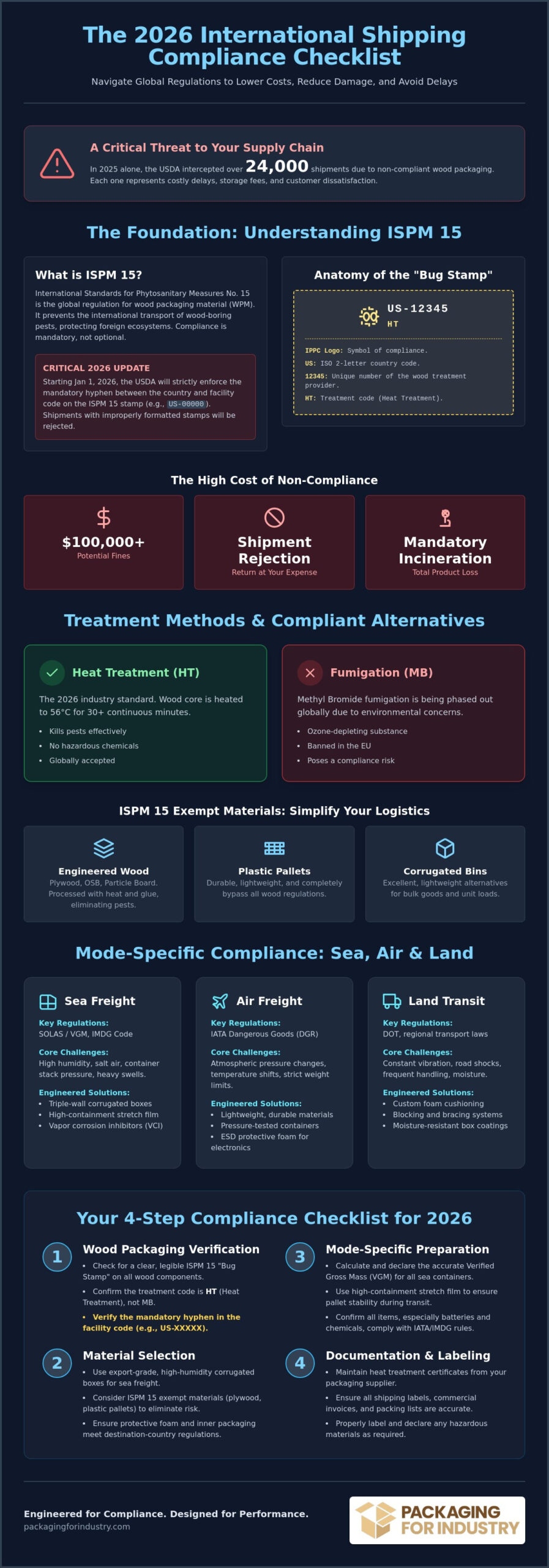
The 2026 International Shipping Compliance Checklist
Your facility’s outgoing dock is the final line of defense against port rejections and administrative fines. Achieving packaging compliance for international shipping requires a methodical audit of every pallet before the truck arrives. This checklist consolidates the regulatory and engineering requirements discussed previously into a single, actionable workflow for your operations team.
- Material Verification: Confirm that every wood pallet and crate features the permanent IPPC “bug stamp.” Starting in 2026, the USDA strictly enforces the hyphen requirement between the country and facility codes. If the stamp is missing or illegible, the shipment will likely be flagged for incineration.
- Weight Accuracy: Record the Verified Gross Mass (VGM) for all maritime containers. Inaccurate weights lead to container stack collapses and significant liability under SOLAS regulations.
- Environmental Protection: Verify that metal components are sealed with VCI materials or moisture-barrier bags. This is essential for sea transit where high humidity can compromise the structural integrity of standard corrugated boxes.
- Labeling Audit: Ensure all HAZMAT labels meet GHS and IATA standards for the destination country. Labels must be printed on high-durability thermal stock to resist peeling in extreme maritime temperatures.
- Documentation Match: Perform a final reconciliation between the physical packaging count and the Bill of Lading. Any discrepancy in weight or piece count can trigger a customs hold.
Pre-Shipment Inspection Steps
A visual inspection should be performed on all six sides of a crate or pallet to ensure compliance marks are visible to inspectors. Check the tension of your stretch wrap to ensure the load remains contained during the heavy G-forces of rail or sea transit. Finally, verify that the correct HS codes and customs documentation are securely attached to the lead pallet in a weatherproof pouch. For manufacturers in Anaheim or Los Angeles, these steps are the difference between seamless delivery and a costly port delay.
Common Compliance Red Flags to Avoid
Using recycled domestic pallets for export is a frequent cause of port rejections. These pallets often lack the necessary heat-treatment certifications required for international entry. Another red flag is over-packing that leads to “bulging” corrugated boxes. Customs agents may reject these shipments because they cannot be safely stacked in a container. Always avoid hand-written labels on industrial shipments; use printed, high-durability thermal labels to maintain a professional and compliant appearance.
Why Choose PFI for Your International Packaging Needs
Manufacturers need more than a vendor; they need a technical partner who understands the intersection of engineering and international law. Packaging For Industry (PFI) specializes in navigating the rigorous requirements of packaging compliance for international shipping while protecting your bottom line. From our hubs in Anaheim, Los Angeles, and San Diego, we provide the localized support and technical expertise necessary to keep your global supply chain moving without administrative delays.
We specialize in lowering your total landed cost through precise material management and engineering. By utilizing our Vendor Managed Inventory (VMI) program, we ensure your export-grade corrugated boxes and ISPM 15 materials are always in stock. This reliability eliminates the risk of missing a shipping window due to inventory shortages. Our cost-reduction analysis also helps you optimize box dimensions, reducing “empty space” to avoid the heavy dimensional weight surcharges common in 2026 maritime and air transit.
Custom Design and Prototyping
Our engineers use CAD/CAM software to design crates and foam inserts that meet rigorous international shock-absorption standards. We offer free prototyping to ensure your compliant packaging fits your product perfectly before you commit to a bulk production run. A professional packaging review often reveals where manufacturers are over-spending on non-compliant or excessive materials. By identifying these engineering inefficiencies, we deliver significant packaging cost savings while actually improving the safety of your cargo.
Local Support for Southern California Manufacturers
PFI’s strategic proximity to the Ports of Los Angeles and Long Beach allows for rapid supply replenishment when transit schedules shift unexpectedly. We provide personalized, sales-focused service to purchasing managers throughout Orange County and the Inland Empire, offering next-day delivery on critical packaging inventory. We’re proactive problem-solvers who understand the pressures of industrial operations and the high cost of shipping damage. Whether you’re in the aerospace, automotive, or medical sector, we have the specialized knowledge to secure your shipments for the 2026 regulatory landscape.
Secure Your Global Supply Chain for 2026
Mastering packaging compliance for international shipping protects your bottom line from the hidden costs of port rejections and maritime damage. As 2026 regulatory updates for ISPM 15 and IATA standards take effect, your facility must transition from generic supplies to engineered, compliant systems. Implementing the checklist provided ensures that every crate, pallet, and corrugated box leaving your dock is prepared for the environmental stressors of global transit.
Packaging For Industry (PFI) supports Southern California manufacturers with specialized aerospace and defense packaging solutions designed for zero-failure environments. We offer free custom prototyping and design reviews to identify cost-saving opportunities before you ship. With local next-day delivery across Anaheim, Los Angeles, and San Diego, we provide the supply reliability your operations team requires to meet tight international windows.
Don’t let a missing stamp or improper material choice derail your global logistics. Our team is ready to help you optimize your protection and lower your total landed cost today.
Frequently Asked Questions
What happens if my shipment is not ISPM 15 compliant?
Non-compliant shipments are typically rejected at the port of entry or ordered for mandatory incineration at the shipper’s expense. Customs officials will hold the cargo, leading to significant storage fees and logistical delays. In some jurisdictions, you may face administrative fines exceeding $100,000 for repeated violations of international phytosanitary standards.
Does ISPM 15 apply to plywood or particle board?
No, ISPM 15 regulations do not apply to processed wood materials like plywood, OSB, or particle board. These products are manufactured using high heat, pressure, and bonding glues that naturally eliminate wood-boring pests. Only solid wood packaging, such as raw timber pallets and crates, requires the official heat-treatment stamp for international transit.
What is the difference between IATA and IMO packaging standards?
IATA standards govern air freight and focus on atmospheric pressure changes and container burst strength. IMO standards, managed through the IMDG Code, regulate sea freight with an emphasis on moisture resistance and vertical stacking strength. Each mode requires different engineering to maintain packaging compliance for international shipping and prevent product damage during transit.
How do I calculate the Verified Gross Mass (VGM) for my shipment?
You can calculate VGM by weighing the fully packed container or by weighing all individual pallets and packaging materials then adding the container’s tare weight. This second method requires certified scales for all components, including crates, stretch film, and dunnage. Accurate VGM reporting is a legal requirement under SOLAS regulations to prevent container stack collapses at sea.
What are the specific labeling requirements for international shipping?
International shipments require GHS pictograms for hazardous materials, ISO-standard handling icons, and multilingual instructions. Labels must be printed on high-durability thermal stock to ensure they don’t peel off in extreme maritime humidity. Clear markings for the country of origin and the consignee’s full address are also mandatory for customs clearance in most major ports.
Can I use standard domestic corrugated boxes for international freight?
Standard domestic boxes are generally insufficient for international routes because they lack the structural integrity to withstand high-humidity maritime environments. Moisture softens standard corrugated fibers, leading to crushed loads. Upgrading to double-wall or triple-wall boxes is essential to ensure your packaging compliance for international shipping and protect your goods from stacking failure.
How does custom foam packaging help with international compliance?
Custom foam packaging provides the specific G-force dampening required to meet IATA and military-spec vibration standards. By engineering inserts that fit your product exactly, you eliminate internal movement and prevent impact damage during rough sea states or air turbulence. This precision engineering is a critical component of a reliable, compliant global supply chain.
Where can I find an ISPM 15 certified packaging supplier in Southern California?
Packaging For Industry (PFI) is a certified supplier providing heat-treated pallets and crates to manufacturers throughout Southern California. We offer local next-day delivery to Anaheim, Los Angeles, and San Diego hubs. Our team specializes in custom-engineered solutions that meet all 2026 compliance standards while helping you lower your total landed costs.