
A single structural failure in a low-quality pallet can compromise a high-value industrial load, yet many procurement teams still treat wood pallets for packaging as an afterthought rather than a critical engineered component. You’ve likely felt the impact of rising freight costs and the professional stress caused by product damage during transit. For manufacturers and distributors in Los Angeles and Orange County, these logistical inefficiencies don’t just eat into margins; they disrupt the entire supply chain and lead to costly stockouts of essential materials.
We understand that your primary goal is a stabilized, compliant load that reaches its destination without a scratch. This guide will show you how to accurately select and procure the right wood pallets for packaging to achieve zero transit damage and full ISPM-15 compliance. We’ll explore the technical differences between pallet designs, the benefits of Vendor Managed Inventory (VMI) for reliable delivery, and how to optimize your packaging spend without sacrificing load integrity. By the end of this article, you’ll have a clear roadmap for stabilizing your industrial loads and reducing your per-unit shipping costs.
Key Takeaways
- Identify whether stringer or block designs best suit your forklift accessibility and load weight requirements to ensure warehouse efficiency.
- Master ISPM-15 compliance standards for export shipping to prevent the seizure or destruction of your international cargo at customs.
- Discover how high-quality wood pallets for packaging can be integrated with custom foam inserts to eliminate transit damage for sensitive electronics or aerospace components.
- Implement Vendor Managed Inventory (VMI) programs to stabilize your supply chain and secure lower per-unit pricing through strategic bulk procurement.
- Leverage local next-day delivery in Orange County and Los Angeles to maintain a lean, just-in-time inventory of critical shipping materials.
Understanding Wood Pallets for Industrial Packaging
Wood pallets for packaging serve as the structural foundation of every industrial shipment. They aren’t merely platforms; they’re engineered tools designed for load stabilization. When you select the correct pallet specification, you create a reliable interface between your product and the chaotic environment of global logistics. This choice directly impacts your bottom line. A well-stabilized load reduces the risk of transit damage, which in turn keeps your insurance premiums low and prevents the logistical nightmare of rejected shipments.
Industrial professionals must distinguish between standard wood pallets and custom-engineered skids. While a standard pallet features both top and bottom deck boards for stacking, a skid lacks the bottom boards. This design is often preferred for heavy machinery that requires a low center of gravity or specific forklift clearance. Because wood offers a superior strength-to-weight ratio and is easily repairable, it remains the industry standard for manufacturers in Los Angeles and Orange County who need to move heavy loads without the high cost of plastic or metal alternatives.
Key Components of a Wood Pallet
The integrity of a pallet depends on its individual components. Deck boards provide the surface area that supports your product, while stringers or blocks provide the vertical support and entry points for material handling equipment. For heavy machinery or aerospace components, board thickness is a critical variable. Thicker boards prevent bowing under concentrated weight. We also prioritize fastener quality. The specific nail patterns and the use of helically threaded nails ensure that the pallet remains rigid even when subjected to the shear forces of a turning freight truck.
New vs. Recycled Pallets: A Cost-Benefit Analysis
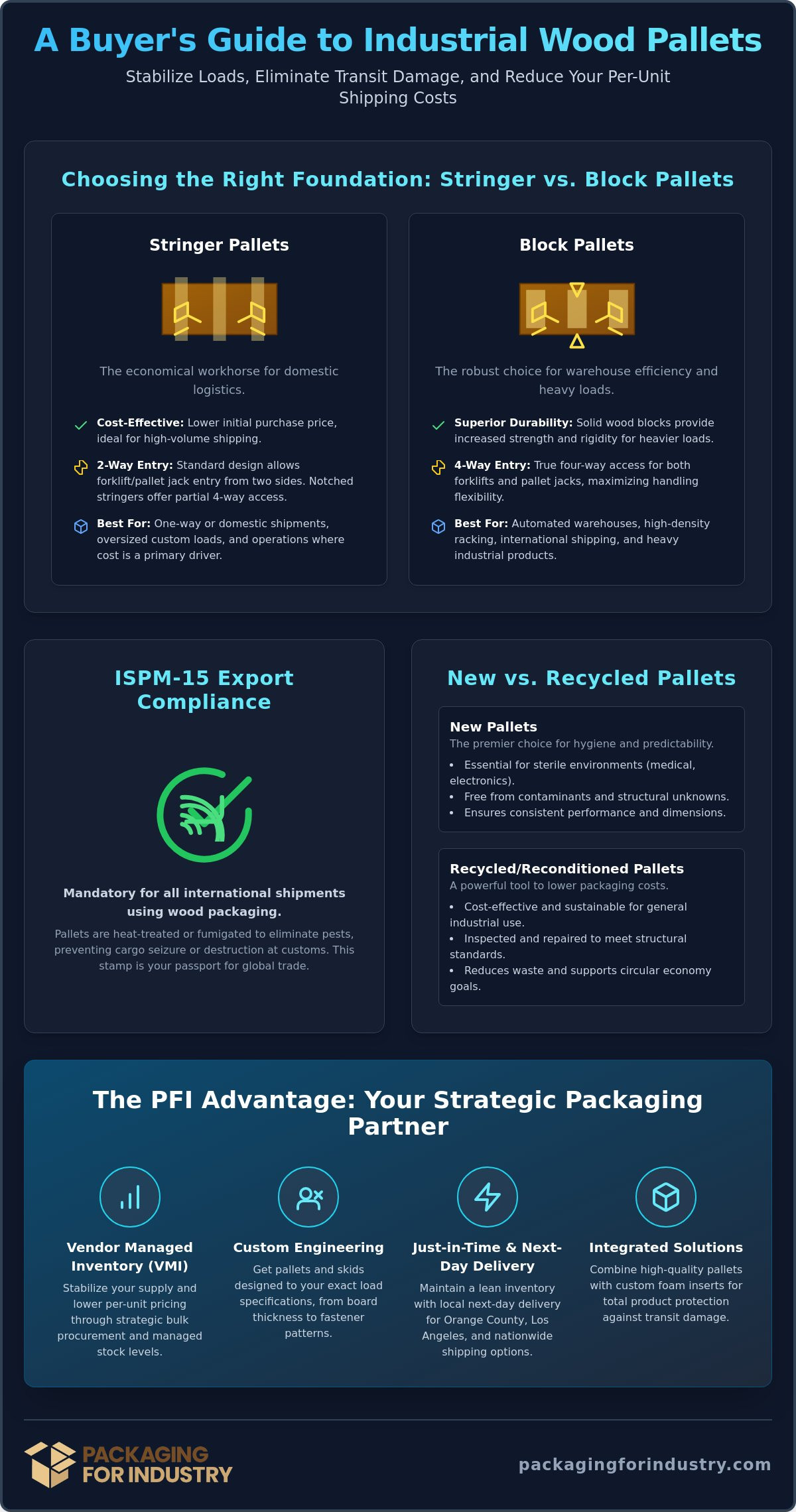
Choosing between new and recycled wood is a matter of balancing hygiene requirements with fiscal responsibility. New wood pallets are the preferred choice for sterile environments, such as medical device manufacturing or high-end electronics. They provide a clean, predictable surface and are free from the contaminants that can accumulate over multiple trips. For general industrial use, however, reconditioned or recycled pallets are a powerful tool to lower packaging costs. These pallets are inspected and repaired to meet structural standards, offering a sustainable solution that fits perfectly into modern circular economy initiatives. Many of our clients integrate these with custom foam packaging to create a high-protection, cost-efficient shipping system.
Stringer vs. Block Pallets: Choosing the Right Foundation
Selecting the correct architecture for wood pallets for packaging is a decision that dictates your warehouse flow and equipment compatibility. The primary distinction lies in how the top and bottom deck boards are supported. The Grocery Manufacturers Association (GMA) standard pallet size is 48×40 inches, which serves as the benchmark for compatibility across North American retail and industrial supply chains. However, the internal structure, either stringers or blocks, determines whether your team has two-way or four-way entry access. Matching this architecture to your product’s footprint is essential for even weight distribution and preventing the pallet from buckling under heavy industrial loads.
The debate between Stringer vs. Block Pallets often comes down to the specific handling requirements of your facility. If your operations rely on manual pallet jacks, a stringer design might suffice. If you’ve invested in automated retrieval systems or high-density racking, the multi-directional accessibility of a block pallet becomes a non-negotiable requirement for efficiency.
Stringer Pallets: The Economical Workhorse
Stringer pallets are the most common foundation used in domestic logistics. They rely on parallel longitudinal boards, called stringers, to support the deck. While traditional designs offer two-way entry, modern notched stringers allow for partial four-way access by forklifts. These are ideal for high-volume domestic shipping where cost efficiency is the priority. For specialized sectors in Los Angeles or Orange County, we often customize stringer lengths to accommodate oversized aerospace components or long automotive parts that exceed standard dimensions. This adaptability makes them a preferred choice for manufacturers looking to lower packaging costs without sacrificing structural support.
Block Pallets: Maximum Durability and Accessibility
Block pallets represent a more robust alternative, utilizing individual wood blocks rather than continuous stringers. This design provides true four-way entry, which is essential for facilities using automated storage and retrieval systems (ASRS). Because forklifts can approach from any side, block pallets significantly improve warehouse efficiency and reduce the time spent maneuvering in tight aisles. They offer superior structural integrity for heavy-duty stacking in high-density racking systems. While the initial investment may be higher, the longevity and accessibility of block designs often lead to a lower total cost of ownership in complex logistics environments. If you’re unsure which foundation fits your specific weight requirements, you can request a packaging quote to get an engineered recommendation tailored to your load profile.
Compliance and Standards: ISPM-15 and Export Packaging
International logistics demand strict adherence to ISPM-15 standards to avoid the logistical nightmare of shipment rejection. When you select wood pallets for packaging destined for global markets, compliance isn’t optional; it’s a critical regulatory requirement. As of July 2026, global customs agencies have implemented a zero-tolerance policy for any bark on wood packaging materials. Failure to meet these standards often results in the immediate destruction of your cargo or expensive re-export fees. Every pallet must bear the official IPPC heat-treatment stamp, which serves as a verified passport for your industrial goods. This mark confirms the wood reached the necessary core temperatures to eliminate invasive wood-boring pests, aligning with the latest USDA Wood Packaging Material Guidelines.
Verification of compliance is a straightforward but essential process for procurement teams. A valid ISPM-15 stamp must be clearly visible and contain the IPPC logo, the country code, a unique manufacturer identification number, and the “HT” designation for heat treatment. For high-value international cargo, we frequently integrate these compliant pallets with custom shipping crates. This engineered approach provides a secondary layer of structural stabilization, ensuring that sensitive industrial equipment remains secure during the multi-modal transitions of global transit.
Heat Treatment (HT) Process and Requirements
The science behind heat treatment involves raising the core temperature of the wood to 56 degrees Celsius (132.8 degrees Fahrenheit) for at least 30 minutes. While HT is the baseline for export, many of our clients in the electronics sector prefer kiln-dried (KD) lumber. KD processes reduce moisture content more aggressively, which is vital for preventing “mold-spec” issues. During long-duration sea freight journeys, high humidity can cause moisture to migrate from the pallet to your product. Using KD wood pallets for packaging mitigates this risk, protecting moisture-sensitive components from corrosion or fungal growth.
Military and Aerospace Pallet Standards
Military and aerospace contracts often require specialized wood packaging that exceeds standard commercial specifications. In Southern California, aerospace firms frequently demand custom skids designed to rigorous Mil-Spec standards to handle the extreme weight and precision tolerances of flight hardware. Our Aerospace Packaging Solutions focus on these exacting requirements. We ensure that every pallet and skid provides the rigid foundation necessary for sensitive defense and aviation logistics, where even a slight structural deflection can lead to catastrophic product damage.
Optimizing Pallet Procurement: Bulk Pricing and VMI
Procurement efficiency is just as vital as the structural engineering of the pallet itself. If your warehouse floor is crowded with towering stacks of wood pallets for packaging, your operational flow and safety suffer. Bulk purchasing is the standard method to capture lower per-unit pricing, but it frequently creates a storage bottleneck that hampers productivity. We help our clients bypass this trade-off by acting as a secondary warehouse. You secure the financial benefit of high-volume pricing while we manage the inventory off-site, releasing valuable square footage back to your production team. This strategy transforms packaging from a storage headache into a streamlined financial asset.
Vendor Managed Inventory (VMI) for Packaging
Stockouts of critical shipping materials cause expensive production halts and missed delivery windows. Our Vendor Managed Inventory Services eliminate this risk by shifting the responsibility of stock monitoring to our team. We monitor your consumption patterns and trigger automatic replenishment before your levels reach a critical point. This proactive approach is particularly beneficial for custom-sized pallets or specialized skids that aren’t available as off-the-shelf items. By maintaining a dedicated safety stock of your specific wood pallets for packaging in our local facility, we ensure your shipping department remains operational without the need for constant oversight.
Southern California Logistics and Delivery
Reliability in the industrial supply chain depends on proximity and speed. For manufacturers operating in the Anaheim, Los Angeles, and Orange County industrial hubs, our local next-day delivery is a significant competitive advantage. While massive catalog suppliers often ship from distant regional centers, our local presence allows for a highly responsive just-in-time (JIT) model. This proximity drastically reduces the transit time and freight costs associated with heavy wood packaging. It also has a positive impact on your cash flow. Instead of tying up capital in months of inventory, you can order precisely what you need for your immediate production schedule. We focus on the logistics so you can focus on manufacturing.
The PFI Advantage: Custom Engineering and Integrated Solutions
Treating wood pallets for packaging as a standalone commodity is a common mistake that leads to structural failure. A one-size-fits-all approach often results in pallet overhang or insufficient deck coverage, which are primary drivers of shipping damage in the industrial sector. At PFI, we view the pallet as the bedrock of a multi-layered protective system. Our engineering team doesn’t just sell you a platform; we design a solution where the pallet, cushioning, and outer container work in perfect synchronization to maintain load integrity.
Prototyping is a core part of our consultative process. Before moving to full-scale production, we create physical samples to verify the fit and load-bearing capacity. This is especially critical for medical device manufacturers in San Diego and Orange County who handle high-value, calibrated equipment. In one recent case, a manufacturer faced recurring transit issues due to harmonic vibration during long-haul trucking. By engineering a custom skid with integrated dampening features, we eliminated the vibration damage that standard catalog pallets couldn’t address. This precision ensures your product arrives in the same condition it left the factory floor.
Integrated Protection: Boxes, Foam, and Pallets
Real protection happens when there’s synergy between heavy-duty corrugated boxes and custom skids. When your outer box is precisely sized to the pallet footprint, you maximize vertical stacking strength and prevent the load from shifting during transit. We often incorporate precision-cut custom foam packaging to lock the product into place on the wood base. This integrated approach reduces your total cost of ownership by virtually eliminating damage-related returns and the administrative costs of processing insurance claims.
Requesting a Custom Packaging Quote
Our process starts with a thorough assessment of your product’s dimensions, weight, and fragility. When you’re ready to optimize your supply chain, providing details about your material handling equipment and destination requirements helps us engineer the most cost-effective solution. Whether you need a specialized crate for aerospace hardware in Los Angeles or a high-volume run of standard pallets, our team provides the end-to-end oversight you expect from a professional partner. We don’t just deliver wood; we deliver a system of protection that stabilizes your bottom line. Request a packaging quote today to start the design process and secure a more reliable shipping foundation.
Stabilize Your Industrial Supply Chain
Selecting the right wood pallets for packaging is a strategic decision that impacts your entire logistical flow. By moving beyond a commodity mindset, you can implement custom-engineered solutions that eliminate transit damage and ensure full ISPM-15 compliance for global shipments. Our specialized approach combines precision prototyping with reliable local logistics to protect your high-value assets and your bottom line. We’ve seen how integrated designs reduce insurance claims and improve warehouse efficiency for manufacturers in Los Angeles and Orange County.
We provide next-day delivery across Southern California and guarantee export compliance for every pallet we manufacture. Our engineering team is ready to develop custom prototypes that integrate seamlessly with your existing foam and corrugated components. This end-to-end oversight ensures your supply chain remains resilient even during peak demand periods. You don’t have to settle for off-the-shelf platforms that don’t fit your specific load profile.
Building a more resilient and cost-effective shipping foundation starts with a single engineered design. We look forward to helping you optimize your packaging spend and improve your supply reliability.
Frequently Asked Questions
What is the difference between a stringer pallet and a block pallet?
Stringer pallets utilize parallel longitudinal boards to support the deck, typically offering two-way or partial four-way forklift entry. Block pallets use individual wood blocks instead of continuous stringers, providing true four-way entry from any side. While stringer designs are the economical standard for domestic shipping, block pallets offer superior durability and accessibility for facilities using automated retrieval systems.
Why do I need heat-treated (ISPM-15) pallets for international shipping?
Heat-treated ISPM-15 pallets are a mandatory requirement for international logistics to prevent the cross-border spread of invasive wood-boring pests. Global customs agencies enforce a zero-tolerance policy for non-compliant wood packaging, and shipments without the official IPPC mark can be seized or destroyed. Our heat-treatment process ensures your wood pallets for packaging meet all current export regulations for total compliance.
How much weight can a standard 48×40 wood pallet hold?
A standard 48×40 wood pallet generally supports a dynamic load capacity of 2,500 to 2,800 pounds and a static load capacity exceeding 4,000 pounds. These capacities depend heavily on the wood species and the thickness of the deck boards. For heavy machinery or concentrated loads, we perform a technical assessment to ensure the pallet architecture safely supports your specific weight requirements.
Can I get custom-sized wood pallets for oversized industrial equipment?
We specialize in designing and manufacturing custom-sized wood pallets for packaging to accommodate oversized or irregularly shaped industrial components. Our engineering team develops custom skids and prototypes that match your product’s unique footprint and weight distribution. This precision prevents the structural failures and transit damage often caused by using improperly sized standard platforms.
What are the benefits of a Vendor Managed Inventory (VMI) program for pallets?
A Vendor Managed Inventory (VMI) program eliminates the risk of packaging stockouts by shifting the responsibility of inventory monitoring to our team. This program reduces your warehouse footprint because we store your safety stock at our facility and deliver it just-in-time. It improves your operational cash flow and ensures your shipping department always has the materials needed to maintain production schedules.
How do I choose between a new pallet and a recycled pallet for my business?
New pallets are the preferred choice for sterile or high-value environments, such as medical device or aerospace manufacturing, where structural perfection and hygiene are non-negotiable. Recycled or reconditioned pallets are a proactive solution to lower packaging costs for general industrial applications. We inspect every recycled unit to ensure it meets load-bearing standards before it enters your supply chain.
Does PFI offer local delivery in Southern California?
PFI provides local next-day delivery for manufacturers and distributors across Southern California, including Los Angeles, Orange County, and San Diego. Our proximity to these major industrial hubs allows us to offer a highly responsive delivery model that reduces your freight costs and lead times. This local presence is essential for businesses operating on a just-in-time manufacturing schedule.
What is the GMA specification for pallets?
The GMA (Grocery Manufacturers Association) specification defines the standard North American pallet as 48×40 inches with a specific configuration of top and bottom deck boards. It’s the most recognized standard in the supply chain, ensuring compatibility with nearly all forklifts, pallet jacks, and racking systems. Following this specification streamlines your logistics by ensuring your loads fit standard freight dimensions.