
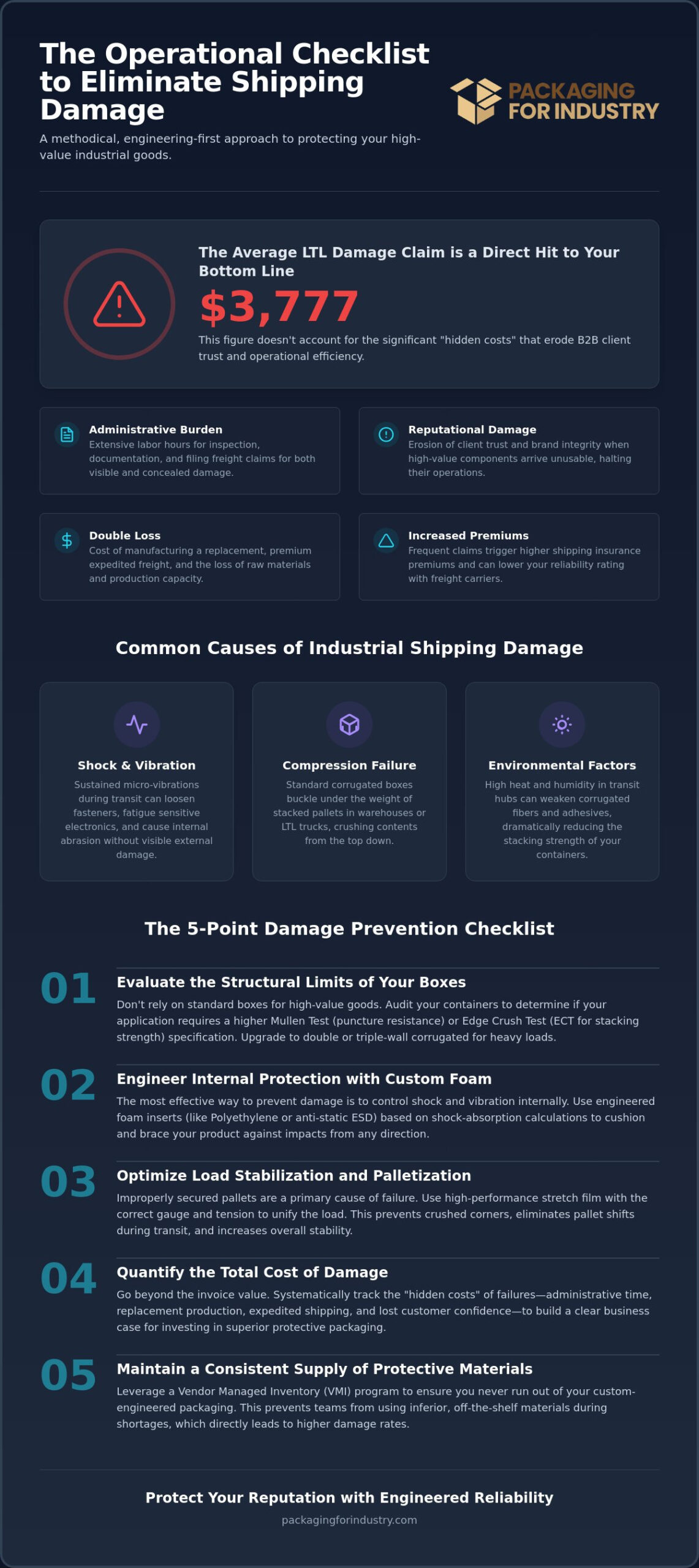
With the average LTL damage claim now reaching $3,777, shipping failures aren’t just a minor logistical hurdle. They’re a direct hit to your bottom line. You’ve likely dealt with the frustration of high-value components arriving at a client’s facility in pieces, followed by the exhausting administrative burden of filing freight claims. Avoiding product damage claims shouldn’t be a game of chance or a cost of doing business. It’s a design challenge that requires a methodical, engineering-first approach to protective packaging.
We understand that your reputation in Southern California and beyond depends on the integrity of every shipment. This 2026 operational checklist provides a clear path to lower damage rates and reduced shipping insurance premiums. You’ll learn how to audit your current materials, implement custom foam or corrugated solutions, and protect your brand through engineered reliability. From Orange County warehouses to nationwide distribution centers, these strategies ensure your products arrive exactly as they left the assembly line.
Key Takeaways
- Quantify the “hidden costs” of shipping failures, from administrative claim filing to the long-term erosion of B2B client trust.
- Evaluate the structural limits of standard corrugated boxes and determine whether your application requires Mullen Test or Edge Crush Test specifications.
- Identify why engineered foam inserts and shock-absorption calculations are the most effective tools for avoiding product damage claims on high-value industrial goods.
- Optimize load stabilization using high-performance stretch film and palletization best practices to eliminate crushed corners and pallet shifts.
- Leverage Vendor Managed Inventory (VMI) to maintain a consistent supply of custom protective materials, preventing the use of inferior packaging during shortages.
Understanding the Financial Impact of Shipping Damage Claims
In a B2B industrial context, a product damage claim is a formal demand for compensation from a carrier or supplier because goods were rendered unusable during transit. While consumer returns are often simple, industrial claims involve high-value components, precise tolerances, and strict delivery schedules. Packaging is effectively a coordinated system of preparing goods for transport. When that system fails, the financial repercussions extend far beyond the price of the item itself.
Beyond the primary invoice value, manufacturers face “hidden costs” that rarely appear on a claim form. These include the labor hours required for inspection and documentation, the cost of disposing of bulky materials, and the erosion of client trust. It is also vital to distinguish between visible transit damage and concealed damage. Visible damage is identified at the time of delivery, such as a punctured crate or a crushed pallet. Concealed damage is discovered only after the package is opened, often weeks later. Both scenarios require extensive administrative time to resolve. If a specialized aerospace component arrives damaged at a facility in Los Angeles, the delay might halt a multimillion-dollar assembly line.
The Real Cost of a $1,000 Damage Claim
A $1,000 loss on paper is significantly more expensive in reality. To maintain your margins, you’ve got to account for the overhead of manufacturing a replacement and the premium cost of expedited freight to meet the original deadline. Frequent claims also trigger higher insurance premiums and lower your reliability rating with carriers. This makes avoiding product damage claims a necessity for maintaining fiscal health. Every failed shipment represents a double loss of raw materials and production capacity. You aren’t just losing the product; you’re losing the opportunity to fulfill the next order on time.
Common Causes of Industrial Shipping Damage
Understanding why damage occurs is the first step toward prevention. Industrial goods face a gauntlet of physical and environmental stressors during transport:
- Shock and vibration: Sustained micro-vibrations during long-haul trucking can loosen fasteners or fatigue sensitive electronics.
- Compression failure: Standard corrugated boxes often buckle under the weight of stacked pallets in high-density warehouses.
- Environmental factors: The heat and humidity in San Diego or Orange County transit hubs can weaken adhesives and soften corrugated fibers. This reduces the stacking strength of your containers.
Working with an experienced industrial packaging supplier allows you to identify these risks before the first pallet leaves the dock. By analyzing the “G-factor” of your product and the specific rigors of your supply chain, you can move from reactive claim filing to proactive damage prevention. Our goal is to ensure your engineering efforts aren’t undone by a single rough transit leg.
The Structural Integrity Checklist: Corrugated Box Selection
The foundation of any damage reduction strategy is the outer shipping container. While the standard Regular Slotted Container (RSC) is the industry workhorse, relying on it for high-value industrial goods without proper specifications is a common mistake. If your boxes arrive crushed at a distribution center, the failure often lies in the material’s structural rating rather than the carrier’s handling. Adhering to established GSA shipping guidelines ensures you select containers that withstand the physical stresses of the freight environment. For manufacturers, avoiding product damage claims starts with matching the box grade to the specific weight and fragility of the internal components.
When shipping heavy machinery or sensitive electronics, a single-wall box is rarely enough. Upgrading to double-wall or even triple-wall corrugated boxes provides the stacking strength necessary for multi-pallet loads. These heavy-duty options offer superior puncture resistance and structural rigidity, ensuring the container doesn’t deform under the weight of overhead pallets. This is particularly critical in LTL shipping, where your goods are frequently moved and restacked by carrier personnel.
ECT vs. Mullen: Which Rating Matters for Your Load?
Edge Crush Test (ECT) is the primary metric for pallet stacking strength and determines how much top-down pressure a box can handle before buckling. While the Mullen Test measures a box’s resistance to being punctured, ECT is far more relevant for modern palletized shipping. For lightweight items, ECT-32 is often sufficient. However, industrial loads typically require an upgrade to ECT-44 or ECT-51 to prevent collapse during long-haul transit. Heavy-duty corrugated board is essential in Southern California warehouses where heat and humidity can weaken the fibers of standard packaging materials, leading to “box fatigue” and eventual failure.
Custom vs. Stock Boxes: The Surcharge Trap
Using oversized stock boxes creates two major problems: excess void space and dimensional weight (DIM) surcharges. When a box is too large for its contents, you’re forced to use more cushioning material, which increases costs and still allows for internal movement. This movement is a primary driver of damage. By investing in custom corrugated boxes, you eliminate the “air” in your shipments. This reduces the risk of internal shifting and lowers your freight bills by avoiding DIM weight penalties. For manufacturers in San Diego or Los Angeles, custom sizing often pays for itself through reduced damage claims alone. If you’re unsure if your current box specs are sufficient, you can request a packaging quote to have our team review your requirements and optimize your container selection.
Engineering Internal Protection with Custom Foam Inserts
While the external corrugated box provides structural integrity, internal protection handles the kinetic energy of transit shocks. Generic void fill like paper or loose-fill peanuts often fails because it compresses during transport, allowing high-value components to shift inside the container. This movement is a primary cause of internal fractures and surface abrasions. For manufacturers in San Diego and Orange County, avoiding product damage claims requires an engineered approach to cushioning that accounts for the specific fragility of the item.
Engineering for custom foam packaging involves calculating the “G-factor” of a product. This metric represents the maximum deceleration an object can withstand before it sustains damage. We select foam densities based on this science. Polyethylene (PE) is a high-performance, closed-cell foam ideal for heavy industrial parts due to its durability and moisture resistance. In contrast, Polyurethane (PU) is a softer, open-cell foam better suited for delicate medical instruments or lightweight electronics that require a gentler “deceleration” during a drop. By locking your product in a fixed position, custom foam eliminates the internal movement that leads to claim denials from carriers.
Die-Cut Foam vs. Foam End Caps
The geometry of your product determines the most efficient foam design. Full die-cut encapsulation is the standard for complex electronics that require total protection on all six sides. For aerospace components or long industrial tubes, foam end caps offer a cost-efficient alternative. They provide high shock absorption while using significantly less material, which helps lower your overall packaging costs. In specialized sectors like semiconductor manufacturing, we provide anti-static (ESD) foam. This is essential to prevent electrostatic discharge from ruining sensitive circuits during the shipping process.
The Prototyping Process for Fragile Goods
Precision is essential when your reputation is on the line. Our engineering team utilizes CAD/CAM support to design foam inserts that mirror the exact geometry of your product. To ensure the design works in the real world, we offer free prototyping for Southern California manufacturers. This allows you to test the fit and function before committing to a full production run. We also assist in reducing damage through simulated drop-testing and vibration analysis. By identifying potential failure points during the design phase, you don’t have to worry about the trial-and-error approach that often leads to expensive shipping failures.
Load Stabilization and Palletization Best Practices
Securing a pallet for nationwide shipping requires more than just a few layers of plastic. It is a calculated process of load containment. A primary factor in avoiding product damage claims is ensuring the entire pallet behaves as a single, unified unit during transit. If the boxes on top move independently from the pallet base, you’ll likely experience “pallet shift.” This lead to crushed corners and potential load collapse when the carrier takes a sharp turn or brakes suddenly. To secure a pallet effectively, you must choose a heavy-duty pallet without broken boards, align your boxes in a column-stack pattern to maximize stacking strength, and ensure your wrap captures the pallet base to prevent the load from sliding off.
High-performance stretch film is the most critical tool for maintaining this containment. It isn’t just about the number of wraps; it’s about the containment force applied to the load. To prevent strap indentation and improve vertical stacking strength, we integrate corner and edge protection. These rigid stabilizers distribute the pressure of the strapping and the weight of overhead pallets. This effectively eliminates “crushed box syndrome,” where the tension of the film or straps damages the very product you’re trying to protect.
Selecting the Right Stretch Film Gauge
Hand film is often sufficient for low-volume shipping, but machine film provides far better containment force and consistency. Machine film allows for precise tension control and utilizes “pre-stretch” technology. This process elongates the film up to 300% before it’s applied, which significantly reduces material waste and lowers your cost per pallet. We help Southern California warehouses optimize their film usage by matching the gauge to the specific weight and profile of their loads, ensuring stability without overspending on plastic.
Corner Guards and Edge Protectors
Vertical stacking strength depends heavily on edge reinforcement. Corner guards allow you to stack pallets higher in a warehouse without risking the collapse of the bottom layer. This is vital for avoiding product damage claims during long-term storage or multi-stage transit. For overweight industrial gear that exceeds standard pallet limits, we design custom crates to provide a solid foundation for international or heavy-duty domestic transit. In logistics hubs like Orange County and San Diego, these reinforcements are the difference between a successful delivery and a costly insurance headache.
Implementing a Damage Reduction Program with PFI
PFI operates as more than just a supplier; we act as a specialized consultant for your entire logistics chain. Successfully avoiding product damage claims requires a transition from reactive buying to an engineered strategy. We review your current workflows to identify where standard catalog items are failing and where custom solutions can drive down costs. By analyzing the intersection of material science and economics, we ensure your products stay protected without inflating your shipping budget. Our goal is to move your operation toward a model of total accountability and logistical optimization.
Supply reliability is a cornerstone of damage prevention. Through our Vendor Managed Inventory (VMI) program, we monitor your stock levels to prevent shortages. When a warehouse runs out of the correct corrugated box or foam insert, employees often resort to “emergency” substitutes that don’t offer the same protection. VMI eliminates this risk, ensuring the right engineered solution is always on your floor. This consistency is vital for maintaining your brand reputation with B2B clients who expect perfection with every delivery.
We also offer kitting services to standardize your packing process. This ensures every component is packed with the correct materials every time, regardless of who is on the assembly line. Local manufacturers in Anaheim, San Diego, and the Inland Empire rely on PFI for next-day delivery and proactive support. Our proximity allows us to respond quickly to your operational shifts, providing the stability you need in a fast-moving market.
The Packaging Audit: Finding the Weak Links
Most businesses fall into one of two categories: they either over-package and waste capital on unnecessary materials, or they under-package and face high damage rates. Our audit process identifies these weak links by evaluating your current shipping environment. We help you transition from stock catalog buying to engineered solutions that target your specific pain points. By reducing the total cost of ownership (TCO) in your shipping department, we improve your bottom line while simultaneously avoiding product damage claims.
Requesting a Custom Packaging Quote
Whether you require specialized aerospace, automotive, or medical packaging, our team understands the regulatory and physical rigors of your industry. We provide the technical expertise to design solutions that survive the most demanding supply chains. Our local support teams in Southern California are ready to help you optimize your procurement and reduce your administrative burden.
Take the first step toward a more efficient and damage-free supply chain today. We look forward to partnering with you to solve your most complex packaging challenges and improving your bottom line through superior engineering.
Frequently Asked Questions
How can I reduce product damage claims without increasing packaging costs?
You can lower your total operational spend by requesting bulk packaging pricing on materials optimized for your specific supply chain. Many businesses waste capital on generic void fill that fails to protect high-value components. By switching to rightsized, engineered containers, you use less material overall while significantly reducing the administrative and replacement costs associated with shipping failures.
What is the most common cause of shipping damage in industrial freight?
Improper palletization and insufficient load containment remain the primary drivers of freight loss. When a pallet isn’t secured as a single unit, the load shifts during transit, leading to crushed corners and structural collapse. Southern California manufacturers can mitigate this risk by utilizing high-performance stretch film and rigid corner protection to ensure stability throughout the LTL environment.
Is custom foam packaging worth the investment for low-margin products?
Custom foam is a strategic investment for avoiding product damage claims, even on low-margin items, because the cost of a single return often exceeds the profit of multiple orders. We provide polyethylene and polyurethane options that lock products in place. This prevents the surface abrasions and internal fractures that occur when products are allowed to shift inside a box during long-haul transit.
How do I know if I need a double-wall or triple-wall corrugated box?
You generally need a double-wall box if your product weight exceeds 80 pounds or if your pallets are stacked multiple layers high in a warehouse. As a specialized custom box manufacturer, PFI reviews your stacking requirements to determine the correct ECT rating. Triple-wall corrugated is reserved for heavy machinery and military-spec applications that require maximum puncture resistance and vertical strength.
What role does stretch film play in preventing damage claims?
Stretch film provides the containment force necessary to keep your products from sliding off the pallet base. It isn’t just about wrapping the load; it’s about applying consistent tension that handles the kinetic energy of transit. Utilizing the correct gauge of machine film ensures your shipment behaves as a unified unit, which is a critical step in avoiding product damage claims.
Can PFI help with Mil-Spec packaging compliance for defense contracts?
PFI understands the strict durability and labeling requirements of military and aerospace contracts. We provide the heavy-duty crates, specialized bags, and cushioning materials required for Mil-Spec compliance. Our team ensures your packaging meets all government standards, preventing the costly rejections and damage that can occur when shipping sensitive defense components across the country.
What is the benefit of a Vendor Managed Inventory (VMI) program for packaging?
If you’re looking for a reliable packaging supplier near me in Los Angeles or San Diego, our VMI program ensures you never run out of critical supplies. When a warehouse runs out of the correct box or foam insert, employees often use inferior, emergency substitutes. VMI eliminates this risk by maintaining your stock levels, ensuring the right protection is always on your floor.
How does custom prototyping help in avoiding product damage claims?
Custom prototyping allows you to verify the fit and shock absorption of a design before placing a large order. This engineering-first approach identifies potential failure points, such as insufficient “G-factor” protection, during the design phase. By testing your custom foam inserts and corrugated boxes before they hit the supply chain, you eliminate the trial-and-error process that leads to expensive shipping failures.